Entrepreneurs Experience – Do It and Learn It

In 2012, in partnership with Stanford UniversityU.C. Berkeley and NCIIAJerry Engel and I first offered the Lean LaunchPad Educators Class. The class was designed to teach educators (and the adjunct entrepreneurs that support them) the Lean LaunchPad approach (Business Model Design, Customer Development and Agile Engineering) for teaching entrepreneurship. In addition the class offers a suggested “Lean Entrepreneurship” curriculum and the details of how to teach the capstone Lean LaunchPad class.

Matthew Terrell attended our latest Lean LaunchPad Educators Class. Matthew is an Adjunct Professor of Entrepreneurship at the University of Delaware where he teaches Introduction to Entrepreneurship in course called Entrepreneurs Experience.

He’s the Founder of Vision Creations & Founders Films. Matt asked some of the toughest questions in the class.

Matthew Terrell

—–

I came to the Lean LaunchPad Educators Program 2 ½ day workshop to learn from the best in the business of entrepreneurship education. My fellow attendees were an accomplished collection of international entrepreneurs, investors, educators and in most cases, comprised all three disciplines.  I had posed many questions during the three-day workshop, but I was struggling to accept the answer Steve now provided.

During the last session of the program I raised my hand and asked Steve, “Based on what we were learning about the Customer Discovery process, would my students develop a better understanding of entrepreneurship by learning Customer Discovery methods, or by launching a business during the semester generating as much as $50K in sales.” Steve’s answer to my question made me physically and emotionally uncomfortable.

Steve replied, “You have to decide if you’re running an incubator whose goal is revenue or teaching students a methodology that will last them the rest of their lives. The students would be better served if they passed on the cash if it meant they developed a better grasp of the key skills needed to be successful entrepreneurs.” I awkwardly shifted the weight around in my chair, my body tensed up, and I could not believe my ears. Steve said I was welcome to disagree with him, but in the long term, the students would be better off in their careers learning Customer Discovery skills. (To be fair Steve did point out that he did have teams that did both in class. Krave Jerky started in his Berkeley class and showed up with a $500K check from Safeway in the middle of course.) Far be it from me to disagree with a legend, but I struggled to digest his advice.

Take the Money First?
I am a founder first and an adjunct professor second.  I am opportunity-obsessed, and I believe the advice I received from Babson President, Len Schlesinger: “Action Trumps Everything.” I love entrepreneurship because it is a full contact sport, requiring complete commitment. New ventures favor the hard-working hustler over the naturally gifted individual. I love teaching entrepreneurship because it sparks a fire in students. As with many educators in this field, I evaluate my success based on the number of new ventures that emerge from our class. Starting a business is a hands-on endeavor, and I am thrilled when my students take action and execute.

Admittedly I have traditionally taught my course with an emphasis on the business plan as the students’ culminating final project.  Last year in recognizing the power of the business model canvas, I changed the final project to an Entrepreneurs Action Plan that required two pages of text on each of the nine canvas blocks, and students were required to create an Advisory Board.  I felt this was an effective approach but during the Lean LaunchPad workshop, I came to accept the death of the business plan. Steve explained (smiling) that the business plan was most appropriate in a University’s English department, specifically in its creative writing courses as they were all fiction. (What he really said, was that an operating plan comes after you have some facts.)

During the break between sessions at the Lean LaunchPad workshop, I could not resist the opportunity to delve further into this topic with Steve. I explained my position: theories and models are useful learning tools, but nothing beats actual business development experience. We agreed, then, the question remains: What is the goal and desired outcome of the class?  My goal is to teach the key skills needed to become a successful founder. Steve said that if this was my goal, then indeed, the Customer Discovery approach is best.

What’s the Goal of Teaching Entrepreneurship?
This concept has consumed me since I returned from the workshop. In trying to accept Steve’s perspective, I surmise that perhaps the customer interview process is not a theoretical feedback survey or focus group, but in fact, it is as dirty as direct sales.  I continue to grapple with the issue and will see it firsthand in my class this semester, as my students dive deeper searching during the interview process.

Steve’s second piece of advice I struggle with is the removal of guest speakers. As part of my course, I created Founders Forum, where I host entrepreneurs to come share their early work experiences, their stories building their businesses, their lessons learned, and their advice to aspiring entrepreneurs. I find the firsthand accounts to be extraordinary learning tools for both my students and for me.  I discourage PowerPoints and recommend the speakers candidly share experiences from the front lines.  Additionally, meeting with speakers grants students an opportunity to develop networking skills. Furthermore, I find the Founders Forum to be a helpful tool in creating a more vibrant local entrepreneurial ecosystem. Steve said, “guest speakers are a wonderful addition to the entrepreneurship curriculum, (and ought to be part of every program as in Stanford’s ecorner speaker series) but they are a distraction in this class. The purpose of the Lean LaunchPad class is full immersion in customer discovery – everything else is a distraction.”

Changes
Since returning from the workshop I rewrote my curriculum and started class last night.  It may best be described as Lean LaunchPad Light. We are using much of the Lean methodology for our curriculum, but I also include key career development skills.

Alexander Osterwalder’s Business Model Generation and Steve’s Udacity Lean LaunchPad Lectures are required reading/viewing.  Additionally I recommend but I do not require: Startup Owner’s ManualFounders at Work and the Founders Films clips. I also recommend students keep a personal journal for mind-mapping and brainstorming business ideas. The first exercise we do in class is Dave McClure’s Half-Baked game (but students also have to use the Value Proposition & the Customer Segment.) This exercise demonstrates the need to be flexible in business.

Additional outside readings includes a number of excellent book summaries ranging from Tina Seelig’s InGenius, Tom Kelley’s 10 Faces of Innovation, Anthony Tjan’s Hearts, Smarts Guts and Luck and Dan Pink’s To Sell is Human.

Steve’s insight and inspiration during the Lean LaunchPad Educators Program was extraordinary. I am enormously grateful for the opportunity to learn from the legend and exchange ideas with the best in the field. I appreciate Steve’s continued advice as I do my best to carry the Lean LaunchPad flag in Delaware.
Listen to the post here: Download the Podcast here

Qualcomm’s Corporate Entrepreneurship Program – Lessons Learned (Part 2)

I ran into Ricardo Dos Santos and his amazing Qualcomm Venture Fest a few years ago and was astonished with its breath and depth.  From that day on, when I got asked about which corporate innovation program had the best process for idea selection, I started my list with Qualcomm.

This is part 2 of Ricardo’s “post mortem” of the life and death of Qualcomm’s corporate entrepreneurship program.  Part 1 outlining the program is here. Read it first.

———

What Qualcomm corporate innovation challenges remained?
Ironically, our very success in creating radically new product and business ideas ran headlong into cultural and structural issues as well as our entrenched R&D driven innovation model:

  • Cultural Issues:  Managers approved their employees sign-up for the bootcamp, but became concerned with the open-ended decision timelines that followed for most of the radical ideas.  Employees had a different concern – they simply wanted more clarity on how to continue to be involved, since formal rules of engagement ended with the bootcamp.
  • Structural Issues:  Most of the radical ideas coming out of the 3-month bootcamp possessed a high hypotheses-to-facts ratio.  When the teams exited the bootcamp, however, it was unclear which existing business unit should evaluate them. Since there weren’t corporate resource for further evaluation, (one of our programs’ constraints was not to create new permanent infrastructures for implementation,) we had no choice but to assign the idea to a business unit and ask them to perform due diligence the best they could. (By definition, before they had a chance to fully buy into the idea and the team).

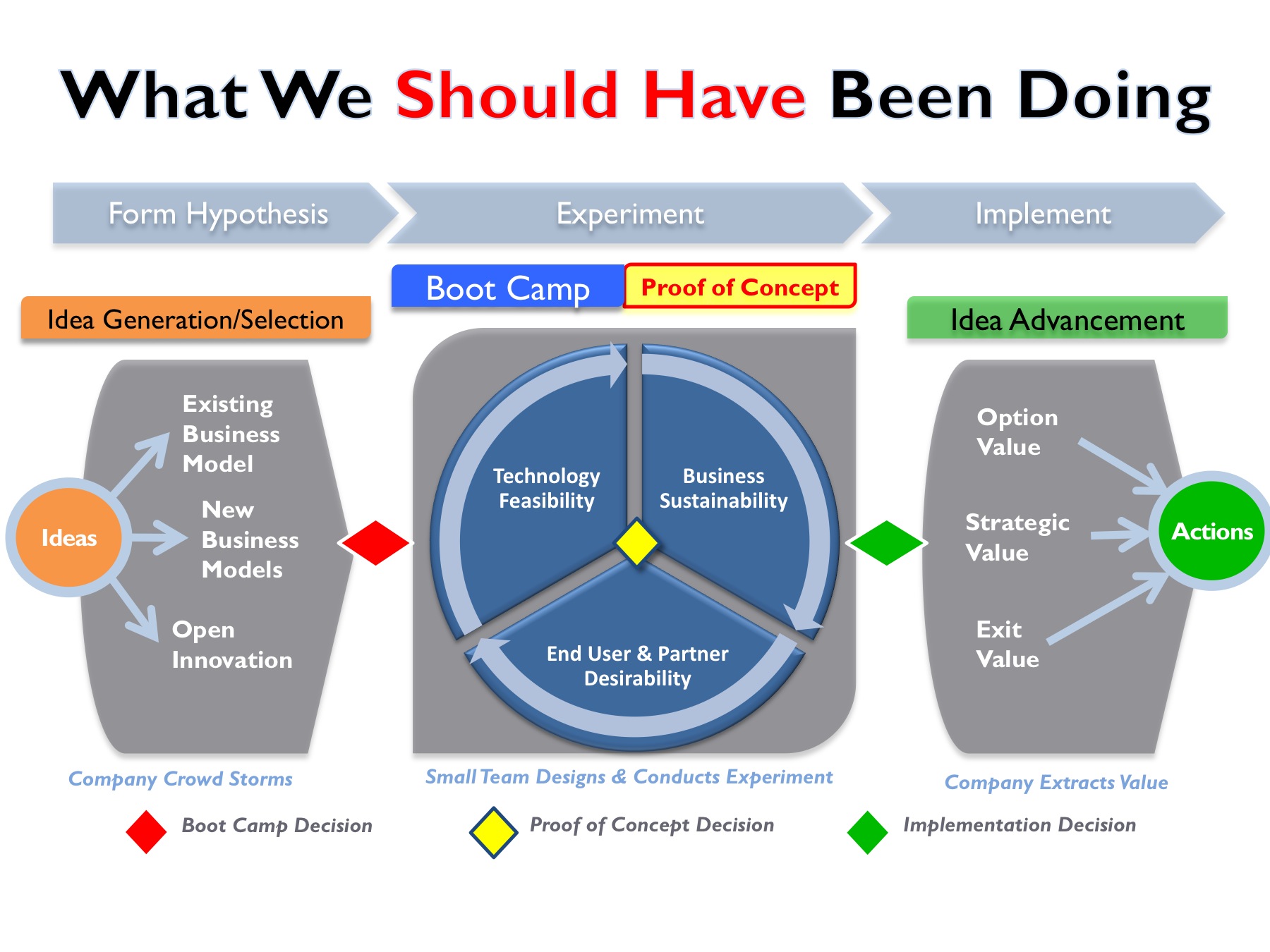
With hindsight we should have had “proof of concepts” tested in a corporate center (think ‘pop-up incubator’) where they would do extensive Customer Discovery. We should had done this before assigning the teams to a particular business unit (or had the ability to create a new business unit, or spin the team out of the company).

The last year of the program, we tried to solve this problem by requiring that the top 20 teams first seek a business unit sponsor before being admitted into the bootcamp (and we raised a $5 million fund from the BUs earmarked for initial implementation ($250K/team.) Ironically this drew criticism from some execs fearing we might have missed the more radical, out-of-the box ideas!

  • Entrenched Innovation Model Issues:  Qualcomm’s existing innovation model – wireless products were created in the R&D lab and then handed over to existing business units for commercialization – was wildly successful in the existing wireless and mobile space. Venture Fest was not integral to their success. Venture Fest was about proposing new ventures, sometimes outside the wireless realm, by stressing new business models, design and open innovation thinking, not proposing new R&D projects.These non-technical ideas ran counter to the company’s existing R&D, lab-to-market model that built on top of our internally generated intellectual property.  The result was that we couldn’t find internal homes for what would have been great projects or spinouts. (Eventually Qualcomm did create a corporate incubator to handle projects beyond the scope of traditional R&D, yet too early to hand-off to existing business unit).

We were asking the company’s R&D leads, the de-facto innovation leaders, who had an existing R&D process that served the company extremely well, to adopt our odd-ball projects. Doing so meant they would have to take risks for IP acquisition and customer/market risks outside their experience or comfort zone. So when we asked them to embrace these new product ideas, we ran into a wall of (justified) skepticism. Therefore a major error in setting up our corporate innovation program was our lack of understanding how disruptive it would be to the current innovation model and to the executives who ran the R&D Labs.

What could have been done differently?
We had relative success flowing a good portion of ideas from the bootcamp into the business and R&D units for full adoption, partial implementation or strategic learning purposes, but it was a turbulent affair.  With hindsight, there were four strategic errors and several tactical ones:

1)   We should have recruited high level executive champions for the program (besides the CEO). They could have helped us anticipate and solve organizational challenges and agree on how we planned to manage the risks.

2)   We should have had buy-in about the value of disruptive new business models, design and open innovation thinking.

3)   We unknowingly set up an organizational conflict on day one. We were prematurely pushing some of the teams in the business units. The ‘elephant in the room’ was that the Venture Fest program didn’t fit smoothly with the BU’s readiness for dealing with unexpected ‘bottoms up’ innovation, in a quarterly- centric, execution environment.

4)   Our largest customer should have been the R&D units, but the reality was that we never sold them that the company could benefit by exploring multiple innovation models to reduce the risks of disruption – we had taken this for granted and met resistance we were unprepared to handle.

Qualcomm Lessons Learned

Qualcomm Lessons Learned

  • The Venture Fest program truly was ground breaking.  Yet we never told anyone outside the company about it. We should have been sharing what we built with the leading business press, highlighting the vision and support of the program’s originator, the CEO.
  • We should have asked for a broader innovation time off and incentive policy for employees, managers, and executives.  Entrepreneurial employees must have clear opportunities to continue to own ideas through any stage of funding – that’s the major incentive they seek.  Managers and execs should be incentivized for accommodating employee involvement and funding valuable experiments.
  • We needed a for a Proof of Concept center.  Radical ideas seldom had an obvious home immediately following the bootcamp.  We lacked a formal center that could help facilitate further experiments before determining an implementation path.  A Proof of Concept center, which is not the same as a full-fledged incubator, would also be responsible to develop a companywide core competence in business model and open innovation design and a VC-like, staged-risk funding decision criteria for new market opportunities.
  • It’s hard to get ideas outside of a company’s current business model get traction (given that the projects have to get buy-in from operating execs) – encouraging spin-offs is a tactic worth considering to keep the ideas flowing.

Epilogue
The program became large enough that it came time to choose between expanding the program or making it more technology focused and closely tied to corporate R&D. In the end my time in the sun eventually ran out.

I had the greatest learning experience of my life running Qualcomm’s corporate entrepreneurship program and met amazingly brave and gracious employees with whom I’ve made a lifetime connection.  I earnestly believe that large corporations should emulate Lean Startups (Business model design, Customer Development and Agile Engineering.)  I am now eager to share and discuss the insights with other practitioners of innovation – I can be reached at ricardo_dossantos@alum.mit.edu

Lessons Learned

  • We now have the tools to build successful corporate entrepreneurship programs.
  • However, they need to match a top-level (board, CEO, exec staff) agreement on strategy and structure.
  • If I were starting a corporate innovation program today, I’d use the Lean LaunchPad classes as the starting framework.
  • Developing a program to generate new ideas is the easy part.  It gets really tough when these projects are launched and have to fight for survival against current corporate business models.

Listen to the post here: Download the Podcast here

Back to Colombia: Vive La Revolución Emprendedora!

My co-author and business Partner Bob Dorf spends much of his time traveling the world teaching countries and companies how to run the Lean LaunchPad program. He’s back to Bogota, Colombia this week for round two.

—–

Back to Colombia: Vive La Revolución Emprendedora!

Lean LaunchPad Colombia starts again today in Bogota with 25 more teams of tech entrepreneurs and at 25 mentors from the country’s universities, incubators, and chambers of commerce.  The program is funded by the Colombian government and modeled after the NSF Innovation-Corps program created and built by my partner and co-author Steve Blank.

In this second cohort, Startup teams were selected from over 100 applicants in Colombia by SENA, a quasi-government organization that provides tech support, prototype labs, and mentoring to Colombian entrepreneurs.  SENA and the Colombian Ministry of IT and Innovation both invest heavily to create jobs for the many skilled, educated and underemployed citizens.   Other than the NSF Innovation-Corps program in the U.S., this may well be the most ambitious government-sponsored startup catalyst effort on the globe.

SENA and the Colombian Ministry of IT: targeting 15,000 young entrepreneurs
The Ministry hopes to supports to more than 15,000 entrepreneurs who have applied for help thus far, and to do it in varying levels of on- and off-line intensity.  The hands-on Lean LaunchPad program offers the most intense support of all.  In cohort one, 25 teams chosen from a field of 100+, worked fulltime for eight weeks to take their ideas from a “cocktail napkin” business idea to a viable, scalable business model.

While the Ministry would be glad to help develop the next Facebook or Google, the initial first step  is more reasonable — get startups to breakeven or better while employing 15, 20, or more Colombians .  Those who don’t make it into the class are offered a variety of on- and off-line tools, including government-funded translations of Steve’s nine-part Udacity.com Customer Development lectures, excerpts from the Startup Owner’s Manual in Spanish, and they’ve translated a long list of Code Academy courses and other tools as well.  The goal is simple:  to extend the reach of Customer Development and tech training far beyond those whose teams and business models earn them seats in the classroom.

Colombia needs to be ambitious to succeed in this effort, and I’m honored and pleased to be helping to drive it.  The emerging economy faces three critical entrepreneurial challenges.  First, there’s virtually no seed or angel investment capital, since affluent Colombian investors are highly risk-averse and put their money into real estate and established companies as a rule.  Second, technology education is more skill-based, graduating lots of smart coders and IT managers, but not a lot of true development visionaries. And the academic community, while strong, still teaches traditional the business plan approach to startups, rather than Customer Development, so ideas have typically evolved far more slowly. 

The first 8-week Lean LaunchPad Colombia program
We held the first cohort of 25 teams in Oct 2012.  Amazingly by the end of the program’s eighth week, 8 of the 25 teams had customer revenue.  One startup, Vanitech, generated revenue from more than 315 consumers in eight weeks, while a software prototyping startup called EZ DEV closed its first deal and had contracts out for two more.  And while the startup ideas ranged from the pedestrian to the very brave (digital preventive healthcare, for example), the common thread was an intense passion for creating a business that would create lucrative jobs for the founders and their fellow Colombians.

This LeanLaunchPad simultaneously trains entrepreneurs and coaches to guide them.  Each cohort started with a day of coach training. Then the coaches joined their teams for three days of business model development, feedback, and training.  When I headed home, teams fanned out across Colombia to “get out of the building” to validate their ideas. They meet at least weekly with their coaches to process their learning and iterate their business models.

I returned twice more to Colombia for this first cohort:  at the midpoint of the 8-week class to work with the coaches and teams, and at the end for the “Lessons Learned day.”  At the Lessons Learned day, the ten teams pitched to an audience of 650, including investors and the Minister and Vice-Minister of IT. The presentations were a real eye-opener to Colombian investors. The hundreds of customer interactions made each team made their presentations credible.  The difference between startups powered by Customer Development and those built the “old way” was on full display. Another unintended consequence of the class is that, we’re effecting a “technology transfer” by training the coaches, who are starting to run Lean LaunchPad programs for additional teams in smaller cities in Colombia.  Overall, it’s one heck of an ambitious program and it’s starting to catch fire.

Three incredibly entrepreneurial government employees (usually quite an oxymoron in any country) conceived and drive this program, working nearly 7×24 and as hard as any Silicon Valley entrepreneurs, in their eight month old “startup,” the apps.co program.  Program leader Claudia Obando and her two star lieutenants—Nayib Abdala and Camilo Zamora—have worked with us to lay every building block in the solid foundation Lean LaunchPad is providing for Colombia.

And so here I am back in Colombia as we launch this next, more cohort on its eight-week sprint, join apps.co in saying Viva Colombia!”
Listen to the post here: Download the Podcast here

Don’t Underestimate the Undergraduates

Jim Hornthal splits his time between venture capital, entrepreneurship and education. Jim has founded six companies, including Preview Travel, one of the first online travel agencies, which went public in 1997 and subsequently merged to create Travelocity.com as an independent company.  Today he is the co-founder and Chairman of Triporati, LaunchPad Central and Zignal Labs.

JIm Hornthal

Jim co-taught classes with me at U.C. Berkeley, joined me in launching the National Science Foundation Innovation Corps class and now has been teaching his own Lean LaunchPad class at Princeton. I asked Jim to share what he learned in teaching the Lean LaunchPad class to undergraduates.  Here’s what Jim had to say…

———

Don’t Underestimate the Undergraduates
Last fall, I began teaching the Lean LaunchPad course at Princeton (EGR 495: Special Topics in Entrepreneurship) with four teams of undergraduates (ok, there were a few engineering grad students in the mix), a brave first-time LLP co-teacher (Cal Simmons), and a talented and dedicated teaching assistant (Ismaiel Yakub).

This would be my fourth voyage in the captain’s cabin of the SS LaunchPad.  My prior journeys were spearheaded by the founder of this school of teaching, Steve Blank. Our teams were from Berkeley/Columbia EMBA, the Haas/Berkeley Engineering graduate student ranks, and as a co-teacher at Stanford for the National Science Foundation I-Corps program.

This would be the first time the course was taught in an undergraduate environment, and the first time we would use Steve’s Udacity lectures to “flip” the classroom.  This approach helped in several ways.  First, it allowed us to use the classroom time to dive deep into each team’s discovery narrative as it related to that week’s section of the business model canvas.  Second, it allowed the teams mentors to “follow along”, since they were all first timers to the Lean LaunchPad approach.  I believe this ability to synchronize the teams with their mentors added a lot to the successful outcomes of each team’s process.  Mentors also got a weekly email of things to look out for from their teams.  These notes were derived (read: stolen) from the Lean LaunchPad Educator’s guide.  Sharing the week-by-week highlights was a great way to focus the mentor’s attention on what we were trying to accomplish at the team level.

Challenges
As a fall course being taught for the first time, there were additional challenges.  The first was selecting the students who could take the class.  Last spring, the course was listed for students, requiring an application AND an in-person interview.  I wanted to make sure that students understood the significant amount of work outside the classroom that this would entail, and did not want to have a significant drop/add turnover once the teams had begun their work in the fall.

We had over 55 students apply, and based on a careful read of their applications, all were eager and capable.  I flew out to Princeton to conduct 5 minute “speed dating” interviews with all of them.  I wanted to assess their flexibility, willingness to accept direct, sometimes harsh input and criticism, and to get a sense of their resiliency in the face of almost certain failure.  That ‘cut’ still left me with over 40 potential thick-skinned budding entrepreneurs.

I next cut out any students for whom this would be one of five courses.  I also eliminated rising all rising sophomores, and got a list of 20 that were invited to the class.

In the fall, 18 showed up, and we then had to address another flaw with a first-time course offered in the fall to undergraduates.  We had no pre-formed teams to work with.  Fortunately, the Princeton academic calendar affords 13 weeks, and the Lean LaunchPad process takes 10, so we had a few weeks in the beginning to run a modified “Startup Weekend” process where students could pitch their ideas to their peers, and the class would rank vote their top 3 choices from the 15 options (some students had more than one idea, and a few chose to work on the ideas of others, so they did not ‘pitch’ on their own).

When the dust settled, we had 4 teams ready to start, and in the context of the overview lecture and discussion from week one, each team was connected to their mentor (most interactions were via Skype), and we were ready to take off for parts unknown.

A huge concern of mine going in was wondering at what level could these students absorb the material?  There was little-to-no practical work experience (one or two summer jobs seems potentially useful, but in the whole, this was virgin territory for nearly every student in the class).

Can you teach the Lean LaunchPad to Undergraduates? Heck Yes!
What did we experience?  Compared to all of the other teams I have taught in my three other “performances”, I can say categorically that these students were the most fearless, adaptable, and relentless of any of the other cohorts, taken as a whole. One inadvertent mistake that we made (and were able to correct mid-course), was that the students took the “get out of the classroom” mandate too literally.  The first month of customer discovery for most of their initiatives relied too much on conversations within the Princeton University community itself (fellow students, faculty and admin).  This inadvertent filter created the risk of generating false positive (and false negative) results to a lot of the preliminary hypothesis testing that is a key part of an early Lean LaunchPad experience — searching to find a solid product-market fit.

Maybe it is because they are all “professional students”, or that they were particularly motivated to have a “real world” class experience for a change, they all devoured the work, their peer-to-peer interactions were exceptional, every week they raised the bar for themselves and each other, and by the end of the class, the teams averaged nearly 200 “customer discovery” engagements (this metric refers to customer interviews + business model canvas entries (and deletions), mentor engagements and faculty engagements.  We were able to track their progress with the LaunchPad Central platform (disclosure: Steve and I are investors), which made keeping up with all of the chaos a more manageable task for faculty, mentors and teams alike.

Rather than try and tell you more about their amazing journeys, I invite you to explore the teams final videos and slides for yourselves.  I think you will see the work of some talented and determined entrepreneurs who have honed their customer discovery and customer development skills to an impressive level.  Don’t underestimate the undergraduates; in fact, the potential dividends of their academic prowess, augmented by their hard fought real-world experience makes them all formidable opponents.  Hopefully none of you will have to face off against any of them in the marketplace.  If you do, my bet is on these talented, motivated and well-prepared undergraduates.  Let the games begin …

Class goals:
“Acquire real-world experience outside the classroom, working as a team to learn the skills of customer discovery and customer development; understand the business model canvas as a tool and learn how to create fast, cost-effective tests for each of their hypothesis along the way, and in the process acquire “x-ray” vision to see through business pitches and be able to ask the questions that matter.”

Lessons Learned

  • The student interview process and selection is critical
  • Undergraduates can handle the class
  • Clarify that “get out of the classroom” means “get off the campus”
  • Students bounce back from the direct and sometimes tough live feedback
  • Align and train mentors to embrace customer development
  • Go for it!

Team Final Videos and Presentations

Beertending

Cookies to Crumbs

Dream Figures

Narrathon.TV


Listen to the post here: Download the Podcast here

Developing a 21st Century Entrepreneurship Curriculum

In 2012, in partnership with Stanford University, U.C. Berkeley and NCIIA, Jerry Engel and I first offered the Lean LaunchPad Educators Class. The class was designed to teach educators (and the entrepreneurs that support them) the Lean LaunchPad approach (Business Model Design, Customer Development and Agile Engineering) for teaching entrepreneurship. In addition the class offers a suggested “Lean Entrepreneurship” curriculum and the details of how to teach the capstone Lean LaunchPad class.

Sidnee Peck from Arizona State University’s Carey School of Business attended the last Lean LaunchPad Educators Class. At ASU Sidnee is the Director of Entrepreneurial Initiatives, and the co-facilitator for the Venture Catalyst’s Rapid Startup School. Sidnee taught her own Lean LaunchPad class a week after returning to ASU, (holding some sort of record for a curriculum Pivot.) I asked her to share what she learned in the class and what she learned when she put it to practice.  Here’s what she had to say…

—–

As an entrepreneurship educator, I have two goals:

Sidnee Peck

  • inspire and encourage students to spark energy around entrepreneurship and their dreams,
  • make the reality of entrepreneurship clear enough to prevent students from wasting time on a life decision that is not right for them.

I believe this is best done through experiential learning where students spend most of their time “doing.” I have spent my entire time at Arizona State University trying to find the most effective tools and methods for teaching entrepreneurship to my students in order to achieve these goals. I update my course frequently in an effort to create the optimal learning environment and before the Lean LaunchPad training course I was still searching for the perfect action-oriented learning model.

The Lean LaunchPad Educators course
I truly did not know what to expect when I arrived for the LLP educators course.  I had been referred by a colleague in the University’s incubator and did some preliminary reading as the trip approached but wasn’t familiar with the concepts of business models or customer development.

I was blown away by what I actually learn and take away from this experience – it has changed the way I teach and the way I view my time in the classroom.  It has also impacted my students’ lives in a significant way.

The biggest surprise I encountered may seem simple, but significantly changed the way I viewed the process.  Coming into the course I had been teaching the class on the basis of execution; teaching my students that they needed to be actively setting goals supported by tasks and executing on them.  My philosophy was sound (and was supported by many bright people): nothing happens on paper or in the classroom, it all happens outside via real action and interaction.

But on the first day, Steve framed it in a different way: execution of a business plan doesn’t matter.  It doesn’t matter because executing on a business plan that has not been validated is a waste of time and energy.  Instead, we should first focus on searching for the best business model and validating our assumptions.  After we prove that the model works, then, and only then, execute on it and build a business.

I may have been the only person at the conference who was learning the methodology for the first time and would be applying it upon my return to ASU within the coming week in my fall class.  This was bold…but it was a “why wait?” mentality, and I am SO thankful that I went for it.  Luckily, I had interviewed students for the course (as I had designed it before coming to the conference) during enrollment months (before I knew I would even teach this methodology) because I knew I wanted only the most passionate and committed students and I would do my best to hold them accountable to executing on their ideas.  It took time and preparation to roll this out so quickly, but the materials I received at the conference made it possible.  I had a roadmap in front of me, and I just had to be prepared to deliver it.

Sidnee Peck ASU ClassOne of the biggest (and best) surprises from actually teaching the class is the way that students bounce back from the direct and sometimes tough live feedback.  I had a major fear that we would scare students right out of the class, but after the first two weeks, they expressed how much they appreciated it, one student tell me that this was his favorite class because he had learned so much in just two weeks.  This realization made the rest of the semester easier, knowing that the feedback that is sometimes hard to give and take is the most important, and is valued by the students.  We established an environment of trust and a place where we were comfortable being uncomfortable.

What I wish I knew going into the semester is that the interview process and student selection is incredibly impactful on the success of the class.  In an effort to be inclusive, I allowed any student who had a business he/she wanted to launch enroll.  Going forward, I will be much more particular based on each student’s readiness.  I did get quite lucky, however, as the majority of my students are a good fit and truly want to work on their business models.  Some, however, are not ready.  They need to mature a bit before the LLP process will hit home with them and I should defer these students to a later year.

In the future I will also train my mentors in a more significant way.  I had an incredible pool of experienced entrepreneurs and business people to choose from – but without fully understanding the customer development process, some were steering my students way off track (asking for business plans!) and I had to pull them back when we met in class.

I also wish I could have recruited more in-class advisors to give live feedback…this was challenging because of my timeline, and while I did get a fair number to visit, more would have been welcomed.  There is an art to giving the right type of feedback in the right manner at the right time.  It takes practice, and the more experts we have in the room, the more powerful it can be.

The best part about the whole thing is, of course, the results my students have experienced from giving the process the attention it deserves.  I was blown away by how hard undergrads would work for their business idea.  I was impressed EVERY week by the outside work that was done and the number of interviews performed.  There were incredible learning points every single week and over the course of the semester multiple businesses made first sales, gained new customers, launched, and one even got hired by a competitor to roll his product into a product line through a proprietary manufacturing process.  Because of this success I have seen increased interest from other colleges and from the MBA program…spring will be an incredible class!

Lessons Learned

  • The student interview process and selection is critical
  • Undergraduates can handle the class
  • Students bounce back from the direct and sometimes tough live feedback
  • Align and train mentors to embrace customer development
  • Go for it!

——–

The next Lean LaunchPad class Jan 30th – Feb 1st is sold out (there is a wait list here.)  Registration is open for the June 18-20th class here.
Listen to the post here: Download the Podcast here

Open Source Entrepreneurship

One of the great things about being a retired entrepreneur is that I get to give back to the community that helped me. I assembled this collection of free and almost free tools, class syllabi, presentations, books, lectures, videos in the hope that it can make your path as an entrepreneur or educator easier.

Free:

Startup Tools
If you’re building a startup, the Startup Tools tab on the top of this page has curated links to hundreds of startup resources.  Specific links are:

  • A list of startup tools is here
  • Market research tools to help you figure out the size of the opportunity your startup is pursuing, are here
  • Some of the best advice on founding and running a startup from other smart voices are here

Updates and suggestions for tools I’ve missed are welcomed on the Startup Tools comments page.

The Lean LaunchPad course online
I teach potential founders a hands-on, experiential class called the Lean LaunchPad at Berkeley, Stanford, Columbia and Caltech. The class teaches the three basic skills all entrepreneurs need to know:

  • business model design
  • customer development
  • agile engineering

For my  Innovation Corps class for the National Science Foundation it made sense to record the lectures and put them on-line. In my regular classes I now “flip” the classroom and have my students watch these online lectures as homework and we use the class time for discussion.

The free on-line class, hosted at Udacity is here.

Class Syllabi, My Lecture Slides and Student Presentations
The Slides/Video tab on the top of this page has all the open source course material for my classes.  Specific links are:

  • Educators Training Guide is here (part of the Educators Course  – described in the Educators section below.)
  • Course for Educators is here
  • Teachable moments videos for the Lean Launchpad class here
  • How do Customer Discovery videos here and here
  • Sample Lean LaunchPad Lecture slides and suggested syllabus here
  • Syllabi for all my classes are here
  • Secret Notes for Instructors here
  • Latest presentations posted click here
  • Stanford presentations, lectures and syllabus here
  • Berkeley presentations, lectures and syllabus here
  • Columbia 5-day presentations, lectures and syllabus here
  • Caltech 5-day presentations, lectures and syllabus here
  • Some general customer development slides click here

The Entreprenuers Checklist
The good folks at Udemy have taken a few of my lectures at Stanford and put them together in a series online.

The free on-line lectures, hosted at Udemy are here.

Online Guide to How to Build a Startup: The Lean LaunchPad
Startupplays.com, publisher of online entrepreneurs processes guides, drew from my Udacity course and The Startup Owner’s Manual to create a free step-by-step guide to understanding your customers and creating your value proposition. Called “How to Build a Startup: The Lean LaunchPad,” it walks you through the Business Model Canvas and an overview of the customer development process.

Find it here.

Videos
The Slides/Video tab on the top of this page has a number of my talks on entrepreneurship, customer development and startup, some short, some long, and a few interesting.

Find them here.

Recommended Reading
The Books for startups tab on the top of this page is my recommended reading list. These books have influenced my thinking. There’s a short synopsis of why I like each book.

Updates and suggestions for books that I’ve missed are welcomed on the books comment page.

Visitors Guide to Silicon Valley
The Guide tab on the top of this page? I got tired watching dignitaries fly into Silicon Valley, visit Google, Facebook, Apple, and Stanford and then say they understand startups and entrepreneurship.

So for the rest of us I put together this Visitors Guide to Silicon Valley.

Updates and suggestions for places to see that I’ve missed are welcomed on the Guide comments page.

Secret History of Silicon Valley
What began as a hobby of mine – research in the intersection of my military, intelligence and Silicon Valley careers combined with my interest in the history of Silicon Valley and technology entrepreneurship – ended up in this video and PowerPoint presentation. I first gave the Secret History of Silicon Valley presentation as an invited talk at Google, then at the Computer History Museum.

When I gave the talk to audience of CIA staffers they asked how I came up with the talk, so I wrote a series of posts as the back-story that can be found here.

I still love giving this talk to people who lived it and people curious about it.

Almost Free:

Startup Weekend Next
Startup Weekend Next is a three-week version of the Lean LaunchPad class with hands-on instructors and mentors – offered in hundreds of cities around the world.

  • The class is organized, led and delivered by Startup Weekend, the global non-profit that teaches entrepreneurs how to launch a startup in 54 hours.
  • TechStars and Startup America are partnering to provide mentors in the U.S.

They don’t ask for equity and charge just enough to cover the costs of pizza and the room rental.

Sign up here.

The Lean LaunchPad Educators Course
Hosted by NCIIAStanford University and U.C. Berkeley, Jerry Engel and I teach a course for educators interested in learning how to update and revise their entrepreneurship curriculum for the 21st century as well as learning how to teach the Lean LaunchPad class.

The Lean LaunchPad Educators Training Guide here is part of this course.

Next class is Jan 30th. Click here for more information.

The Startup Owner’s Manual
The Startup Owners Manual written with Bob Dorf, has become the step-by-step reference manual for anyone even thinking about a startup. Each section offers detailed guidance and how-to’s, helping you make your way through the Customer Development process using MVP’s and Pivots as you search for a Business Model.

Last month we added a Kindle version, reorganized to make it easier to follow on a tablet and incorporating hundreds of links to websites, blog posts, and presentations.

The Founder’s Workbook
Zoomstra, the publisher of online workbooks offers The Founders Workbook to help you track and monitor your progress through every step of the Customer Development process. It takes the static 57 checklists from The Startup Owner’s Manual and makes them dynamic and accessible by putting them online as an interactive checklist. Use it to keep your team on track and ensure you have completed each critical task as you search for a scalable business model.

Click here for more information.

The Four Steps to The Epiphany
The Four Steps to the Epiphany has been described as the book that launched the Lean Startup movement. The book is still relevant today as when it was written. The last two chapters deal with scale and management of growing startups.

Now get out of the building and make something happen!

Customer Development in Japan: a History Lesson

The Japanese edition of The Startup Owner’s Manual hit the bookstores in Japan this week. The book has been shepherded and edited by a great Japanese VC at Mitsui Sumitomo Insurance Venture Capital, Takashi Tsutsumi, with help from Masato Iino. I asked Tsutsumi-san to write a guest post for my blog to describe his experience with Customer Development in Japan.

————-

To celebrate the debut of the Japan edition of “The Startup Owner’s Manual” and to express great thanks to Steve and his co-author Bob Dorf, I would like to reflect back what first drew me to this book and offer Steve’s worldwide readers a look at the progress of Customer Development and the Lean LaunchPad class in Japan.

The Crater in my rookie days
Back in 1990’s, I was working for one of the leading sogo shohsa (trading company) in Japan, building data communications startups. After helping build the first Ethernet switch startup, I was attracted by Asynchronous Transfer Mode 25Mbit/sec technology, (ATM25) which was 2.5x faster than Ethernet and ran data but plus voice and video. Leveraging my marketing skills, I successfully made what Steve calls an “onslaught launch”, generating a lot of press coverage and apparent early success. But customers didn’t agree. After many sales calls, early prospects showed little rush to buy it! I got comments like, “Well, ATM25 is interesting technology, but I have no need to rush to buy it” or “I like ATM25 very much, but we need to replace my existing infrastructure to appreciate multimedia features, which I do not think that important.” I discovered my product was a “nice to have,” not a “must have,” and we shut the company down a year a later.

This made me believe deeply in the extreme importance of talking to customers before investing time and money, something I took to my next startup. The result: great success of my third startup, a load balancing technology for web servers back in the late 1990’s.

Finding a repeatable process for startups
Despite my success based on talking to customers upfront, however, I wasn’t confident I could replicate startup success consistently without a clear, and repeatable process to talk to customers. By then, I had become a venture capitalist at Mitsui Sumitomo Insurance and found myself talking to a lot of entrepreneurs who were proclaiming their great technology yet were struggling with little revenue, and claiming they were “crossing the chasm”. However, when I looked into the detail, most of them did not have even early adaptors and the problem wasn’t “chasm crossing,” it was that almost nobody wanted their products.

In 2004, Googling terms like “high tech marketing” and “startup” I discovered “The Four Steps to The Epiphany” at Cafépress.com. Amazon did not carry it yet, and I was nervous spending money at a website known mostly for cups and t-shirts, completely irrelevant to business books. After waiting for a week or so for the book to make it to Japan, I was very much shocked how impressed I was by the Customer Development Model detailed in the book. A few of the many quotations that struck me:

  • “Most startups fail due not to the failure of product development but due to the lack of customers”
  • “Learning and discovering who a company’s initial customers will be and what market they are in, requires a process separate and distinct from product development”
  • “All a startup has are mere hypotheses,” and
  • “in a startup no facts exist inside the building, get out of the building to talk to customers”

This was exactly what I was searching for.

The first meeting with Steve
After my reading The Four Steps to The Epiphany several times, my Customer Development conviction got stronger. I wanted this book not only as my “secret weapon,” but also for all entrepreneurs in Japan.

I sent Steve a cold email to allow me to translate the book into Japanese and evangelize Customer Development in Japan. Steve responded to my email in ten minutes, saying “come meet with me!” Soon we had our first meeting Steve’s favorite spot, Café Borrone on El Camino Real.

After listening to me for fifteen minutes, Steve said “Go ahead. I will support you”.  It was very, very happy moment for me.

I was extremely surprised that he gave a huge trust on completely unknown and strange Japanese VC who suddenly contacted him by email. We kept talking, with Steve asking “How long are you staying in Silicon Valley?” When I told him, “two more days,” he asked, “Are you interested in meeting with venture firms in the Valley?”  When I said of course, but who would meet with me with two days notice, he picked up his mobile phone and, surprisingly for me, started dialing … and I actually had a great meeting with one of them the very next day. More “pay it forward” culture in action.

Evangelizing Customer Development in Japan
After that meeting, I started working on the translation word by word over a number of weekends and published the Japanese edition of “The Four Steps Epiphany” in May 2009 (now in its third printing.)  Since then, I have been teaching Customer Development and running Lean LaunchPad style classes at variety of universities, national research laboratories, incubators, and startup communities throughout Japan.

After three years of evangelizing, I am very pleased to see success cases emerging in Japan by following Customer Development Model. For example, Maysee, a business card cloud services startup, got out of the building and then developed an MVP, avoiding costly UI development that customers in fact found no need for. They pivoted the product by implementing Google like wide-open search windows requested time and again in customer interviews. Maysee now enjoys hockey stick revenue growth.

Goryo Chemical, new fluorescent probe for Chemical biology startups (leveraging a technology from a university), found early in Customer Discovery that the original value proposition hypothesis was wrong, but one other feature was in fact very valuable. Their pivot resulted in great deal of customer tractions.

These kinds of success cases continue to happen in Japan’s startup community and in corporations that have to innovate to remain competitive in the global market.

Customer Development Education
Customer Development is growing fast here in Japan, with Lean LaunchPad programs in great demand among entrepreneurs and “wanabees” learning to build hypothesis and test them by getting out of the building. Some have actually established new startups with tested business model hypotheses under their belt. Lean LaunchPad teaches entrepreneurs, to test their business model until they find customers who are eager to buy, and a business model that scales profitably and repeatedly. I am confident we will see real startups and business emerge soon.

Lean LaunchPad class at Hosei University business school

Much more is happening with collaborative learning and tools, and I am looking forward to more Customer Development success ahead as more entrepreneurs, investors, and educators read the new book, The Startup Owner’s Manual.

In fact, I recently started my Customer Development blog with my partner, Masato Iino, to accumulate the learning and discovery of Customer Development and Lean LaunchPad in Japan, and to update readers with more concepts and tools to do Customer Development in their startups.

Lessons Learned – Japanese Style

  • Failure comes often, but failure is mother of success.  To appreciate a “mother,” it is important to improve from the failure and to look for a solution continuously to do a better job with a solution, hopefully resulting in a great success.
  • Pushing the boundaries collaboratively is really powerful.  Try collaborative learning by leveraging global intelligence and passion of entrepreneurs.
  • Pay-it-forward culture actually exists.  But, the key is for me to transfer the same culture to my next generation by giving them an opportunity like the one I appreciated.

Takashi Tsutsumi
ttutumi@gmail.com

本ブログ記事の内容は、堤孝志個人の見解に基づいており、所属する組織の見解を示すものではありません。
Listen to the post here: Download the Podcast here

10,000 Startups – Startup Weekend Next

Today we are announcing the biggest entrepreneurial program ever launched – Startup Weekend Next. A partnership of Startup WeekendStartup AmericaTechStars and UdacityStartup Weekend Next brings four weeks of amazing hands-on training learning to build your startup to cities around the world. Our goal– to inspire, educate and empower hundred’s of thousands of entrepreneurs and help create 10,000 startups.

The Lean LaunchPad Class
You may have read my previous posts about the Lean LaunchPad entrepreneurship class. The class teaches founders how to dramatically reduce their failure rate through the combination of business model design, customer development and agile development using the Startup Owners Manual. Just a crazy idea two years ago, the class is now taught at Stanford, Berkeley, Columbia, Caltech, Princeton and for the National Science Foundation at the University of Michigan and Georgia Tech.

And in the thirty days since we’ve put the Lean LaunchPad class online at Udacity50,000 students have been taking it.

While the Lean LaunchPad online has received rave reviews (it’s being translated into Spanish, French, Russian, Japanese and Greek, and it’s being used as part of a “flipped classroom” in other entrepreneurship courses), it’s different than taking the class in person. It doesn’t require you to form a team, and there’s no immediate instructor feedback. More importantly, it makes no demands of you to stand and deliver your weekly customer development progress in front of your peers. In sum, it lacks the rigorous and collaborative hands-on experience that entrepreneurs get in our university classes.

We thought long and hard about how we could take the Lean LaunchPad Online to the next level and deliver the same level of experiential instruction to tens and hundreds of thousands of entrepreneurs around the world.

The result – Startup Weekend Next.

Hands-On in 100’s of Cities
Startup Weekend Next is a four-week version of the Lean LaunchPad class with hands-on instructors and mentors – and we will teach it in hundreds of cities around the world.

I’m partnered with four great organizations to deliver the program. The class is organized, led and delivered by Startup Weekend, the global non-profit that teaches entrepreneurs how to launch a startup in 54 hours. They’ve hosted close to 800 Startup Weekend events in over 350 cities worldwide educating a staggering 57,000 entrepreneurs who’ve created over 5,000 startups. Today they are going to take Startup Weekend to the next level by organizing and teaching a four-week version of the Lean LaunchPad class as their Startup Weekend Next course. Their reach and scale means our goal of helping to create 10,000 startups is within our grasp.

(If you can’t see the video above click here.)

In addition, the leading experts in building entrepreneurial companies and regions, TechStars and Startup America are partnering with us in this endeavor.

In the U.S, Startup America will leverage its network of 30 startup regions to engage entrepreneurial leaders throughout the country. And TechStars will use its broad and unparalleled network of mentors (experienced entrepreneurs and investors) to coach the teams. And Udacity has put their awesome production resources behind the class and hosts the Lean LaunchPad online lectures.  And we are looking for other partners worldwide to help make this successful.

The first four-week Startup Weekend Next classes will start on Nov. 28 in more than 25 cities worldwide. The program expands to all of Startup Weekend’s 350 member communities in 2013 where it will be offered up to five times a year in each city.

The cost of attending a Startup Weekend Next is ridiculously inexpensive. It doesn’t take equity and just has a small fee that varies by city ($140 to $299), to cover event operations and expenses.

How it Works
We now know how to crack the entrepreneurial code by creating an Entrepreneurship API – a standard language for entrepreneurs. When you leave the class, you’ll know how to think about your startup in the now standard  “language” of the business model canvas. You’ll understand the customer development process used to test those hypotheses and learn how to iterate or pivot when your hypotheses need to change.  And you’ll learn about how to build a minimal viable product to get feedback early and often from customers.

Here’s how the four intense weeks in a Startup Weekend Next class works.

  • You form a startup team (if you don’t have one, taking the 54-hour Startup Weekend class is a great a way to find one) and come into class with an initial idea
  • Your team arrives with an initial Business Model Canvas. (Your pre-class reading is to watch the Lean LaunchPad initial lectures on Udacity)
  • You present your hypotheses and what you learned in front of your peers and coaches
  • Your team gets live coaching and advice from Startup Weekend Next mentors.
  • You’ll take the suggestions from the meeting, get out of the building and talk to ten plus customers per week.
  • You’ll refine your business model by iterating or pivoting your product, your target customers, pricing, channels, partners, etc.
  • Repeat for four weeks– all while working with volunteer mentor partners from Startup Weekend, Startup America and TechStars – serial entrepreneurs and seasoned startup investors – to see whether your business idea was truly a vision or simply a hallucination.

The Big Idea – Incubators – Accelerators – and Something New
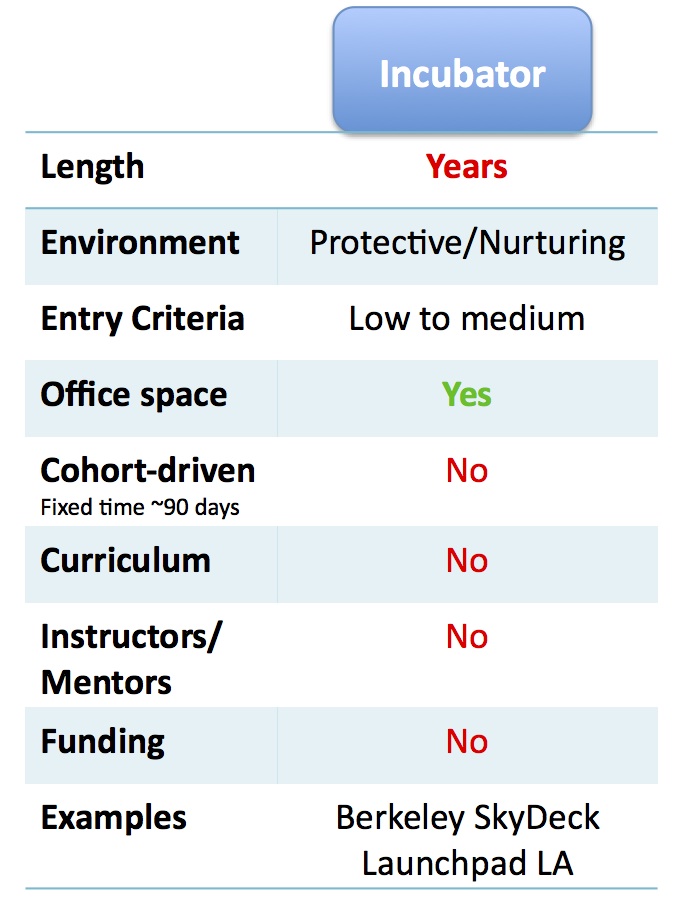
In the last decade startup incubators have become increasingly popular. These incubators which provides new startups with year-round physical office space, infrastructure and advice in exchange for a fee (often in equity.)  They may be privately run but often are non-profit, attached to a university or in some locations a local government.  There is no formal “start date” so there is a no fixed time for their stay. (For some incubators, entrepreneurs can stay as long as they want.) There is no curriculum and seldom any formal instructors or mentors. There is no guaranteed funding. Think of incubators as “shelter from the storm.”

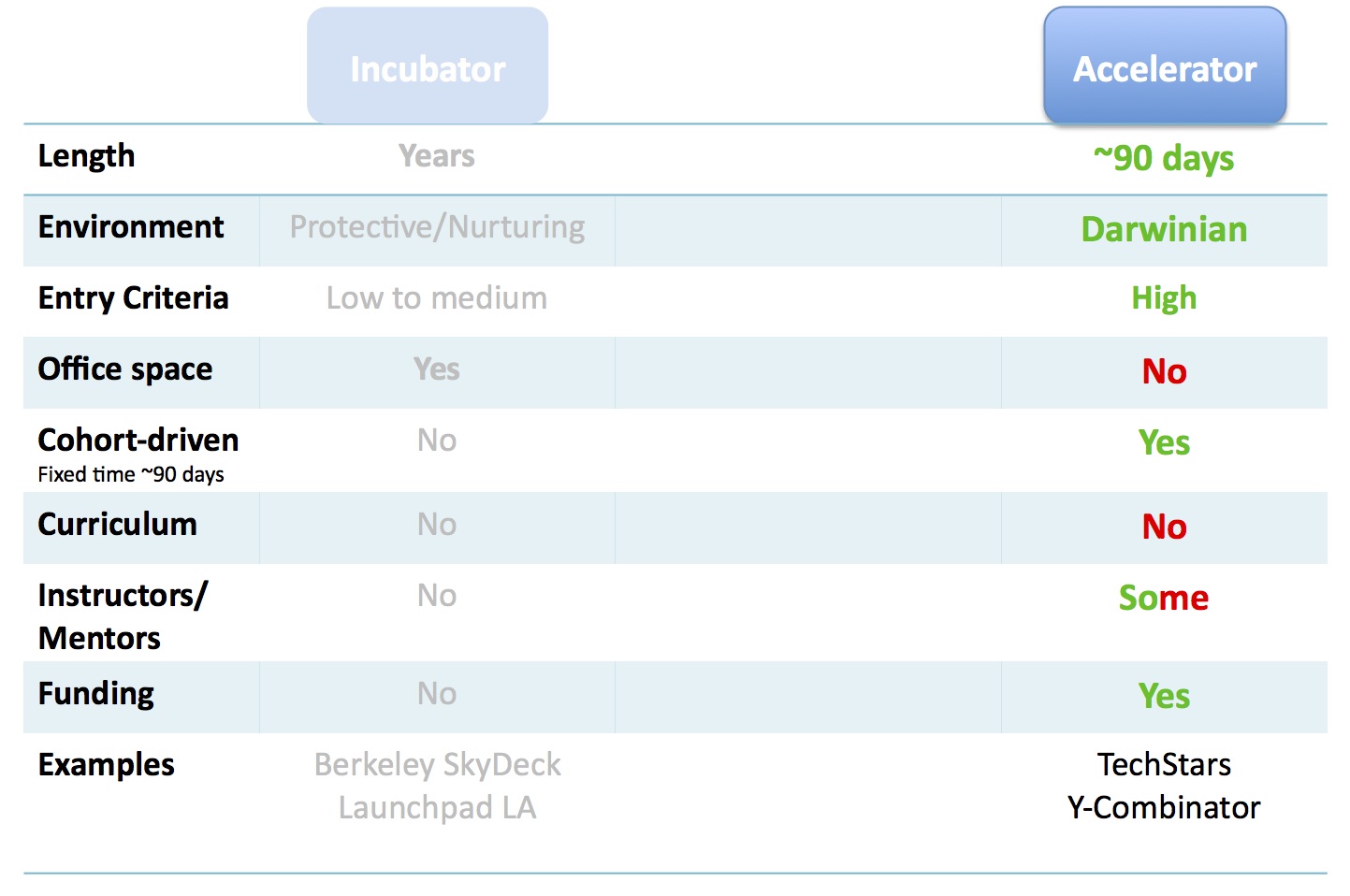
In contrast, the goal of an accelerator is not physical office space, it’s a fundable company. Startups enter and leave as a cohort (starting and ending the program at the same time) in a program of a set length. While there is no formal curriculum, most offer weekly expert lectures, experienced mentors, coaching and introductions.  Accelerators provide funding at the end of the program.  Getting into an accelerator is more competitive than grad school.

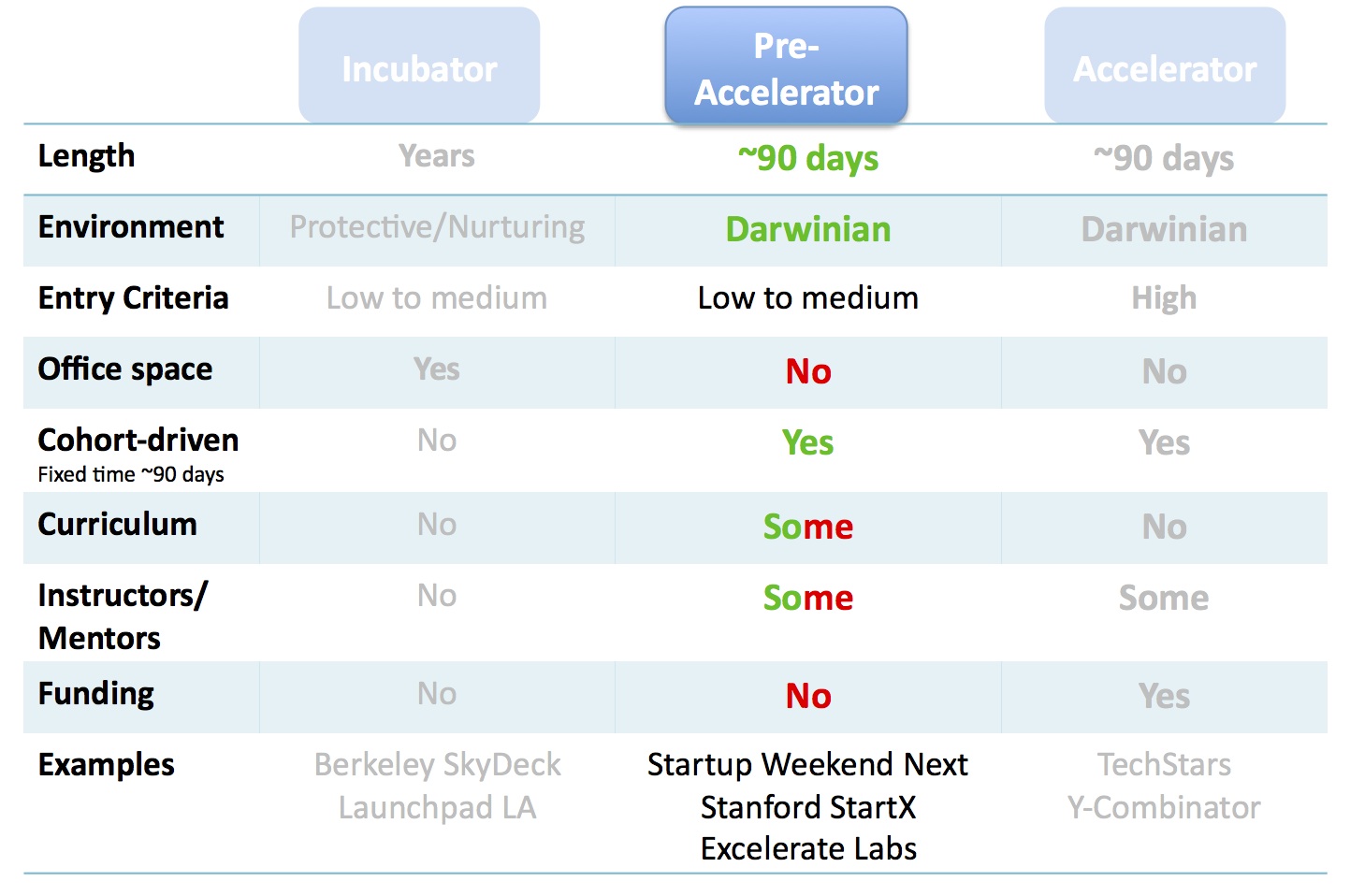
Startup Weekend Next represents something new – a pre-accelerator.

Like an accelerator there is no physical office space, and startups enter and leave as a cohort in a program of a set length. But the key difference is that Startup Weekend Next engages you in a formal curriculum. We believe we know what startups need to learn, and we focus on teaching you that. Instead of guest lecturers, you get out of the building and you learn by doing. Like the best accelerators, you get experienced mentors, coaching and introductions. Unlike accelerators, there is no funding at the end of the program.  But you leave knowing a lot more of what it takes to build a company beyond a PowerPoint deck for a VC presentation.

Lessons Learned

If you have passion, an idea and a team, and you want to take advantage of the most advanced entrepreneurial training program, sign up at Startup Weekend Next

and wait until you see what we do next.
Listen to the post here: Download the Podcast here

10,000 Startups

In 24 hours we’ll announce something revolutionary.

Moving entrepreneurship forward.

The Lean LaunchPad Online

You may have read my previous posts about the Lean LaunchPad class taught at Stanford, Berkeley, Columbia, Caltech and for the National Science Foundation.

Now you too can take this course.

I’ve worked with the Udacity, the best online digital university on a mission to democratize education, to produce the course. They’ve done an awesome job.

The course includes lecture videos, quizzes and homework assignments. Multiple short video modules make up each 20-30 minute Lecture. Each module is roughly three minutes or less, giving you the chance to learn piece by piece and re-watch short lesson portions with ease. Quizzes are embedded within the lectures and are meant to let you check-in with how completely you are digesting the course information. Once you take a quiz, which could be a multiple-choice quiz or a fill in the blank quiz, you will receive immediate feedback.

Sign up here

——–

Why This Class?

Ten years ago I started thinking about why startups are different from existing companies.  I wondered if business plans and 5-year forecasts were the right way to plan a startup.  I asked, “Is execution all there is to starting a company?”

Experienced entrepreneurs kept finding that no business plan survived first contact with customers. It dawned on me that the plans were a symptom of a larger problem: we were executing business plans when we should first be searching for business models. We were putting the plan before the planning.

So what would a search process for a business model look like? I read a ton of existing literature and came up with a formal methodology for search I called Customer Development.

That resulted in a new process for Search: Customer Development + traditional product management/Waterfall Engineering. It looked like this:

This meant that the Search for a business model as a process now could come before execution. So I wrote a book about this called the Four Steps to the Epiphany.

And in 2003 the Haas Business School at U.C. Berkeley asked me to teach a class in Customer Development.  With Rob Majteles as a co-instructor, I started a tradition of teaching all my classes with venture capitalists as co-instructors.

In 2004 I funded IMVU, a startup by Will Harvey and Eric Ries. As a condition of my investment I insisted Will and Eric take my Customer Development class at Berkeley. Having Eric in the class was the best investment I ever made. Eric’s insight was that traditional product management and Waterfall development should be replaced by Agile Development.  He called it the “Lean Startup.”

Meanwhile, I had said startups were “Searching” for a business model, I had been purposefully a bit vague about what exactly a business model looked like. For the last two decades there was no standard definition.  That is until Alexander Osterwalder wrote Business Model Generation.

This book was a real breakthrough. Now we understood that the strategy for startups was to first search for a business model and then after you found it, put together an operating plan.

Now we had a definition of what it was startups were searching for. So business model design + customer and agile development is the process that startups use to search for a business model.

And the organization to implement all this was not through traditional sales, marketing and business development groups on day one. Instead the founders need to lead a customer development team.

And then to get things organized Bob Dorf and I wrote a book, The Startup Owners Manual that put all these pieces together.

But then I realized rather than just writing about it, or lecturing on Customer Development, we should have a hands-on experiential class. So my book and Berkeley class turned into the Lean LaunchPad class in the Stanford Engineering school, co-taught with two VC’s – Jon Feiber and Ann Miura-Ko. And we provided dedicated mentors for each team.

Then in the fall of 2011, the National Science Foundation read my blog posts on the Stanford version of the Lean LaunchPad class.  They said scientists had already made a career out of hypotheses testing, and the Lean LaunchPad was simply a scientific method for entrepreneurship. They asked if I could adapt the class to teach scientists who want to commercialize their basic research. I modified the class and recruited another great group of VC’s and entrepreneurs – Jim Hornthal, John Burke, Jerry Engel,Bhavik Joshi and Oren Jacob – to teach with me.

We taught the first two classes of 25 teams each, and then in March of 2012 trained faculty from Georgia Tech and the University of Michigan how to teach the class at their universities. Georgia Tech and the University of Michigan faculty then taught 54 teams each in July of this year and will teach another 54 teams in October.

We then added four more schools – Columbia, Caltech, Princeton and Hosei – where our team taught the Lean LaunchPad. We also developed a 5-day version of the class to complement the full semester and quarter versions.

Then last month we partnered with NCIIA and taught 62 college and university educators in our first Lean LaunchPad Educators Program.

And now we’ve spent weeks in the Udacity studio putting the lecture portion of the Lean LaunchPad class online.

Sign up and find out how to start a company!

Listen to the post here: Download the Podcast here