Reinventing Life Science Startups – Evidence-based Entrepreneurship

What if we could increase productivity and stave the capital flight by helping Life Sciences startups build their companies more efficiently?

We’re going to test this hypothesis by teaching a Lean LaunchPad class for Life Sciences and Health Care (therapeutics, diagnostics, devices and digital health) this October at UCSF with a team of veteran venture capitalists.

Part 1 of this post described the issues in the drug discovery. Part 2 covered medical devices and digital health. This post describes what we’re going to do about it.  And why you ought to take this class.

——

When I wrote Four Steps to the Epiphany and the Startup Owners Manual, I believed that Life Sciences startups didn’t need Customer Discovery. Heck how hard could it be?  You invent a cure for cancer and then figure out where to put the bags of money. (In fact, for oncology, with a successful clinical trial, this is the case.)

Pivots in life sciences companies

But I’ve learned that’s not how it really works. For the last two and a half years, we’ve taught hundreds of teams how to commercialize their science with a version of the Lean LaunchPad class called the National Science Foundation Innovation Corps.  Quite a few of the teams were building biotech, devices or digital health products.  What we found is that during the class almost all of them pivoted – making substantive changes to one or more of their business model canvas components.

In the real world a big pivot in life sciences far down the road of development is a very bad sign due to huge sunk costs.  But pivoting early, before you raise and spend millions or tens of millions means potential disaster avoided.

Some of these pivots included changing their product/service once the team had a better of understanding of customer needs or changing their position in the value chain (became an OEM supplier to hospital suppliers rather than selling to doctors directly.) Other pivots involved moving from a platform technology to become a product supplier, moving from a therapeutic drug to a diagnostic or moving from a device that required a PMA to one that required a 510(k).

Some of these teams made even more radical changes.  For example when one team found the right customer, they changed the core technology (the basis of their original idea!) used to serve those customers. Another team reordered their device’s feature set based on customer needs.

These findings convinced me that the class could transform how we thought about building life science startups.  But there was one more piece of data that blew me away.

Control versus Experiment – 18% versus 60%
For the last two and a half years, the teams that were part of the National Science Foundation Innovation Corps were those who wanted to learn how to commercialize their science, applied to join the program, fought to get in and went through a grueling three month program.  Other scientists attempting to commercialize their science were free to pursue their startups without having to take the class.

Both of these groups, those who took the Innovation Corps class and those who didn’t, applied for government peer-reviewed funding through the SBIR program. The teams that skipped the class and pursued traditional methods of starting a company had an 18% success rate in receiving SBIR Phase I funding.

The teams that took the Lean Launchpad class  – get ready for this – had a 60% success rate. And yes, while funding does not equal a successful company, it does mean these teams knew something about building a business the other teams did not.

The 3-person teams consisted of Principal Investigators (PI’s), mostly tenured professors (average age of 45,) whose NSF research the project was based on. The PI’s in turn selected one of their graduate students (average age of 30,) as the entrepreneurial lead. The PI and Entrepreneurial Lead were supported by a mentor (average age of 50,) with industry/startup experience.

This was most definitely not the hoodie and flip-flop crowd.

Obviously there’s lots of bias built into the data – those who volunteered might be the better teams, the peer reviewers might be selecting for what we taught, funding is no metric for successful science let alone successful companies, etc.  – but the difference in funding success is over 300%.

The funding criteria for these new ventures wasn’t solely whether they had a innovative technology. It was whether the teams understood how to take that idea/invention/patent and transform it into a company. It was whether after meeting with partners and regulators, they had a plan to deal with the intensifying regulatory environment. It was whether after talking to manufacturing partners and clinicians, they understood how they were going to reduce technology risk. And It was after they talked to patients, providers and payers whether they understood the customer segments to reduce market risk by having found product/market fit.

Scientists and researchers have spent their careers testing hypotheses inside their labs. This class teaches them how to test the critical hypotheses that turn their idea into a business as they deal with the real world of regulation, customers and funding.

So after the team at UCSF said they’d like to prototype a class for Life Sciences, I agreed.

Here’s what we’re going to offer.

The Lean LaunchPad Life Sciences and Health Care class

The goal of the Lean LaunchPad Life Sciences class at UCSF is to teach researchers how to move their technology from an academic lab into the commercial world.UCSF Logo

We’re going to help teams:

  • assess regulatory risk before they design and build
  • gather data essential to customer purchases before doing the science
  • define clinical utility now, before spending millions of dollars
  • identify financing vehicles before you need them

We’ve segmented the class into four cohorts: therapeutics, diagnostics, devices and digital health.  And we recruited a team of world class Venture Capitalists and entrepreneurs to teach and mentor the class including Alan May, Karl Handelsman, Abhas Gupta, and Todd Morrill.

The course is free to UCSF, Berkeley, and Stanford students; $100 for pre-revenue startups; and $300 for industry. – See more here

The syllabus is here.

Class starts Oct 1st and runs through Dec 10th.

Download the all three parts of the Life Science series here.

Listen to the podcast here [audio http://traffic.libsyn.com/albedrio/steveblank_clearshore_130821.mp3]

Download the podcast here

Reinventing Life Science Startups – Medical Devices and Digital Health

What if we could increase productivity and stave the capital flight by helping Life Sciences startups build their companies more efficiently?

We’re going to test this hypothesis by teaching a Lean LaunchPad class for Life Sciences and Healthcare (therapeutics, diagnostics, devices and digital health) this October at UCSF with a team of veteran venture capitalists.

In this three post series, Part 1 described the challenges Life Science companies face in Therapeutics and Diagnostics. This post describes the issues in Medical Devices and Digital Health.  Part 3 will offer our hypothesis about how to change the dynamics of the Life Sciences industry with a different approach to commercialization of research and innovation.  And why you ought to take this class.

——–

Medical devices prevent, treat, mitigate, or cure disease by physical, mechanical, or thermal means (in contrast to drugs, which act on the body through pharmacological, metabolic or immunological means). They span they gamut from tongue depressors and bedpans to complex programmable pacemakers and laser surgical devices. They also diagnostic products, test kits, ultrasound products, x-ray machines and medical lasers.

Incremental advances are driven by the existing medical device companies, while truly innovative devices often come from doctors and academia. One would think that designing a medical device would be a simple engineering problem, and startups would be emerging right and left. The truth is that today it’s tough to get a medical device startup funded.

Life Sciences II – Medical Devices

Regulatory Issues
In the U.S. the FDA Center for Devices and Radiological Health (CDRH) regulates medical devices and puts them into three “classes” based on their risks.

Class I devices are low risk and have the least regulatory controls. For example, dental floss, tongue depressors, arm slings, and hand-held surgical instruments are classified as Class I devices. Most Class I devices are exempt Premarket Notification 510(k) (see below.)

Class II devices are higher risk devices and have more regulations to prove the device’s safety and effectiveness. For example, condoms, x-ray systems, gas analyzers, pumps, and surgical drapes are classified as Class II devices.FDA approvals

Manufacturers introducing Class II medical devices must submit what’s called a 510(k) to the FDA. The 510(k) identifies your medical device and compares it to an existing medical device (which the FDA calls a “predicate” device) to demonstrate that your device is substantially equivalent and at least as safe and effective.

Class III devices are generally the highest risk devices and must be approved by the FDA before they are marketed. For example, implantable devices (devices made to replace/support or enhance part of your body) such as defibrillators, pacemakers, artificial hips, knees, and replacement heart valves are classified as Class III devices. Class III medical devices that are high risk or novel devices for which no “predicate device” exist require clinical trials of the medical device a PMA  (Pre-Market Approval).Life Science Decline

  • The FDA is tougher about approving innovative new medical devices. The number of 510(k)s being required to supply additional information has doubled in the last decade.
  • The number of PMA’s that have received a major deficiency letter has also doubled.
  • An FDA delay or clinical challenge is increasingly fatal to Life Science startups, where investors now choose to walk away rather than escalate the effort required to reach approval.

med device pipeline

Business Model Issues

  • Cost pressures are unrelenting in every sector, with pressure on prices and margins continuing to increase.
  • Devices are a five-sided market: patient, physician, provider, payer and regulator. Startups need to understand all sides of the market long before they ever consider selling a product.
  • In the last decade, most device startups took their devices overseas for clinical trials and first getting EU versus FDA approval
  • Recently, the financing of innovation in medical devices has collapsed even further with most Class III devices simply unfundable.
  • Companies must pay a  medical device excise tax of 2.3% on medical device revenues, regardless of profitability delays or cash-flow breakeven.
  • The U.S. government is the leading payer for most of health care, and under ObamaCare the government’s role in reimbursing for medical technology will increase. Yet two-thirds of all requests for reimbursement are denied today, and what gets reimbursed, for how much, and in what timeframe, are big unknowns for new device companies.

Venture Capital Issues

  • Early stage Venture Capital for medical device startups has dried up. The amount of capital being invested in new device companies is at an 11 year low.
  • Because device IPOs are rare, and M&A is much tougher, liquidity for investors is hard to find.
  • Exits have remained within about the same, while the cost and time to exit have doubled.

Life Sciences III – The Rise of Digital Health
Over the last five years a series of applications that fall under the category of “Digital Health” has emerged. Examples of these applications include: remote patient monitoring, analytics/big data (aggregation and analysis of clinical, administrative or economic data), hospital administration (software tools to run a hospital), electronic health records (clinical data capture), and wellness (improve/monitor health of individuals). A good number of these applications are using Smartphones as their platform.digital health flow

Business Model Issues

  • A good percentage of these startups are founded by teams with strong technical experience but without healthcare experience. Yet healthcare has its own unique regulatory and reimbursement issues and business model issues that must be understood
  • Most of these startups are in a multisided market, and many have the same five-sided complexity as medical devices: patient, physician, provider, payer and regulator.  (Some are even more complex in an outpatient / nurse / physical therapy setting.)
  • Reimbursement for digital health interventions is still a work in progress
  • Some startups in this field are actually beginning with Customer Development while others struggle with the classic execution versus search problem

Regulatory Issues

  • Digital Health covers a broad spectrum of products, unless the founders have domain experience startups in this area usually discover the FDA and the 510(k) process later than they should. 

Venture Capital

  • Seed funding is still scarce for Digital Health, but a number of startups (particularly those making physical personal heath tracking devices) are turning to crowdfunding.
  • Moreover, the absence of recent IPOs and public companies benchmarks creates uncertainty for VCs evaluating later investments too

Try Something New
The fact that the status quo for Life Sciences is not working is not a new revelation. Lots of smart people are running experiments in search of ways to commercialize basic research  more efficiently.

Universities have set up translational R&D centers; (basically university/company partnerships to commercialize research).  The National Institute of Health (NIH) is also setting up translational centers through its NCATS program.  Drug companies have tried to take research directly out of university labs by licensing patents, but once inside Pharma’s research labs, these projects get lost in the bureaucracy.  Realizing that this is not optimal, drug companies are trying to incubate projects directly with universities and the researchers who invented the technology, such as the recent Janssen Labs program.

But while these are all great programs, they are likely to fail to deliver on their promise. The assumption that the pursuit of drugs, diagnostics, devices and digital health is all about the execution of the science is in most cases a mistake.

The gap between the development of intriguing but unproven innovations, and the investment to commercialize those innovations is characterized as “the Valley of Death.”valley of death

We believe we need a new model to attract private investment capital to fuel the commercialization of clinical solutions to todays major healthcare problems that is in many ways technology agnostic. We need a “Needs Driven/Business Model Driven” approach to solving the problems facing all  the stakeholders in the vast healthcare system.

We believe we can reduce the technological, regulatory and market risks for early-stage life science and healthcare ventures, and we can do it by teaching founding teams how to build new ventures with Evidence-Based Entrepreneurship.

——

Part 3 in the next post will offer our hypothesis how to change the dynamics of the Life Sciences industry with a different approach to commercialization of research and innovation. And why you ought to take this class.

Listen to the post here

Download the post here

Reinventing Life Science Startups–Therapeutics and Diagnostics

It was the best of times, it was the worst of times, it was the age of wisdom, it was the age of foolishness, it was the epoch of belief, it was the epoch of incredulity, it was the season of Light, it was the season of Darkness, it was the spring of hope, it was the winter of despair, we had everything before us, we had nothing before us, we were all going direct to Heaven, we were all going direct the other way.

Charles Dickens

Life Science (therapeutics- drugs to cure or manage diseases, diagnostics- tests and devices to find diseases, devices to cure and monitor diseases; and digital health –health care hardware, software and mobile devices and applications streamline and democratize the healthcare delivery system) is in the midst of a perfect storm of decreasing productivity, increasing regulation and the flight of venture capital.

But what if we could increase productivity and stave the capital flight by helping Life Sciences startups build their companies more efficiently?

We’re going to test this hypothesis by teaching a Lean LaunchPad class for Life Sciences and Healthcare (therapeutics, diagnostics, devices and digital health) this October at UCSF with a team of veteran venture capitalists and angels.

It was the best of times and the worst of times
The last 60 years has seen remarkable breakthroughs in what we know about the biology underlying diseases and the science and engineering of developing commercial drug development and medical devices that improve and save lives. Turning basic science discoveries into drugs and devices seemed to be occurring at an ever increasing rate.

Yet during those same 60 years, rather than decreasing, the cost of getting a new drug approved by the FDA has increased 80 fold.  Yep, it cost 80 times more to get a successful drug developed and approved today than it did 60 years ago.Overall efficiency

75% or more of all the funds needed by a Life Science startup will be spent on clinical trials and regulatory approval. Pharma companies are staggering under the costs.  And medical device innovation in the U.S. has gone offshore primarily due to the toughened regulatory environment.

At the same time, Venture Capital, which had viewed therapeutics, diagnostics and medical devices as hot places to invest, is fleeing the field. In the last six years half the VC’s in the space have disappeared, unable to raise new funds, and the number of biotech and device startups getting first round financing has dropped by half. For exits, acquisitions are the rule and IPOs the exception.

While the time, expense and difficulty to exit has soared in Life Sciences, all three critical factors have been cut by orders of magnitude in other investment sectors such as internet or social-local-mobile.  And while the vast majority of Life Science exits remain below $125M, other sectors have seen exit valuations soar.  It has gotten so bad that pension funds and other institutional investors in venture capital funds have told these funds to stay away from Life Science – or at the least, early stage Life Science.

WTF is going on?  And how can we change those numbers and reverse those trends?

We believe we have a small part of the answer.  And we are going to run an experiment to test it this fall at UCSF.

In this three post series, the first two posts are a short summary of the complex challenges Life Science companies face; in Therapeutics and Diagnostics in this post and in Medical Devices and Digital Health in Part 2.  Part 3 explains our hypothesis about how to change the dynamics of the Life Sciences industry with a different approach to commercialization of research and innovation.  And why you ought to take this class.

——-

Life Sciences I—Therapeutics and Diagnostics

It was the Age of Wisdom – Drug Discovery
There are two types of drugs. The first, called small molecules (also referred to as New Molecular Entities or NMEs), are the bases for classic drugs such as aspirin, statins or high blood pressure medicines. Small molecules are made by reactions between different organic and/or inorganic chemicals. In the last decade computers and synthesis methods in research laboratories enable chemists to test a series of reaction mixtures in parallel (with wet lab analyses still the gold standard.) Using high-throughput screening to search for small molecules, which can be a starting point (or lead compound) for a new drug, scientists can test thousands of candidate molecules against a database of millions in their libraries.

Ultimately the FDA Center for Drug Evaluation and Research (CDER) is responsible for the approval of small molecules drugs.Drug discovery pipeline

The second class of drugs created by biotechnology is called biologics (also referred to as New Biological Entities or NBEs.) In contrast to small molecule drugs that are chemically synthesized, most biologics are proteins, nucleic acids or cells and tissues. Biologics can be made from human, animal, or microorganisms – or produced by recombinant DNA technology. Examples of biologics include: vaccines, cell or gene therapies, therapeutic protein hormones, cytokines, tissue growth factors, and monoclonal antibodies.

The FDA Center for Biologics Evaluation and Research (CBER) is responsible for the approval of biologicals.

It was the Season of Light
The drug development pipeline for both small molecules and biologics can take 10-15 years and cost a billion dollars. The current process starts with testing thousands of compounds which will in the end, produce a single drug.

In the last few decades scientists searching for new drugs have had the benefit of new tools — DNA sequencing, 3D protein database for structure data, high throughput screening for “hits”, computational drug design, etc. — which have sped up their search dramatically.Drug funnel

The problem is that the probability that a small molecule drug gets through clinical trials is unchanged after 50 years. In spite of the substantial scientific advances and increased investment, over the last 20 years the FDA has approved an average of 23 new drugs a year. (To be fair, this is indication-dependent. For example, in oncology, things have gotten significantly better. In most other areas, particularly drugs for the central nervous system and metabolism, they have not.)

drugs approved

It was the Season of Despair
With the exception of targeted therapies, the science and tools haven’t made the drug discovery pipeline more efficient. Oops.

There are lots of reasons why this has happened.

Regulatory and Reimbursement Issues

  • Drug safety is a high priority for the FDA. To avoid problems like Vioxx, Bexxar etc., the regulatory barriers (i.e. proof of safety) are huge, expensive, and take lots of time. That means the FDA has gotten tougher, requiring more clinical trials, and the stack of regulatory paperwork has gotten higher.
  • Additional trials to demonstrate both clinical efficacy (if not superiority) and cost outcomes effectiveness are further driving up the cost, time and complexity of clinical trials.

Drug Discovery Pipeline Issues

Drug target Issues

  • In a perfect world the goal is to develop a drug that will go after a single target (a protein, enzyme, DNA/RNA, etc. that will undergo a specific interaction with chemicals or biological drugs) that is linked to a disease.
  • Unfortunately most diseases don’t work that simply. There are a few diseases that do, (i.e. insulin and diabetes, GleevecPhiladelphia Chromosome and chronic myeloid leukemia), but most small molecule drugs rarely act on a single target (target-based therapy in oncology being the bright spot.)
  • To get FDA approval new drugs have to be proven better than existing ones.  Most of the low-hanging fruit of easy drugs to develop are already on the market.

Venture Capital Issues

  • For the last two decades, biotech venture capital and corporate R&D threw dollars into interesting science (find a new target, publish a paper in Science, Nature or Cell, get funded.) The belief was that once a new target was found, finding a drug was a technology execution problem.  And all the new tools would accelerate the process.  It often didn’t turn out that way, although there are important exceptions.
  • Moreover, the prospect of the FDA also evaluating drugs for their cost-effectiveness is adding another dimension of uncertainty as the market opportunity at the end of the funnel needs to be large enough to justify venture investment

drug dev pipeline fundedIn Part 2 of this series, we describe the challenges new Medical Device and Digital Health companies face.  Part 3 will offer our hypothesis how to change the dynamics of the Life Sciences industry with a different approach to commercialization of research and innovation in this sector.  And why you ought to take this class.
Listen to the post here
Download the post here

The Lean LaunchPad Educators Class

There is nothing more powerful than an idea whose time has come

Victor Hugo

The Lean LaunchPad entrepreneurship curriculum has caught fire. This week 100 educators from around the world will come to Stanford to learn how to teach it.

—–

Life is full of unintended consequences.

Ten years ago I started thinking about why startups are different from existing companies.  I wondered if business plans and 5-year forecasts were the right way to plan a startup.  I asked, “Is execution all there is to starting a company?”

It dawned on me that the plans were a symptom of a larger problem: we were executing business plans when we should first be searching for business models. We were putting the plan before the planning.

So what would a search process for a business model look like? I read a ton of existing literature and came up with a formal methodology for search I called Customer Development. I wrote a book about this called the Four Steps to the Epiphany.

Teaching “Search versus Execution”
In 2003 U.C. Berkeley asked me to teach a class in Customer Development at Haas business school. In 2004 I funded IMVU, a startup by Will Harvey and Eric Ries. As a condition of my investment I insisted Will and Eric take my class at Berkeley. Having Eric in the class was the best investment I ever made. Eric’s insight was that traditional product management and Waterfall development should be replaced by Agile Development. While I had said startups were “Searching” for a business model, I had been a bit vague about what exactly a business model looked like. For the last two decades there was no standard definition. That is until Alexander Osterwalder wrote Business Model Generation.

Finally we had a definition of what it was startups were searching for. Business model design + customer development + agile development is the process that startups use to search for a business model. It’s called the Lean Startup. The sum of these parts is now the cover story of the May 2013 Harvard Business Review. Bob Dorf and I wrote a book, The Startup Owners Manual that put all these pieces together.


But then I realized rather than just writing about it, or lecturing on Customer Development, we should have a hands-on experiential class. So my book and Berkeley class turned into the Lean LaunchPad class in the Stanford Engineering school. The class emphasizes experiential learning, a flipped classroom and immediate feedback as a way to engage students with real world entrepreneurship.

Students learn by proposing and immediately testing hypotheses. They get out of the classroom and talk to customers, partners and competitors and encounter the chaos and uncertainty of commercializing innovations and creating new ventures.

Then in July 2011, the National Science Foundation read my blog posts on the Lean LaunchPad class.  They said scientists had already made a career out of hypotheses testing, and the Lean LaunchPad was simply a scientific method for entrepreneurship. They asked if I could adapt the class to teach scientists who want to commercialize their basic research. The result was the NSF Innovation Corps, my Lean LaunchPad class now taught at 11 major universities to 400 teams/year. ARPA-E joined the program this year, and in the fall we’ll teach a Life Science version of the class at UCSF. And other countries are adopting the class to commercialize their nations scientific output.

Unexpected Consequences
One of the most surprising things that came out of the National Science Foundation classes was the reaction of the principal investigators (these were the tenured professors who leading their teams in commercializing their science.)  A sizable number of them went back to their schools and asked, “How come we don’t offer this class to our students?”

While I had open-sourced all my lectures and put them online via Udacity, I was getting requests to teach other educators how teach the class.  I wasn’t sure how to respond, until Jerry Engel, the National Faculty Director of the NSF Innovation Corps suggested we hold an educators class.  So we did. The Lean LaunchPad Educators program is a 3-day program designed for experienced entrepreneurship faculty.  It is a hands-on program where you experience the process, and be given the tools to create, a curriculum and course plan you can put to immediate use.

We offered the first class in August and had 50 attendees, the January class had 70, and the one being held this week we had to cap at 100.

As part of each of the classes we open source our educators guide here

and all our other tools for educators here.

Where are we in Entrepreneurial Education?
Entrepreneurial education is in the middle of a major transition.

Entrepreneurship educators are realizing that curricula oriented around business plans and “execution” fail to prepare students for the realities of building or working in startups. Startups are a fundamentally a different activity than managing a business and “search versus execute” require very different skills. Therefore entrepreneurial education must teach how to search the uncertainties and unknowns.

Educators are now beginning to build curricula that embrace startup management tools built around “searching for a business model” rather than the “execution of a business model” tools needed in larger companies.

But we’re just beginning the transition. Like other revolutionary changes there are the early adopters and others who adopt later. For the Lean LaunchPad classes we’ve seen adoption fall into five categories:

  1. Those who get how teaching students how to “search versus execute” changes our curriculum.
    • They say, “Here’s how we are going to add value to what you started.”
  2. Those who get how teaching students how to “search versus execute” changes our curriculum.
    • They say, “We’re teaching the Lean Launchpad class as is. Thanks!”
  3. Those who get that there is a major shift in entrepreneurial education occurring and we understand business model design + customer development + agile engineering is at it’s core
    • They say, “We are going to rename each of these components so we can take credit for them at our business school.”
  4. Those who are not changing anything
    • They say, “We don’t buy it.”
  5. Those who really don’t understand the key concepts but we need to be “buzzword compliant” to seem relevant
    • They say, “We’re throwing Lean on top of our “how to write a business plan” and other standard classes.”

The good news is that it’s the marketplace that will eventually drive all schools to adopt experiential classes that teach Lean principles. We’re incredibly proud of those educators who already have.
There is nothing more powerful than an idea whose time has come

The next Lean LaunchPad Educators Class will be held in New York, September 25-27th. Info here.

We’ll also offer a version for incubators and accelerators in New York, September 22-24th. info@kandsranch.com

Lessons Learned

  • Entrepreneurial education is in the middle of a major transition
  • Transition from startups are a smaller version of a large company, teaching execution
  • To teaching that startups search for a business model
  • Business model design + customer development + agile development is the process that startups use to search for a business model
  • Lean LaunchPad is an experiential class that teaches students how to search
    • It’s part of a broader new entrepreneurial curriculum
    • We teach this in the Lean LaunchPad Educators Class

Listen to the post here: or download the Podcast here

Who’s Doing the Learning?

In a startup instead of paying consultants to tell you what they learned you want to pay them to teach you how to learn.

—-

Roominate, one of my favorite Lean LaunchPad teams came out to the ranch last week for a strategy session. Alice and Bettina had taken an idea they had tested in the class – building toys for young girls to have fun with Science, Technology, Engineering, and Math, and started a company. The Roominate dollhouse building kits are being sold via their own website and soon, retail channels. They’ve shipped over 5,000 to enthusiastic parents and their daughters.

Roominate kit

As soon as they had designed the product, they found a contract manufacturer to build the product in China. Alice and Bettina are hands-on mechanical and electrical engineers, so instead of assuming everything would go smoothly, they wisely got on a plane to Dongguan China and worked with the factory directly. They learned a ton.

But we were meeting to talk about sales and marketing. They outlined their retail channel and PR strategy and told me about the type of consultants they wanted to hire.

Hiring Channel Sales
“So what would the retail channel consultant do?” I asked.  Alice looked at me like I was a bit slow, but went on to describe how this consultant was going to take their product around to buyers inside major retail chains like Target, Toys R Us, Walmart, and others to see if they could get them to buy their product. “That sounds great.” I said, “When are you leaving for the trip?”  They looked confused.  “We’re not going on any of these calls.  Our consultant is going and then he’s going to give us a report of how willing these stores are to carry our product.”  Oh…

I said, “Let me see if I understand this correctly. What if a buyer asks, can you make a custom version of your product? Can your consultant answer that question on the spot? What if a buyer said no? Will your consultant know what questions to ask right then to figure out how to get them to yes?”  I let this sink in and then offered, “Think about it for a minute. You’re going to pay someone else to learn and discover if your product fits this channel, and you’re are not going to do any of the learning yourself?  You didn’t skip the trip learning how to manufacture the product. You got on a plane yourself and went to China. Why doesn’t this sound like the right thing to do for channel sales?”  They thought about it for a moment and said, “Well we feel like we understand how to build things, but sales is something we thought we’d hire an expert to do.”

Hiring PR Agencies
We had an almost identical conversation when the subject turned to hiring a Public Relations agency.  Bettina said, “We want to drive customer demand into our channel.”  That’s smart I thought, a real clear charter for PR.  “What are they going to do for you?” I asked.  “Well all the agencies we interview tell us they can survey our customers and come up with our positioning and then help us target the right blogs, influencers and press.

This felt like déjà vu all over again.

I took a deep breath and said, “Look this is just like the channel consultant conversation. But in this case it’s even clearer.  Didn’t you get started by testing out every iteration with girls and watching firsthand what gets them excited? Don’t you have 5,000 existing customers? And haven’t you been telling me you’ve been talking to them continuously?”  They nodded in agreement.  I suggested, “Why don’t you guys take a first pass and draft a positioning brief with target messages, think through who you think the audiences are, and you take a first pass at who you think the press should be.  The team looked at me incredulously.  “You want us to do this? We don’t know the first thing about press, that’s why we want to hire the experts.”  It was the answer I expected.Roominate project

“Let me be clear,” I explained.  “At this moment you know more about your customers than any PR agency will.  You’ve spent the last six months testing positioning, messages, and talking to the press yourself.  What I want you to do is spend an hour in a conference room and write up all you learned.  What worked, what didn’t, etc.  Then summarize it in a brief – a one, max two-page document that you hand to prospective PR agencies.  And when you hand it to them say, “We know you can do better, but here’s what we’ve learned so far.”” They thought about it for a while and said, “We want to hire a PR agency so we don’t have to do this stuff. We’re too busy focusing on getting the product right.”

I pushed back, reminding them, “Look, half the agencies that see your brief are going to decline to work with you. They make most of their money doing the front-end work you already did.  You do need to hire a PR agency, but I’m suggesting that you start by raising the bar on where they need to start.”

You Need to Do the Learning
Thinking that founders hire domain experts to get them into places and do things they don’t have any clue about is a mistake most founding CEOs make.  It’s wrong. If you plan to be the CEO who runs the company, you need these resources teaching you how to do it, not reporting their results to you.  For Roominate I suggested that Alice and Bettina needed to try to find a channel consultant who would take them along on the sales calls and have the founders meet buyers directly.  Why?  Not to turn them into channel sales people but to hear customer objections unfiltered. To get data that they – and only they, not a consultant – could turn into insight about iterations and pivots about their business model.  And to see how the process works directly.

A year from now when they will be hiring their first VP of Channel Sales, they want the interview to go something like,  “Well we sold the first three channel partners ourselves – what can you do for us?”

The same is true for hiring the PR agency.  The conversation should be, “Here’s what we learned, but we know this is your expertise.  Tell us what we’re missing and how your firm can do better than our first pass.”

As a founder –  when you’re searching for a business model make sure that you’re the ones doing the learning… not the outsourced help.

There’s Not Enough Time
The biggest objections I get when I offer this advice is, “There’s not enough time in the day,” or “I need to be building the product,” or the more modern version is, “I’m focused on product/market fit right now.”

The reality is that they’re all excuses. Of course product and product/market fit are the first critical steps in a startup –  but outsourcing your learning about the other parts of the business model are the reasons why your investors will be hiring an operating executive as your replacement – once you done all the hard work.

Lessons Learned

  • You need to do the learning not your consultants
  • Most consultants will think that’s their secret sauce and not want your business
    • The smart ones will realize that’s how they’ll build a long-term relationship with you
    • Hire them
  • Not understanding the other parts of your business model is a reason investors hire an operating executive

Listen to the post or download the podcast here

Free Reprints of “Why the Lean Startup Changes Everything”

The Harvard Business Review is offering free reprints of  the May 2013 cover article, “Why the Lean Startup Changes Everything

Available here

Page 1 HBR with text

Fly High

Todd Branchflower was one of my Lean LaunchPad students entrepreneurial enough to convince the Air Force send him to Stanford to get his graduate engineering degree. After watching my Secret History of Silicon Valley talk, he became fascinated by how serendipity created both weapon systems and entrepreneurship in World War II – and brought us federal support of science and Silicon Valley.

In class I would tease Todd that while the Navy had me present the Secret History talk in front of 4,000 cadets at the Naval Post Graduate School, I had yet to hear from the Air Force Academy.  He promised that one day he would fix that.

F-22Fast-forward three years and Todd is now Captain Todd Branchflower, teaching electrical engineering at the Air Force Academy.  He extended an invitation to me to come out to the Academy in Colorado Springs to address the cadets and meet the faculty.

Out of the airport the first stop was in Denver – an impromptu meetup at Galvanize and a fireside chat with a roomful of 200 great entrepreneurs.

U.S. Military Academies
Then it was on to Colorado Springs and the Air Force Academy. All officers in the U.S. military need a college degree. The Air Force Academy is one of the four U.S. military service academies (academy is a fancy word for 4-year college.) The oldest is the Army’s U.S. Military Academy at West Point in New York, founded in 1802 to educate Army officers. The next military college was the Naval Academy in Annapolis Maryland, set up in 1845 to train Navy officers. The Coast Guard Academy opened in New London Connecticut in 1876. The Air Force, originally part of the U.S. Army, wasn’t an independent military branch until 1947, set up their academy in 1955 in Colorado Springs. Only ~20% of officers go through a service academy. Over 40% get the military to pay for their college by joining via the Reserve Officers Training Corps (ROTC) program. The rest get their college degree in a civilian college or university and then join their branch of the military after a 10-week Officer Training School.

Secret History
Given my Air Force career I came thinking that sharing the Secret History of Silicon Valley talk with 1000 soon to be Air Force Officers would be the highpoint of the visit. And it was as much fun as I expected – a full auditorium – a standing ovation, great feedback and a trophy – but two other things, completely unexpected, made the visit even more interesting.Air Force Trophy

First, I got to meet the faculty in both electrical/computer engineering and management and share what I’ve learned about Lean and the Lean LaunchPad class. In their senior year all Air Force cadets on the electrical engineering track have a two-semester “Capstone” class project.  They specify, design and build a project that may be of use.  Unfortunately the class operates much like the military acquisition system: the project specification has minimal input from real world users, the product gets built with a waterfall engineering process, and there’s no input on whether the product actually meets real world needs until the product is delivered. This means students spend a ton of time and effort to deliver a “final” product release but it’s almost certain that it wouldn’t meet real world users’ needs without extensive rework and modification.

I was surprised how interested the faculty was in exploring whether the Capstone class could be modified to use the Customer Development process to get input from potential “customers” inside the Air Force.  And how the engineering process could be turned Agile. with the product built incrementally and iteratively, as students acquire more customer feedback. Success in the Capstone project would not only be measured on the technical basis of “did it work?” but also on how much they learned about the users and their needs.  I invited the faculty to attend the Lean LaunchPad educators’ course to learn how we teach the class.

We’ll see if I made a dent.

Table for 4000
In between faculty meetings I got a great tour of the Academy facilities and some of the classes.  As on any college campus there are dorms, great sports facilities (sports is not optional), classrooms, etc. The curriculum was definitely oriented to practical science and service. However not on too many other college campuses will you find dorms arranged in squadrons of 40 of 100 students each, where students have to make their beds and have full-time hall monitors, and simultaneously eat lunch with 4,000 other cadets in one dining room (an experience I got to participate in from the guest tower overlooking the dining hall.)  All the hierarchal rituals were on  display; freshman have to run on the main quad walking on narrow strips, carry their backpacks in their hands, daily room inspections, etc.

And I saw things that made this uniquely an Air Force college – they had their own airfield, flying clubs, the Aero Lab with three wind tunnels, heavy emphasis on engineering and aeronautics, etc. (And it was fun to play “what aircraft is that” with those on static display around the grounds.) But the second surprise for me was the one that made me feel very, very old – it was the Academy’s Cyber Warfare curriculum.

Cyber Warfare
I visited the Cyber 256 class and got a look at the syllabus. Imagine going to college not only to learn how to hack computers but also actually majoring in it. The class consisted of basic networking and administration, network mapping, remote exploits, denial of service, web vulnerabilities, social engineering, password vulnerabilities, wireless network exploitation, persistence, digital media analysis, and cyber mission operations. In addition to the class in Cyber Warfare, there was also a cadet Cyber Warfare Club and an annual National Security Agency Cyber Warfare competition. The Air Force competes with other military branches and National Guard units; the instructor proudly told me that the Air Force has won for the last two years.  I only wish I had taken a picture of the huge trophy in the back of the classroom.

We do what?
On the plane ride home I had time to process what I saw.

When I was in the military the battle was just ending between the National Security Agency (NSA) and the military branches over who owned signals and communications intelligence. Was it the military (Air Force, Navy) or was it our intelligence agencies?  In the end the NSA became the primary owner, the NRO (National Reconnaissance Office) owned and built the spacecraft that collected the intelligence and the military branches had organizations (Air Force Security Services, Army Security Agency or Naval Security Group) that manned the collection platforms (airplanes, listening posts, etc) which all fed back into the National Security Agency.

Cyber Warfare has been through the same battles. While each of the military branches have Cyber Warfare organizations reporting into a unified military Cyber Command, the head of the National Security Agency is its director, making the NSA the agency that owns Cyber Warfare for the U.S.  Cyber Warfare has three components:

1) Computer Network Attack (CNA) – shut down an enemies ability to command and control its weapon systems in a war (i.e. Chinese satellite and over the horizon radar systems targeting U.S. carriers) or prevent potential adversaries from creating weapons of mass destruction, (i.e. Stuxnet targeted at the Iranian nuclear weapons program),
2) Computer Network Defense (CND) – stop potential adversaries from doing the same to you.
3) Computer Network Espionage (CNE) – steal everything you can get your hands (China and RSA’s SecureID breach, hacks of Google and AWS.)

While the U.S. complains about the Chinese military hackers from the PLA’s GSD 3rd Department (the equivalent of our National Security Agency,) and their 2nd Bureau, Unit 61398 tasked euphemistically for “Computer Network Operations,” we’ve done the same.

Unfortunately, potential adversaries have much softer targets in the U.S. While the military is hardening its command and control systems, civilian computer systems are relatively unprotected. Financial institutions have successfully lobbied against the U.S. government forcing them to take responsibility in protecting your data/money.  Given our economy is just bits, the outcome of a successful attack will not be pretty.

Summary

  • Thanks to the Air Force Academy, it’s faculty, cadets and Captain Todd Branchflower for a great visit
  • The Lean LaunchPad class may find a place in the military
  • We should be glad that the military is taking Cyber Warfare seriously, you should wish your bank did the same

Listen to the post here or download the podcast here

When Hell Froze Over – in the Harvard Business Review

Page 1 HBR with text

“I refuse to join any club that would have me as a member.”

Groucho Marx

In my 21 years as an entrepreneur, I would come up for air once a month to religiously read the Harvard Business Review. It was not only my secret weapon in thinking about new startup strategies, it also gave me a view of the management issues my customers were dealing with. Through HBR I discovered the work of Peter Drucker and first read about management by objective. I learned about Michael Porters’s five forces. But the eye opener for me was reading Clayton Christensen HBR article on disruption in the mid 1990’s and then reading the Innovators Dilemma. Each of these authors (along with others too numerous to mention) profoundly changed my view of management and strategy. All of this in one magazine, with no hype, just a continual stream of great ideas.

HBR Differences

For decades this revered business magazine described management techniques that were developed in and were for large corporations –  offering more efficient and creative ways to execute existing business models. As much as I loved the magazine, there was little in it for startups (or new divisions in established companies) searching for a business model. (The articles about innovation and entrepreneurship, while insightful felt like they were variants of the existing processes and techniques developed for running existing businesses.) There was nothing suggesting that startups and new ventures needed their own tools and techniques, different from those written about in HBR or taught in business schools.

To fill this gap I wrote The Four Steps to the Epiphany, a book about the Customer Development process and how it changes the way startups are built. The Four Steps drew the distinction that “startups are not smaller versions of large companies.” It defined a startup as a “temporary organization designed to search for a repeatable and scalable business model.” Today its concepts of  “minimum viable product,” “iterate and pivot”, “get out of the building,” and “no business plan survives first contact with customers,” have become part of the entrepreneurial lexicon. My new book, The Startup Owners Manual, outlined the steps of building a startup or new division inside a company in far greater detail.

HBR Cust DevIn the last decade it’s become clear that companies are facing continuous disruption from globalization, technology shifts, rapidly changing consumer tastes, etc. Business-as-usual management techniques focused on efficiency and execution are no longer a credible response. The techniques invented in what has become the Lean Startup movement are now more than ever applicable to reinventing the modern corporation. Large companies like GE, Intuit, Merck, Panasonic, and Qualcomm are leading the charge to adopt the lean approach to drive corporate innovation. And  the National Science Foundation and ARPA-E adopted it to accelerate commercialization of new science.

Today, we’ve come full circle as Lean goes mainstream. 250,0000 copies of the May issue of Harvard Business Review go in the mail to corporate and startup executives and investors worldwide. In this month’s issue, I was honored to write the cover story article, “Why the Lean Startup Changes Everything.”  The article describes Lean as the search for a repeatable and scalable business model – and business model design, customer development and agile engineering – as the way you implement it.

I’m  proud to be called the “father” of the Lean Startup Movement. But I hope at least two—if not fifty—other catalysts of the movement are every bit as proud today. Eric Ries, who took my first Customer Development class at Berkeley, had the insight that Customer Development should be paired with Agile Development. He called the combination “The Lean Startup” and wrote a great book with that name.

HBR CanvasAlexander Osterwalder‘s inspired approach to defining the business model in his book Business Model Generation provide a framework for the Customer Development and the search for facts behind the hypotheses that make up a new venture. Osterwalder’s business model canvas is the starting point for Customer Development, and the “scorecard” that monitors startups’ progress as they turn their hypotheses about what customers want into actionable facts—all before a startup or new division has spent all or most of its capital.

The Harvard Business Review is providing free access to the cover story article, “Why the Lean Startup Changes Everything.  Go read it.

Then go do it.

Page 1 HBR with text

Listen to the post here or download the podcast here

The Lean LaunchPad Goes to Middle School

While the Lean LaunchPad class has been adopted by Universities and the National Science Foundation, the question we get is, “Can students in K-12 handle an experiential entrepreneurship class?”  Hawken School has now given us an answer.

Hawken is an independent school for grades K-12 in Cleveland, Ohio, committed to the idea that students learn more “by doing than by listening.” Experiential education is threaded in the school’s DNA.

Doris Korda, spent the first 15 years of her career in the high tech industry and is now the Associate Head of School. Natasha Chornesky, who ran a publishing business, is the Director of Entrepreneurial Studies. They both attended our latest Lean LaunchPad Educators Class. These two posts are what they did when they returned.

Part one was about Hawken School’s experience using the Lean LaunchPad curriculum for high school seniors, this post is what happened when they used it for 6th- to 8th-graders.

——
6th  to 8th Graders: from Pitch to Prototype
We believed that we could teach entrepreneurship at Hawken to the 6th to the 8th graders, so the week after Christmas Break I taught a 35-hour, one-week course in our Middle School Insights Program. Boys and girls ages 11 -14 pitched ideas on Monday and then worked through the week to pitch their Minimum Viable Products to VCs on Friday — StartUp Weekend style.

Hawken Middle School LLP classBecause it is important for kids in North East Ohio to understand what high tech is and why and how a solution may be scalable, students were allowed to pitch any idea that could be solved using a mobile/web solution.

The Week
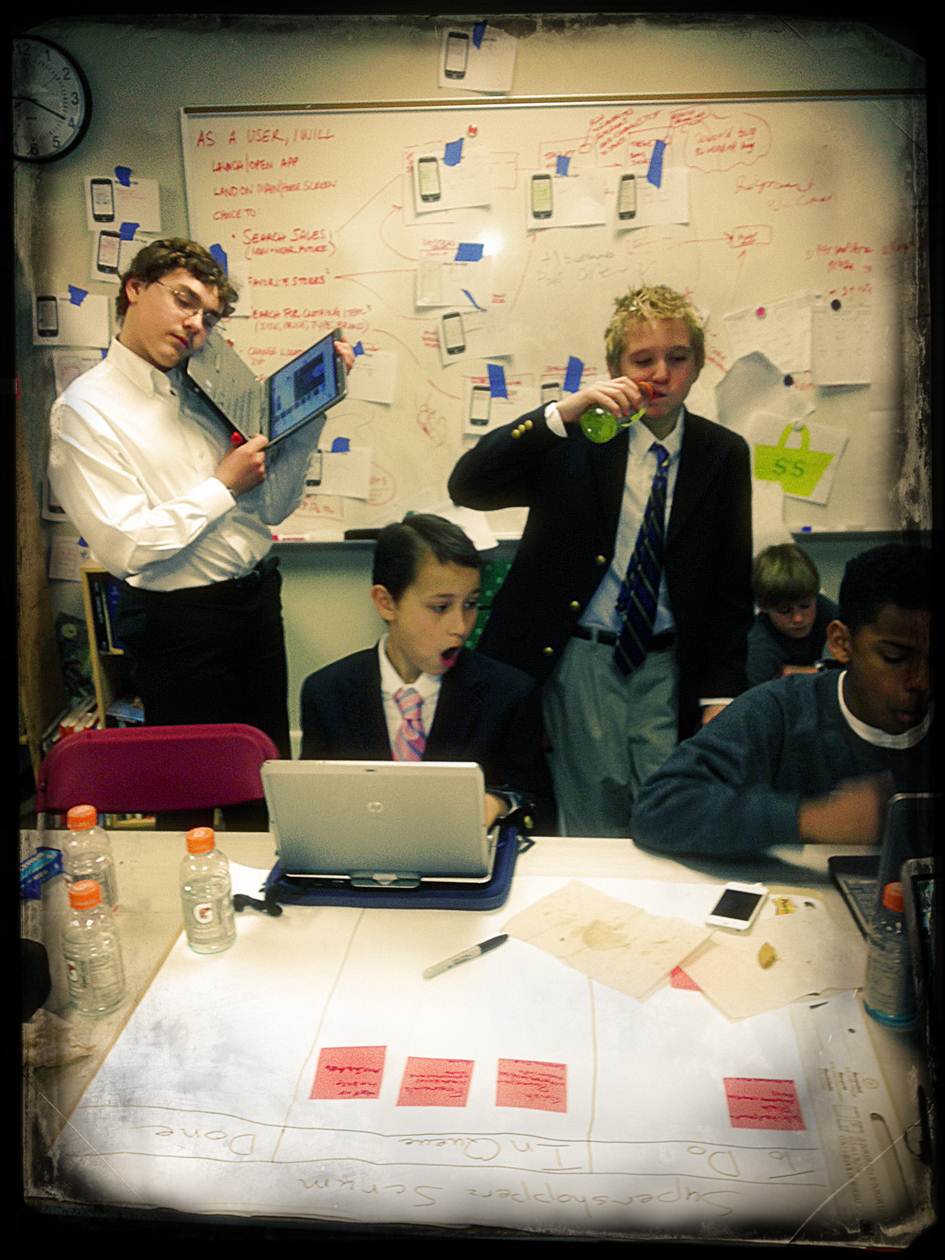
Monday students pitched, voted and joined teams. By Tuesday morning, students fleshed out what they believed to be their value proposition and customer segments. We spent a lot of time defining an MVP and steering them away from multiple features for the user. Scrum boards went up detailing everything they needed to accomplish by Friday afternoon. Tuesday afternoon they got out of the building and headed to a local mall to begin the customer validation and development process.

Wednesday morning they tabulated data and brought their original hypotheses to a grinding halt based on what they learned outside the building.  With new hypotheses and the help of a local UX Designer from Cleveland’s agile methods experts, LeanDog, the pivots began. Using paper templates, students worked out user experiences and taped them to the wall next to their drawings of customer archetypes. The energy in the room was electrifying.

In addition to regular lunch, the kids consumed 16 boxes of dry cereal, a crate of Clementines and an untold number of juice boxes. On Wednesday and Thursday, splash pages were launched; email addresses captured, cost structures and revenue streams explored. By Thursday noon each team knew, through hypothesis testing and customer interviews, the single feature behind its MVP and they headed out of the building one last time.

Results
Teams conducted 20-40 face-to-face interviews that week. They drew customer archetypes and storyboards, tried emailing, phone scripts and face-to-face conversations. We instituted the “Great Idea Gong” (GIG) that they thwacked every time a teammate wanted to share a “Big Idea” with the rest of the class.  We didn’t blog, but kids submitted an exit ticket at the end of each day. They answered Steve’s prompts: “This is what I thought . . . this is what I learned . . . This is what I am doing next . . . This is what I am keeping in mind… “

“I thought everyone at the mall would want to talk to us. I learned that people are in a hurry and busy and they may not care. Next time, I am going to talk to people without my partner so it’s one-to-one. And, I am going to change where I stand,” wrote Max, an 8th-grader.

Students even watched a little Shark Tank, which explains why on Friday, when they pitched local VCs from Cleveland’s business accelerator, JumpStart they declined the celebratory cake and ice cream and spent their last hour of class time grilling the judges not only on what their financial terms were, but about what level of expertise they would bring to the particular team? “If we move forward, we don’t just need a big check, we need someone who is really knowledgeable and experienced in creating partnerships. We don’t know much about that when it comes to clothing brands. Without that help, the money won’t matter,” explained Stephanie, a 7th-grader.

Lessons Learned:

  • When stuck with “no ideas,” instruct younger students to become detectives and identify the things that bug their friends, family and themselves. Next ask, “What is a possible solution to that problem?”
  • For each block in the business model canvas, have the students focus on only one or two questions
  • Reword the questions in age-appropriate language. Asking, “What do we need to do to make our solution a reality?” and “What are the things/people we need to make our solution a reality?” helps students who are stuck completing a business model canvas
  • Encourage an atmosphere of sharing with everything from food to great ideas
  • Scrum boards are a huge success for kid teams
  • Worry less about covering content and more about students developing the skill and willingness to take a risk, fail, makes some changes and try again.
  • Interrupt work every so often with something physical like dancing to loud music or running around outside. Ask the kids to teach you a new game
  • Teachers should check their own egos at the door

Summary for the Lean LaunchPad in K-12 Education
We are learning how to use the Lean LaunchPad model to build our entrepreneurial program for high school and middle school students, and will soon use it as the basis for developing an entrepreneurial program for our youngest students as well.

Our educational Goals for Hawken Middle and High School students is to:

  • Develop and apply an entrepreneurial mindset in all their endeavors (inside and outside of entrepreneurship class):            
    • This is what I thought . .  .
    • This is what I learned . . .
    • This is what I am doing next . . .
    • This is what I am keeping in mind . . .
    • Acquire real-world experience outside the classroom
    • Identify the key components of high-tech scalable businesses, not common in our geographic region.
    • Develop project management and team communication skills.
    • Become better and more empathetic listeners through the customer development process.
    • Embrace failure as an essential element of success.
    • Understand the ever-evolving relationships among the 9 BMC blocks.

We are finding the Lean LaunchPad curriculum to be a powerfully relevant and inspiring educational tool for students of all ages.

For additional information and/or resources, contact dkorda@hawken.edu or nchor@hawken.edu

The Lean LaunchPad Goes to High School

While the Lean LaunchPad class has been adopted by Universities and the National Science Foundation, the question we get is, “Can students in K-12 handle an experiential entrepreneurship class?”  Hawken School has now given us an answer.

Hawken is an independent school for grades K-12 in Cleveland, Ohio, committed to the idea that students learn more “by doing than by listening.” Experiential education is threaded in the school’s DNA.

Doris Korda, spent the first 15 years of her career in the high-tech industry and is now the Associate Head of School. Natasha Chornesky, who ran a publishing business, is the Director of Entrepreneurial Studies.  They both attended our latest Lean LaunchPad Educators Class. These two posts are what they did when they returned.

Part one is about Hawken School’s experience using the Lean LaunchPad curriculum for high school seniors, part two is what happened when they used it for 6th- to 8th-graders.

——

High School Entrepreneurship:  Choosing the Lean LaunchPad over a Mini-MBA Program
Adopting the Lean LaunchPad instead of a “mini MBA program” for Hawken students made good sense pedagogically, (we knew that searching for a viable business model is the core of entrepreneurship,) though it presented some challenges in perception:

  • None of the neighboring high schools was using the Lean LaunchPad
  • Most of these schools have entrepreneurship classes focused on students making crafts and selling them
  • Other schools curricula were steeped in traditional management and economics texts

Having taught grades 6-12, survived two “tours of duty” as a middle school principal, and designed curriculum for grades 3 and up, it was obvious to me that Steve’s Lean LaunchPad provides an accessible framework for young students to search successfully. We started with a few hypotheses, and iterated and pivoted to a successful program.Hawken High School Students

Hypothesis 1:
High school students will come through the door burning with passion to transform an idea into a business.

Reality: My seniors arrived to class with no ideas and no idea that they needed an idea. They thought they were learning about other people’s ideas in case studies and articles. They didn’t think they’d be doing entrepreneurship.

Practice:  We created time in class to share ideas. I framed the search for a viable business model as the focus. We determined as a class that we wouldn’t pass judgment on ideas until we dove into the customer development process. I stressed to the students they would be assessed on their ability to move through the Customer Development process, rather than be graded on an idea’s perceived worth. How quickly can you test hypotheses, learn from the tests, iterate?

Currency in my class became the ability to quickly test hypotheses, iterate and pivot.  It would be several months before my seniors, obsessed with college admissions, embraced this methodology, which felt so foreign at the onset.

Still apprehensive about working on their own businesses, I connected them with local entrepreneurs, but with a twist. Following Steve’s Golden Rule that entrepreneurs were not allowed as guest speakers in class, I went out to the community and located entrepreneurs who needed help with their customer discovery process. I worked with the entrepreneurs to craft a deliverable that was both helpful to them and with which my students would be successful. One of the requirements was that my students had to get out of the building and start talking to customers. Students blogged using Steve’s four prompts, below. The more they were out in the field, the stronger their entrepreneurial mindset grew, which was reflected in their posts.

  • This is what I thought . .  .
  • This is what I learned . . .
  • This is what I am doing next . . .
  • This is what I am keeping in mind . . .

Result: By the end of the first semester, the world opened up, questions and opportunities popped up everywhere, even where kids previously had seen failure or disappointment. Students’ entrepreneurial mindsets had permeated the most unlikely places.  “I don’t know what is going on in your class, but these kids have changed. Their entire mindset is different and the way they are showing up in the college admissions process is really different—in a great way,” remarked Director of College Admissions, Andrea Hays.

Hypothesis 2:
Hawken’s entrepreneurship class needed to look and feel familiar to students, parents and others in order to be successful.

Reality: A local school that is held as the pinnacle of entrepreneurship education uses Harvard case studies, so I thought we should, too. We were three-quarters of the way through the year and we hadn’t touched one. We didn’t need them.

The customer discovery and development process provides real experience, and real experience trumps case studies.  Plus, kids will tell you that the cases are the same old problems and they’ve already been solved.  Reading and discussing problems is never as meaningful as experiencing the problem, which can only be achieved by getting out of the building.

Practice:  Throughout the entire first semester, I maintained a routine of weekly take-home quizzes. Quiz questions asked students to use their favorite businesses to flush out business models using the Business Model Canvas. While the students aced these quizzes, they quickly forgot the information.

Initially students craved a syllabus, a checklist and the opportunity to easily memorize and regurgitate facts and concepts, and wanted to be told what to do. By second semester, they outgrew these needs. “We’re biased toward action and the action is always changing,” explains senior Peter Labes, adding, “We’ve learned to prioritize based on urgency, which is a lot different than operating off a teacher’s checklist.”

Iteration: I “flipped the classroom” by switched from assigning chapters to read to assigning Steve’s Udacity videos. Understanding, enthusiasm and retention increased. I abandoned the weekly quizzes and instituted weekly “here’s what I learned for customer discovery” presentations from the students , followed with a class Q&A session. The presentations demonstrated their hypotheses tested, results, customer interactions and iterations. I graded the presentations and I graded the verbal feedback students offered one another.

When the quality of the verbal feedback became such that there was too much great information for kids to just remember, I introduced the use of Steve’s live feedback through Google Docs. At first my seniors giggled and snickered and told me I was nuts to put this tool in their hands. We talked about the value of immediate meaningful feedback. They quit giggling. We’re never going back. The quality of feedback and the quality of the presentations has increased exponentially.  “I opened up the Google Doc to review the commentary from my classmates about the slide decks. The variety, complexity and creativity of ideas were impressive. Some people touched on concepts that our four-person group hadn’t even thought to consider. There really is strength in numbers,” writes a senior in her blog.

What’s next: Having completed in-depth customer discovery my students will be the first to tell you that “Being an entrepreneur is a TON of work!” Returning from spring break, the entire class will break up into teams and commence their own search for a viable business model for a passion-driven idea. It’s going to be dirty, messy and lots of time outside the building.

Result: “At the beginning of the year, we were scared to commit ourselves,” explains senior Emily Leizman. “We worked, but not 100%. Now, we’ve worked the customer development process for three companies and we treated them like our own. We’re working at 110% commitment now, so it’s time to do it for ourselves. We’re ready,”

Lessons Learned

  • The Lean LaunchPad methodology is proven. Go 100% from the start.  Don’t phase it in.
  • Be transparent with your students. Your class is in Startup mode. Embrace failure.
  • Kids have less to “unlearn” than older students and they are naturally excited by Lean LaunchPad 100% experiential methodology.
  • Be clear in your mind that the skills acquired through Lean LaunchPad methodology trump content and act accordingly. Act tough, too.
  • Remind kids that they are being assessed on how quickly they learn from testing their hypotheses and how quickly they iterate and pivot.
  • Leverage your local entrepreneurship community in meaningful ways, instead of using them as guest speakers.

In the next post, 6-8th graders use the Lean LaunchPad at Hawken School.
Listen to the post here: Download the Podcast here