The Lean LaunchPad Online

You may have read my previous posts about the Lean LaunchPad class taught at Stanford, Berkeley, Columbia, Caltech and for the National Science Foundation.

Now you too can take this course.

I’ve worked with the Udacity, the best online digital university on a mission to democratize education, to produce the course. They’ve done an awesome job.

The course includes lecture videos, quizzes and homework assignments. Multiple short video modules make up each 20-30 minute Lecture. Each module is roughly three minutes or less, giving you the chance to learn piece by piece and re-watch short lesson portions with ease. Quizzes are embedded within the lectures and are meant to let you check-in with how completely you are digesting the course information. Once you take a quiz, which could be a multiple-choice quiz or a fill in the blank quiz, you will receive immediate feedback.

Sign up here

——–

Why This Class?

Ten years ago I started thinking about why startups are different from existing companies.  I wondered if business plans and 5-year forecasts were the right way to plan a startup.  I asked, “Is execution all there is to starting a company?”

Experienced entrepreneurs kept finding that no business plan survived first contact with customers. It dawned on me that the plans were a symptom of a larger problem: we were executing business plans when we should first be searching for business models. We were putting the plan before the planning.

So what would a search process for a business model look like? I read a ton of existing literature and came up with a formal methodology for search I called Customer Development.

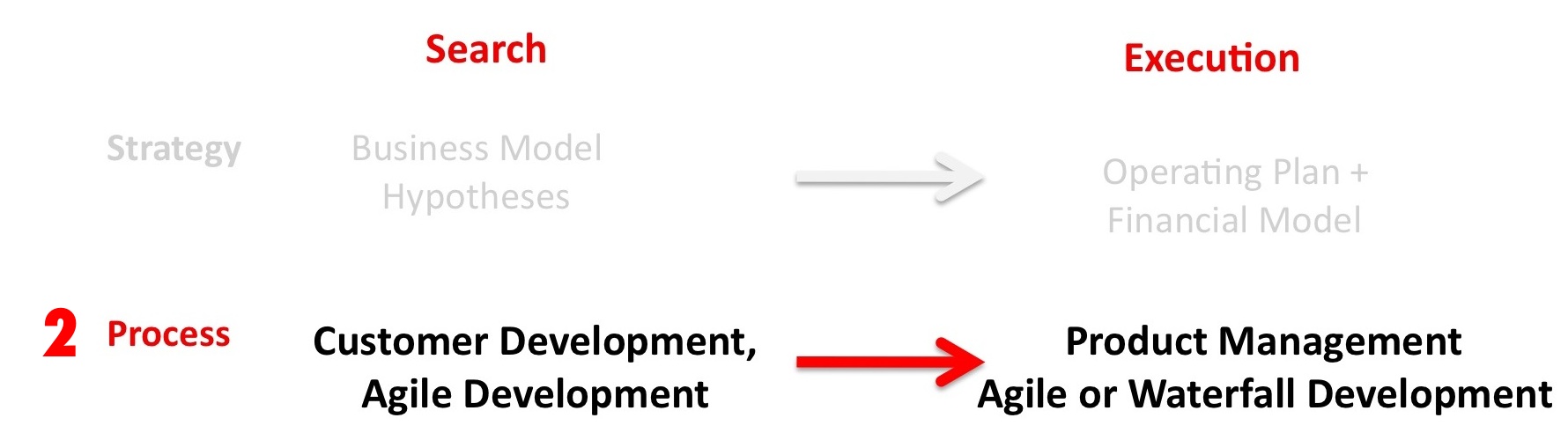
That resulted in a new process for Search: Customer Development + traditional product management/Waterfall Engineering. It looked like this:

This meant that the Search for a business model as a process now could come before execution. So I wrote a book about this called the Four Steps to the Epiphany.

And in 2003 the Haas Business School at U.C. Berkeley asked me to teach a class in Customer Development.  With Rob Majteles as a co-instructor, I started a tradition of teaching all my classes with venture capitalists as co-instructors.

In 2004 I funded IMVU, a startup by Will Harvey and Eric Ries. As a condition of my investment I insisted Will and Eric take my Customer Development class at Berkeley. Having Eric in the class was the best investment I ever made. Eric’s insight was that traditional product management and Waterfall development should be replaced by Agile Development.  He called it the “Lean Startup.”

Meanwhile, I had said startups were “Searching” for a business model, I had been purposefully a bit vague about what exactly a business model looked like. For the last two decades there was no standard definition.  That is until Alexander Osterwalder wrote Business Model Generation.

This book was a real breakthrough. Now we understood that the strategy for startups was to first search for a business model and then after you found it, put together an operating plan.

Now we had a definition of what it was startups were searching for. So business model design + customer and agile development is the process that startups use to search for a business model.

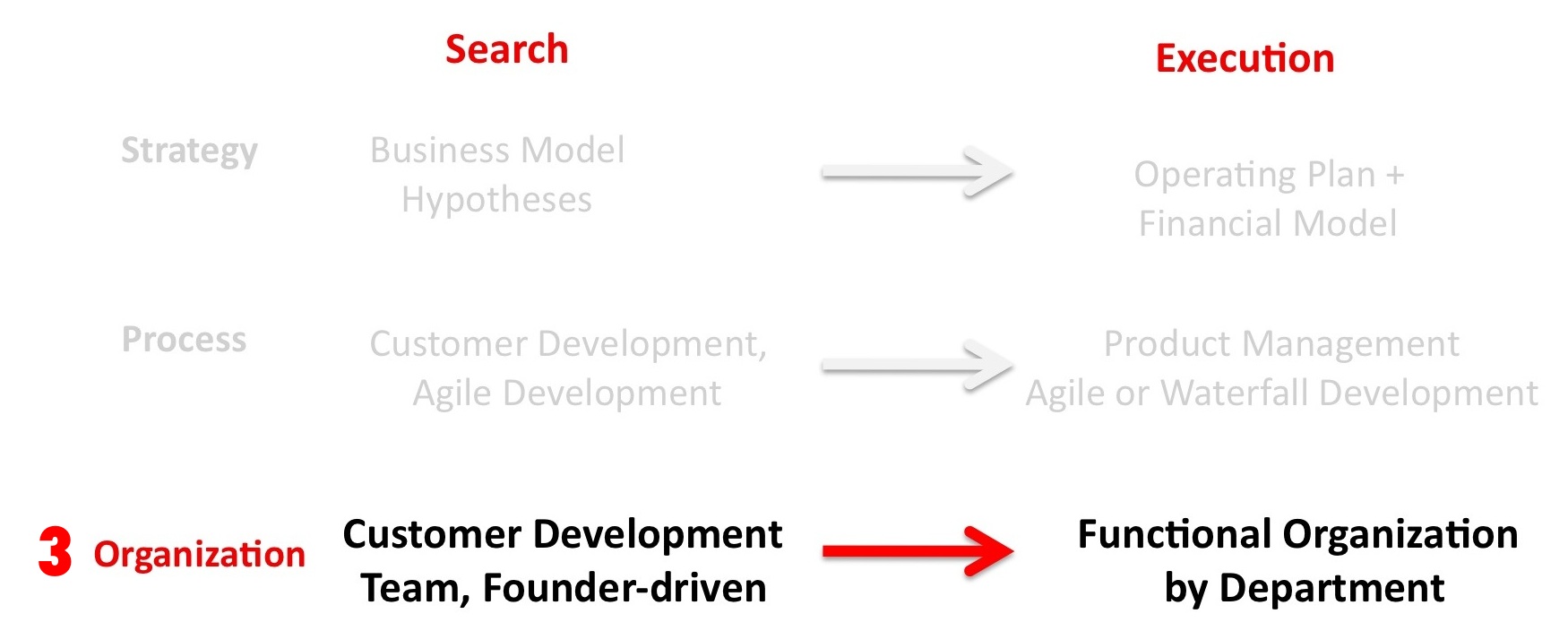
And the organization to implement all this was not through traditional sales, marketing and business development groups on day one. Instead the founders need to lead a customer development team.

And then to get things organized Bob Dorf and I wrote a book, The Startup Owners Manual that put all these pieces together.

But then I realized rather than just writing about it, or lecturing on Customer Development, we should have a hands-on experiential class. So my book and Berkeley class turned into the Lean LaunchPad class in the Stanford Engineering school, co-taught with two VC’s – Jon Feiber and Ann Miura-Ko. And we provided dedicated mentors for each team.

Then in the fall of 2011, the National Science Foundation read my blog posts on the Stanford version of the Lean LaunchPad class.  They said scientists had already made a career out of hypotheses testing, and the Lean LaunchPad was simply a scientific method for entrepreneurship. They asked if I could adapt the class to teach scientists who want to commercialize their basic research. I modified the class and recruited another great group of VC’s and entrepreneurs – Jim Hornthal, John Burke, Jerry Engel,Bhavik Joshi and Oren Jacob – to teach with me.

We taught the first two classes of 25 teams each, and then in March of 2012 trained faculty from Georgia Tech and the University of Michigan how to teach the class at their universities. Georgia Tech and the University of Michigan faculty then taught 54 teams each in July of this year and will teach another 54 teams in October.

We then added four more schools – Columbia, Caltech, Princeton and Hosei – where our team taught the Lean LaunchPad. We also developed a 5-day version of the class to complement the full semester and quarter versions.

Then last month we partnered with NCIIA and taught 62 college and university educators in our first Lean LaunchPad Educators Program.

And now we’ve spent weeks in the Udacity studio putting the lecture portion of the Lean LaunchPad class online.

Sign up and find out how to start a company!

Listen to the post here: Download the Podcast here

The Lean LaunchPad Class Online

Making a Dent in the Universe – Results from the NSF I-Corps

Our goal teaching for the National Science Foundation was to make a dent in the universe.

Could we actually teach tenured faculty how to turn an idea into a company?  And if we did, could it change their lives?

We can now answer these questions.

Hell yes.

———–

The Lean LaunchPad class for the National Science Foundation (NSF)
Over the last 6 months, we’ve been teaching a version of the Lean LaunchPad class for the National Science Foundation Innovation Corps.  We’ve taught two cohorts: 21 teams ending in December 2011, and 24 teams ending in May 2012. In July 2012 we’ll teach 50 more teams, and another 50 in October. Each 3-person team consists of a Principal Investigator, an Entrepreneurial Lead and a Mentor.

The Principal Investigator (average age of ~45) is a tenured faculty running their own research lab who has had an active NSF grant within the last 5 years. The Principal Investigator forms the team by selecting one of his graduate students to be the Entrepreneurial Lead.

The Entrepreneurial Lead is a graduate student or post doc (average age ~ 28) who works within the Principal Investigator’s lab. If a commercial venture comes out of the I-Corps, it’s more than likely that the Entrepreneurial Lead will take an active role in the new company. (Typically Principal Investigators stay in their academic role and continue as an advisor to the new venture.)

Mentors (average age ~50) are an experienced entrepreneur located near the academic institution and has experience in transiting technology out of academic labs. Mentors are recommended by the Principal Investigator (who has worked with them in the past) or they may be a member of the NSF I-Corps Mentor network. Some mentors may become an active participant in a startup that comes out of the class.

The NSF I-Corps: Class Goals
The NSF I-Corps Lean LaunchPad class has different goals then the same class taught in a university or incubator. In a university, the Lean LaunchPad class teaches a methodology the students can use for the rest of their careers. In an incubator, the Lean LaunchPad develops angel or venture-funded startups.

Unlike an incubator or university class, the goal of the NSF I-Corps is to teach researchers how to move their technology from an academic lab into the commercial world. A successful outcome is a startup or a patent or technology license to a U.S. company.

(While many government agencies use Technology Readiness Levels to measure a projects technical maturity, there are no standards around Business Maturity Levels. The output of the NSF I-Corps class provides a proxy.)

The NSF I-Corps doesn’t pick winners or losers. It doesn’t replace private capital with government funds. Its goal is to get research the country has already paid for educated to the point where they can attract private capital. (It’s why we teach the class with experienced Venture Capitalists.)

Teaching Objectives
Few of the Principal Investigators or Entrepreneurial Leads had startup experience, and few of the mentors were familiar with Business Model design or Customer Development.

Therefore, the teaching objectives of the I-Corps class are:

1) Help each team understand that a successful company was more than just their technology/invention by introducing all the parts of a business model (customers, channel, get/keep/grow, revenue models, partners, resources, activities and costs.)

2) Get the teams out of the building to test their hypotheses with prospective customers. The teams in the first cohort averaged 80 customer meetings per team; the second cohort spoke to an average of 100.

3) Motivate the teams to pursue  commercialization of their idea. The best indicators of their future success were whether they a) found a scalable business model, b) had an interest in starting a company, and c) would pursue additional funding.

Methodology
The National Science Foundation worked with NCIIA to establish a baseline of what the students knew before the class and followed it up with a questionaire after the class.

While my experience in teaching students at Stanford, Berkeley and Columbia told me that this class was an effective way to teach all the parts that make up a startup, would the same approach work with academic researchers?

Here’s what they found.

Results
Teams came into the class knowing little about what parts made up a company business model (customers, channel, get/keep/grow, revenue models, partners, resources, activities and costs.) They left with very deep knowledge.

I-Corps teams spent the class refining their business model and minimum viable product. By the end of the class:

  • Over 95% believed that they found a scalable business model.
  • 98% felt that they had found “product/market fit”.

The class increased everyones interest in starting a company. 92% said they were going to go out and raise money – either from the NSF or with private capital. (This was a bit astonishing. Given that most of them didn’t know what a startup was coming in. These are new jobs being created.)

One of the unexpected consequences of the class was its effect on the Principal Investigators, (almost all tenured professors.)  A surprising number said the ideas for the class will impact their research, and 98% of all of the attendees said it was going to be used in their careers.

Another unexpected result was the impact the class had on the professors own thinking about how they would teach their science and engineering students. We got numerous comments about “I’m going to get my department to teach this.”

What’s Next
The NSF and NCIIA understand that the analysis doesn’t end by just studying the results of each cohort. We need to measure what happens to the teams and each of the team members (Principal Investigator, Entrepreneurial Lead and Mentor) over time. It’s only after a longitudinal study that will take years, can we see how deep of a dent we made in the universe.

But I think we’ve made a start.

Acknowledgements
Thanks to the team at NCIIA that provided the questionaire and analytical data (Angela Shartrand) and the logistical support (Anne Hendrixson) to run these NSF classes.

The National Science Foundation (Errol Arkilic, Babu DasGupta) took a chance at changing the status quo.

Members of Congress on both sides of the aisle who’ve realized cracking the code on how to teach starting companies means a brighter day for the future of  all jobs in the United States – not just tech startups.

And thanks to the venture capitalists and entrepreneurs who volunteer their time for their country; Jon Feiber from MDV, John Burke from True Ventures, Jim Hornthal from CMEA, Jerry Engel from Monitor Ventures (and the U.C. Berkeley Haas Business School,) Oren Jacob from ToyTalk and Lisa Forssell of Pixar.

And to our new teaching teams at University of Michigan and Georgia Tech – It’s your turn.

Lessons Learned

  • The Lean LaunchPad class (Business Model design+Customer Development+ extreme hands-on) works
  • They leave knowing:
    • how to search for a business model (customers, channel, get/keep/grow, revenue models, partners, resources, activities and costs,)
    • how to find product/market fit, and a scalable business model
  • It has the potential to change careers, lives and our country

Listen to the post here: Download the Podcast here

Entrepreneurship for the 99%

This is a guest post from Jerry Engel, the Faculty Director of the National Science Foundation Innovation Corps (and the Founding Faculty Director of the Lester Center for Entrepreneurship at UC Berkeley.)

———–

The 99%
As the morning fog burns off the California coast, I am working with Steve Blank, preparing for the Lean LaunchPad Faculty Development Program we are running this August at U.C. Berkeley. This is a 3-day program for entrepreneurship faculty from around the world how to teach entrepreneurship via the Lean LaunchPad approach (business model canvas + customer development) and bring their entrepreneurship curriculums into the 21st century. Over the past couple of years this Lean LaunchPad model has proven immensely effective at Berkeley, Stanford, Columbia and, of course, the National Science Foundations Innovation-Corps program. The data from the classes seem to indicate that we’ve found have a method how to make scalable startups fail less.

While we’re excited by the results, we’ve realized that we’ve been solving the problem for the 1% of new ventures that are technology startups. The reality is that the United States is still a nation of small businesses. 99.7% of the ~6 million companies in the U.S. have less than 500 people and they employ 50% of the 121 million workers getting a paycheck. They accounted for 65 percent (or 9.8 million) of the 15 million net new jobs created between 1993 and 2009. And while they increasingly use technology as a platform and/or a way of reaching and managing customers, most are in non-tech businesses (construction, retail, health care, lodging, food services, etc.)

While we were figuring out how to be incredibly more efficient in building new technology startups, three out out of 10 new small businesses will fail in 2 years, half fail within 5 years.  The tools and techniques available to small businesses on Main Street are the same ones that were being used for the last 75 years.

Therefore, our remaining challenges are how to make them fail less – and how can we make the Lean LaunchPad approach relevant to the rest of the 99% of startups.

Serendipity
A serendipitous answer came to us around noon. His name is Alex Lawrence. Alex, vice provost for Innovation & Economic Development at Weber State University in Utah and completing his first year of teaching entrepreneurship. Alex is a successful serial entrepreneur –with the same drive and energy of many we have known here in Silicon Valley, but different. His nine startups have ranged from franchised fruit juice shops to Lendio a financial services company for small businesses. Alex had been recruited back by his Alma Matter to create an entrepreneurship program. In fact he had just been charged with creating an entrepreneurship minor – five or six courses for students of any major at the University that would help prepare them for the challenge of starting their own businesses.

Alex’s first insight was that the traditional “how to write a business plan” was as obsolete for Main Street as it is for Silicon Valley. So he had adopted Steve’s Lean LaunchPad class and was using The Startup Owner’s Manual as his core text. He had contacted us seeking advice on developing his curriculum, and it just seemed natural to invite him out to the ranch for a deeper dive.

As we dug into learning about Alex’s teaching experience we naturally asked him about the ventures his own students were creating. It was clear Alex was a bit apologetic; photo studios, online retail subscriptions to commodity household and personal hygiene products, etc. Alex explained that in his community building a successful venture that generated nice cash flows – not IPO’s – were the big win. To his students these were not “small businesses”, but ‘their businesses’, their livelihoods and their opportunities to create wealth and independence for themselves and their families.

Mismatch for Main Street
As we walked out to the pond, Alex explained that while he found the teachings of the Lean LaunchPad directly applicable and effective, there was a mismatch for his students in the size of the end goal (a great living versus a billion dollar IPO) and the details of the implementation of the business model (franchise and multilevel marketing versus direct sales, profit sharing versus equity for all, family and SBA loans versus venture capital, etc.)

Sitting by the pond we had a second epiphany: we could easily adjust the Lean LaunchPad class to bring 21st century entrepreneurship techniques to ‘Main Street’. To do this we needed to do is change the end goals and implementation details to match the aspirations and realities that these new small businesses face.

We called this Mainstream Entrepreneurship.

Mainstream Entrepreneurship
Mainstream Entrepreneurship recognizes that with the Lean LaunchPad class we now have a methodology of making small businesses fail less.  That accelerating business model search and discovery and using guided customer engagement as a learning process, we could help founders of mainstream businesses just like those starting technology ventures.

For the rest of the afternoon, Steve and I brainstormed with Alex about how he could take his 20 years of entrepreneurial small business experience and use the Business Model Canvas and Customer Development to create a university entrepreneurship curriculum and vocabulary for the mainstream of American Business.

We think we got it figured out.

Alex Lawrence will be one of the presenters at the Lean LaunchPad Educators Program August 22-24th in Berkeley.

Lessons Learned

  • Small businesses make up 99.7% of U.S. companies
  • “How to write a business plan” is as obsolete for Main Street as it is for Silicon Valley
  • Using the Lean LaunchPad (the business model canvas and Customer Development) are the right tools
  • Small businesses have different end goals and implementation details
  • We can adapt/modify the Lean LaunchPad approach to embrace these goals/details

Listen to the post here: or download the podcasts here

Five Days to Change the World – The Columbia Lean LaunchPad Class

We’ve taught our Lean LaunchPad entrepreneurship class at Stanford, Berkeley, Columbia and the National Science Foundation in 8 week, 10 week and 12 week versions.  We decided to find out what was the Minimum Viable Product for our Lean LaunchPad class.

Could students get value out of a 5-day version of the class?

The Setup
At the invitation of Murray Low at the Entrepreneurship Center in the Columbia Business School, we went to New York to find out.  We were going to teach the Lean LaunchPad class in 5-days.   I was joined by my Startup Owners Manual co-author Bob Dorf, Alexander Osterwalder (author of Business Model Generation) and Fred Wilson of Union Square Ventures.

As we’ve done in previous classes, the students form teams and come up with an idea before the class.

Potential students watched an on-line video of Osterwalder explaining the Business Model Canvas and then applied for admission to the class with a fully completed business model canvas. Here are two examples:

If you can’t see the presentation above, click here.

If you can’t see the presentation above, click here.

The Class
We had 69 students in 13 teams. Instead of going around the room introducing themselves, each group hit the ground running by presenting their canvas.

The class organization was pretty simple:

  • textbooks were The Startup Owners Manual and Business Model Generation
  • team presentations 9-12:30 (with continual instructor critiques)
  • working lunch 12:30-1:30 (with office hours)
  • lecture 1:30-3:00
  • get out of the building 3:00-on
  • repeat for 5-days

Resources
The 5-day syllabus is here.

All 13 teams Day 1 presentations are here.
Day 2 presentations here.
Day 3 presentations here.
Day 4 presentations here.
Day 5 presentations here.

The Outcome
After 5 days the teams collectively had ~1,200 face-to-face customer interviews, with another 1,000+ potential customers surveyed on-line.

Take a look at the same two teams presentations (compare it to their slides above):

If you can’t see the presentation above, click here.

If you can’t see the presentation above, click here.

Lessons Learned:

  • A five day Lean Launchpad Class is definitely worth doing.
  • The Business Model Canvas + Customer Development works even in this short amount of time
    • However we were in NYC where customer density was high.
  • As we’ve already found, this class needs to be taught as a joint engineering/mba class
  • Next time we teach we will complete the transition to a flipped classroom:
    • Have no lectures during class. We’ll offer video lectures, and use the time for class labs built around detailed analysis of 2 or 3 canvas pivots
    • Make teams use Salesforce, or some similar package, to track all contacts/customer calls

Listen to the post here: Download the Podcast here

The National Science Foundation Innovation Corps – What America Does Best

We ran the first National Science Foundation Innovation Corps class October to December 2011.

63 scientists and engineers in 21 teams made ~2,000 customer calls in 10 weeks, turning laboratory ideas into formidable startups. 19 of the 21 teams are moving forward in commercializing their technology.

Watching the final presentations it was clear that  the results were way past our initial expectations (comments from mentors as well as pre- and post-class survey data suggested that most of the teams learned more in two months than others had in two years.) So much so that the NSF decided to scale the Innovation Corps program.

In 2012 the NSF will put 150 teams of the best scientists in the U.S. through the Lean Launchpad class.  And to help teach these many teams, the NSF will recruit other universities that have engineering entrepreneurship programs to become part of the Innovation Corps network.

Congress Gets It
In-between the 2011 pilot class and the first NSF class of 2012, I got a call from Congressman Dan Lipinski. He sits on the House committee that oversees the NSF – the Science, Space and Technology committee (a place where his engineering degree and PhD comes in handy.) He had read my blog posts about the NSF Innovation Corps and was interested in how the first class went. He wanted to fly out to Stanford and sit in the Lean LaunchPad class about to start in the engineering school.

While I’ve had visitors in my classes before, having a congressman was a first. He showed up with no press in-tow, no entourage, just a genuine search for understanding of whether this program was a waste of taxpayer money or good for the country.

He asked tough questions about why the government not private capital should be doing this. I explained that the goal of the Innovation Corps was to bridge what the NSF calls the “ditch of death” – the gap between when NSF research funding runs out and when a team is credible enough (with enough customer and market knowledge) to raise private capital or license/partner with existing companies. The goal was not to replace private capital but to help attract it. The amount of money spent on the Innovation Corps would be about 1/4 of one percent of the $7.373 billion NSF budget, but it would leverage the tens of billions basic research dollars already invested. It’s payoff would be disproportionately large for the country. It’s one of the best investments this country can make for keeping the U.S. competitive and creating jobs.

After class the Congressman joined the teaching team at our favorite pizza place for our weekly post-class debrief.

If you like science, technology or entrepreneurship, this guy is the real deal. He gets it.

“Innovation, jobs and entrepreneurship” have become popular buzzwords in an election year. But it was pretty amazing to see a congressman jump on a plane to actually find out if he can help the country do so.  He issued this press release asking Congress to fully fund the Innovation Corps when he came back to Washington.

The National Science Foundation Innovation Corps combines the best of what the U.S. government, American researchers in academia and risk capital can do together. If we’re correct, we can compress the time for commercializing scientific breakthroughs and reduce the early stage risks of these new ventures. This means more jobs, new industries and a permanent edge for innovation in the United States.

———

The 3-person teams consisted of Principal Investigators (PI’s), mostly tenured professors (average age of 45,) whose NSF research the project was based on. The PI’s in turn selected one of their graduate students (average age of 30,) as the entrepreneurial lead. The PI and Entrepreneurial Lead were supported by a mentor (average age of 50,) with industry/startup experience.

This was most definitely not the hoodie and flip-flop crowd.

Part one of the posts on the NSF Innovation Corps is here, part two here. Syllabus for the class is here.  Textbook is here.

Here are some of the final Lessons Learned presentations and team videos:

Akara Solutions: Flexible, Low Cost Cooling Technology for LED Lighting
Principal Investigator: Satish Kandlikar Rochester Institute of Technology

If you can’t see the video above, click here.

If you can’t see the presentation above, click here.

Semiconductor-Based Hydrogen and Hydrocarbon Sensors
Principal Investigator: Lisa Porter Carnegie-Mellon University

If you can’t see the video above, click here.

If you can’t see the presentation above, click here.

Pilot Production Of Large Area Uniform Single-Crystal Graphene Films
Principal Investigator: Alan Johnson University of Pennsylvania

If you can’t see the video above, click here.

If you can’t see the presentation above, click here.

Radiotracer Synthesis Commercialization
Principal Investigator: Stephen DiMagno University of Nebraska-Lincoln

If you can’t see the video above click here.

If you can’t see the presentation above, click here.

Commercialization of an Engineered Pyrolysis Blanket for the Conversion of Forestry Residues to Soil Amendments and Energy Products
Principal Investigator: Daniel Schwartz University of Washington

If you can’t see the video above, click here

If you can’t see the presentation above, click here.

Photocatalysts for water remediation
Principal Investigator: Pelagia Gouma SUNY at Stony Brook

If you can’t see the video above, click here.

If you can’t see the presentation above, click here.

The other teams were equally interesting. Here are links to their Lessons Learned presentations.

IDecideFast – A web-based application for effective decision making for the layperson
Principal Investigator: Ali Abbas University of Illinois at Urbana-Champaign

Silicon Terahertz Electronics
Principal Investigator: Michael Shur  Rensselaer Polytechnic Institute

Standoff detection of explosives using novel signal-amplifying nanocomposite and hand-held UV light
Principal Investigator: Yu Lei University of Connecticut

MEMS-based drug infusion pumps
Principal Investigator: Ellis Meng University of Southern California

TexCone – Laser-Generated Surface Textures for Anti-Icing and Sun-Light-Trapping Applications
Principal Investigator: Mool Gupta University of Virginia

Concentric Technology
Principal Investigator: Walter Besio University of Rhode Island

Hand-Held Tonometer for Transpalpebral Intraocular Pressure Measurement
Principal Investigator:  Eniko Enikov University of Arizona

Artificial Membrane-based Ion Channel Screening
Principal Investigator: Jacob Schmidt University of California-Los Angeles

Privacy-Preserving Location Based Services
Principal Investigator: Nan Zhang   George Washington University

MySkinTone: A breakthrough technology and product for skin melanin evaluation
Principal Investigator: Michael Silevitch Northeastern University

Mobidemics: Using Mobile Gaming for Healthcare
Principal Investigator: Nilanjan Banerjee University of Arkansas

SmartMenu
Principal Investigator: Elizabeth Mynatt (mynatt@cc.gatech.edu); Georgia Tech Research Corporation

Sweet Sensors – Portable sensors using widely available personal glucose monitor
Principal Investigator: Yi Lu University of Illinois at Urbana-Champaign

SwiftVax – A Green Manufacturing Platform for Faster, Cheaper, and Scalable Vaccine Manufacturing
Principal Investigator: Karen McDonald University of California-Davis

Lessons Learned

  • Yes, entrepreneurship can be taught
  • No, there’s no age limit
  • We now know how to reduce customer and market risk for new ventures
  • The combination of government, researchers in academia and risk capital make a powerful accelerator for technology commercialization
  • There’s at least one congressman who understands it

Listen to the post here: Download the Podcast here

Stanford 2012 Lean LaunchPad Presentations – part 2 of 2

Today, the second half of the Stanford Engineering Lean LaunchPad Class gave their final presentations. Here are the final four (the first five are here.)

Team ParkPoint Capital
This team spoke face-to-face with 326 customers. As often happens, this team came into class convinced that their market research proved that their business was providing credit to underbanked customers.  8 weeks later they ended up as a financial service provider for immigrants.  Lots of learning and pivots on the way.

We thought the team summarized their lessons learned well:

Team DentalOptics
Team DentalOptics spoke face-to-face with 72 customers.  Their journey was from a lighting solution for dentists to an automated way to test for periodontal disease. How they got to their destination was truly amazing.

Team MiCasa
They spoke to 105 customers and surveyed 98 more.

You can watch as this team pivots through Customer Segments by clicking through their business model canvases at the end of presentation. It is the first film-strip of entrepreneurship in action.

If you can’t see the slide presentation above, click here.

The MiCasa customer discovery narrative blog is here

Team ZiiLion
Interviewed 154 customers in China plus surveyed another 48.

This team was trying to do something extremely difficult. Create an app for Renren (a Chinese version of Facebook) for event planning.  And do it while in school in the U.S.  Lots of learning and Pivots here.

If you can’t see the slide presentation above, click here.

The Ziilion customer discovery narrative blog is here.

———

Congratulations to all the teams.  They taught us a lot.

Stanford e245 2012 class photo

Next week the Lean LaunchPad class will be taught to 25 teams for the National Science Foundation Innovation Corps. And later in the week we’ll be sharing what we learned with other entrepreneurial educators it at the NCIIA conference. Then in April we’ll be teaching Corporate Entrepreneurship at Columbia University.

Lessons Learned

  • Class is a mix of engineering students and MBA’s
  • Students apply as preformed teams
  • Application to the class is the teams business model canvas
  • Curriculum = business model canvas + customer development
  • Minimal lecture, maximum experiential immersion
  • Relentless customer visits (10-20 a week)
  • On-line journal to document their customer discovery narrative
  • One mentor (VC or experienced entrepreneur) per team
  • Mandatory office hours
  • Weekly in-class presentations for all teams
  • Weekly critiques of team customer discovery progress
  • Workshop on how to present a story-arc and narrative
  • Lean LaunchPad teaching guide

Stanford 2012 Lean LaunchPad Presentations – part 1 of 2

Today, the first half of the Stanford Engineering Lean LaunchPad Class gave their final presentations. Here are the first five. (Part two is here.)

It Feels Like 20 Years Ago Today
It’s hard to believe it’s only been a year since we taught the first 10 teams in the Stanford Lean LaunchPad class. To share what we learned, we blogged each of those class sessions, (all the slides can be found here.)  Since then we’ve taught an additional 50 Lean LaunchPad teams: 21 teams for the National Science Foundation (NSF) Innovation Corps, 11 teams for a joint Berkeley/Columbia MBA class, another 9 for a Berkeley MBA/Engineering class, and now 9 more teams in this Stanford Engineering Lean LaunchPad Class class.

Later this month, the next 25 National Science Foundation Innovation Corps teams will show up – but this time with reinforcements. The NSF has selected the best entrepreneurship teaching teams from two major universities and they will be joining the class. The goal is for them is to observe this class, then host and teach the next round of 50 NSF Innovation Corps scientist/engineer teams in July.  The process will repeat itself, quarter by quarter – new students, new University entrepreneurship teaching teams.

We’ll teach over 175 NSF Innovation Corps teams in the Lean LaunchPad course in 2012. While at the same time spreading the Lean LaunchPad entrepreneurship curriculum to campuses across the United States.

The 2012 Stanford Lean LaunchPad Presentations
The class is intensely and deliberately experiential to develop the mindset, reflexes, agility and resilience an entrepreneur needs to search for certainty in a chaotic world. Students were going to get a hands-on experience in how to start a new company. The premise of the class is that startups, are not about executing a plan where the product, customers, channel are known. Startups are in fact only temporary organizations, organized to search–not execute–for a scalable and repeatable business model.

Yet this isn’t an incubator. We trying to teach students a methodology that combines customer development, agile development, business models and pivots. (The slides and syllabus here describe the details of the class.) Our goal is to teach them the art, science and strategy of entrepreneurship that will forever change how they view early stage ventures.

And do it in 8 weeks.

Team EngineKites
A kite-boarding startup? Only in California! This team spoke face-to-face with 50+ end users, 3 manufacturers, 25 potential partners, 22 domain experts and surveyed an additional 115 customers. And they got to the beach a lot. Don’t miss their video of the product below.

If you can’t see the slide presentation above, click here.

If you can’t see the video above, click here

The EngineKites customer discovery narrative blog is here.

Team Sync
Team Sync spoke face-to-face with 74 customers, 10 experts and surveyed another 103 customers.

If you can’t see the slide presentation above, click here.

The Sync customer discovery narrative blog is here.

Team Nudge/Dynamo
This team won the award for the most pivots in the class. They had face-to-face interviews with 252 customers + 10 partner interviews + 76 surveyed.

Loved the “evolution” slide.

If you can’t see the slide presentation above, click here.

The Nudge/Dyanmo customer discovery narrative blog is here

Team GameSpeed
These guys hold the record for the number of customers touched 4,000!  147 face-to-face or phone interviews.

If you can’t see the slide presentation above, click here.

The GameSpeed customer discovery narrative blog is here.

Team ColorWheels
This team was trying to solve a hard problem – getting girls engaged in science and engineering. They spoke to 294 people: 69 parents, 110 kids, 6 high school girls 32 experts, 6 manufacturers, and surveyed an addtional 68 parents.

If you can’t see the presentation above, click here.

The ColorWheels customer discovery narrative blog is here.

We Got Smarter Too
One of the great things about the class is that the curriculum is evolving as fast as the teams are learning. As a teaching team we’ve learned a ton of how to best select teams, so we now insist that they come in as preformed teams. We hold mixers a month or two in advance to help facilitate the process. It has made a dramatic difference in team efficiency and cohesion

We have the students formally apply for the class by filling out a business model canvas. And at the first class they introduce themselves and their teams by presenting the canvas. This moved the learning up by one entire class session since we can now hit the ground running.

Given how important the students work in customer discovery outside the building was, we made each team keep an online journal on each step of their progress. Since the teaching team read each of their narrative before class and office hours, it made their in-class presentations short and efficient.

We realized that students needed help turning all that they were learning from customers into a coherent and crisp presentation. So we offered a special evening workshop on how to present a story-arc and narrative.

We’ve been experimenting in other ways – trying to figure out how to “bubble-up” some of the customer discovery data onto the canvas with red/yellow/green dots you see on some of the business model canvas slides. We suggested that teams talk about their hypothesis tests, draw diagrams of product flows through the channel and let us know who the customer segment is with a “customer archetype” slide.

We’re about to move our class text to The Startup Owners Manual and put together a draft of a standard Lean LaunchPad teaching guide.

Finally, we’ve been paring the lectures back to the absolute minimum to impart the information necessary for the teams to move forward, but leaving more time for us to provide feedback and critique of their weekly presentations. We’re actively considering running an experiment of making the lectures an on-line homework requirement (with on-line quizzes to make sure they view the material.)

None of this would be possible without the two VC’s who volunteer their time to teach this Stanford class with me: Jon Feiber of Mohr Davidow Ventures and Ann Miura-ko of Floodgate,

And we had the help of Lisa Forssell, director of technical artists from Pixar, who taught the “how to present class” and Thomas Haymore our indefatigable Teaching Assistant and our team of mentors.

And hats off to Kathy Eisenhardt and Tom Byers of the Stanford Technology Ventures Program who gave us the freedom to invent and teach the class.

—–

The rest of the teams present next week.  We’ll post their slides in part 2.
Listen to the post here: Download the Podcast here

Search versus Execute

One of the confusing things to entrepreneurs, investors and educators is the relationship between customer development and business model design and business planning and execution.

When does a new venture focus on customer development and business models? And when do business planning and execution come into play?

Here’s an attempt to put this all in context.

Don’t Throw the Tomatoes
I was in Washington D.C. last week presenting at the ARPA-E conference. I spent the next day working with the National Science Foundation on the Innovation Corps, and talking to congressional staffs about how entrepreneurial educational programs can reshape our economy. (And I even found time to go to the Spy Museum.)

One of the issues that came up is whether the new lexicon of entrepreneurial ideas – Customer Development, Business Model Design, Lean, Lean LaunchPad class, etc. – replace all the tools and classes that are currently being taught in entrepreneurship curriculums and business schools.  I was a bit surprised since most of what I’ve been advocating is complementary to existing courses. However, I realize I’ve primarily written about business model design and customer development. Given that I’m speaking this month in front of entrepreneurship educators at the NCIIA conference, I thought I should put it in context before they throw tomatoes at me.

Search Versus Execution
One of the things startups have lacked is a definition of who they were. For years we’ve treated startups like they are just smaller versions of a large company. However, we now know that a startup is a temporary organization designed to search for a repeatable and scalable business modelWithin this definition, a startup can be a new venture or it can be a new division or business unit in an existing company.

If your business model is unknown – that is just a set of untested hypotheses- you are a startup searching for a repeatable business model. Once your business model (market, customers, features, channels, pricing, Get/Keep/Grow strategy, etc.) is known, you will be executing it. Search versus execution is what differentiates a new venture from an existing business unit.

Strategy


The primary objective of a startup is to validate its business model hypotheses (and iterate and pivot until it does.) Then it moves into execution mode. It’s at this point the business needs an operating plan, financial forecasts and other well-understood management tools.

Process

The processes used to organize and implement the search for the business model are Customer Development and Agile Development. A search for a business model can be in any new business – in a brand new startup new or in a new division of an existing company.

In search, you want a process designed to be dynamic, so you work with a rough business model description knowing it will change. The model changes because startups use customer development to run experiments to test the hypotheses that make up the model. And most of the time these experiments fail. Search embraces failure as a natural part of the startup process. Unlike existing companies that fire executives when they fail to match a plan, we keep the founders and change the model.

Once a company has found a business model (it knows its market, customers, product/service, channel, pricing, etc.), the organization moves from search to execution.

The product execution process – managing the lifecycle of existing products and the launch of follow-on products – is the job of the product management and engineering organizations. It results in a linear process where you make a plan and refine it into detail. The more granularity you add to a plan, the better people can execute it: a Business Requirement document (BRD) leads to a Market Requirements Document (MRD) and then gets handed off to engineering as a Functional Specifications Document (FSD) implemented via Agile or Waterfall development.

Organization

Searching for a business model requires a different organization than the one used to execute a plan. Searching requires the company to be organized around a customer development team led by the founders. In contrast, execution, (which follows search) requires the company to be organized by function (product management, sales, marketing, business development, etc.)

Companies in execution suffer from a “fear of failure culture“, (quite understandable since they were hired to execute a known job spec.) Startups with Customer Development Teams have a “learning and discovery” culture for search. The fear of making a move before the last detail is nailed down is one of the biggest problems existing companies have when they need to learn how to search.

The idea of not having a functional organization until the organization has found a proven business model is one of the hardest things for new startups to grasp. There are no sales, marketing or business development departments when you are searching for a business model.  If you’ve organized your startup with those departments, you are not really doing customer development.  (It’s like trying to implement a startup using Waterfall engineering.)

Education
Entrepreneurship curriculums are only a few decades old. First taught as electives and now part of core business school curriculums, the field is still struggling to escape from the bounds of the business plan-centric view that startups are “smaller versions of a large company.” VC’s who’ve watched as no startup business plan survived first contact with customers continue to insist that startups write business plans as the price of entry to venture funding. Even as many of the best VCs understand that the business ‘planning’ and not the ‘plan’ itself, are what is important.

The trouble is that over time – this key message has gotten lost. As business school professors, many of whom lack venture experience, studied how VCs made decisions, they observed the apparently central role of the business plan and proceeded to make the plan [not the planning], the central framework for teaching entrepreneurship. As new generations of VCs with MBA’s came into the business, they compounded the problem (“that’s how we always done it” or “that’s what I learned (or the senior partners learned) in business school.”)

Entrepreneurship educators have realized that plan-centric curriculum may get by for teaching incremental innovation but they’re not turning out students prepared for the realities of building new ventures. Educators are now beginning to build their own E-School curriculum with a new class of management tools built around “search and discovery.” Business Model Design, Product/Service Development, Customer Development, Startup Team-Building, Entrepreneurial Finance, Marketing, Founder Transition, etc. all provide the startup equivalent of the management tools MBAs learn for execution.

Instructional Strategy

Entrepreneurial education is also changing the focus of the class experience from case method to hands-on experience. Invented at Harvard, the case method approach assumes that knowledge is gained when students actively participate in a discussion of a situation that may be faced by decision makers.

The search for a repeatable business model for a new product or service is not a predictable pattern. An entrepreneur must start with the belief that all her assumptions are simply hypotheses that will undoubtedly be challenged by what she learns from customers. Analyzing a case in the classroom removed from the realities of chaos and conflicting customer responses adds little to an entrepreneur’s knowledge. Cases can’t be replicated because the world of a startup too chaotic and complicated. The case method is the antithesis of how entrepreneurs build startups – it teaches pattern recognition tools for the wrong patterns –  and therefore has limited value as an entrepreneurship teaching tool.

The replacement for cases are not better cases written for startups. Instead, it would be business model design – using the business model canvas as a way to 1) capture and visualize the evolution of business learning in a company, and 2) see what patterns match real world iterations and pivots. It is a tool that better matches the real-world search for the business model.

An entrepreneurial curriculum obviously will have some core classes based on theory, lecture and mentorship. There’s embarrassing little research on entrepreneurship education and outcomes, but we do know that students learn best when they can connect with the material in a hands-on way – personally making the mistakes and learning from them directly.

As much as possible the emphasis ought to be on experiential, learner-centric and inquiry-based classes that help to develop the mindset, reflexes, agility and resilience an entrepreneur needs to search for certainty in a chaotic world.

Lessons Learned

  • The search for the business model is the front end of the startup process
  • This is true in the smallest startup or largest company
  • The goal is to find a repeatable/scalable model, and then execute
  • Execution requires operating plans and financial forecasts
  • Customer and Agile Development are the processes to search and build the model
  • Product management is the process for executing the model
  • Entrepreneurial education needs to develop its own management stack
    • Starting with how to design and search for a business model
    • Adding all the other skills startups needs
    • The case-method is the antitheses of an entrepreneurial teaching method

Listen to the post here: Download the Podcast here

Who Dares Wins – The 2nd Annual International Business Model Competition

Alexander Osterwalder and I spent last week in Salt Lake City, Utah as judges at the 2nd Annual International Business Model Competition, hosted by Professor Nathan Furr, and his team at the BYU Center for Entrepreneurship.

The idea of a Business Model competition first emerged when I realized that Business Plan writing ought to be taught in English Departments – as they’re the best example of creative writing entrepreneurs will ever do.

The Business Plan 
- a roadmap for execution
When venture capital teamed up with technology entrepreneurs in the 1960’s they brought with them the canonical MBA planning tool – the business plan.

The business plan is a wonderful document for organizing and planning for existing companies to launch follow-on products. In an existing corporation, the business plan is the execution document for sustaining innovation.

The problem is that once a plan is written it’s static and assumes minimal new learning. This makes sense in a company where your customers, channel and competition are known. And your revenue plan is something more than a hallucination.  But for startups, business plans fail to match the chaotic reality they encounter in the real world. Yet year after year, decade after decade, VC’s would watch as no startup business plan survived first contact with customers. So what did the venture industry do? They kept insisting startups write business plans as the price of entry to venture funding.

Why?

VC’s thought of startups as smaller versions of large companies.  Large companies wrote business plans, so VC’s made startups write business plans.  Large companies had VP’s of Sales and Marketing, so VC’s made startups organize that way as well. Large companies executed plans well and when they didn’t work, they fired the executives who screwed up.  So VC’s assumed that startups should equally unfold per the plan – firing executives when reality intruded.

The reality is that startups needed a new class of management tools. Tools to help them manage the search for a repeatable and scalable business model. Startups needed tools to help them organize their hypotheses, and then needed a process to rapidly test those hypotheses. And they needed tools that recognized that most startups go from failure to failure as they searched for, and discovered, product/market fit. And that instead of firing executives to match a plan, it was the plan itself that needed to rapidly iterate.

Business Plan vs. Business Model + Customer Development
The term business model first appeared ~50 years ago, but the concept didn’t catch on until the 1990’s. It wasn’t until 2010 when Alexander Osterwalder published his book Business Model Generation that it became clear that this was the tool to organize startup hypotheses.

It wasn’t long before Alexander and I realized that organizing hypotheses with his canvas was just the first step in building a business. The next step was getting out of the building and testing the business model in a formal process – and that process is Customer Development.

We’ve blogged about the combined methodologies here and here.  Our Lean LaunchPad class at Stanford, Berkeley, Columbia and the National Science Foundation teach the combined Business Model Canvas + Customer Development tools.  My new book, The Startup Owners Manual integrates the two.

Three years ago, after watching my nth business plan competition I realized this was simply wrong.  Rather than having students invest months writing a 100-page tome and polishing slides that taught them almost nothing about what it was really like to build a company, I thought there had to be a better way.

I suggested that we hold competitions that actually emulated the real world (rather than what’s easy to grade) and hold competitions that emulate what entrepreneurs actually encounter – chaos, uncertainty and unknowns. A business model competition would emulate the “out of the building” experience of real entrepreneurs executing the customer development / business model / agile development stack.

You can write a business plan slide deck in your dorm or library.  But you can’t fake a business model/customer development presentation. It takes a ton of face-face customer interactions.

The International Business Model Competition
From the seed of this initial idea Professor Nathan Furr at BYU did the hard work and created a global business model competition, this year receiving over 100 submissions. The finals were held in the packed 1,000 seat BYU auditorium with lines of students outside unable to get in.

(I love walking around the BYU campus. It feels like being at a giant Eagle Scout convention.)

It was an eye-opener to see each of the teams take the stage to describe their journey in trying to validate each of the 9 parts of a business model, rather than the static theory of a business plan.

Each team used the business model canvas and customer development stack to go from initial hypotheses, getting outside the building to validate their ideas with customers, and going through multiple pivots to find a validated business model.

All of the Business Model finalists were pretty amazing.   Each one of these presentations moved the teams closer to building a real company.

This years winner were:

1. XoomPark, BYU

The XoomPark team spoke to over 300 people (customers and channel partners,) ended up with 2 partners, 30 parking lot customers, a working website and a validated revenue model.
If you can’t see the slide deck above, click here.
.

3. AutoBid, BYU

AutoBid’s pivots were pure artistry.

If you can’t see the slide deck above, click here.

4. FlexLeg, BYU 

FlexLeg got to experience first-hand the complexity of a multi-sided market – something the Business Model Canvas illustrates with startling clarity.

If you can’t see the slide deck above, click here.

Business Plan competitions are for those want to write PowerPoint slides. Business Model competitions are for entrepreneurs who want to learn how to build companies. Harvard will be hosting the 2013 International Business Model Competition and Stanford in 2014.

Come join us.

Lessons Learned

  • Business Plan competitions offer VC’s a PowerPoint beauty contest.
  • They teach entrepreneurs little about how to build a company.
  • You can’t fake a Business Model/Customer Development presentation.
  • It tough, grueling and relentless, requiring a ton of face-face customer interactions.
  • It what winners do.

Listen to the post here: Download the Podcast here