The Democratization of Entrepreneurship

Last week I had 15 Finnish entrepreneurs out to the ranch (Aalto University has a partnership with Stanford’s Technology Ventures Program.)  Monday we hosted 40 Danish entrepreneurs for dinner and today its graduate students from Chalmers University in Sweden.

Looks like the ice is melting in Scandinavia.

Welcome to the democratization of entrepreneurship.

Hermione Way of TheNextWeb grabbed me for a short interview below that covers the challenges and opportunities of startups outside of Silicon Valley and the never ending discussion of the “new bubble.” (Skip the first minute.)

If you have trouble seeing/playing the video click here.
Listen to the post here: Download the Podcast here

Reinventing the Board Meeting – Part 2 of 2 – Virtual Valley Ventures

There is nothing more powerful than an idea whose time has come
Victor Hugo

When The Boardroom is Bits
A revolution has taken hold as customer development and agile engineering reinvent the Startup process. It’s time to ask why startup board governance has failed to keep pace with innovation. Board meetings that guide startups haven’t changed since the early 1900’s.

It’s time for a change.

Reinventing the board meeting may allow venture-backed startups a more efficient, productive way to direct and measure their search for a profitable business model.

Reinventing the board meeting may offer angel-funded startups that don’t have formal boards or directors (because of geography or size of investment) to attract experienced advice and investment outside of technology clusters (i.e. Silicon Valley, New York).

Here’s how.

A Hypothesis – The Boardroom As Bits
Startups now understand what they should be doing in their early formative days is search for a business model. The process they use to guide their search is customer development. And to track their progress startups now have a scorecard to document their week-by-week changes – the business model canvas.

Yet even with all these tools, early stage startups still need to physically meet with advisors and investors. That’s great if you can get it.  But what if you can’t?

What’s missing is a way to communicate all this complex information and get feedback and guidance for startups who cannot get advice in a formal board meeting.

We propose that early stage startups communicate in a way that didn’t exist in the 20th century – online – collaboratively through blogs.

We suggest that the founders/CEO invest 1 hour a week providing advisors and investors with “Continuous Information Access” by blogging and discussing their progress online in their startup’s search for a business model. They would:

What Does this Change?
1) Structure. Founders operate in a chaotic regime. So it’s helpful to have a structure that helps “search”
 for a business model. The “boardroom as bits” uses Customer Development as the process for the search, and the business model canvas as the scorecard to keep track of the progress, while providing a common language for the discussion.

This approach offers VC’s and Angels a semi-formal framework for measuring progress and offering their guidance in the “search”
 for a business model. It turns ad hoc startups into strategy-driven startups.

2) Asynchronous Updates. Interaction with advisors and board members can now be decoupled from the – once every six weeks, “big event” – board meeting. Now, as soon as the founders post an update, everyone is notified. Comments, help, suggestions and conversation can happen 24/7. For startups with formal boards, it makes it easy to implement, track, and follow-up board meeting outcomes.

Monitoring and guiding a small angel investment no longer requires the calculus to decide whether the investment is worth a board commitment. It potentially encourages investors who would invest only if they had more visibility but where the small number of dollars doesn’t justify the time commitment.

A board as bits ends the repetition of multiple investor coffees. It’s highly time-efficient for investor and founder alike.

3) Coaching. This approach allows real-time monitoring of a startup’s progress and zero-lag for coaching and course-correction.  It’s not just a way to see how they’re doing. It also provides visibility for a deep look at their data over time and facilitates delivery of feedback and advice.

4) Geography. When the boardroom is bits, angel-funded startups can get experienced advice – independent of geography. An angel investor or VC can multiply their reach and/or depth. In the process it reduces some of the constraints of distance as a barrier to investment.

Imagine if a VC took $4 million (an average Series A investment) and instead spread it across 40 deals at $100K each in a city with a great outward-facing technology university outside of Silicon Valley. In the past they had no way to monitor and manage these investments. Now they can. The result – an instant technology cluster – with equity at a fraction of Silicon Valley prices.  It might be possible to create Virtual Valley Ventures.

We Ran the Experiment
At Stanford our Lean Launchpad class ran an experiment that showed when “the boardroom is bits” can make a radical difference in the outcome of an early stage startup.

Our students used Customer Development as the process to search for a business model. The used a blog to record their customer learning, and their progress and issues. The blog became a narrative of the search by posting customer interviews, surveys, videos, and prototypes. They used the Business Model Canvas as a scorekeeping device to chart their progress. The result invited comment from their “board” of the teaching team.

Here are some examples of how rich the interaction can become when a management team embraces the approach.

We were able to give them near real-time feedback as they posted their results. If we had been a board rather than a teaching team we would have added physical reality checks with Skype and/or face-to-face meetings.

Show Me the Money
While this worked in the classroom, would it work in the real world? I thought this idea was crazy enough to bounce off a five experienced Silicon Valley VC’s. I was surprised at the reaction – all of them want to experiment with it. Jon Feiber at MDV is going to try investing in startups emerging from Universities with great engineering schools outside of Silicon Valley that have entrepreneurship programs, but minimal venture capital infrastructure. (The University of Michigan is a possible first test.) Kathryn Gould of Foundation Capital and Ann Miura-Ko of Floodgate also want to try it.

Shawn Carolan of Menlo Ventures not only thought the idea had merit but seed-funded the LeanLaunchLab, a startup building software to automate and structure this process. (More than 700 startups signed up for the LeanLaunchLab software the day it was first demo’d.) Other entrepreneurs think this is an idea whose time has come and are also building software to manage this process including Alexander Osterwalder, Groupiter, and Angelsoft. Citrix thought this was such a good idea that their Startup Accelerator has offered to provide GoToMeeting and GoToMeeting HD Faces free to participating VC’s and startups. Contact them here.

Summary
For startups with traditional boards, I am not suggesting replacing the board meeting – just augmenting it with a more formal, interactive and responsive structure to help guide the search for the business model. There’s immense value in face-to-face interaction. You can’t replace body language.

But for Angel-funded companies I am proposing that a “board meeting in bits” can dramatically change the odds of success. Not only does this approach provide a way for founders to “show your work” to potential and current investors and advisors, but also it helps expand opportunities to attract investors from outside the local area.

Lessons Learned

  • Startups are a search for a business model
  • Startups can share their progress/get feedback in the search
  • Weekly blog of the customer development narrative
  • Weekly summary of the business model canvas
  • Interactive comments and questions
  • Skype and face-to-face when needed
  • This may be a way to augment traditional board meetings
  • This might be a way to rethink our notion of geography as a barrier to investments

Or watch the video here.
Listen to the post here: Download the Podcast here

Why Board Meetings Suck – Part 1 of 2

There are none so blind as those who will not see.
Jonathan Swift

What’s Wrong With Today’s Board Meetings
As customer and agile development reinvent the Startup, it’s time to ask why startup board governance has not kept up with the pace of innovation. Board meetings that guide startups haven’t changed since the early 1900’s.

It’s time.

Reinventing the board meeting may offer venture-backed startups a more efficient, productive way to direct and measure their search for a profitable business model.

Reinventing the board meeting may offer angel-funded startups – which because of geography or size of investment typically don’t have formal boards or directors – to attract experienced advice and investment outside of technology clusters (i.e. Silicon Valley, New York).

Here’s how.

Because We’ve Always Done It This Way
The combination of Venture Capital and technology startups is only about 50 years old. Rather than invent a new form of corporate governance, venture investors adopted the traditional board meeting structure from large corporations. Yet boards of large companies exist to monitor efficient strategy and execution of a known business model. While startups eventually get into execution mode, their initial stages are devoted to a non-linear, chaotic search for a business model: finding product/market fit to identify a product or service people will buy in droves at a sustainable, profitable pace.

In the last few years, our understanding that startups are not smaller versions of large companies, made us recognize that startups need their own tools, different from those used in existing companies: Customer Development – the process to search for a Business Model, the Business Model Canvas – the scorecard to measure progress in the search, and Agile Engineering – the tools to physically construct the product.

Yet while we’ve reinvented how startups build their companies, startup investors are still having board meetings like it’s the 19th century.

Why Have a Board Meeting?
From a VC’s point of view there are two reasons for board meetings.

1) It’s their fiduciary responsibility. Once a startup gets going, it has asymmetric information. Investors get board seats to assure themselves and their limited partners that they are duly informed about their investment.

2) Investors believe that their experience and guidance can maximize their return. Here it’s the board that has asymmetric knowledge. A veteran board can bring 50-100x more experience into a board meeting than a first time founder. (VC’s sit on 6 – 12 boards at a time. Assume an average tenure of 4 years per board. Assume two veteran VC’s per board.
=
50-100x more experience.)

From a founder’s point of view there are three reasons for board meetings.

1) It’s an obligation that came with the check.

2) Founders who have a great board do recognize the uncanny pattern recognition skills that good VC’s bring.

3) An experienced board brings an extensive network of customers, partners, help in recruiting, follow-on financing, etc.

What’s Wrong With a Board Meeting?
The Wrong Metrics. Traditional startup board meetings spend an insane amount of wasted time using Fortune 100 company metrics like income statements, cash flow, balance sheet, waterfall charts. The only numbers in those documents that are important in the first year of a startup’s life are burn rate and cash balance. Most board meetings never get past big company metrics to focus on the crucial startup numbers. That’s simply a failure of a startup board’s fiduciary responsibility.

The Wrong Discussions. The most important advice/guidance that should come from investors in a board meeting is about a startup’s search for a business model: What are the business model hypotheses? What are the most important hypotheses to test now? How are we progressing validating each hypothesis? What do those numbers/metrics look like? What are the iterations and Pivots – and why?

Not Real-time.  Startup board meetings occur every 4-6 weeks. While that’s great when you showed up in your horse and buggy, the strategy-to-tactic-to implementation lag is painful at Internet speeds. And unless there’s rigor in the process, because there is no formal structure for follow up, tracking what happened as a result of meeting recommendations and action items gets lost in the daily demands of everyone’s work. (Of course great VC’s mix in coffees, phone calls, coaching and other non-board meeting interactions but it’s ad hoc and not always done.)

Wastes Founders Time. For the founders, “the get ready for the board meeting” drill is often a performance rather than a snapshot. Powerpoints, spreadsheets and rehearsals consume time for materials that are used once and discarded. There are no standards for what each side (board versus management) does. What is the entrepreneur supposed to be doing? What are the board members supposed to be contributing?

The Wrong Structure. If you read advice on how to run a board meeting you’ll get advice that would have felt comfortable to Andrew Carnegie or John D. Rockefeller.

In the age of the Internet why do we need to get together in one room on a fixed schedule? Why do we need to wait a month to six weeks to see progress? Why don’t we have standards for what metrics VC’s want to see from their early stage startup teams?

Angels In America
For angel-funded startups, life is even tougher. Data from the Startup Genome project shows that startups that have helpful mentors, listen to customers, and learn from startup thought leaders raise 7x more money and have 3.5x better user growth. If you’re in a technology cluster like Silicon Valley you may be able to attract ad hoc advice from experienced investors. But very little of it is formal, and almost none of it approaches the 50-100x experience level of professional investors.

As there’s no formal board, most of these angel/investors meetings are over coffees. And lacking a board meeting there’s no formal mechanism to get investor advice. Angel investments in mobile and web apps today are approaching the “throw it against the wall and see if it sticks” strategy.

And for startups outside of technology clusters, there’s almost no chance of attracting Silicon Valley VC’s or angels. Geography is a barrier to investment.

So given all this, the million dollar question is: Why in the age of the Internet haven’t we adopted the tools we build/sell to solve these problems?

In the next post – Reinventing the Board Meeting.

Lessons Learned

  • Early stage board meetings are often clones of large company board meetings
  • That’s very, very wrong
  • Angel-funded startups have no formal mechanism for experienced advice
  • There’s a better way

Listen to the post here: Download the Podcast here

Tune In, Turn On, Drop Out – The Startup Genome Project

In April 2010 I received an email that said, “I’m an incoming Stanford student in the fall and working on a project that a number of people suggested I get in touch with you about.”

Ok, I get a lot of these. Is this some grad student or post doc who wanted to do some independent study?

The email continued,  “The problem I’m working on is that many founders are either making uninformed decisions or inefficiently learning the new skills they need. The solution I’m exploring is a just in time learning methodology that accelerates founders’ learning curve by aggregating relevant content, peers and mentors.”

Hmm, now I’m getting intrigued. This sounded like one heck of an interesting guy and it’s a subject I care about. I wondered where he got his MBA from?

The email closed by saying, “The project is a hybrid between academic and entrepreneurial circles and I’d really love to begin a dialogue with people in the academic world also interested in solving this problem. Your name has come up a lot in that regard. Let me know if this interests you and if you have any time to speak.”

It was signed Max Marmer.

I set up a meeting and at Cafe Borrone some kid who looked 18-years old came up to me and introduced himself as Max. “How old are you? I asked. “18,” he replied.

Holy sx!t.

When I asked Max why he was interested in solving entrepreneurial education problems he replied, “I was always interested in big picture trends for where the world is headed. I spent time with organizations like the Institute for the Future and Singularity University. My conjecture became that the world’s biggest problem isn’t poverty or disease or any oft-stated major problem, but that we don’t have enough people engaged in trying to solve these problems. A big piece of the solution lies in the scalable impact of entrepreneurship and an increase of successful entrepreneurs. But potential impact consistently fails to be realized because of self-destruction.”

I don’t think I touched my sandwich. I tried to remember what I was doing at 18 and whatever it was I wasn’t this. Max continued, “That’s why I’m really interested in ways of optimizing the entrepreneurship ecosystem to allow more entrepreneurs to go from idea to reality. To do this requires: a methodology, tools and systematically reducing friction.”

I was feeling pretty old. Max set the record for smarts divided by age.

Tune In, Turn On, Drop Out
Max entered Stanford in the fall of 2010 as a freshman, took as many of the engineering entrepreneurship classes as he could and independent study with me. (He was part of the Sandbox network – a group of incredibly smart under 30 year olds.)

Max dropped out of Stanford after his first quarter.

But he left to work on what he told me he came to do – crack the innovation code of Silicon Valley and share it with the rest of the world. He set up Blackbox.vc, a seed accelerator for technology startups (and one of the tour stops for entrepreneurs from around the world.) They went to work gathering deep knowledege of what makes successful Internet startups.

Max and his partners interviewed and analyzed over 650 early-stage Internet startups. Today they released the first Startup Genome Report— a 67 page in-depth analysis on what makes early-stage Internet startups successful.

Startup Genome Report
Some of their key findings:

1. Founders that learn are more successful: Startups that have helpful mentors, track metrics effectively, and learn from startup thought leaders raise 7x more money and have 3.5x better user growth.

2. Startups that pivot once or twice times raise 2.5x more money, have 3.6x better user growth, and are 52% less likely to scale prematurely than startups that pivot more than 2 times or not at all.

3. Many investors invest 2-3x more capital than necessary in startups that haven’t reached problem solution fit yet. They also over-invest in solo founders and founding teams without technical cofounders despite indicators that show that these teams have a much lower probability of success.

4. Investors who provide hands-on help have little or no effect on the company’s operational performance. But the right mentors significantly influence a company’s performance and ability to raise money. (However, this does not mean that investors don’t have a significant effect on valuations and M&A)

5. Solo founders take 3.6x longer to reach scale stage compared to a founding team of 2 and they are 2.3x less likely to pivot.

6. Business-heavy founding teams are 6.2x more likely to successfully scale with sales driven startups than with product centric startups.

7. Technical-heavy founding teams are 3.3x more likely to successfully scale with product-centric startups with no network effects than with product-centric startups that have network effects.

8. Balanced teams with one technical founder and one business founder raise 30% more money, have 2.9x more user growth and are 19% less likely to scale prematurely than technical or business-heavy founding teams.

9. Most successful founders are driven by impact rather than experience or money.

10. Founders overestimate the value of IP before product market fit by 255%

11. Startups need 2-3 times longer to validate their market than most founders expect. This underestimation creates the pressure to scale prematurely.

12. Startups that haven’t raised money over-estimate their market size by 100x and often misinterpret their market as new.

13. Premature scaling is the most common reason for startups to perform worse. They tend to lose the battle early on by getting ahead of themselves.

14. B2C vs. B2B is not a meaningful segmentation of Internet startups anymore because the Internet has changed the rules of business. We found 4 different major groups of startups that all have very different behavior regarding customer acquisition, time, product, market and team.

———

I’m not sure I believe every one of the report conclusions – it just covers very early stage web startups, and the methodology is still shaky – but this is a landmark study. I think these guys have gone a long way to turn hypotheses about early-stage Internet startups into facts. And they’re just getting started.

Congratulations.  A+

Download the full Startup Genome report here.

——-

I can’t wait to see what Max does by the time he’s 21.
Listen to the post here: Download the Podcast here

Greatest Hits – The Gigaom Interview

Om Malik runs Gigaom, probably the most interesting and technically accurate sites on the blogosphere.

He had me in for an interview. We covered a wide range of topics.

0:22 – the Entrepreneurial explosion
1:45 – Are we in a Bubble?
3:20  – The Last Bubble
6:30 – Rules for the New Bubble
8:05 – Metrics for Success
10:10 – Total Available Market in the Billions
11:45 – Is this a Really a Bubble – the greater fool theory
13:00 – VC’s – The Pact With the Devil
14:10 – What to Use VC’s $’s for?
15:36 – How to Get Customer Centric – an unnatural act
17:00 – The Secrets to Social Networks – Bowling Alone
17:45 – Who Are the Best Entrepreneurs?
18:45 – Entrepreneurs are Artists
21:39 – What Makes Silicon Valley Special?
22:50 – Risk and Culture in Silicon Valley

Risk and Culture in Silicon Valley

Om Malik runs Gigaom, probably the most interesting and accurate site on the blogosphere.

Om was kind enough to have me in for an interview. We covered a wide range of topics. This talk on Risk and Culture in Silicon Valley is a small  1 minute snippet of a longer interview on his blog.

Flowery Words – True Ventures Founders Camp

The team at True Ventures was kind enough to invite me to speak at their Founders Camp. They pull in the founders of all their startups for 24 hours of activities, speakers, and discussions. I was blown away by the raw talent of these teams.

They had someone translating my words into a diagram as I spoke. (Click on it for the full effect.)


Listen to the post here: Download the Podcast here.

One Hand Clapping – Entrepreneurship In Ann Arbor, Michigan

I spent a few days in March in Ann Arbor Michigan as a guest of Professor Thomas Zurbuchen, Associate Dean for Entrepreneurial Programs, and Doug Neal, Director of Center for Entrepreneurship in the Engineering School at the University of Michigan. I gave a keynote on entrepreneurship to MPowered, the student Entrepreneurship Organization, spoke on a panel on Entrepreneurship and the Aerospace Industry, and gave another keynote at the Ann Arbor New Tech Meetup and A2Geeks, the regional startup network. I got smarter about engineering and innovation in “flyover country”, met some wonderful people and shared some thoughts about what it might take to spark an innovation cluster in Ann Arbor.

This post is a personal view of what I saw in Ann Arbor — in no way does it represent the views of the fine institutions I teach at. Read this with all the usual caveats: visiting a place for a few days doesn’t make you an expert, I’m not an economist, and the odds are I misunderstood or misinterpreted what I saw or just didn’t see enough.

One Hand Clapping – Creating an Innovation Cluster – The Ann Arbor Experiment
In my short time in Ann Arbor, I spent time meeting with:

The good news:
Entrepreneurship and innovation has been embraced big time at U of M. The Engineering School has 5,600 undergrads and 3,000 graduate students. It’ s probably no coincidence that the Dean of the Engineering School founded a company and gets what “startup” means first hand. The Center for Entrepreneurship in the Engineering School is akin to Stanford’s STVP program. It offers 35 entrepreneurship courses. Everyone I met in this program “gets” the principles of Agile, Lean and Customer Development big time. The TechArb is the engineering student accelerator/incubator (cofounded by the local VC) and also embraces these ideas. Finally, I was impressed to find a robust local entrepreneurial community centered around A2Geeks and the Tech Brewery (after I met Dug Song I understood why.) (I didn’t have enough time to connect with the entrepreneurial groups working on medical devices and life sciences, but they are another big component of the startup pool coming out of the University.)

What needs work:
It’s been 33 years since I was last in Ann Arbor. (I call it the best school I was ever thrown out of.)  I was incredibly impressed with how far the University has inculcated innovation into the fabric of the Engineering School. However the challenges that still needed to be addressed were pretty apparent.

You Can’t Start a Fire Without A SparkA Lack of Venture Capital
For an Engineering School so focused on innovation and startups the lack of sufficient numbers of venture capitalists in the local community for Cleantech, hardware, Web/Mobile apps and aerospace was noticeable. Given the interesting things going on in the engineering labs I visited and the startups I met, one would have thought the school would have been crawling with VC’s fighting over deals. Instead it seems that students who graduate simply pick up a plane ticket with their diploma. (Of course, some do stay. The spin-outs from Center of Entrepreneurship are impressive. Many of those companies are still Ann Arbor, but the ecosystem is a limiting factor.)

While one can’t recreate all the happy accidents that made Silicon Valley, it doesn’t take a rocket scientist to realize that it’s the combination of technology entrepreneurs and risk capital that are two of the essential ingredients in any cluster.  (I list some of the others in the diagram below.)

Innovation Cluster – What’s Missing in Ann Arbor

Therefore the lack of critical mass in Venture Investors in Ann Arbor was palpable – and incomprehensible. This place could support at least one or two seed funds like 500 Startups, and a couple of True Venture/Floodgate-type of VC’s as well as more Cleantech investors. Getting them in Ann Arbor would solve the other missing piece; the lack of a startup culture.

A Lack of a Startup Culture in the Community
Visiting Silicon Valley you can’t mistake that its primary business is innovation. In Ann Arbor and southeast Michigan entrepreneurship is a small part of a more diverse business culture. One of the characteristics of a cluster is that it isn’t hard to find other like-minded individuals. In Ann Arbor, they’re scattered in between the auto industry, biotech, hospital workers, etc. As a consequence Ann Arbor lacks the culture of risk-taking and respect for failure critical in an innovation cluster. You see it in the existing angel groups and VC’s. They feel more like banks than risk capital. And that lack of tolerance for failure and comfort with the status quo gets fed back to the entrepreneurs. Getting a few experienced super-angels and/or VC’s seeding 5-10 Lean Startup deals here a year, with a couple of Cleantech/energy deals as well, could kickstart the culture.

Not My Problem
The interesting thing is that no one seems to own the problem. The University of Michigan tech transfer office has an incubator but 1) mixes software, hardware, med devices and life sciences deals in the same program, and 2) takes no ownership of figuring out how to get a risk capital ecosystem in place. Surprisingly, the same with the entrepreneurship center in the Business School. I would have thought they’d be leading the charge.
The new governor of Michigan, Rick Snyder was a venture capitalist in Ann Arbor, so I’m surprised he hasn’t jawboned some combination of Michigan alumni working in venture capital in Silicon Valley to return, and paired them with the old-school money from the Auto industry, that’s hiding under mattresses. —- The real test of a cluster “catching fire” is not when it provides local employment, but when people from outside the area start coming to work and invest there. These guys are this close to making it happen. It would be a shame if it didn’t.

Lessons Learned

  • U of M has a College of Engineering dean who “gets it”
  • He’s turned the school into an outward facing school, fostering an entrepreneurial and innovation culture
  • The Center for Entrepreneurship is on board with passionate faculty, innovative curriculum and excited students
  • The area has almost no experienced Angel, super Angel or Venture Capital (as we know it in Silicon Valley) for web/mobile apps, hardware and software
  • The lack of experienced risk capital means a lack of experienced mentors, coaches, and infrastructure.

Listen to the post here: Download the Podcast here

New Rules for the New Internet Bubble

Carpe Diem

We’re now in the second Internet bubble. The signals are loud and clear: seed and late stage valuations are getting frothy and wacky, and hiring talent in Silicon Valley is the toughest it has been since the dot.com bubble. The rules for making money are different in a bubble than in normal times. What are they, how do they differ and what can a startup do to take advantage of them?

First, to understand where we’re going, it’s important to know where we’ve been.

Paths to Liquidity: a quick history of the four waves of startup investing.

  • The Golden Age (1970 – 1995): Build a growing business with a consistently profitable track record (after at least 5 quarters,) and go public when it’s time.
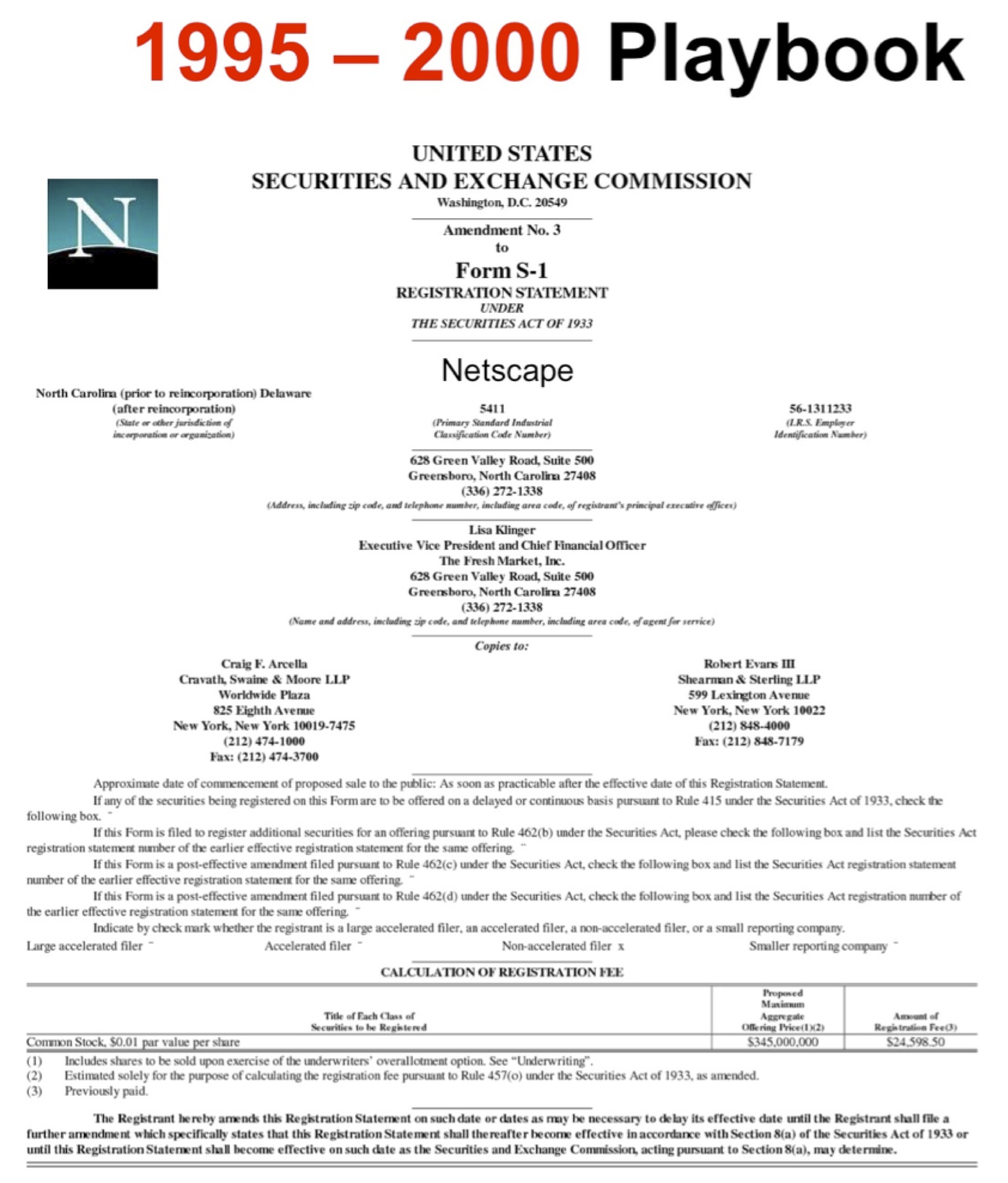
  • Dot.com Bubble (1995-2000):Anything goes” as public markets clamor for ideas, vague promises of future growth, and IPOs happen absent regard for history or profitability.
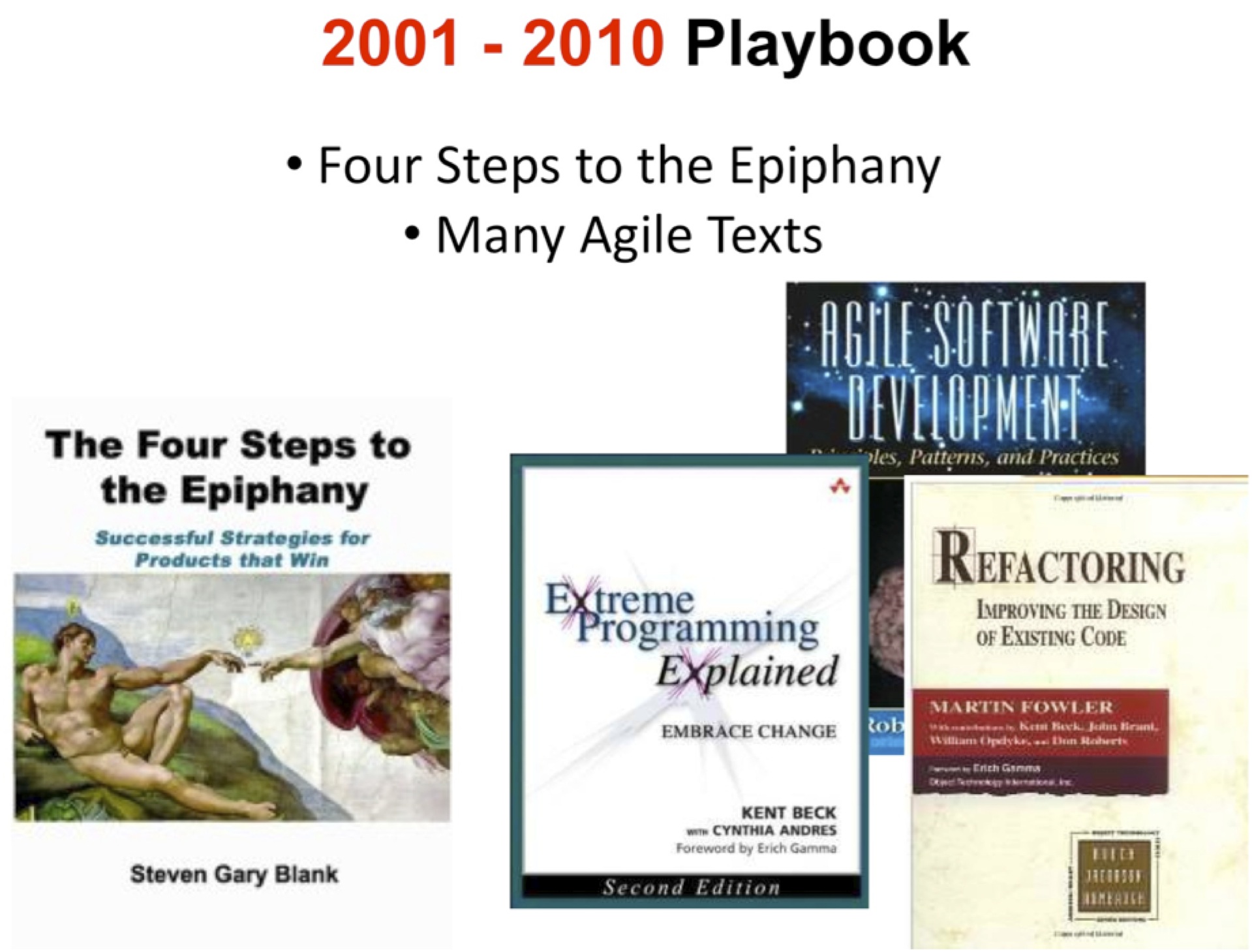
  • Lean Startups/Back to Basics (2000-2010): No IPO’s, limited VC cash, lack of confidence and funding fuels “lean startup” era with limited M&A and even less IPO activity.
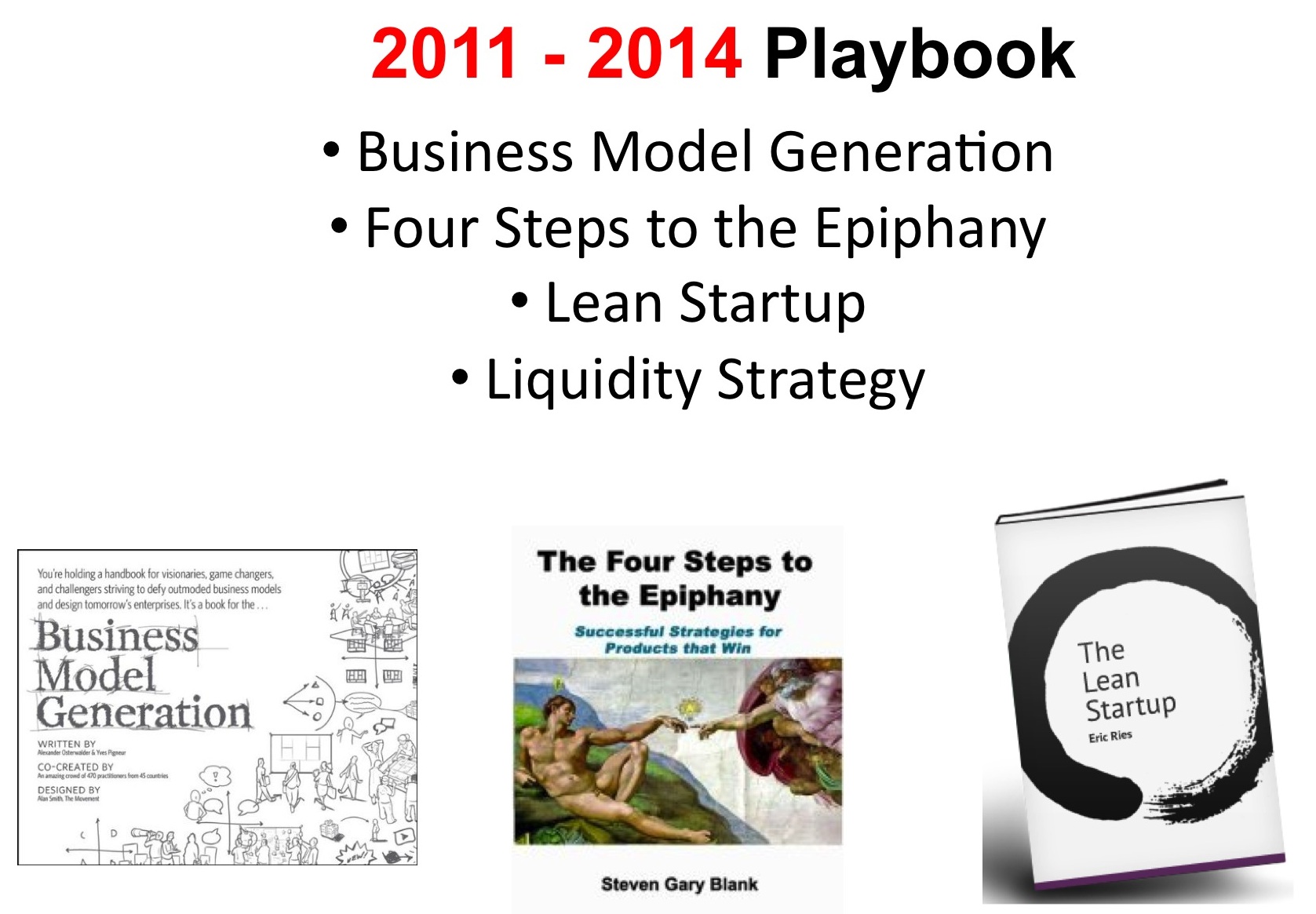
  • The New Bubble: (2011 – 2014): Here we go again….

(If you can’t see the slide presentation above, click here.)

If you “saw the movie” or know your startup history, and want to skip ahead click here.

1970 – 1995: The Golden Age
VC’s worked with entrepreneurs to build profitable and scalable businesses, with increasing revenue and consistent profitability – quarter after quarter. They taught you about customers, markets and profits. The reward for doing so was a liquidity event via an Initial Public Offering.

Startups needed millions of dollars of funding just to get their first product out the door to customers. Software companies had to buy specialized computers and license expensive software. A hardware startup had to equip a factory to manufacture the product. Startups built every possible feature the founding team envisioned (using “Waterfall development,”) into a monolithic “release” of the product taking months or years to build a first product release.

The Business Plan (Concept-Alpha-BetaFCS) became the playbook for startups. There was no repeatable methodology, startups and their VC’s still operated like startups were simply a smaller version of a large company.

The world of building profitable startups ended in 1995.

August 1995 – March 2000: The Dot.Com Bubble
With Netscape’s IPO, there was suddenly a public market for companies with limited revenue and no profit. Underwriters realized that as long as the public was happy snapping up shares, they could make huge profits from the inflated valuations. Thus began the 5-year dot-com bubble. For VC’s and entrepreneurs the gold rush to liquidity was on. The old rules of sustainable revenue and consistent profitability went out the window. VC’s engineered financial transactions, working with entrepreneurs to brand, hype and take public unprofitable companies with grand promises of the future. The goals were “first mover advantage,” “grab market share” and “get big fast.” Like all bubbles, this was a game of musical chairs, where the last one standing looked dumb and everyone else got absurdly rich.

Startups still required millions of dollars of funding. But the bubble mantra of get “big fast” and “first mover advantage” demanded tens of millions more to create a “brand.” The goal was to get your firm public as soon as possible using whatever it took including hype, spin, expand, and grab market share – because the sooner you got your billion dollar market cap, the sooner the VC firm could sell their shares and distribute their profits.

Just like the previous 25 years, startups still built every possible feature the founding team envisioned into a monolithic “release” of the product using “Waterfall development.” But in the bubble, startups got creative and shortened the time needed to get a product to the customer by releasing “beta’s” (buggy products still needing testing) and having the customers act as their Quality Assurance group.

The IPO offering document became the playbook for startups. With the bubble mantra of “get big fast,” the repeatable methodology became “brand, hype, flip or IPO”.

2001 – 2010: Back to Basics: The Lean Startup
After the dot.com bubble collapsed, venture investors spent the next three years doing triage, sorting through the rubble to find companies that weren’t bleeding cash and could actually be turned into businesses. Tech IPOs were a receding memory, and mergers and acquisitions became the only path to liquidity for startups. VC’s went back to basics, to focus on building companies while their founders worked on building customers.

Over time, open source software, the rise of the next wave of web startups, and the embrace of Agile Engineering meant that startups no longer needed millions of dollars to buy specialized computers and license expensive software – they could start a company on their credit cards. Customer Development, Agile Engineering and the Lean methodology enforced a process of incremental and iterative development. Startups could now get a first version of a product out to customers in weeks/months rather than months/years. This next wave of web startups; Social Networks and Mobile Applications, now reached 100’s of millions of customers.

Startups began to recognize that they weren’t merely a smaller version of a large company. Rather they understood that a startup is a temporary organization designed to search for a repeatable and scalable business model. This meant that startups needed their own tools, techniques and methodologies distinct from those used in large companies. The concepts of Minimum Viable Product and the Pivot entered the lexicon along with Customer Discovery and Validation.

The playbook for startups became the Agile + Customer Development methodology with The Four Steps to the Epiphany and Agile engineering textbooks.

Rules For the New Bubble: 2011 -2014
The signs of a new bubble have been appearing over the last year – seed and late stage valuations are rapidly inflating, hiring talent in Silicon Valley is the toughest since the last bubble and investors are starting to openly wonder how this one will end.

Breathtaking Scale
The bubble is being driven by market forces on a scale never seen in the history of commerce. For the first time, startups can today think about a Total Available Market in the billions of users (smart phones, tablets, PC’s, etc.) and aim for hundreds of millions of customers. And those customers may be using their devices/apps continuously. The revenue, profits and speed of scale of the winning companies can be breathtaking.

The New Exits
Rules for building a company in 2011 are different than they were in 2008 or 1998. Startup exits in the next three years will include IPO’s as well as acquisitions. And unlike the last bubble, this bubble’s first wave of IPO’s will be companies showing “real” revenue, profits and customers in massive numbers. (Think Facebook, Zynga, Twitter, LinkedIn, Groupon, etc.)  But like all bubbles, these initial IPO’s will attract companies with less stellar financials, the quality IPO pipeline will diminish rapidly, and the bubble will pop. At the same time, acquisition opportunities will expand as large existing companies, unable to keep up with the pace of innovation in these emerging Internet markets, will “innovate” by buying startups. Finally, new forms of liquidity are emerging such as private-market stock exchanges for buying and selling illiquid assets (i.e. SecondMarket, SharesPost, etc.)

Tools in the New Bubble
Today’s startups have all the tools needed for a short development cycle and rapid customer adoption – Agile and Customer Development plus Business Model Design.

The Four Steps to the Epiphany, Business Model Generation and the Lean Startup movement have become the playbook for startups. The payoff: in this bubble, a startup can actively “engineer for an acquisition.” Here’s how:

Order of Battle
Each market has a finite number of acquirers, and a finite number of deal makers, each looking to fill specific product/market holes. So determining who specifically to target and talk to is not an incalculable problem. For a specific startup this list is probably a few hundred names.

Wide Adoption
Startups that win in the bubble will be those that get wide adoption (using freemium, viral growth, low costs, etc) and massive distribution (i.e. Facebook, Android/Apple App store.) They will focus on getting massive user bases first, and let the revenue follow later.

Visibility
During the the Lean Startup era, the advice was clear; focus on building the company and avoid hype. Now that advice has changed. Like every bubble this is a game of musical chairs. While you still need irrational focus on customers for your product, you and your company now need to be everywhere and look larger than life. Show and talk at conferences, be on lots of blogs, use social networks and build a brand. In the new bubble PR may be your new best friend, so invest in it.

Lessons Learned

  • We’re in a new wave of startup investing – it’s the beginning of another bubble
  • Rules for liquidity for startups and investors are different in bubbles
  • Pay attenton to what those rules are and how to play by them
  • Unlike the last bubble this one is not about selling “vision” or concepts.
  • You have to deliver. That requires building a company using Agile and Customer Development
  • Startups that master speed, tempo and Pivot cycle time will win

Listen to this post here: Download the post here

A Visitors Guide to Silicon Valley

If you’re a visiting dignitary whose country has a Gross National Product equal to or greater than the State of California, your visit to Silicon Valley consists of a lunch/dinner with some combination of the founders of Google, Facebook, Apple and Twitter and several brand name venture capitalists. If you have time, the President of Stanford will throw in a tour, and then you can drive by Intel or some Clean Tech firm for a photo op standing in front of an impressive looking piece of equipment.

The “official dignitary” tour of Silicon Valley is like taking the jungle cruise at Disneyland and saying you’ve been to Africa. Because you and your entourage don’t know the difference between large innovative companies who once were startups (Google, Facebook, et al) and a real startup, you never really get to see what makes the valley tick.

If you didn’t come in your own 747, here’s a guide to what to see in the valley (which for the sake of this post, extends from Santa Clara to San Francisco.) This post offers things to see/do for two types of visitors: I’m just visiting and want a “tourist experience” (i.e. a drive by the Facebook / Google / Zynga / Apple building) or “I want to work in the valley” visitor who wants to understand what’s going on inside those buildings.

I’m leaving out all the traditional stops that you can get from the guidebooks.

Hackers’ Guide to Silicon Valley
Silicon Valley is more of a state of mind than a physical location. It has no large monuments, magnificent buildings or ancient heritage. There are no tours of companies or venture capital firms. From Santa Clara to South San Francisco it’s 45 miles of one bedroom community after another. Yet what’s been occurring for the last 50 years within this tight cluster of suburban towns is nothing short of an “entrepreneurial explosion” on par with classic Athens, renaissance Florence or 1920’s Paris.

California Dreaming
On your flight out, read Paul Graham’s essays and Jessica Livingston’s Founders at Work. Then watch the Secret History of Silicon Valley and learn what the natives don’t know.

Palo Alto – The Beating Heart 1
Start your tour in Palo Alto. Stand on the corner of Emerson and Channing Street in front of the plaque where the triode vacuum tube was developed. Walk to 367 Addison Avenue, and take a look at the HP Garage. Extra credit if you can explain the significance of both of these spots and why the HP PR machine won the rewrite of Valley history.

Walk to downtown Palo Alto at lunchtime, and see the excited engineers ranting to one another on their way to lunch. Cram into Coupa Café full of startup founders going through team formation and fundraising discussions. (Noise and cramped quarters basically force you to listen in on conversations) or University Café or the Peninsula Creamery to see engineers working on a startup or have breakfast in Il Fornaio to see the VC’s/Recruiters at work.

Stanford – The Brains
Drive down University Avenue into Stanford University as it turns into Palm Drive. Park on the circle and take a walking tour of the campus and then head to the science and engineering quad. Notice the names of the buildings; Gates, Allen, Moore, Varian, Hewlett, Packard, Clark, Plattner, Yang, Huang, etc. Extra points if you know who they all are and how they started their companies. You too can name a building after your IPO (and $30 million.) Walk by the Terman Engineering building to stand next to ground zero of technology entrepreneurship. See if you can find a class being taught by Tom Byers, Kathy Eisenhardt, Tina Seelig or one of the other entrepreneurship faculty in engineering.

Attend one of the free Entrepreneurial Thought Leader Lectures in the Engineering School. Check the Stanford Entrepreneurship Network calendar or the BASES calendar for free events. Stop by the Stanford Student Startup Lab and check out the events at the Computer Forum.  If you have time, head to the back of campus and hike up to the Stanford Dish and thank the CIA for its funding.

Mountain View – The Beating Heart 2
Head to Mountain View and drive down Amphitheater Parkway behind Google, admiring all the buildings and realize that they were built by an extinct company, Silicon Graphics, once one of the hottest companies in the valley (Shelley’s poem Ozymandias should be the ode to the cycle of creative destruction in the valley.) Next stop down the block is the Computer History Museum. Small but important, this museum is the real deal with almost every artifact of the computing and pre-computing age (make sure you check out their events calendar.) On leaving you’re close enough to Moffett Field to take a Zeppelin ride over the valley. If it’s a clear day and you have the money after a liquidity event, it’s a mind-blowing trip.

Next to Moffett Field is Lockheed Missiles and Space, the center of the dark side of the Valley. Lockheed came to the valley in 1956 and grew from 0 to 20,000 engineers in four years. They built three generations of submarine launched ballistic missiles and spy satellites for the CIA, NSA and NRO on assembly lines in Sunnyvale and Palo Alto. They don’t give tours.

While in Mountain View drive by the site of Shockley Semiconductor and realize that from this one failed company, founded the same year Lockheed set up shop, came every other chip company in Silicon Valley.

Lunch time on Castro Street in downtown Mountain View is another slice of startup Silicon Valley. Hang out at the Red Rock Café at night to watch the coders at work trying to stay caffeinated. If you’re still into museums and semiconductors, drive down to Santa Clara and visit the Intel Museum.

Sand Hill Road – Adventure Capital
While we celebrate Silicon Valley as a center of technology innovation, that’s only half of the story. Startups and innovation have exploded here because of the rise of venture capital. Think of VC’s as the other equally crazy half of the startup ecosystem.

You can see VC’s at work over breakfast at Bucks in Woodside, listen to them complain about deals over lunch at Village Pub or see them rattle their silverware at Madera. Or you can eat in the heart of old “VC central” in the Sundeck at 3000 Sand Hill Road. While you’re there, walk around 3000 Sand Hill looking at all the names of the VC’s on the building directories and be disappointed how incredibly boring the outside of these buildings look. (Some VC’s have left the Sand Hill Road womb and have opened offices in downtown Palo Alto and San Francisco to be closer to the action.) For extra credit, stand outside one of the 3000 Sand Hill Road buildings wearing a sandwich-board saying “Will work for equity” and hand out copies of your executive summary and PowerPoint presentations.

Drive by the Palo Alto house where Facebook started (yes, just like the movie) and the house in Menlo Park that was Google’s first home. Drive down to Cupertino and circle Apple’s campus. No tours but they do have an Apple company store which doesn’t sell computers but is the only Apple store that sells logo’d T-shirts and hats.

San Francisco – Startups with a Lifestyle
Drive an hour up to San Francisco and park next to South Park in the South of Market area. South of Market (SoMa) is the home address and the epicenter of Web 2.0 startups. If you’re single, living in San Francisco and walking/biking to work to your startup definitely has some advantages/tradeoffs over the rest of the valley. Café Centro is South Park’s version of Coupa Café. Or eat at the American Grilled Cheese Kitchen. (You’re just a few blocks from the S.F. Giants ballpark. If it’s baseball season take in a game in a beautiful stadium on the bay.) And four blocks north is Moscone Center, the main San Francisco convention center. Go to a trade show even if it’s not in your industry.

The Valley is about the Interactions Not the Buildings
Like the great centers of innovation, Silicon Valley is about the people and their interactions. It’s something you really can’t get a feel of from inside your car or even walking down the street. You need to get inside of those building and deeper inside those conversations. Here’s a few suggestions of how to do so.

  • If you want the ultimate startup experience, see if you can talk yourself into carrying someone’s bags as they give a pitch to a VC.  Be a fly on the wall and soak it in.
  • If you’re trying to get a real feel of the culture, apply and interview for jobs in three Silicon Valley companies even if you don’t want any of them. The interview will teach your more about Silicon Valley company culture and the valley than any tour.
  • If you’re visiting to raise money or to get to know “angels” use AngelList to get connected to seed investors before you arrive.
  • Never leave.

Listen to the post here: Download the Podcast here