Entrepreneurs as Dissidents

Here’s to the crazy ones. The misfits. The rebels. The troublemakers. The round pegs in the square holes. The ones who see things differently. They’re not fond of rules. And they have no respect for the status quo. You can quote them, disagree with them, glorify or vilify them. About the only thing you can’t do is ignore them. Because they change things. They push the human race forward. While some may see them as the crazy ones, we see genius. Because the people who are crazy enough to think they can change the world, are the ones who do.

If you can’t see the video above click here.

Countries that put their artists and protesters in jail will never succeed in building a successful culture of entrepreneurship.  They will be relegated to creating better mousetraps or cloning other countries’ business models.

Entrepreneurs as Dissidents
When Steve Jobs returned to Apple, he ran the Think Different ads, a brilliant marketing campaign to make Apple’s core customers believe that Apple was still fighting for the brand.

But in hindsight, the ad captured something much more profound.

The crazy ones? The misfits? The rebels? The troublemakers? To celebrate those people as heroes requires a country and culture that tolerates and encourages dissent.

Because without dissent there is no creativity.

Countries that stifle dissent while attempting to encourage entrepreneurship will end up at a competitive disadvantage.

Pushing the boundaries
Most startups solve problems in existing markets – making something better than what existed before. Some startups choose to resegment a market – finding an underserved niche in an existing market or providing a good-enough low cost solution.  These are all good businesses, and there’s nothing wrong with founding one of these.

But some small segment of founders are truly artiststhey see something no one else does. These entrepreneurs are the ones who want to change “what is” and turn it into “what can be.“ These founders create new ideas and new markets by pushing the boundaries. This concept of creating something that few others see – and the reality distortion field necessary to recruit the team to build it – is at the heart of what these founders do.

The founders that make a dent in the universe are dissidents. They are not afraid to tell their bosses they are idiots or tell their schools they been teaching the wrong thing or to tell an entire industry to think different. And more importantly they are not afraid to tell their country it’s mistaken.

Freedom of Speech, Expression and Thought
Entrepreneurs in the United States take for granted our freedom of speech, freedom of expression and freedom of thought. It’s enshrined in our constitution as the first amendment.

In the last few years I’ve traveled to lots of countries that understand that the rise of entrepreneurship will be an economic engine for the 21st century. In several of these countries, the government is pouring enormous sums into building entrepreneurship programs, faculties and even cities. Yet time and again when I ask the local entrepreneurs themselves what questions they have, most often the first question is, “How do I get a visa to the United States?’

For years I thought the reason hands were raised was simply an economic one. The same countries that repress dissent tend to have institutionalized corruption, meaning the quality of your idea isn’t sufficient enough to succeed by itself, you now need new “friends in the right places.” But I now see that these are all part of the same package. It’s hard to focus on being creative when a good part of your creative energies are spent trying to figure out how to work within a system that doesn’t tolerate dissent.

Lessons Learned

  • Entrepreneurs require the same creative freedom as artists and dissidents
  • Without that freedom, countries will be relegated to cloning others’ business models or creating better versions of existing products
  • History has shown that the most creative people leave repressive regimes and create elsewhere

Listen to the post here:

Download the Podcast here

10,000 Startups – Startup Weekend Next

Today we are announcing the biggest entrepreneurial program ever launched – Startup Weekend Next. A partnership of Startup WeekendStartup AmericaTechStars and UdacityStartup Weekend Next brings four weeks of amazing hands-on training learning to build your startup to cities around the world. Our goal– to inspire, educate and empower hundred’s of thousands of entrepreneurs and help create 10,000 startups.

The Lean LaunchPad Class
You may have read my previous posts about the Lean LaunchPad entrepreneurship class. The class teaches founders how to dramatically reduce their failure rate through the combination of business model design, customer development and agile development using the Startup Owners Manual. Just a crazy idea two years ago, the class is now taught at Stanford, Berkeley, Columbia, Caltech, Princeton and for the National Science Foundation at the University of Michigan and Georgia Tech.

And in the thirty days since we’ve put the Lean LaunchPad class online at Udacity50,000 students have been taking it.

While the Lean LaunchPad online has received rave reviews (it’s being translated into Spanish, French, Russian, Japanese and Greek, and it’s being used as part of a “flipped classroom” in other entrepreneurship courses), it’s different than taking the class in person. It doesn’t require you to form a team, and there’s no immediate instructor feedback. More importantly, it makes no demands of you to stand and deliver your weekly customer development progress in front of your peers. In sum, it lacks the rigorous and collaborative hands-on experience that entrepreneurs get in our university classes.

We thought long and hard about how we could take the Lean LaunchPad Online to the next level and deliver the same level of experiential instruction to tens and hundreds of thousands of entrepreneurs around the world.

The result – Startup Weekend Next.

Hands-On in 100’s of Cities
Startup Weekend Next is a four-week version of the Lean LaunchPad class with hands-on instructors and mentors – and we will teach it in hundreds of cities around the world.

I’m partnered with four great organizations to deliver the program. The class is organized, led and delivered by Startup Weekend, the global non-profit that teaches entrepreneurs how to launch a startup in 54 hours. They’ve hosted close to 800 Startup Weekend events in over 350 cities worldwide educating a staggering 57,000 entrepreneurs who’ve created over 5,000 startups. Today they are going to take Startup Weekend to the next level by organizing and teaching a four-week version of the Lean LaunchPad class as their Startup Weekend Next course. Their reach and scale means our goal of helping to create 10,000 startups is within our grasp.

(If you can’t see the video above click here.)

In addition, the leading experts in building entrepreneurial companies and regions, TechStars and Startup America are partnering with us in this endeavor.

In the U.S, Startup America will leverage its network of 30 startup regions to engage entrepreneurial leaders throughout the country. And TechStars will use its broad and unparalleled network of mentors (experienced entrepreneurs and investors) to coach the teams. And Udacity has put their awesome production resources behind the class and hosts the Lean LaunchPad online lectures.  And we are looking for other partners worldwide to help make this successful.

The first four-week Startup Weekend Next classes will start on Nov. 28 in more than 25 cities worldwide. The program expands to all of Startup Weekend’s 350 member communities in 2013 where it will be offered up to five times a year in each city.

The cost of attending a Startup Weekend Next is ridiculously inexpensive. It doesn’t take equity and just has a small fee that varies by city ($140 to $299), to cover event operations and expenses.

How it Works
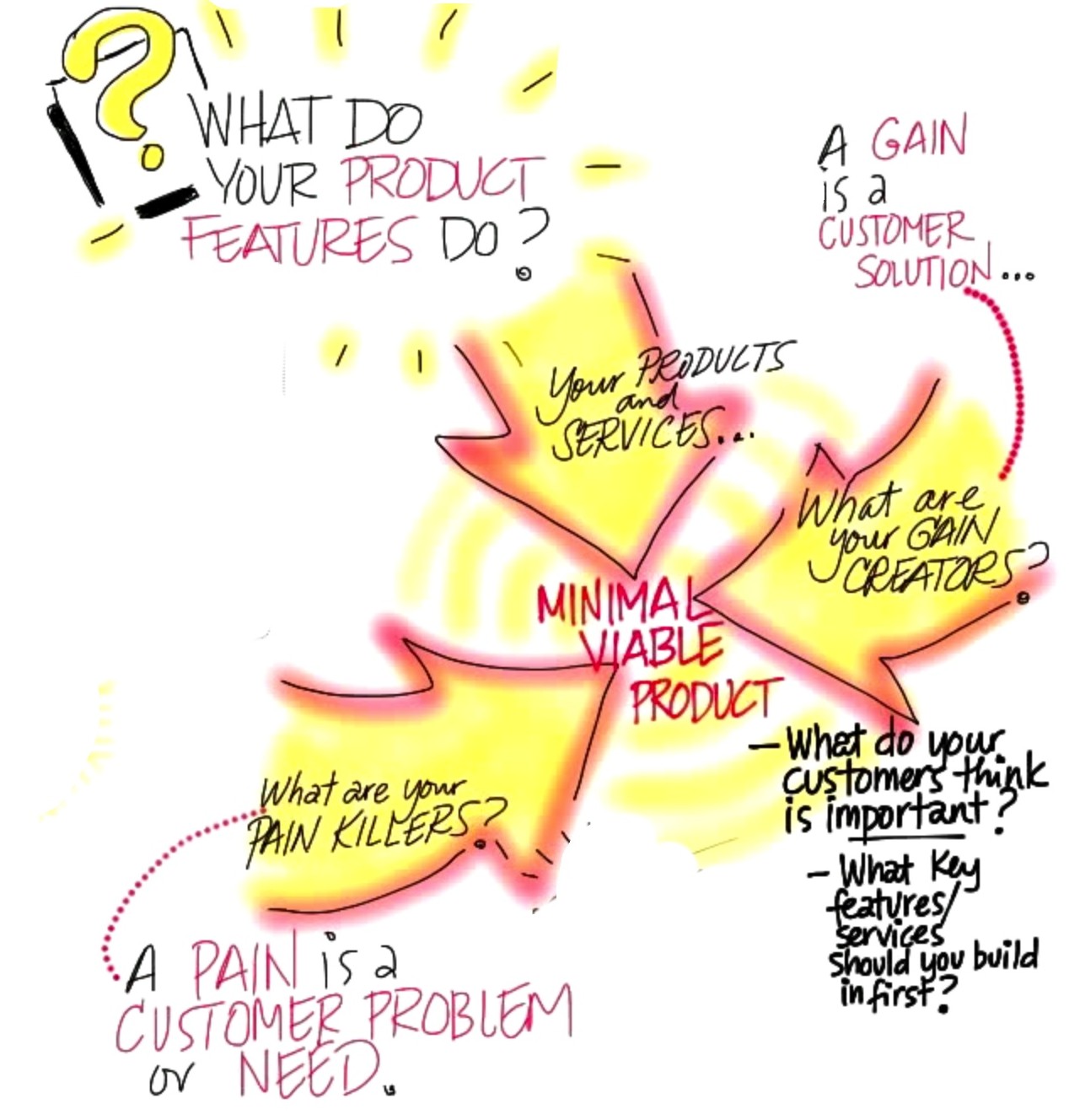
We now know how to crack the entrepreneurial code by creating an Entrepreneurship API – a standard language for entrepreneurs. When you leave the class, you’ll know how to think about your startup in the now standard  “language” of the business model canvas. You’ll understand the customer development process used to test those hypotheses and learn how to iterate or pivot when your hypotheses need to change.  And you’ll learn about how to build a minimal viable product to get feedback early and often from customers.

Here’s how the four intense weeks in a Startup Weekend Next class works.

  • You form a startup team (if you don’t have one, taking the 54-hour Startup Weekend class is a great a way to find one) and come into class with an initial idea
  • Your team arrives with an initial Business Model Canvas. (Your pre-class reading is to watch the Lean LaunchPad initial lectures on Udacity)
  • You present your hypotheses and what you learned in front of your peers and coaches
  • Your team gets live coaching and advice from Startup Weekend Next mentors.
  • You’ll take the suggestions from the meeting, get out of the building and talk to ten plus customers per week.
  • You’ll refine your business model by iterating or pivoting your product, your target customers, pricing, channels, partners, etc.
  • Repeat for four weeks– all while working with volunteer mentor partners from Startup Weekend, Startup America and TechStars – serial entrepreneurs and seasoned startup investors – to see whether your business idea was truly a vision or simply a hallucination.

The Big Idea – Incubators – Accelerators – and Something New
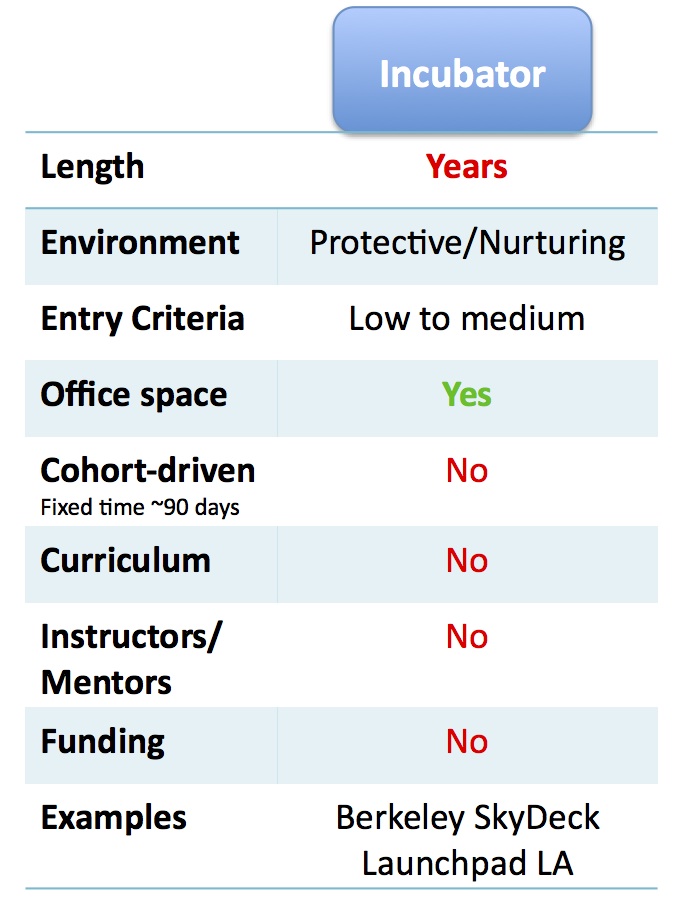
In the last decade startup incubators have become increasingly popular. These incubators which provides new startups with year-round physical office space, infrastructure and advice in exchange for a fee (often in equity.)  They may be privately run but often are non-profit, attached to a university or in some locations a local government.  There is no formal “start date” so there is a no fixed time for their stay. (For some incubators, entrepreneurs can stay as long as they want.) There is no curriculum and seldom any formal instructors or mentors. There is no guaranteed funding. Think of incubators as “shelter from the storm.”

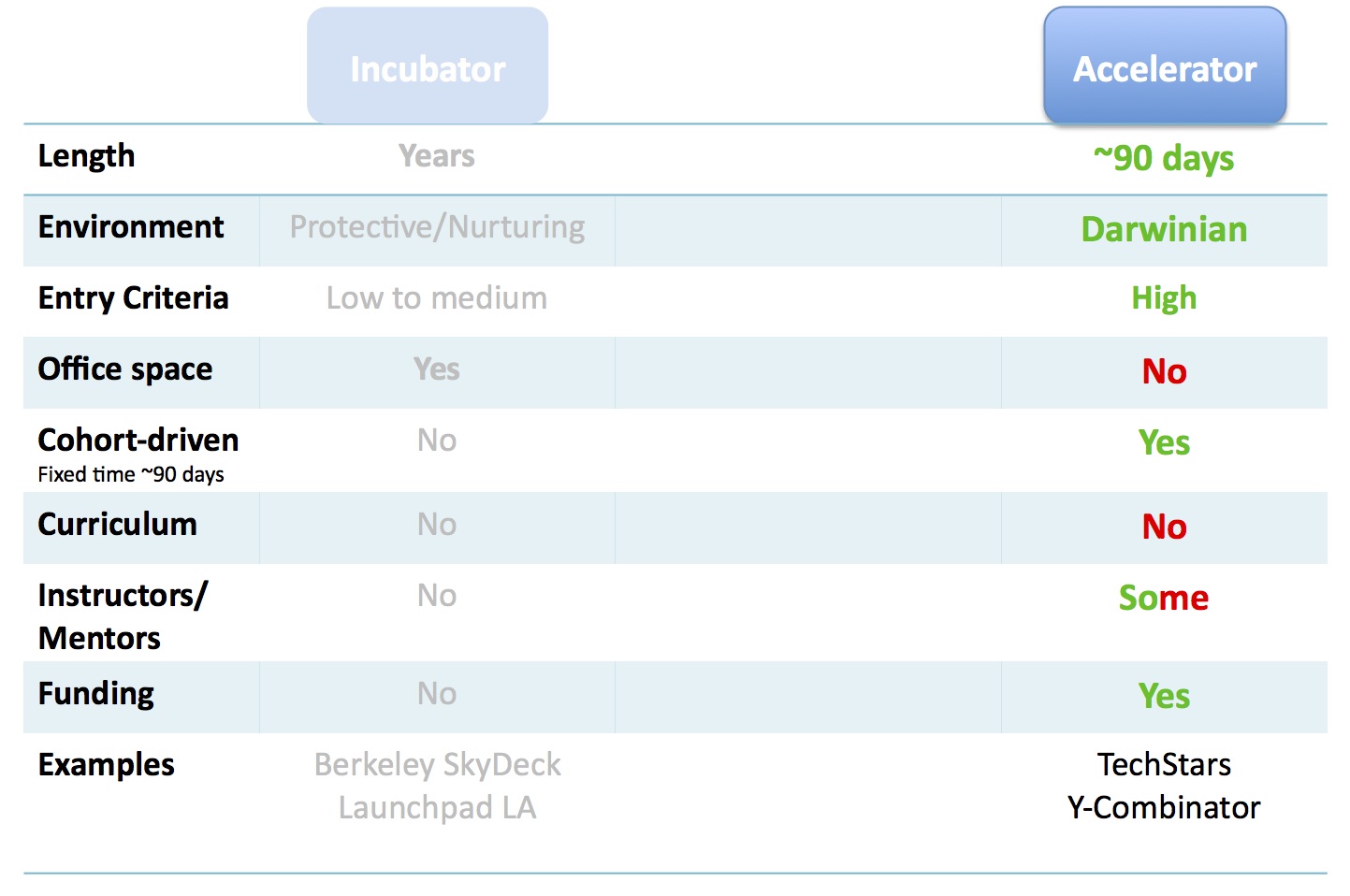
In contrast, the goal of an accelerator is not physical office space, it’s a fundable company. Startups enter and leave as a cohort (starting and ending the program at the same time) in a program of a set length. While there is no formal curriculum, most offer weekly expert lectures, experienced mentors, coaching and introductions.  Accelerators provide funding at the end of the program.  Getting into an accelerator is more competitive than grad school.

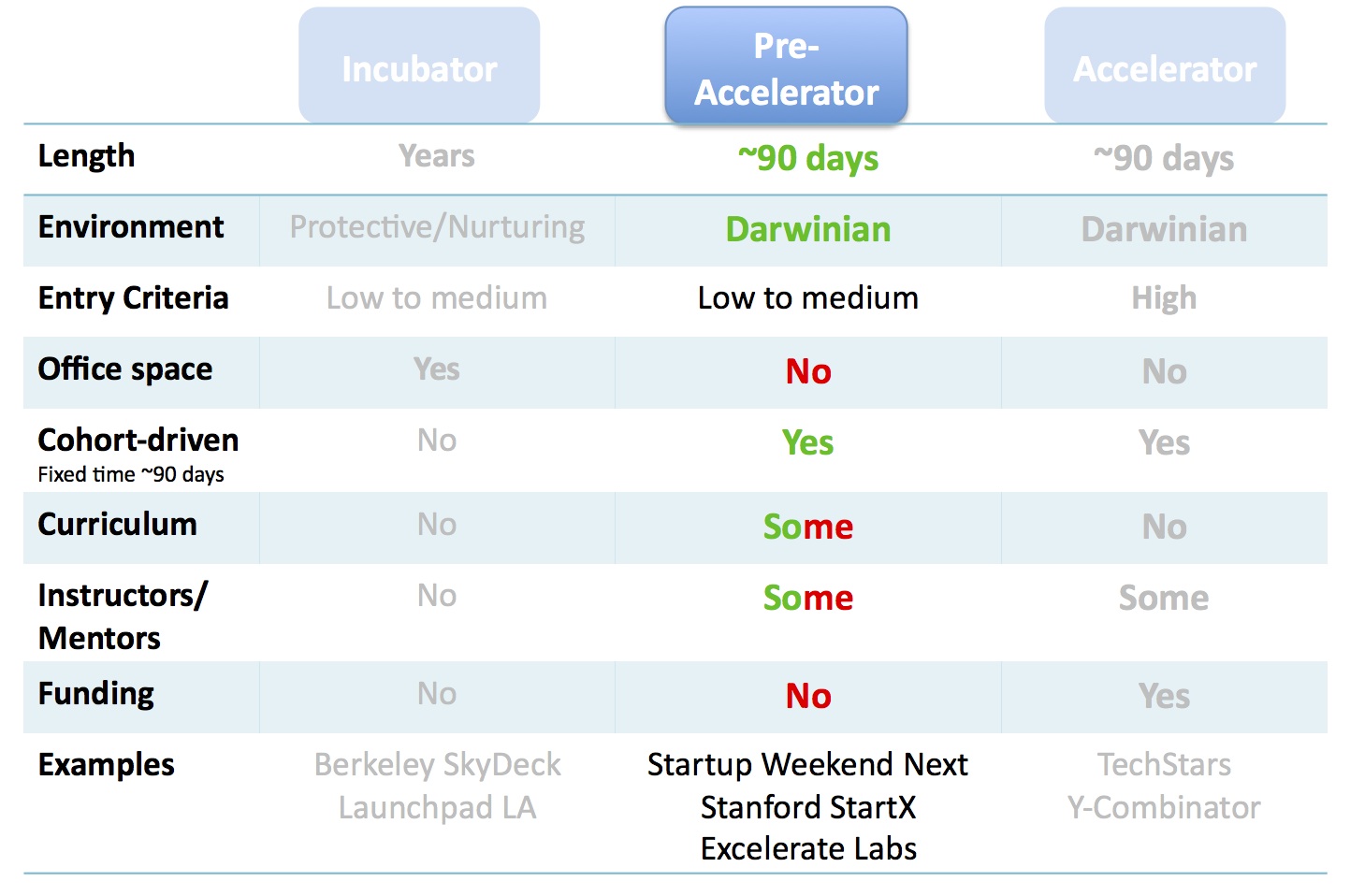
Startup Weekend Next represents something new – a pre-accelerator.

Like an accelerator there is no physical office space, and startups enter and leave as a cohort in a program of a set length. But the key difference is that Startup Weekend Next engages you in a formal curriculum. We believe we know what startups need to learn, and we focus on teaching you that. Instead of guest lecturers, you get out of the building and you learn by doing. Like the best accelerators, you get experienced mentors, coaching and introductions. Unlike accelerators, there is no funding at the end of the program.  But you leave knowing a lot more of what it takes to build a company beyond a PowerPoint deck for a VC presentation.

Lessons Learned

If you have passion, an idea and a team, and you want to take advantage of the most advanced entrepreneurial training program, sign up at Startup Weekend Next

and wait until you see what we do next.
Listen to the post here: Download the Podcast here

10,000 Startups

In 24 hours we’ll announce something revolutionary.

Moving entrepreneurship forward.

How We Fight – Cofounders in Love and War

I often get asked about finding cofounders and I usually give the standard list of characteristics of what I look for in a founder.  And I emphasize the value of a founding team with complementary skills sets – i.e. the hacker/hustler/designer cofounder archetype for web/mobile apps.  But Jessica Alter, Cofounder & CEO of FounderDating, pointed out that cofounders did not mean two founders in the same room.  She suggested that I was missing one of the key attributes of what makes successful startup teams powerful. She suggested that how cofounders fight was a key metric in predicting the success of a founding team.  So I asked her to write a guest post.

——————

I think about [cofounding] teams a lot – an insane amount.  And, not surprisingly, I frequently get asked what to look for or what to think about when starting the process of finding a cofounder – a true partner to start your next company with.

Like second nature, I start to recite a list of important attributes: complimentary skill sets, common visions, the notion of not trying to make someone fall in love with your idea (because the idea will likely change and then where are you?).  There are plenty more and they are important. But a few weeks ago after I sat on a panel about cofounders at Startup2Startup there was a small group dinner conversation to dig deeper on the topic.  Garry Tan (Posterous, YC), in recounting his personal experience said, “success can cover up a lot.”

And it clicked in my head – one of the key things to pay attention to in a search for a cofounder is how you fight.

Taking Time
How you fight with your potential cofounder(s) matters for a lot of reasons, the simplest of which is that you have time to fight – meaning you’ve worked together long enough to hit disagreements or bumps.  It’s one of the most common mistakes we see. I literally just received an email from someone (that I don’t know) asking to me to meet with them so that they can circumvent our regular process because, “I don’t feel like I have time for the regular FounderDating process.“  Quick advice to people that think finding a cofounder is a box to check and “don’t have time” – you won’t find someone and if you do the relationship is unlikely to last.  You’re looking for an employee, not a partner.

We tell all our FounderDating members that we’re a great starting point to connect with amazing people all with high intent to start something. But in order to figure out if you can work together you have to (wait for it…) actually work together.  That could be starting a side-project, heading over to a Startup Weekend or other hackathon, working full-time for a few months or some combination of those options.  However you do it, you need to build something together.  It doesn’t ultimately matter it if ends up being the right product, you will still have areas you disagree on throughout the process. Ask yourself: Have we had disagreements? If you haven’t, maybe you should consider a longer courtship period.

Simulating Real-Life
Consider what real startup life is going to be like.  For a long-time (longer than you plan) things are not going to work and you’ll have to figure out what to do – together.  If you do eventually reach a point where the company is making real progress, you’re still going hit crazy challenges on a regular basis that you’ll have to navigate together. This pressure – which is compounded by the sound of the ticking clock if you took money – will up the stress levels and hence the propensity to disagree.

If you don’t have at least a taste of what that’s going to be like, not only have you not done your homework, but also could be in for a rude awakening. So, let’s agree you’re going to fight. That, in and of itself, doesn’t mean anything. In fact, it’s quite healthy. What matters in real life is what are the fights like? Do they escalate rapidly or become knock down, drag outs? Can you recover quickly and keep moving? Entrepreneurship and early stage companies are about moving fast; if you’re caught in a disagreement for days at a time it means decisions are not being made and/or people are walking around feeling resentful.  Either one will eventually lead to failure.  Ask yourself: When we fight do we get over it quickly and respectfully?

What Are You Fighting About?
Finally, and this is insanely important, it matters what the fights are about.  Are you fighting about whether a button should be green or blue or are you fighting about whether or not you want to raise money?

A lot of people approach finding cofounders as just a skill set need and believe once that box is checked, everything will be smooth sailing. Complimentary skill sets are important and if you’re fighting about one functional area  (e.g. design, product) it might be a sign you have too much skill set overlap. But if it were just about complimentary skill set matching it wouldn’t be very hard.

What’s difficult is making sure you’re aligned on the softer side: Why do you want to build a company? What kind of company you want to build? What are your working styles? What are your values?  What are your other priorities (family, etc.)?  We don’t care if entrepreneurs want to build lifestyle businesses or go for IPOs, if they are tethered to their email or check out at 7pm – that’s a personal decision. But you better make sure you’re on the same page as your potential cofounder about those topics. These are the issues that break up relationships, not button colors.

Ask yourself: What are we fighting about and why?

Make no mistake; I’m not suggesting you should manufacture a fight. But every relationship has ups and downs, the ones that last are able to bounce back from the downs quickly and respectfully and be better for it.  So give yourselves permission and time to fight and reflect on how you do it before you take the leap together.
Listen to the post here: Download the Podcast here

How to Get a VC Meeting – the flowchart

I often get asked, “how do I get a meeting with a VC?”  Here is my slightly tongue-in-cheek view.


Why Too Many Startups (er) Suck

This is a guest post by my Startup Owner’s Manual co-author Bob Dorf.

——————-

While statistics are weak on startup success rates, the worst one I’ve seen suggests that 2 in 1000 venture backed startups will ever achieve $100-million or more in valuation. Another stat puts that number at 2% rather than 0.2%.  Either way, the “hurdle” for successful, scalable startups is high, and it gets higher every day as customer acquisition challenges continue to increase.

I’ve spent more than four decades founding, coaching, teaching and investing in startups, and nothing breaks my heart more than meeting a starry-eyed founder who says “we’re almost ready to show it to people.”  The “it” is a physical or web product they’ve often been locked-down, pounding away at, for many weeks.

In my view, this is the nastiest of all startup sins: failing to involve customers and their feedback from literally the first day of a startup’s life, keeping the most vital opinions silent—those of the eventual customers—for far longer than necessary.

When I hear this comment, as I do far too often, I switch to pleading mode: “Please.  Take a week. Get some feedback. Does anybody really care, or are they giving you polite nods and little more.  This generally leads to the second biggest reason too many startups suck: they’re solving a non-problem.

Does anybody care? Many Startup Owner’s Manual readers ask why Steve Blank and I are adamant that Customer Discovery happen in two separate, distinct phases: “problem” discovery and, later, “solution” discovery. There’s just no other way but, as Steve Blank has said for a decade, to “get out of the building” and talk to the only folks who matter—your customers.

Building a solution to a problem of moderate or lukewarm interest to users is a long-term death sentence for startups, where founders will almost certainly commit to 20,000 hours of their lives(or 5 years of 80-hour workweeks) in order to “beat the odds” and deliver a breakout success: a sustainable, scalable, profitable business.

Why, then, are so many founders so reluctant to invest even 500 or 1,000 hours upfront to be sure that, when they’re done, the business they’re building will face genuine, substantial demand or enthusiasm.  Without passionate customers, even the most passionate entrepreneur will flounder at best.  Dropbox is a great example. It scaled like lightning by solving an urgent, painful problem for millions of consumers. The product is so good, helpful, and easy to use that it literally almost does its own marketing organically through the product’s viral nature, just as Hotmail and Gmail have done since inception.

What’s the honest trajectory?  There can only be one Mark Zuckerberg, and at last look he’s young and healthy.  Can every startup skyrocket like Facebook or Square or Google? It’s downright impossible.  The solution: understand your startup’s “honest trajectory” and align objectives of the founding team and—importantly—its investors to define and agree about what “success” looks like.  Thousands of entrepreneurs would be a lot happier if their focus was a solid, growable, defensible niche business that might never go public or be worth $100-million.  There’s a ton of money to be made “in the middle,” a broad swath between struggling or gasping for cash and ringing the bell at the NASDAQ.

Find the right trajectory for your business and focus not only on reaching it, but on assuring that the result is a sustainable, repeatable profit engine that can perform and grow healthily over time. Use Customer Development to identify and refine the potential profitable niche and stay in close contact with customers as you build, to be sure you’re building something they’ll want to have…and keep.

Stand Out in the Crowd: If you’re solving an important problem, make sure your solution stands out in the crowd.  Hundreds of entrepreneurs I’ve met never spent an entire day Googling their industry, other ways to solve “their” problem, and few have spent time “playing consumer,” trying to find “their” own product, or one like it, and creating a “market map” that assesses all the competitive solutions, their strengths/weaknesses, and where the new product fits clearly and distinctly in its competitive environment.  If you can’t figure this out on your own, and relate it to customers succinctly, it’s a certainty that your customers never will.

Going Forward is NOT About Standing Still:  Another of my high-frequency “sad” moments happens when visiting with a team that is consistently “flatlining,” or delivering minimal or trivial user growth week after week or worse.  Clearly, something’s horribly wrong, and everyone just keeps showing up, doing their jobs, without attacking the core problem that’s almost always a lack of palpable customer enthusiasm.  What’s the point? What are they waiting for? It’s time to bring the leadership team into a room, dissect each key element of the business model, and identify pivots that are worth exploring smartly—where else—with customers.

Going Forward Is Often About Going Backward First:  Entrepreneurs pride themselves in their problem-solving abilities, tenacity, and willingness to run through brick walls to make things “go.”  More often than not, the DNA strand that makes entrepreneurs great is the one that’s their undoing when confronted with “flatlining” user adoption, growth, referrals, or frequency.  These entrepreneurs need to switch smartly out of “do” mode and return to the earliest “discovery” steps to find a distinctive, exciting solution to a seriously painful customer need or problem.

It’s the only way to make a startup not suck.
Listen to this post here: Download the Podcast here

The Lean LaunchPad Online

You may have read my previous posts about the Lean LaunchPad class taught at Stanford, Berkeley, Columbia, Caltech and for the National Science Foundation.

Now you too can take this course.

I’ve worked with the Udacity, the best online digital university on a mission to democratize education, to produce the course. They’ve done an awesome job.

The course includes lecture videos, quizzes and homework assignments. Multiple short video modules make up each 20-30 minute Lecture. Each module is roughly three minutes or less, giving you the chance to learn piece by piece and re-watch short lesson portions with ease. Quizzes are embedded within the lectures and are meant to let you check-in with how completely you are digesting the course information. Once you take a quiz, which could be a multiple-choice quiz or a fill in the blank quiz, you will receive immediate feedback.

Sign up here

——–

Why This Class?

Ten years ago I started thinking about why startups are different from existing companies.  I wondered if business plans and 5-year forecasts were the right way to plan a startup.  I asked, “Is execution all there is to starting a company?”

Experienced entrepreneurs kept finding that no business plan survived first contact with customers. It dawned on me that the plans were a symptom of a larger problem: we were executing business plans when we should first be searching for business models. We were putting the plan before the planning.

So what would a search process for a business model look like? I read a ton of existing literature and came up with a formal methodology for search I called Customer Development.

That resulted in a new process for Search: Customer Development + traditional product management/Waterfall Engineering. It looked like this:

This meant that the Search for a business model as a process now could come before execution. So I wrote a book about this called the Four Steps to the Epiphany.

And in 2003 the Haas Business School at U.C. Berkeley asked me to teach a class in Customer Development.  With Rob Majteles as a co-instructor, I started a tradition of teaching all my classes with venture capitalists as co-instructors.

In 2004 I funded IMVU, a startup by Will Harvey and Eric Ries. As a condition of my investment I insisted Will and Eric take my Customer Development class at Berkeley. Having Eric in the class was the best investment I ever made. Eric’s insight was that traditional product management and Waterfall development should be replaced by Agile Development.  He called it the “Lean Startup.”

Meanwhile, I had said startups were “Searching” for a business model, I had been purposefully a bit vague about what exactly a business model looked like. For the last two decades there was no standard definition.  That is until Alexander Osterwalder wrote Business Model Generation.

This book was a real breakthrough. Now we understood that the strategy for startups was to first search for a business model and then after you found it, put together an operating plan.

Now we had a definition of what it was startups were searching for. So business model design + customer and agile development is the process that startups use to search for a business model.

And the organization to implement all this was not through traditional sales, marketing and business development groups on day one. Instead the founders need to lead a customer development team.

And then to get things organized Bob Dorf and I wrote a book, The Startup Owners Manual that put all these pieces together.

But then I realized rather than just writing about it, or lecturing on Customer Development, we should have a hands-on experiential class. So my book and Berkeley class turned into the Lean LaunchPad class in the Stanford Engineering school, co-taught with two VC’s – Jon Feiber and Ann Miura-Ko. And we provided dedicated mentors for each team.

Then in the fall of 2011, the National Science Foundation read my blog posts on the Stanford version of the Lean LaunchPad class.  They said scientists had already made a career out of hypotheses testing, and the Lean LaunchPad was simply a scientific method for entrepreneurship. They asked if I could adapt the class to teach scientists who want to commercialize their basic research. I modified the class and recruited another great group of VC’s and entrepreneurs – Jim Hornthal, John Burke, Jerry Engel,Bhavik Joshi and Oren Jacob – to teach with me.

We taught the first two classes of 25 teams each, and then in March of 2012 trained faculty from Georgia Tech and the University of Michigan how to teach the class at their universities. Georgia Tech and the University of Michigan faculty then taught 54 teams each in July of this year and will teach another 54 teams in October.

We then added four more schools – Columbia, Caltech, Princeton and Hosei – where our team taught the Lean LaunchPad. We also developed a 5-day version of the class to complement the full semester and quarter versions.

Then last month we partnered with NCIIA and taught 62 college and university educators in our first Lean LaunchPad Educators Program.

And now we’ve spent weeks in the Udacity studio putting the lecture portion of the Lean LaunchPad class online.

Sign up and find out how to start a company!

Listen to the post here: Download the Podcast here

Vision versus Hallucination – Founders and Pivots

A founder’s skill is knowing how to recognize new patterns and to pivot on a dime. At times the pattern is noise, and the vision turns out to be a hallucination. Knowing how to sort between vision and  hallucination can avoid chaos inside your startup.

———

Yuri, one of my ex students started a big-data analytics company last year. He turned his PhD thesis into a killer product, got it funded and now was CEO of a company of 30. It was great to watch him embrace the spirit and practice of customer development. He was constantly in front of customers, listening, selling, installing and learning.

And that’s where the problem was.

I got to spend time inside his company while I was using their software to analyze early-stage ventures. What I saw reminded me of some of the best and worst things I did as a founder.

A Pivot a Week
It seemed like once a week Yuri would come back from a customer meeting brimming with new insights. “We’re building the wrong product!” he’d declare. “We got to pivot now.” Tossing their agile development process and at times their entire business model in the air, the company would go into fire-drill mode and engineering would start working on whatever his latest insight was.

Other weeks Yuri would be buffeted by the realities of his burn rate, declining bank account and depressing comments from customers. This time he’d be back in the building declaring “We’re going to be out of business in 3 months if we don’t get our act together.”  I even heard him say to a customer, “If we don’t get your order we’ll just have to close up in 90 days.”

As a consequence everyone was afraid to make a decision because they couldn’t guess what Yuri wanted to do that week. Some of the engineers figuring if the founder was declaring they were toast in 90 days were updating their resumes. The company already was gaining a reputation as one without a coherent strategy.

I cringed when I saw this – it sounded like me early in my career. I would come back from customer visits convinced that what I just learned was the “real” solution to the company’s future and havoc would reign.

Unfortunately for Yuri’s company, while there were three other founders, Yuri was the CEO and none of them had the stature to tell him that his “insights” were damaging his company.

So when we had a few minutes alone I offered Yuri that he was misusing the word “pivot” and confusing it with “whatever I feel like at the moment.” I said, “You got to realize you’re not just a smart engineer anymore; 30 people are dropping everything they’re doing when you make these pronouncements.”

Pivot as an excuse
I wasn’t surprised when he pushed back, “I’m just getting out of the building and listening to customers. All I’m doing is pivoting based on their feedback.”  By now I’ve heard this more times than I liked. “Yuri, one of the things that you make you a great founder is that you have insight others don’t. But like all great founders some of these insights are simply hallucinations. The problem is you and other founders want immediate action every time you have a new idea.”

“That’s a mistake.”

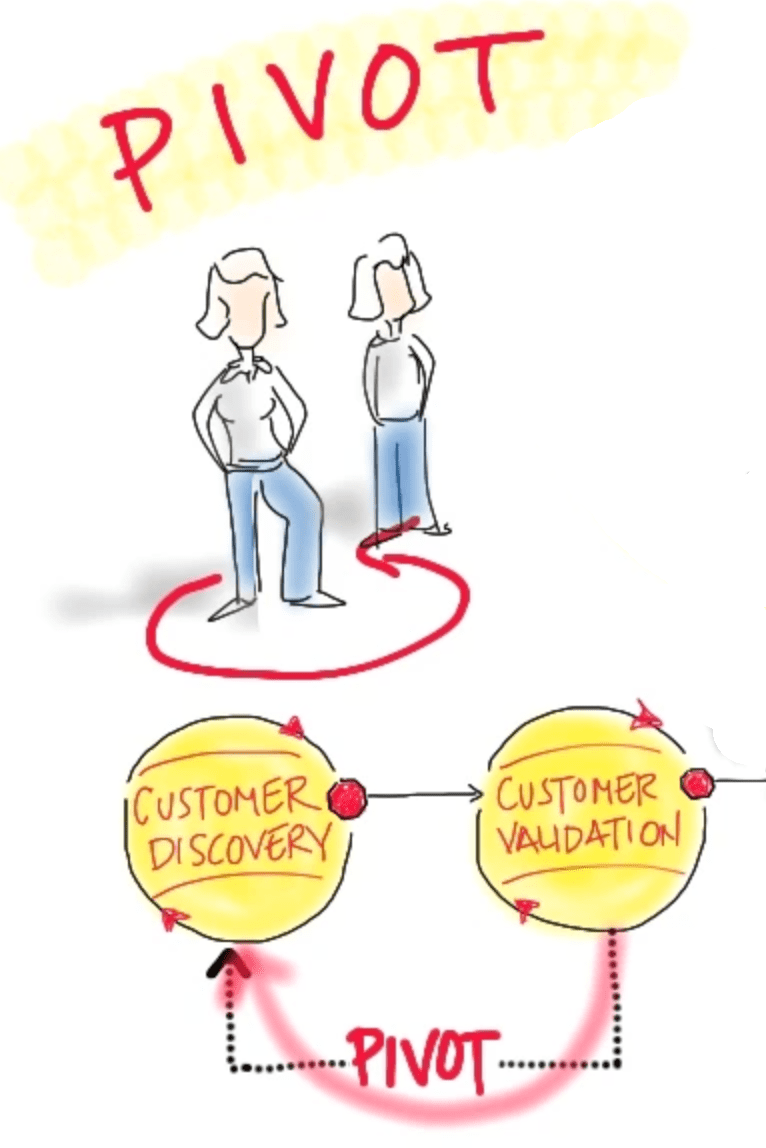
“A pivot is a substantive change to one or more of components to your business model. You’re using “Pivot” as an excuse to skip the hard stuff – keeping focused on your initial vision and business model and integrating what you’ve heard if and only if you think it’s a substantive improvement to your current business model. There is no possible way you can garner enough information to pivot based on one customers feedback or even 20. You need to make sure it’s a better direction than the one you are already heading in.”

Sit on it for awhile
I said, “Sit on your great insights for 72 hours and see if they still seem good after reflection. Better, during that time brainstorm them with someone you trust.  If not your co-founders, someone outside the company.”

I offered that at Epiphany, my partner Ben’s office was the first place I would go when I thought I had new “insights.” And we’d run them to the ground for days before we’d even let anyone else know. Most of the time after a few days of thought, these insights were really not much better than the current course the company was on. Or by then other customers would tell us something quite different. And the rule was we weren’t changing anything about the product architecture until Ben and I agreed. Which required Ben hearing from the same customers I did.

Change Value Proposition Last
Second, that he needed to recognize that changing the value proposition – the features of the products/services he was offering – was a lot more traumatic for a startup than changing other parts of the business model.

He should make sure that there aren’t other parts of the business model (revenue model, pricing, partners, channel, etc.) that couldn’t change before he declares “we’re building the wrong product.”

In searching for product/market fit (the right match between value proposition and customer segment) the product should be the last part you think of changing – not the first – as the cost of upending your product development organization is high.

And to make sure everyone knew what he was doing, he might want to consider letting the entire company know “don’t worry when I’m talking about changing our business model every week – it’s a natural part of searching – only worry if I ask you to change the value proposition every month.”

Find a Brainstorm Buddy
Finally, I suggested that he find someone he respects on his advisory board, who he was comfortable brainstorming with and would tell him when he has a bad idea.

Yuri sat quietly for awhile. I wasn’t sure he had heard a thing I said, until he said “Wait 72 hours? I can do that.  Now can I call you when I have a hot new idea?

Lessons Learned

  • Founders are great at seeing things others don’t – at times it’s a vision, most often it’s a hallucination
  • Founders want immediate action – often they call it a pivot
  • A Pivot should not be an excuse for a lack of a coherent strategy or a lack of impulse control
  • Disconnect your insights from your mouth for 72-hours
  • If you can unilaterally overrule your co-founders there are no brakes on you
  • Your board members are not your brainstorm buddies-find others you trust

Listen to the post here: Download the Podcast here

The Lean LaunchPad Class Online

At times not losing is as important as winning

At times not losing is as important as winning.

Customer Validation
E.piphany was an 11-month-old startup with 31 people and on fire. We had closed four $100,000 deals for our customer relationship management software.

Joe Dinucci, our VP of Sales, was hot on the trail of our next big order. He had just demo’d our product to his friend, the CFO of Autodesk. After seeing the demo, the CFO walked Joe over to the office of Autodesk’s VP of sales, and said to her, “I think this product might solve your sales reporting problem.”

After a demo she agreed it would.

Joe came back to our company excited. If we won the Autodesk account it could be worth half a million dollars or more.

They Have A Problem and Know It
At the time Autodesk’s sales organization was frustrated with their IT department. It took weeks or months for Sales to get financial, sales results and customer reports from IT. Autodesk’s VP of Sales fit the profile of a earlyvangelist: she understood she had a pressing problem (couldn’t get timely data needed to forecast sales), she was searching for a solution (beating up the Autodesk CIO on a weekly basis to solve her problem), she had a timetable for a solution (now) and her company had committed budget dollars to solve this problem (they spend anything to stop missing forecasts.)

A Match Made in Heaven
For the next several weeks, the entire E.piphany engineering department worked with Autodesk’s sales operation team to build a prototype using real Autodesk data. Joe made a compelling ROI (Return On Investment) presentation to the VP of Sales and the CFO. E.piphany and Autodesk seemed like a match made in heaven and it looked like we had a $500,000 deal that could close in weeks.

Not quite.

The CIO
The CFO casually mentioned that as IT would install and maintain the system, they would have to recommend and sign off on an E.piphany purchase. As the CIO worked for the CFO, Joe paid what he thought was a courtesy call on Autodesk’s CIO.

The CIO didn’t say much in the presentation (warning, warning) and he passed Joe on to his manager of data warehouse development. What Joe didn’t know was that months ago, this IT group has been tasked to solve Sales’ reporting problems and was struggling with the complexity and difficulty of extracting data from SAP.

Joe was aware of the tense history between Autodesk sales and its IT department, but given how happy the VP of Sales was with E.piphany’s prototypes plus Joe’s personal relationship with the CFO, he didn’t see this as a serious obstacle. Joe believed the IT organization had nothing but technical piece parts to compete with E.piphany’s complete solution. Given E.piphany had a vastly superior solution, Joe believed there was no logical way they could recommend to the CIO to deploy anything else but E.piphany.

Wrong.

The IT Revolt
Unbeknownst to Joe a revolt was brewing in Autodesk’s IT organization. “Sales keeps asking for all these reports and now they are telling us what application to buy?  If we deploy E.piphany’s entire solution, we’ll all be out of jobs. But if we recommend software tools from another startup, we could say we’re solving the needs of the Sales VP and still keep our jobs.“

Late in the afternoon, Joe got a call from a friend in Autodesk’s IT department warning that they were give the order to another startup. And the CIO would approve the recommendation and pass this to his boss, the CFO, the next day.

We’re Going to Lose
Joe arrived in my office, his face making it clear he brought bad news. E.piphany was now about to lose a half million-dollar Autodesk sale. Joe looked at his shoes while he muttered his frustrations with internal Autodesk politics.

We had a long discussion about the consequences if we lost. It was one thing for a startup to lose to a large company like Oracle or IBM. But to lose the sale to another startup with an inferior product would have been psychologically devastating to our little startup. E.piphany’s product development team had spent weeks inside the account, and they believed the deal was all but won. The competitor would trumpet the sales win far and wide and use the momentum to get more sales.

We couldn’t afford to lose this sale. What could we do?

The Third Way
It struck me that there might be more than two outcomes.Sales had defined the problem as a win or lose situation. But what if we added a third choice?  What if we formally, publicly and noisily withdrew from the account? The worst case was that we could tell our engineering team that we should have won but the game was rigged. While we certainly wouldn’t win the business, withdrawing would solve the more emotionally explosive issue of losing. (And In the back of my mind, I believed this third way had a chance of giving us the winning hand.)

At first Joe hated the idea. Like every great sales guy, he was eternally optimistic about the outcome. However, I wasn’t in the mood to put the company’s future at risk on the testosterone levels of our sales guy. Withdrawing by claiming that Autodesk’s IT staff had already decided that it was “any solution but ours” was making the best of a deteriorating sales situation.

Joe called his friend the CFO, waiting until after 5pm, when he was sure he wasn’t in his office, and left him a message: “Thanks for introducing us to the VP of Sales and your technical staff. We really appreciate the opportunity to work with you. Unfortunately it looks like this deal isn’t going to happen. You have a bunch of smart guys working for you, but they are determined to make sure that the status quo won’t change. We have limited resources and can’t continue to give demos and hold meetings when the outcome is predetermined. My guess is we’ll be back in six to nine months when the VP of Sales is still unhappy. I’m going to call her and let her know that we can’t put in the system that she wanted, but I thought I’d check-in with you first. Thanks again for the opportunity.”

The “Take Away” Gambit
This is known as the “take-away” gambit. I believed that by pulling the deal away, there was at least a 50% chance the CFO would do what I knew he didn’t want to – go to his CIO and help him make the “right” decision. I understood that a potential downside consequence of this maneuver was an uncooperative IT organization when we tried to install the product, but by then their check would be in the bank, and I had a plan to win them over.

Joe was concerned that we had just lost the account, but he made the call and left the message.

Two hours later Joe got a call back from the CFO who said,, “Wait, wait! Don’t pull out. Why don’t you come up and meet with me tomorrow morning. I’ve chatted with my staff and we’re now ready for a contract proposal.”

Autodesk became our third paying customer. Over the next year they paid us over $1million for our software.

After a full-court charm offensive, the IT person who wanted anyone but us became our biggest advocate. She keynoted our first user conference.

Lessons Learned

  • In complex B-to-B sales, multiple “Yes” votes are required to get an order.
  • A single “No” can kill the deal.
  • Understanding the saboteurs in a complex sale is as important as understanding the recommenders and influencers
  • We needed a selling strategy that took all of this into account.
  • In a startup not losing is sometimes more important than winning.

Listen to the post here: or download the podcast here