

If you can’t see the video click here
Share this:
Filed under: 2 Minute Lessons, Business Model versus Business Plan, Customer Development, Lean LaunchPad, Teaching | 7 Comments »
If you can’t see the video click here

Filed under: 2 Minute Lessons, Business Model versus Business Plan, Customer Development, Lean LaunchPad, Teaching | 7 Comments »
We’ve pivoted our Lean LaunchPad / I-Corps curriculum. We’re changing the order in which we teach the business model canvas and customer development to better-fit therapeutics, diagnostics and medical devices.
—
Over the last three years the Lean LaunchPad class has started to replace the last century’s “how to write a business plan” classes as the foundation for entrepreneurial education. The Lean LaunchPad class uses the three “Lean Startup” principles:
Teams talk to 10-15 customers a week and make a minimum of 100 customer visits. The Lean LaunchPad is now being taught in over 100 universities. Three years ago the class was adopted by the National Science Foundation and has become their standard for commercializing science. Today the National Institutes of Health announced their I-Corps @ NIH program.
The one constant in all versions of the Lean LaunchPad / I-Corps class has been the order in which we teach the business model canvas.
Value Propositions and Customer Segments are covered in weeks 1 and 2, emphasizing the search for problem/solution and then product/market fit. Next we teach Distribution Channels (how are you going to sell the product) and Customer Relationships (how do you Get/Keep/Grow customers) and Revenue Streams (what’s the Revenue Model strategy and pricing tactics.) Finally we move to the left side of the canvas to teach the supporting elements of Resources, Partners, Activities and Costs.

Teaching the class lectures in this order worked great, it helped the teams understand that the right-side of the canvas was where the action was. The left- hand side had the supporting elements of the business that you needed to test and validate, but only after you made sure the hypotheses on the right were correct.
This lecture order was embedded in the Udacity Lectures, the syllabi and educators guide I open-sourced. Hundreds of teams in the NSF, and my Stanford, Berkeley, Columbia, and UCSF classes learned to search for a repeatable and scalable business model in this way.
It’s consistency was the reason that the NSF was able to scale the I-Corps from 15 to 30 University sites.
So why change something that worked so well?
Rationale
Last fall at UCSF we taught 125 researchers and clinicians in therapeutics, diagnostics, medical devices and digital health in a Lean LaunchPad for Life Sciences class. While the teaching team made heroic efforts to adapt their lectures to our “standard” canvas teaching order, it was clear that for therapeutics, diagnostics and medical devices the order was wrong. Hypotheses about Intellectual Property, Reimbursement, Regulation and Clinical Trials found on the left side of canvas are as, or more important than those on the right side of the canvas.
I realized we were trying to conform to a lecture order optimized for web, mobile, hardware. We needed to cover Intellectual Property, Reimbursement, Regulation and Clinical Trials a month earlier in the class than in the current format.
The National Institutes of Health has adopted our class for its I-Corps @ NIH program starting this October. Most teams will be in therapeutics, diagnostics and medical devices. Therefore we’re going to teach the class in the following order:
1) value proposition, 2) customer segments, 3) activities, 4) resources, 5) partners, 6) channel, 7) customer relationships, 8) revenue/costs

I-Corps @ NIH Lecture Order Details
Customer Segments change over time. CROs or Payers may ultimately be a resource, a partner or a revenue source, but until you get them signed up they’re first a customer. Your potential exit partners are also a customer. And most importantly, who reimburses you is a customer. (You get an introduction to reimbursement early here, while the details are described later in the “Revenue” lecture.)
Activities are the key things you need to do to make the rest of the business model (value proposition, distribution channel, revenue) work. Activities cover clinical trials, FDA approvals, Freedom to Operate (IP, Licenses) software development, drug or device design, etc.
Activities are not the product/service described in the value prop, they are the unique expertise that the company needs to deliver the value proposition. In this week we generally describe the business rationale of why you need these. The specifics of who they are and how to work with them are covered in the “Resource” and “Partners” lectures.
Resources – Once you establish what activities you need to do, the next question is, “how do these activities get accomplished?” I.e. what resources do I need to make the activities happen. The answer is what goes in the Resources box (and if necessary, the Partners box.) Resources may be CRO’s, CPT consultants, IP, Financial or Human resources (regardless of whether they’re consultants or employees.)
Partners are external resources necessary to execute the Activities. You’ve identified the “class of partner” in the Resources box. This lecture talks about specifics – who are they, what deals work with them, how to get them, how to work with them.
Customer Relationships is what we think of as traditional sales and marketing; assembling a SAB, getting the KOL’s, conferences, articles, etc. Customer Relationships answers the question, “How will we create demand and drive it to our channel?”

We think we now have a syllabus that will better fit a Life Science audience. Once the syllabus stops moving around we’ll open source it along with the educators guide this fall.
Lessons Learned
[soundcloud url=”https://api.soundcloud.com/tracks/156404645″ params=”show_artwork=false” height=”66″ iframe=”true” /]
- The Lean LaunchPad class has started to replace the last century’s “how to write a business plan” classes
- The lecture order emphasizes testing the right-side of the canvas first
- That works for almost all markets
- However, for life sciences hypotheses about Intellectual Property, Reimbursement, Regulation and Clinical Trials are critical to test early
- Therefore we created a more effective lecture order for Life Sciences

Filed under: Customer Development, Lean LaunchPad, Life Sciences (NIH), NIH (National Institutes of Health), Teaching | 12 Comments »


Filed under: 2 Minute Lessons, Business Model versus Business Plan, Customer Development, Teaching | 6 Comments »
Today the National Institutes of Health announced they are offering my Lean LaunchPad class (I-Corps @ NIH ) to commercialize Life Science.
There may come a day that one of these teams makes a drug, diagnostic or medical device that saves your life.
—-
Over the last two and a half years the National Science Foundation I-Corps has taught over 300 teams of scientists how to commercialize their technology and how to fail less, increasing their odds for commercial success.
After seeing the process work so well for scientists and engineers in the NSF, we hypothesized that we could increase productivity and stave the capital flight by helping Life Sciences startups build their companies more efficiently.
So last fall we taught 26 life science and health care teams at UCSF in therapeutics, diagnostics and medical devices. 110 researchers and clinicians, and Principal Investigators got out of the lab and hospital, and talked to 2,355 customers, tested 947 hypotheses and invalidated 423 of them. The class had 1,145 engagements with instructors and mentors.
The results from the UCSF Lean LaunchPad Life Science class showed us that the future of commercialization in Life Sciences is Lean – it’s fast, it works and it’s unlike anything else ever done. It’s going to get research from the lab to the bedside cheaper and faster.
Translational Medicine
In life sciences the process of moving commercializing research –moving it from the lab bench to the bedside – is called Translational Medicine.
The traditional model of how to turn scientific discovery into a business has been:
1) make a substantive discovery, 2) write a business plan/grant application, 3) raise funding, 4) execute the plan, 5) reap the financial reward.
For example, in therapeutics the implicit assumption has been that the primary focus of the venture was to validate the biological and clinical hypotheses. (i.e. What buttons does this molecule push in target cells and what happens when these buttons are pushed? What biological pathways respond?) and then when these pathways are impacted, why do we believe it will matter to patients and physicians?
We assumed that for commercial hypotheses (clinical utility, who the customer is, data and quality of data, how reimbursement works, what parts of the product are valuable, roles of partners, etc.) if enough knowledge was gathered through proxies or research a positive outcome could be precomputed. And that with sufficient planning successful commercialization was simply an execution problem. This process built a false sense of certainty, in an environment that is fundamentally uncertain.
We now know the traditional translational medicine model of commercialization is wrong.
The reality is that as you validate the commercial hypotheses (i.e. clinical utility, customer, quality of data, reimbursement, what parts of the product are valuable, roles of CRO’s, and partners, etc.,) you make substantive changes to one or more parts of your initial business model, and this new data affects your biological and clinical hypotheses.
We believe that a much more efficient commercialization process recognizes that 1) there needs to be a separate, parallel path to validate the commercial hypotheses and 2) the answers to the key commercialization questions are outside the lab and cannot be done by proxies. The key members of the team CEO, CTO, Principal investigator, need to be actively engaged talking to customers, partners, regulators, etc.

And that’s just what we’re doing at the National Institutes of Health.
Join the I-Corps @ NIH
Today the National Institutes of Health announced the I-Corps at NIH.
It’s a collaboration with the National Science Foundation (NSF) to develop NIH-specific version of the Innovation-Corps. (Having these two federal research organizations working together is in itself a big deal.) We’re taking the class we taught at UCSF and creating an even better version for the NIH. (I’ll open source the syllabus and teaching guide later this year.)
The National Cancer Institute SBIR Development Center, is leading the pilot, with participation from the SBIR & STTR Programs at the National Heart, Lung and Blood Institute, the National Institute of Neurological Disorders and Stroke, and the National Center for Advancing Translational Sciences.
 The class provides real world, hands-on learning on how to reduce commercialization risk in early stage therapeutics, diagnostics and device ventures. We do this by helping teams rapidly:
Like my Stanford/Berkeley and NSF classes, the I-Corps @ NIH is a nine-week course. It’s open to NIH SBIR/STTR Phase 1 grantees.
The class is team based. To participate grantees assemble three-member teams that include:
Space is limited to 25 of the best teams with NIH Phase 1 grants. Application are due by August 7th (details are here.)
If you’re attending the BIO Conference join our teaching team (me, Karl Handelsman, Todd Morrill and Alan May) at the NIH Booth Wednesday June 25th at 2pm for more details. Or sign up for the webinar on July 2nd here.
—
This class takes a village: Michael Weingarten and Andrew Kurtz at the NIH, the teaching team: Karl Handelsman, Todd Morrill and Alan May, Babu DasGupat and Don Millard at the NSF, Erik Lium and Stephanie Marrus at UCSF, Jerry Engel and Abhas Gupta, Errol Arkilic at M34 Capital and our secret supporters; Congressman Dan Lipinski and Tom Kalil and Doug Rand at the OSTP and tons more.
Lessons Learned
- There needs to be a separate, parallel path to validate the commercial hypotheses
- The answers to commercialization questions are outside the lab
- They cannot be done by proxies
- Commercial validation affects biological and clinical hypotheses
Listen to the blog post here

Filed under: Customer Development, Lean LaunchPad, Life Sciences (NIH), NIH (National Institutes of Health) | Leave a comment »
If you can’t see the video click here

Filed under: 2 Minute Lessons, Business Model versus Business Plan, Customer Development, Teaching | 3 Comments »

Filed under: 2 Minute Lessons, Business Model versus Business Plan, Customer Development, Teaching | 4 Comments »
D.R. Widder is the Vice President of Innovation and holds the Steve Blank Innovation Chair at Philadelphia University. He’s helping city government in Philadelphia become more innovative by applying Lean startup methods and Philadelphia University’s innovation curriculum. I asked him to share an update on his work on teaching lean techniques to local governments.
—-
This February Philadelphia University and the City of Philadelphia founded the Academy for Municipal Innovation (AMI). Our goal is to foster innovation principles and practice in local government by changing the way government employees think about innovation and act on their ideas. We just graduated the inaugural class. Here’s the story of our journey.

Inaugural Class Academy of Innovation Management
The Academy for Municipal Innovation has come out of collaboration between Philadelphia University and the City of Philadelphia. Soon after I came to PhilaU as the chief innovation officer, I met Adel Ebeid, who was newly appointed as Chief Innovation Officer for the City of Philadelphia. We bonded over our similar challenges, as Adel was only the second chief innovation officer in city government and I was one of the first chief innovation officers in higher education.
Building a Government Innovation Curriculum
The Academy for Municipal Innovation curriculum is built on Philadelphia University’s distinctive approach to innovation education – it’s collaborative, multidisciplinary, and engaged in the real world. The curriculum draws from Philadelphia University’s design, engineering, and business disciplines, as all are needed to make innovation relevant in the government.

Philadelphia University Undergraduate Curriculum
The program is built around five core innovation practices that we teach:
We took this these core innovation practices in the form that has worked at the undergraduate level, and adapted the processes and content for the working professional in the government.
The Academy for Municipal Innovation (AMI) curriculum
We deliver the class to government employees in an Executive Ed format comprised of seven 4-hour sessions.
Each class is a mix of theory and practice. A key design principle is that each session includes at least one tool that participants can use the very next day at work, so they can make it real immediately. For example, simple brainstorming techniques like “Yes, And” and “Silent Brainstorming” were put to use the same week they learned them.
We select one common theme that runs through all the classes for continuity, and they build upon it as they go. The theme for the pilot class was “How can the city better communicate and advance innovative ideas”. We built on this theme teaching the students opportunity finding, concept development, stakeholder mapping, systems dynamics, research, and business models perspective, culminating with a capstone workshop where they bring it all together.
The strategy is to take participants from across the full range of city organization chart to seed the culture change. The pilot class (we call them the Pioneers) learned innovation principles and tools, and will bring them back to their groups and spread the word. For example, a subset of the class self organized around how to better service businesses starting and operating in the city. They used the capstone to pilot a process that they plan to take back to their organizations and implement at scale.
Scaling the Academy for Municipal Innovation
We see the Academy for Municipal Innovation scaling in three dimensions:

Lessons Learned
Working with the City of Philadelphia on Academy for Municipal Innovation has left me exhilarated. The city leadership, and members of this pioneer class, are committed to real innovation in government. They are taking on systems highly resistant to change, with diverse stakeholders in intricate relationships, under public scrutiny and political complexities. The magnitude of the challenge and their commitment is inspiring.
If you would like to find out more, click here
Download the podcast here

Filed under: Customer Development, Lean LaunchPad, Teaching | 3 Comments »
Henry Chesbrough is known as the father of Open Innovation and wrote the book that defined the practice. Henry is the Faculty Director of the Garwood Center for Corporate Innovation, at U.C. Berkeley in the Haas Business School. Henry and I teach a corporate innovation class together.
——
Thanks to Steve for the opportunity to share my thoughts with you all. This post follows directly on Steve’s earlier excellent post, Why Companies are not Startups.
The question of how corporations can be more innovative is one I have wrestled with for a long time. For those who don’t know, I wrote the book Open Innovation in 2003, and followed it with Open Business Models in 2006, and Open Services Innovation in 2011.
More recently, Steve, Alexander Osterwalder and I have started sharing notes, ideas and insights on this problem. We even ran an executive education course last fall at Berkeley on Corporate Business Model Innovation that helped each of us understand the others’ perspectives on this problem. In this post, I want to share some new thoughts that build on Steve’s post, and connect them to Lean Startup methods. However, I will then argue that while these methods are necessary to managing new ventures inside a company, they are insufficient.
First, let me recap a key insight for me from Steve’s post. A startup is a temporary organization in search of a repeatable, scalable business model. A corporation, by contrast, is a permanent organization designed to execute a repeatable, scalable business model. While a simple statement, this is a profound insight. When companies want to innovate a new business model (vs. innovating new products and services within an already scaled business model), the processes that companies have optimized for execution inevitably interfere with the search processes needed to discover a new business model.
This has serious implications for corporate venturing, for innovating new businesses – and new business models – inside an existing corporation. The context for an internal venture inside an existing company is dramatically different from the context confronting an external startup out in the wild. The good news is that corporations have access to resources and capabilities that most startups can only dream of, whether it is free cash flow, a strong brand, a vibrant supply chain, strong distribution, a skilled sales force, and so on. The bad news is that, as Steve reminded us above, each of these assets is tailored to execute the existing business model, not to help search for a new one. So what seem like unfair advantages for corporate ventures become inflexible liabilities that block the search process of the venture.
But the contextual differences go even beyond these substantial differences. A corporate venture, struggling to search for a new, repeatable and scalable business model, must wage that struggle on two fronts, not just one. The external startup has to work long hours, and make many pivots, to identify the product-market fit, validate the MVP, and articulate a winning business model that can then be repeated and scaled. The internal venture must do all this, and more! The internal venture must fight on a second front at the same time within the corporation. That second fight must obtain the permissions, protection, resources, etc. needed to launch the venture initiative, and then must work to retain that support over time as conflicts arise (which they will).
Knowing Steve’s fondness for military metaphors, think of the corporate venture as fighting a war on two fronts at the same time. Just as Germany’s domination of Western Europe in World War II was eventually undone by its decision to launch a second front by invading Russia, so too unlike a start up, corporate ventures cannot focus solely on winning in the external marketplace. This leads to two key points:
Point 1: You have to fight – and win- on two fronts (both outside and inside), in order to succeed in corporate venturing. As Steve would say, this is a big idea.
One memorable example of this was Xerox’s internal venture capital fund, Xerox Technology Ventures (XTV). Launched by Robert Adams in 1989, this $30 million fund grew to over $200 million in the next 7 years, as it launched companies like Documentum and Document Sciences out of Xerox’s fabled Palo Alto Research Center. This financial performance was extraordinary, and put XTV in the top quartile of all VC funds launched in 1989. Ordinary VCs would use this success to raise an even larger fund, and try to create the magic once more.
But Xerox instead chose to shut XTV down in 1996, despite its external success. Why? XTV’s success created lots of internal dissatisfaction within Xerox. The success of Documentum and Document Sciences, they felt, came largely from Xerox technology and customers, yet the startup companies XTV funded got all the credit. Worse, Robert Adams and his two partners got 20% of the carried interest in the fund, resulting in payouts of $30 million to the partnership. This was more, far more, than the Xerox CEO was paid in those years. So XTV won in the market, but lost inside the corporation.
This leads us to:
Point two: Corporate ventures may need to pivot to obtain and retain internal corporate support for the venture. This is likely to be controversial for adherents to Lean Startup thinking because we traditionally think of pivoting to improve the product-market fit in the external marketplace. But astute corporate venture managers, realizing that they must fight the war on two fronts, will also be alert to the need to pivot if needed in order to keep the internal support they require in order to succeed. For example, the new venture might pivot away from current customers of the corporation in the early days of the venture, in order to reduce friction with the established sales force (who want to sell large quantities of the current product, not test minute quantities of some future product that may or may not ever be built in volume. Worse, the potential new product might give customers a reason to delay the purchase of today’s products).
This also suggests that the internal organization must be carefully designed and prepared in order to sustain internal support for ventures over time. Ventures that launch without this preparation are at great risk as soon as the initial enthusiasm for innovation begins to wane. One bad quarter for the company, or one transition for a key internal champion, or the arrival of a new CEO who wants to clean house, any of these unforeseen changes could spell doom for an unprepared internal venture program.
This suggests a further modification to Lean Startup: Get Upstairs in the Building. You will need strong, sustained internal support for successful internal venturing. You will need to get the bigwigs upstairs to sign up to the risks, and put structures in place to insulate and protect the ventures from the execution processes in a large company that will attack the new venture. Think of it as internal political product-market fit, and prepare to pivot in order to increase that fit (and your support).
We will continue our conversations, and I fully expect that Steve, Alex and I will have more to say about how best to structure and support new ventures inside a large corporation in future posts!
Lessons Learned:
- Internal ventures face a different context than do external startups.
- Venturing inside a corporation is a 2-front war.
- Lean Startup Methods are necessary, but insufficient, to fight this war.
- An internal venture may need to pivot to gain or maintain internal support. Get Upstairs in the Building, to generate this support.
- Stay tuned, as Steve, Alex and I have more coming….
Listen to the blog post here [audio http://traffic.libsyn.com/albedrio/steveblank_hplewis_140326_FULL.mp3]
Download the podcast here

Filed under: Corporate/Gov't Innovation, Customer Development | 23 Comments »
With a ~$2 billion endowment the Kauffman Foundation is the largest non-profit focused on entrepreneurship in the world. Giving away $80 million to every year (~$25 million to entrepreneurial causes) makes Kauffman the dominant player in the entrepreneurship space.
Kauffman launched Founders School – a new education series to help entrepreneurs develop their businesses during the startup stage by highlighting how startups are different from big companies.
In January 2014 Part 1 of the “Startups” section of Founders School went online.
Now you can watch Part 2 “The Lean Approach“.
This group of six videos provides an overview of how to successfully do Customer Discovery. You’ll learn how to:
As in the first part of this series, I’m in good company – I’m joined in Founders School by Noam Wasserman of Harvard teaching Founder’s Dilemmas, Craig Wortmann University of Chicago covering Entrepreneurial Selling, Peter McDermott helping understand Intellectual Property, and Nathan Gold offering how to give Powerful Presentations.
These videos are not only great tutorials for founders but also provide educators with another source of well produced and curated resources.
These “Startup and The Lean Approach” videos are a great general purpose companion to my “How to Build a Startup” lectures on Udacity.
And you get a tour of my living room and office…
Listen to the blog post here [audio http://traffic.libsyn.com/albedrio/steveblank_hplewis_140318_FULL.mp3]
Download the podcast here

Filed under: Customer Development, Lean LaunchPad, Teaching | 7 Comments »
While the Lean LaunchPad class has been adopted by Universities and the National Science Foundation, the question we get is, “Can students in K-12 handle an experiential entrepreneurship class?” Hawken School has now given us an answer. Their seniors just completed the school’s first-ever 3-credit semester program in evidence-based entrepreneurship. Students are fully immersed in real-world learning during the 12-week Entrepreneurial Studies course.
Here’s what Doris Korda Associate Head of School and Tim Desmond, Assistant Director of Entrepreneurial Studies did, and how they did it.
—
Teaching students to think like entrepreneurs not accountants
We realized that past K-12 Entrepreneurial classes taught students “the lemonade stand” version of how to start a company: 1) come up with an idea, 2) execute the idea, 3) do the accounting (revenue, costs, etc.).
We wanted to teach our students how to think like entrepreneurs not accountants. Therefore we needed them to think and learn about two parts of a startup; 1) ideation – how to create new ideas and 2) customer development – how do they test the validity of their idea (is it the right product, customer, channel, pricing, etc.)
Our first insight was that if broke the class in half, and separated ideation from customer development, our students would understand 1) that an idea is not the company, 2) almost all initial ideas are wrong.
So rather than starting with their own business ideas, we decided to first give our students experience doing customer discovery on someone else’s idea. Then in the second half of our semester let our students come up with their own ideas and then run the customer discovery process on their own product.
Customer Discovery in the Real World
Our students first worked with two local startups who agreed to be their clients, on real-problems. These two startups had problems they could not solve on their own due to lack of resources—time, people, money. The startups and the teaching team crafted a challenge for the kids to tackle using the Customer Development methodology, Lean Launchpad tools and the business model canvas.
For their first startup, we chose a 3-year old funded company that was working to refine its customer segment and channel for its physical product. For the second startup, we chose a year-old web/mobile startup whose market is college bound teens, with a founder who had skipped the initial customer validation process. These two startups served as the students’ introduction to customer development methodology. Each student team conducted over 100 detailed interviews in an effort to develop results for each client.

Hawken students practicing Customer Discovery in a mall
Because these were high school kids with, for the first time, a real business relying on them, this portion of the class shook them so badly they couldn’t move from their seats–literally. All their hard-wired school habits turned to dust as the kids realized their school tools were useless: there were no solution keys, no rubrics, no answers in the back of the book. Feeling the pressure, after 3 wasted days, one student on one team finally convinced her team they needed to get out of the building, like in Steve’s video. That’s when everything changed.
Knowing they had 3 weeks before presenting to the company co-founders, the kids felt intensity like no traditional classroom could generate. The pace and uncertainty of the class picked up and never let up from that point.
The second startup, because it was in an earlier stage and more complicated than the first, had the kids going even deeper into the 9 blocks of the business model canvas. Because the students’ customer development narratives revealed the client’s user interface was problematic, students with no programming experience began redesigning the user interface using Lean UX principles, tools and strategies.
Yet students were still afraid to rethink the client’s product: “if we tell [her] how to unclutter the interface, it will cost her a ton of money and she’ll be mad at us.” One of their mentors, a professional UX designer, encouraged the kids, “You have the facts. You’ve developed archetype and narratives from a ton of real customer interviews. You need to propose disruptive solutions. What can you propose that will solve the customers’ problems and set this product apart in a meaningful way?” This was a huge learning moment. Their final presentations were substantive and evidence-based.
Starting Your Own Company
For the last three weeks of class, the 16 students came up with their own business ideas that they pitched to their peers; 4 of these ideas moved forward in the quest for viable business models. Interestingly the four founders of teams whose ideas “won” argued over which team would get the students with the most advanced technical skills. By the end of the half hour, students were suggesting that our school should offer more programming earlier in school and throughout this course.
We assigned one mentor to each of the four teams and used LaunchPad Central to hold all the details together, including hundreds of customer interviews, narratives, days in the life, archetypes, storyboards, user interfaces, live presentations and tons of often painful feedback.
Teams spent 3 weeks getting out of the classroom and iterated and pivoted, put to use the visual and lean tools along with all they learned from Steve Blank’s Udacity lectures, then pulled together enough data and crafted compelling stories for their final Shark-Tank style presentations. They presented to local sharks from four local accelerators—Bizdom, JumpStart, FlashStarts and LaunchHouse (which runs the country’s first kid launched/kid run accelerator for kids, called LightHouse).
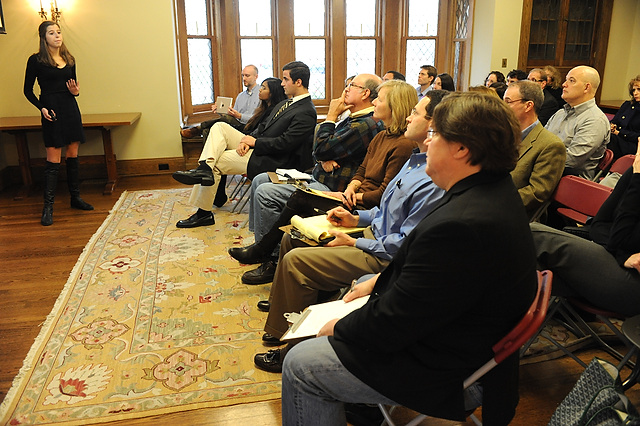
Hawken students pitching the local “Sharks”
Having practiced negotiating terms, students calculated their companies’ valuations, ranging from 50k- 300k, and wrestled with the sharks over equity. Sharks, in turn, argued with one another and even attempted to form syndication in one instance. At the close of the presentations, two teams were invited to apply for funding through local accelerators. The semester concluded with pizza and ice cream.
Pioneers are the Ones With Arrows in Their Backs
Trying to fit an Entrepreneurial Studies course into a college prep high school outside of Silicon Valley is an interesting challenge.
Being a pioneer means that there’s nothing familiar about this for parents, students and our administration. Hawken is exactly the right school to do this, but still our high school students and parents and other teachers are steeped in more traditional classes and subjects, college placement-related pressures, graduation requirements, AP courses, grades, etc.
Creating it feels a lot like building something totally new inside an existing business. But the course was spectacular for its students in ways that no other course is, so we’re getting money and institutional support for growing it. We’re learning a lot as we go…we’re figuring it out.
Summary
The Entrepreneurial Studies course serves as a vehicle for the school to realize its mission — forward-focused preparation for the real world through development of character and intellect. The 16 seniors who just completed the first Entrepreneurial Studies course told us that it was different from anything they have ever done in school – all the learning was active and all the work was collaborative and team-oriented. In evaluations they explained the biggest lessons they learned were often about themselves and how they handled failure, their character and their own strengths and weaknesses.
From one senior: “For the first time I am working because I care. Not just for a grade.”
Lessons Learned:
- Students work harder, better and deeper when the stakes are real
- Working for local startups gives them a great way to quickly gain business and life experience alongside customer development experience
- Working for local startups creates real world intensity and urgency in the course
- Kids freak out, get paralyzed and waste time doing so. It’s all part of the learning process
- The learning and growth of how to work well on a team is reason enough for students to enroll in Lean Launch Pad
- We never anticipated the amount of learning that happened here
- Even at a very progressive school, we are breaking new ground and challenging all the traditions and biases of regular school
This June, Hawken School is holding an Educator’s Workshop for middle and high school educators who want to build or grow their own LLP-based programs.
Listen to the post here
[audio http://traffic.libsyn.com/albedrio/steveblank_hplewis_140312_FULL.mp3]Download the podcast here

Filed under: Customer Development, Teaching | 19 Comments »


 Get the Podcasts for Free