The Endless Frontier: U.S. Science and National Industrial Policy: Part 6a The Secret History of Silicon Valley

The U.S. has spent the last 70 years making massive investments in basic and applied research. Government funding of research started in World War II driven by the needs of the military for weapon systems to defeat Germany and Japan. Post WWII the responsibility for investing in research split between agencies focused on weapons development and space exploration (being completely customer-driven) and other agencies charted to fund basic and applied research in science and medicine (being driven by peer-review.)

The irony is that while the U.S. government has had a robust national science and technology policy, it lacks a national industrial policy; leaving that to private capital. This approach was successful when U.S. industry was aligned with manufacturing in the U.S., but became much less so in the last decade when the bottom-line drove industries offshore.

In lieu of the U.S. government’s role in setting investment policy, venture capital has set the direction for what new industries attract capital.

This series of blog posts is my attempt to understand how science and technology policy in the U.S. began, where the money goes and how it has affected innovation and entrepreneurship. In future posts I’ll offer some observations how we might rethink U.S. Science and National Industrial Policy as we face the realities of China and global competition.

Office of Scientific Research and Development – Scientists Against Time
As World War II approached, Vannevar Bush, the ex-dean of engineering at MIT, single-handledly reengineered the U.S. governments approach to science and warfare. Bush predicted that World War II would be the first war won or lost on the basis of advanced technology. In a major break from the past, Bush believed that scientists from academia could develop weapons faster and better if scientists were kept out of the military and instead worked  in civilian-run weapons labs. There they would be tasked to develop military weapons systems and solve military problems to defeat Germany and Japan. (The weapons were then manufactured in volume by U.S. corporations.)

In 1940 Bush proposed this idea to President Roosevelt who agreed and appointed Bush as head, which was first called the National Defense Research Committee and then in 1941 the Office of Scientific Research and Development (OSRD).

OSRD divided the wartime work into 19 “divisions”, 5 “committees,” and 2 “panels,” each solving a unique part of the military war effort. These efforts spanned an enormous range of tasks – the development of advanced electronics; radar, rockets, sonar, new weapons like proximity fuse, Napalm, the Bazooka and new drugs such as penicillin and cures for malaria.

OSRD

The civilian scientists who headed the lab’s divisions, committees and panels were given wide autonomy to determine how to accomplish their tasks and organize their labs. Nearly 10,000 scientists and engineers received draft deferments to work in these labs.

One OSRD project – the Manhattan Project which led to the development of the atomic bomb – was so secret and important that it was spun off as a separate program. The University of California managed research and development of the bomb design lab at Los Alamos while the US Army managed the Los Alamos facilities and the overall administration of the project. The material to make the bombs – Plutonium and Uranium 235 – were made by civilian contractors at Hanford Washington and Oak Ridge Tennessee.

OSRD was essentially a wartime U.S. Department of Research and Development. Its director, Vannever Bush became in all but name the first presidential science advisor. Think of the OSRD as a combination of all of today’s U.S. national research organizations – the National Science Foundation (NSF), National Institute of Health (NIH), Centers for Disease Control (CDC), Department of Energy (DOE) and a good part of the Department of Defense (DOD) research organizations – all rolled into one uber wartime research organization.

OSRD’s impact on the war effort and the policy for technology was evident by the advanced weapons its labs developed, but its unintended consequence was the impact on American research universities and the U.S. economy that’s still being felt today.

National Funding of University Research
Universities were started with a mission to preserve and disseminate knowledge. By the late 19th century, U.S. universities added scientific and engineering research to their mission. However, prior to World War II corporations not universities did most of the research and development in the United States. Private companies spent 68% of U.S. R&D dollars while the U.S. Government spent 20% and universities and colleges accounted just for 9%, with most of this coming via endowments or foundations.

Before World War II, the U.S. government provided almost no funding for research inside universities. But with the war, almost overnight, government funding for U.S. universities skyrocketed. From 1941-1945, the OSRD spent $450 million dollars (equivalent to $5.5 billion today) on university research. MIT received $117 million ($1.4 billion in today’s dollars), Caltech $83 million (~$1 billion), Harvard and Columbia ~$30 million ($370 million.) Stanford was near the bottom of the list receiving $500,000 (~$6 million). While this was an enormous sum of money for universities, it’s worth putting in perspective that ~$2 billion was spent on the Manhattan project (equivalent to ~$25 billion today.)OSRD and Universities

World War II and OSRD funding permanently changed American research universities. By the time the war was over, almost 75% of government research and development dollars would be spent inside Universities. This tidal wave of research funds provided by the war would:

  • Establish a permanent role for U.S. government funding of university research, both basic and applied
  • Establish the U.S. government – not industry, foundations or internal funds – as the primary source of University research dollars
  • Establish a role for government funding for military weapons research inside of U.S. universities (See the blog posts on the Secret History of Silicon Valley here, and for a story about one of the University weapons labs here.)
  • Make U.S. universities a magnet for researchers from around the world
  • Give the U.S. the undisputed lead in a technology and innovation driven economy – until the rise of China.

The U.S. Nationalizes Research
As the war drew to a close, university scientists wanted the money to continue to flow but also wanted to end the government’s control over the content of research. That was the aim of Vannevar Bush’s 1945 report, Science: the Endless Frontier. Bush’s wartime experience convinced him that the U.S. should have a policy for science. His proposal was to create a single federal agency – the National Research Foundation – responsible for funding basic research in all areas, from medicine to weapons systems. He proposed that civilian scientists would run this agency in an equal partnership with government. The agency would have no laboratories of its own, but would instead contract research to university scientists who would be responsible for all basic and applied science research.

But it was not to be. After five years of post-war political infighting (1945-1950), the U.S. split up the functions of the OSRD.  The military hated that civilians were in charge of weapons development. In 1946 responsibility for nuclear weapons went to the new Atomic Energy Commission (AEC). In 1947, responsibility for basic weapons systems research went to the Department of Defense (DOD). Medical researchers who had already had a pre-war National Institutes of Health chafed under the OSRD that lumped their medical research with radar and electronics, and lobbied to be once again associated with the NIH. In 1947 the responsibility for all U.S. biomedical and health research went back to the National Institutes of Health (NIH). Each of these independent research organizations would support a mix of basic and applied research as well as product development.

The End of OSRD

Finally in 1950, what was left of Vannevar Bush’s original vision – government support of basic science research in U.S. universities – became the charter of the National Science Foundation (NSF).  (Basic research is science performed to find general physical and natural laws and to push back the frontiers of fundamental understanding. It’s done without thought of specific applications towards processes or products in mind. Applied research is systematic study to gain knowledge or understanding with specific products in mind.)

Despite the failure of Bush’s vision of a unified national research organization, government funds for university research would accelerate during the Cold War.

Coming in Part 2 – Cold War science and Cold War universities.

Lessons Learned

  • Large scale federal funding for U.S. science research started with the Office of Scientific Research and Development (OSRD) in 1940
  • Large scale federal funding for American research universities began with OSRD in 1940
  • In exchange for federal science funding, universities became partners in weapons systems research and development

More in the next post, “The Secret Life of Fred Terman” Part 6b of the Secret History of Silicon Valley.

Open Source Entrepreneurship

One of the great things about being a retired entrepreneur is that I get to give back to the community that helped me. I assembled this collection of free and almost free tools, class syllabi, presentations, books, lectures, videos in the hope that it can make your path as an entrepreneur or educator easier.

Free:

Startup Tools
If you’re building a startup, the Startup Tools tab on the top of this page has curated links to hundreds of startup resources.  Specific links are:

  • A list of startup tools is here
  • Market research tools to help you figure out the size of the opportunity your startup is pursuing, are here
  • Some of the best advice on founding and running a startup from other smart voices are here

Updates and suggestions for tools I’ve missed are welcomed on the Startup Tools comments page.

The Lean LaunchPad course online
I teach potential founders a hands-on, experiential class called the Lean LaunchPad at Berkeley, Stanford, Columbia and Caltech. The class teaches the three basic skills all entrepreneurs need to know:

  • business model design
  • customer development
  • agile engineering

For my  Innovation Corps class for the National Science Foundation it made sense to record the lectures and put them on-line. In my regular classes I now “flip” the classroom and have my students watch these online lectures as homework and we use the class time for discussion.

The free on-line class, hosted at Udacity is here.

Class Syllabi, My Lecture Slides and Student Presentations
The Slides/Video tab on the top of this page has all the open source course material for my classes.  Specific links are:

  • Educators Training Guide is here (part of the Educators Course  – described in the Educators section below.)
  • Course for Educators is here
  • Teachable moments videos for the Lean Launchpad class here
  • How do Customer Discovery videos here and here
  • Sample Lean LaunchPad Lecture slides and suggested syllabus here
  • Syllabi for all my classes are here
  • Secret Notes for Instructors here
  • Latest presentations posted click here
  • Stanford presentations, lectures and syllabus here
  • Berkeley presentations, lectures and syllabus here
  • Columbia 5-day presentations, lectures and syllabus here
  • Caltech 5-day presentations, lectures and syllabus here
  • Some general customer development slides click here

The Entreprenuers Checklist
The good folks at Udemy have taken a few of my lectures at Stanford and put them together in a series online.

The free on-line lectures, hosted at Udemy are here.

Online Guide to How to Build a Startup: The Lean LaunchPad
Startupplays.com, publisher of online entrepreneurs processes guides, drew from my Udacity course and The Startup Owner’s Manual to create a free step-by-step guide to understanding your customers and creating your value proposition. Called “How to Build a Startup: The Lean LaunchPad,” it walks you through the Business Model Canvas and an overview of the customer development process.

Find it here.

Videos
The Slides/Video tab on the top of this page has a number of my talks on entrepreneurship, customer development and startup, some short, some long, and a few interesting.

Find them here.

Recommended Reading
The Books for startups tab on the top of this page is my recommended reading list. These books have influenced my thinking. There’s a short synopsis of why I like each book.

Updates and suggestions for books that I’ve missed are welcomed on the books comment page.

Visitors Guide to Silicon Valley
The Guide tab on the top of this page? I got tired watching dignitaries fly into Silicon Valley, visit Google, Facebook, Apple, and Stanford and then say they understand startups and entrepreneurship.

So for the rest of us I put together this Visitors Guide to Silicon Valley.

Updates and suggestions for places to see that I’ve missed are welcomed on the Guide comments page.

Secret History of Silicon Valley
What began as a hobby of mine – research in the intersection of my military, intelligence and Silicon Valley careers combined with my interest in the history of Silicon Valley and technology entrepreneurship – ended up in this video and PowerPoint presentation. I first gave the Secret History of Silicon Valley presentation as an invited talk at Google, then at the Computer History Museum.

When I gave the talk to audience of CIA staffers they asked how I came up with the talk, so I wrote a series of posts as the back-story that can be found here.

I still love giving this talk to people who lived it and people curious about it.

Almost Free:

Startup Weekend Next
Startup Weekend Next is a three-week version of the Lean LaunchPad class with hands-on instructors and mentors – offered in hundreds of cities around the world.

  • The class is organized, led and delivered by Startup Weekend, the global non-profit that teaches entrepreneurs how to launch a startup in 54 hours.
  • TechStars and Startup America are partnering to provide mentors in the U.S.

They don’t ask for equity and charge just enough to cover the costs of pizza and the room rental.

Sign up here.

The Lean LaunchPad Educators Course
Hosted by NCIIAStanford University and U.C. Berkeley, Jerry Engel and I teach a course for educators interested in learning how to update and revise their entrepreneurship curriculum for the 21st century as well as learning how to teach the Lean LaunchPad class.

The Lean LaunchPad Educators Training Guide here is part of this course.

Next class is Jan 30th. Click here for more information.

The Startup Owner’s Manual
The Startup Owners Manual written with Bob Dorf, has become the step-by-step reference manual for anyone even thinking about a startup. Each section offers detailed guidance and how-to’s, helping you make your way through the Customer Development process using MVP’s and Pivots as you search for a Business Model.

Last month we added a Kindle version, reorganized to make it easier to follow on a tablet and incorporating hundreds of links to websites, blog posts, and presentations.

The Founder’s Workbook
Zoomstra, the publisher of online workbooks offers The Founders Workbook to help you track and monitor your progress through every step of the Customer Development process. It takes the static 57 checklists from The Startup Owner’s Manual and makes them dynamic and accessible by putting them online as an interactive checklist. Use it to keep your team on track and ensure you have completed each critical task as you search for a scalable business model.

Click here for more information.

The Four Steps to The Epiphany
The Four Steps to the Epiphany has been described as the book that launched the Lean Startup movement. The book is still relevant today as when it was written. The last two chapters deal with scale and management of growing startups.

Now get out of the building and make something happen!

Customer Development in Japan: a History Lesson

The Japanese edition of The Startup Owner’s Manual hit the bookstores in Japan this week. The book has been shepherded and edited by a great Japanese VC at Mitsui Sumitomo Insurance Venture Capital, Takashi Tsutsumi, with help from Masato Iino. I asked Tsutsumi-san to write a guest post for my blog to describe his experience with Customer Development in Japan.

————-

To celebrate the debut of the Japan edition of “The Startup Owner’s Manual” and to express great thanks to Steve and his co-author Bob Dorf, I would like to reflect back what first drew me to this book and offer Steve’s worldwide readers a look at the progress of Customer Development and the Lean LaunchPad class in Japan.

The Crater in my rookie days
Back in 1990’s, I was working for one of the leading sogo shohsa (trading company) in Japan, building data communications startups. After helping build the first Ethernet switch startup, I was attracted by Asynchronous Transfer Mode 25Mbit/sec technology, (ATM25) which was 2.5x faster than Ethernet and ran data but plus voice and video. Leveraging my marketing skills, I successfully made what Steve calls an “onslaught launch”, generating a lot of press coverage and apparent early success. But customers didn’t agree. After many sales calls, early prospects showed little rush to buy it! I got comments like, “Well, ATM25 is interesting technology, but I have no need to rush to buy it” or “I like ATM25 very much, but we need to replace my existing infrastructure to appreciate multimedia features, which I do not think that important.” I discovered my product was a “nice to have,” not a “must have,” and we shut the company down a year a later.

This made me believe deeply in the extreme importance of talking to customers before investing time and money, something I took to my next startup. The result: great success of my third startup, a load balancing technology for web servers back in the late 1990’s.

Finding a repeatable process for startups
Despite my success based on talking to customers upfront, however, I wasn’t confident I could replicate startup success consistently without a clear, and repeatable process to talk to customers. By then, I had become a venture capitalist at Mitsui Sumitomo Insurance and found myself talking to a lot of entrepreneurs who were proclaiming their great technology yet were struggling with little revenue, and claiming they were “crossing the chasm”. However, when I looked into the detail, most of them did not have even early adaptors and the problem wasn’t “chasm crossing,” it was that almost nobody wanted their products.

In 2004, Googling terms like “high tech marketing” and “startup” I discovered “The Four Steps to The Epiphany” at Cafépress.com. Amazon did not carry it yet, and I was nervous spending money at a website known mostly for cups and t-shirts, completely irrelevant to business books. After waiting for a week or so for the book to make it to Japan, I was very much shocked how impressed I was by the Customer Development Model detailed in the book. A few of the many quotations that struck me:

  • “Most startups fail due not to the failure of product development but due to the lack of customers”
  • “Learning and discovering who a company’s initial customers will be and what market they are in, requires a process separate and distinct from product development”
  • “All a startup has are mere hypotheses,” and
  • “in a startup no facts exist inside the building, get out of the building to talk to customers”

This was exactly what I was searching for.

The first meeting with Steve
After my reading The Four Steps to The Epiphany several times, my Customer Development conviction got stronger. I wanted this book not only as my “secret weapon,” but also for all entrepreneurs in Japan.

I sent Steve a cold email to allow me to translate the book into Japanese and evangelize Customer Development in Japan. Steve responded to my email in ten minutes, saying “come meet with me!” Soon we had our first meeting Steve’s favorite spot, Café Borrone on El Camino Real.

After listening to me for fifteen minutes, Steve said “Go ahead. I will support you”.  It was very, very happy moment for me.

I was extremely surprised that he gave a huge trust on completely unknown and strange Japanese VC who suddenly contacted him by email. We kept talking, with Steve asking “How long are you staying in Silicon Valley?” When I told him, “two more days,” he asked, “Are you interested in meeting with venture firms in the Valley?”  When I said of course, but who would meet with me with two days notice, he picked up his mobile phone and, surprisingly for me, started dialing … and I actually had a great meeting with one of them the very next day. More “pay it forward” culture in action.

Evangelizing Customer Development in Japan
After that meeting, I started working on the translation word by word over a number of weekends and published the Japanese edition of “The Four Steps Epiphany” in May 2009 (now in its third printing.)  Since then, I have been teaching Customer Development and running Lean LaunchPad style classes at variety of universities, national research laboratories, incubators, and startup communities throughout Japan.

After three years of evangelizing, I am very pleased to see success cases emerging in Japan by following Customer Development Model. For example, Maysee, a business card cloud services startup, got out of the building and then developed an MVP, avoiding costly UI development that customers in fact found no need for. They pivoted the product by implementing Google like wide-open search windows requested time and again in customer interviews. Maysee now enjoys hockey stick revenue growth.

Goryo Chemical, new fluorescent probe for Chemical biology startups (leveraging a technology from a university), found early in Customer Discovery that the original value proposition hypothesis was wrong, but one other feature was in fact very valuable. Their pivot resulted in great deal of customer tractions.

These kinds of success cases continue to happen in Japan’s startup community and in corporations that have to innovate to remain competitive in the global market.

Customer Development Education
Customer Development is growing fast here in Japan, with Lean LaunchPad programs in great demand among entrepreneurs and “wanabees” learning to build hypothesis and test them by getting out of the building. Some have actually established new startups with tested business model hypotheses under their belt. Lean LaunchPad teaches entrepreneurs, to test their business model until they find customers who are eager to buy, and a business model that scales profitably and repeatedly. I am confident we will see real startups and business emerge soon.

Lean LaunchPad class at Hosei University business school

Much more is happening with collaborative learning and tools, and I am looking forward to more Customer Development success ahead as more entrepreneurs, investors, and educators read the new book, The Startup Owner’s Manual.

In fact, I recently started my Customer Development blog with my partner, Masato Iino, to accumulate the learning and discovery of Customer Development and Lean LaunchPad in Japan, and to update readers with more concepts and tools to do Customer Development in their startups.

Lessons Learned – Japanese Style

  • Failure comes often, but failure is mother of success.  To appreciate a “mother,” it is important to improve from the failure and to look for a solution continuously to do a better job with a solution, hopefully resulting in a great success.
  • Pushing the boundaries collaboratively is really powerful.  Try collaborative learning by leveraging global intelligence and passion of entrepreneurs.
  • Pay-it-forward culture actually exists.  But, the key is for me to transfer the same culture to my next generation by giving them an opportunity like the one I appreciated.

Takashi Tsutsumi
ttutumi@gmail.com

本ブログ記事の内容は、堤孝志個人の見解に基づいており、所属する組織の見解を示すものではありません。
Listen to the post here: Download the Podcast here

10,000 Startups – Startup Weekend Next

Today we are announcing the biggest entrepreneurial program ever launched – Startup Weekend Next. A partnership of Startup WeekendStartup AmericaTechStars and UdacityStartup Weekend Next brings four weeks of amazing hands-on training learning to build your startup to cities around the world. Our goal– to inspire, educate and empower hundred’s of thousands of entrepreneurs and help create 10,000 startups.

The Lean LaunchPad Class
You may have read my previous posts about the Lean LaunchPad entrepreneurship class. The class teaches founders how to dramatically reduce their failure rate through the combination of business model design, customer development and agile development using the Startup Owners Manual. Just a crazy idea two years ago, the class is now taught at Stanford, Berkeley, Columbia, Caltech, Princeton and for the National Science Foundation at the University of Michigan and Georgia Tech.

And in the thirty days since we’ve put the Lean LaunchPad class online at Udacity50,000 students have been taking it.

While the Lean LaunchPad online has received rave reviews (it’s being translated into Spanish, French, Russian, Japanese and Greek, and it’s being used as part of a “flipped classroom” in other entrepreneurship courses), it’s different than taking the class in person. It doesn’t require you to form a team, and there’s no immediate instructor feedback. More importantly, it makes no demands of you to stand and deliver your weekly customer development progress in front of your peers. In sum, it lacks the rigorous and collaborative hands-on experience that entrepreneurs get in our university classes.

We thought long and hard about how we could take the Lean LaunchPad Online to the next level and deliver the same level of experiential instruction to tens and hundreds of thousands of entrepreneurs around the world.

The result – Startup Weekend Next.

Hands-On in 100’s of Cities
Startup Weekend Next is a four-week version of the Lean LaunchPad class with hands-on instructors and mentors – and we will teach it in hundreds of cities around the world.

I’m partnered with four great organizations to deliver the program. The class is organized, led and delivered by Startup Weekend, the global non-profit that teaches entrepreneurs how to launch a startup in 54 hours. They’ve hosted close to 800 Startup Weekend events in over 350 cities worldwide educating a staggering 57,000 entrepreneurs who’ve created over 5,000 startups. Today they are going to take Startup Weekend to the next level by organizing and teaching a four-week version of the Lean LaunchPad class as their Startup Weekend Next course. Their reach and scale means our goal of helping to create 10,000 startups is within our grasp.

(If you can’t see the video above click here.)

In addition, the leading experts in building entrepreneurial companies and regions, TechStars and Startup America are partnering with us in this endeavor.

In the U.S, Startup America will leverage its network of 30 startup regions to engage entrepreneurial leaders throughout the country. And TechStars will use its broad and unparalleled network of mentors (experienced entrepreneurs and investors) to coach the teams. And Udacity has put their awesome production resources behind the class and hosts the Lean LaunchPad online lectures.  And we are looking for other partners worldwide to help make this successful.

The first four-week Startup Weekend Next classes will start on Nov. 28 in more than 25 cities worldwide. The program expands to all of Startup Weekend’s 350 member communities in 2013 where it will be offered up to five times a year in each city.

The cost of attending a Startup Weekend Next is ridiculously inexpensive. It doesn’t take equity and just has a small fee that varies by city ($140 to $299), to cover event operations and expenses.

How it Works
We now know how to crack the entrepreneurial code by creating an Entrepreneurship API – a standard language for entrepreneurs. When you leave the class, you’ll know how to think about your startup in the now standard  “language” of the business model canvas. You’ll understand the customer development process used to test those hypotheses and learn how to iterate or pivot when your hypotheses need to change.  And you’ll learn about how to build a minimal viable product to get feedback early and often from customers.

Here’s how the four intense weeks in a Startup Weekend Next class works.

  • You form a startup team (if you don’t have one, taking the 54-hour Startup Weekend class is a great a way to find one) and come into class with an initial idea
  • Your team arrives with an initial Business Model Canvas. (Your pre-class reading is to watch the Lean LaunchPad initial lectures on Udacity)
  • You present your hypotheses and what you learned in front of your peers and coaches
  • Your team gets live coaching and advice from Startup Weekend Next mentors.
  • You’ll take the suggestions from the meeting, get out of the building and talk to ten plus customers per week.
  • You’ll refine your business model by iterating or pivoting your product, your target customers, pricing, channels, partners, etc.
  • Repeat for four weeks– all while working with volunteer mentor partners from Startup Weekend, Startup America and TechStars – serial entrepreneurs and seasoned startup investors – to see whether your business idea was truly a vision or simply a hallucination.

The Big Idea – Incubators – Accelerators – and Something New
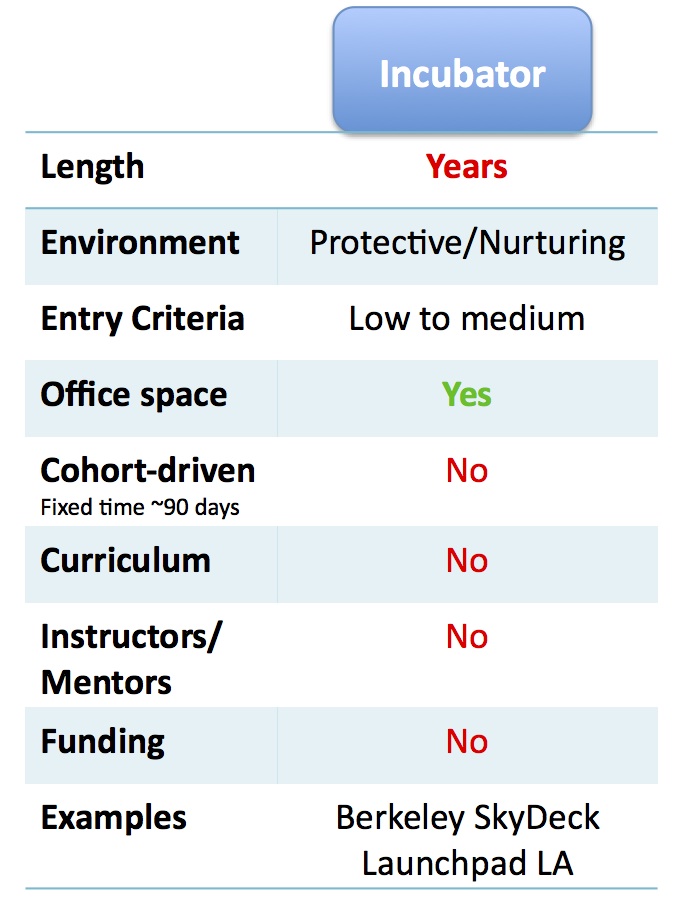
In the last decade startup incubators have become increasingly popular. These incubators which provides new startups with year-round physical office space, infrastructure and advice in exchange for a fee (often in equity.)  They may be privately run but often are non-profit, attached to a university or in some locations a local government.  There is no formal “start date” so there is a no fixed time for their stay. (For some incubators, entrepreneurs can stay as long as they want.) There is no curriculum and seldom any formal instructors or mentors. There is no guaranteed funding. Think of incubators as “shelter from the storm.”

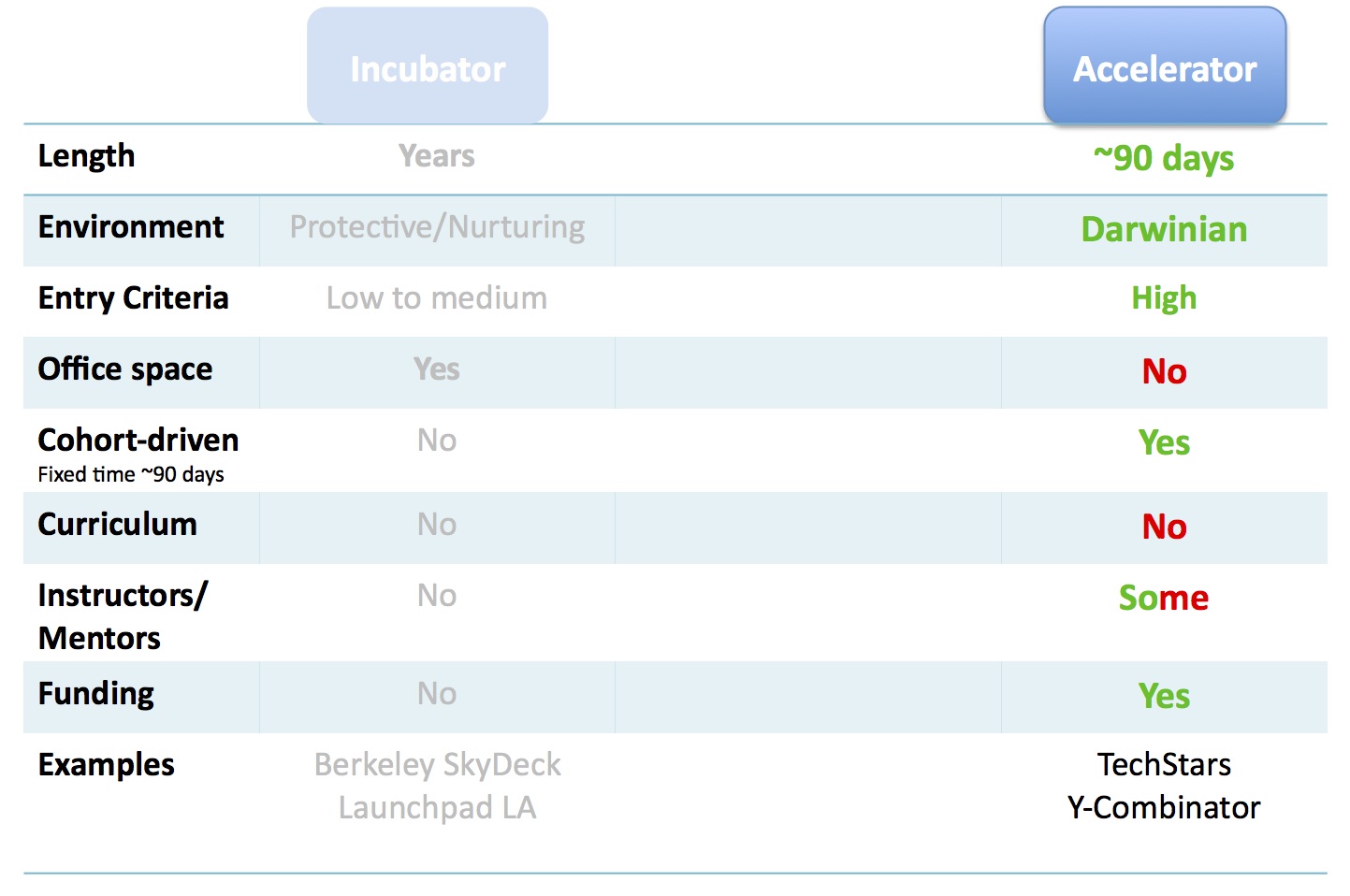
In contrast, the goal of an accelerator is not physical office space, it’s a fundable company. Startups enter and leave as a cohort (starting and ending the program at the same time) in a program of a set length. While there is no formal curriculum, most offer weekly expert lectures, experienced mentors, coaching and introductions.  Accelerators provide funding at the end of the program.  Getting into an accelerator is more competitive than grad school.

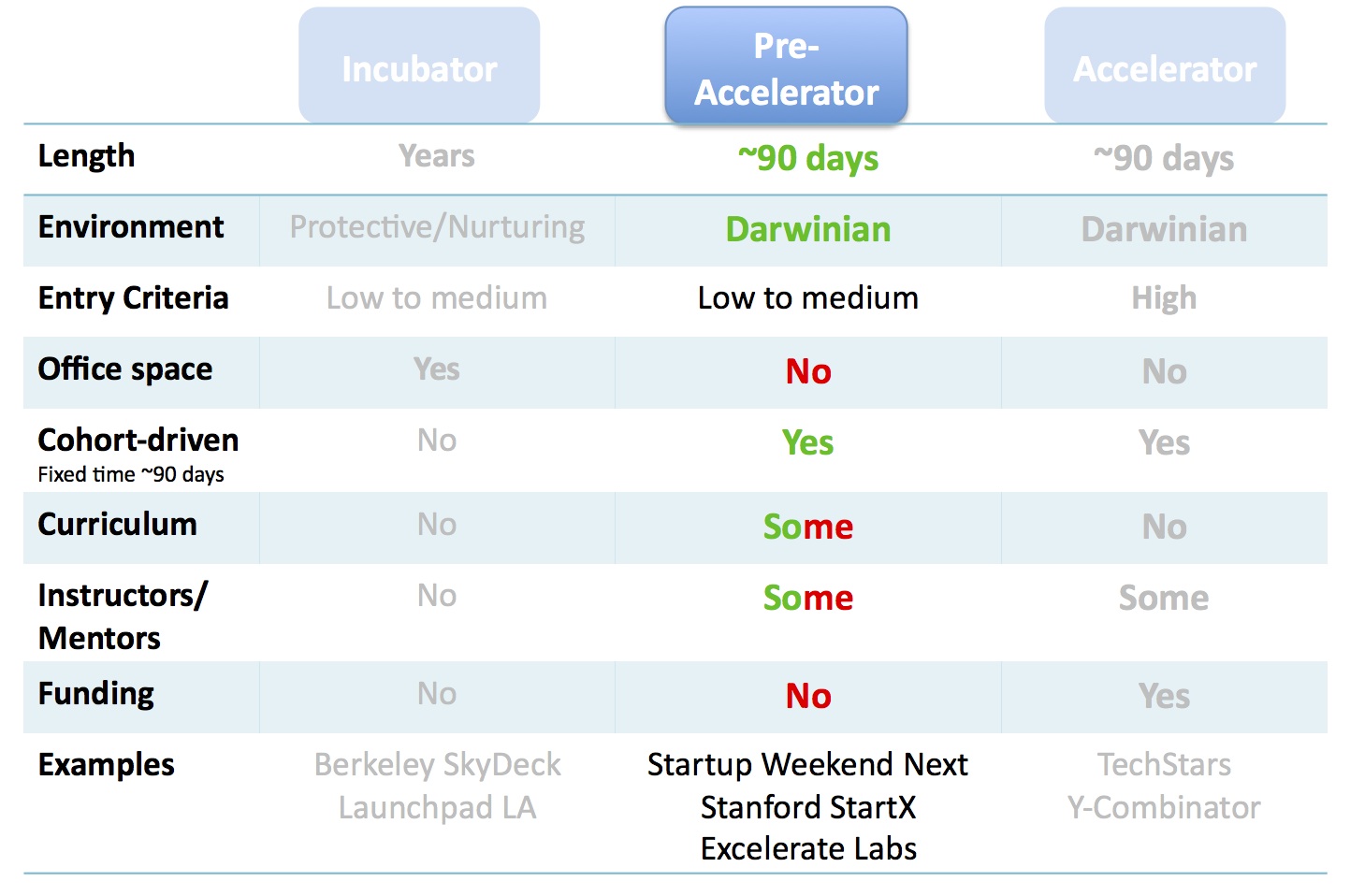
Startup Weekend Next represents something new – a pre-accelerator.

Like an accelerator there is no physical office space, and startups enter and leave as a cohort in a program of a set length. But the key difference is that Startup Weekend Next engages you in a formal curriculum. We believe we know what startups need to learn, and we focus on teaching you that. Instead of guest lecturers, you get out of the building and you learn by doing. Like the best accelerators, you get experienced mentors, coaching and introductions. Unlike accelerators, there is no funding at the end of the program.  But you leave knowing a lot more of what it takes to build a company beyond a PowerPoint deck for a VC presentation.

Lessons Learned

If you have passion, an idea and a team, and you want to take advantage of the most advanced entrepreneurial training program, sign up at Startup Weekend Next

and wait until you see what we do next.
Listen to the post here: Download the Podcast here

10,000 Startups

In 24 hours we’ll announce something revolutionary.

Moving entrepreneurship forward.

Startup Communities – Building Regional Clusters

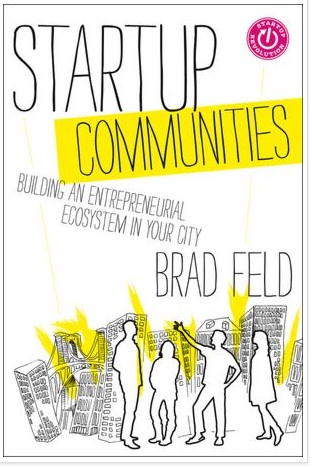
How to build regional entrepreneurial communities has just gotten it’s first “here’s how to do it” book. Brad Feld’s new book Startup Communities joins the two other “must reads,” (Regional Advantage and Startup Nation) and one “must view” (The Secret History of Silicon Valley) for anyone trying to understand the components of a regional cluster.

There’s probably no one more qualified to write this book then Brad Feld (startup founder, co founder of two VC firms – Mobius and Foundry, and founder of TechStars.)

Leaders and Feeders
Feld’s thesis is that unlike the common wisdom, it is entrepreneurs that lead a startup community while everyone else feeds the community.

Feld describes the characteristics of those who want to be regional Entrepreneurial Leaders; they need to be committed to their region for the long term (20+ years), the community and its leaders must be inclusive, play a non-zero sum game, be mentorship-driven and be comfortable experimenting and failing fast.

Feeders include the government, universities, investors, mentors, service providers and large companies. He points out that some of these, government, universities and investors think of themselves as the leaders and Feld’s thesis is that we’ve gotten it wrong for decades.

This is a huge insight, a big idea and a fresh way to view and build a regional ecosystem in the 21st century. It may even be right.

Activities and Events
One of the most surprising (to me) was the observation that a regional community must have continual activities and events to engage all participants. Using Boulder Colorado as an example, (Feld’s home town) this small entrepreneurial community runs office hours, Boulder Denver Tech Meetup, Boulder Open Coffee ClubIgnite Boulder, Boulder Beta, Boulder Startup Digest, Startup Weekend events, CU New Venture Challenge, Boulder Startup Week, Young Entrepreneurs Organization and the Entrepreneurs Foundation of Colorado. For a city of 100,000 (in a metro area of just 300,000 people) the list of activities/events in Boulder takes your breath away. They are not run by the government or any single organization. These are all grassroots efforts by entrepreneurial leaders. These events are a good proxy for the health and depth of a startup community.

Incubators and Accelerators
One of the best definitions in the book is when Feld articulates the difference between an incubator and an accelerator. An incubator provides year-round physical space, infrastructure and advice in exchange for a fee (often in equity.) They are typically non-profit, attached to a university (or in some locations a local government.) For some incubators, entrepreneurs can stay as long as they want. There is no guaranteed funding. In contrast, an accelerator has cohorts going through a program of a set length, with funding typically provided at the end.

Feld describes TechStars (founded in 2006 with David Cohen) as an example of how to build a regional accelerator. In contrast to other accelerators TechStars is mentor-driven, with a profound belief that entrepreneurs learn best from other entrepreneurs. It’s a 90-day program with a clear beginning and end for each cohort. TechStars selection criteria is to first focus on picking the right team then the market. They invest $118,000 ($18k seed funding + $100K convertible note) in 10 teams per region.

Role of Universities
To the entrepreneurial community Stanford and MIT are held up as models for “outward-facing” research universities. They act as community catalysts, as a magnet for great entrepreneurial talent for the region, and as teachers and then a pipeline for talent back into the region. In addition their research offers a continual stream of new technologies to be commercialized.

Feld’s observation is that that these schools are exceptions that are hard to duplicate. In most universities entrepreneurial engagement is not rewarded, there’s a lack of resources for entrepreneurial programs and cross-campus collaboration is not in the DNA of most universities.

Rather than thinking of the local university as the leader, Feld posits a more effective approach is to use the local college or university as a resource and a feeder of entrepreneurial students to the local entrepreneurial community. He uses Colorado University’ Boulder as an example of of a regional university being as inclusive as possible with courses, programs and activities.

Finally, he suggests engaging alumni for something other than fundraising – bringing back to the campus, having them mentor top students and celebrating their successes.

Role of Government
Feld is not a big fan of top-down government driven clusters. He contrasts the disconnect between entrepreneurs and government. Entrepreneurs are painfully self-aware but governments are chronically not self-aware.  This makes government leaders out of touch on how the dynamics of startups really work. Governments have a top-down command and control hierarchy, while entrepreneurs work in a bottoms-up networked world. Governments tend to focus on macro metrics of economic development policy while entrepreneurs talk about lean, startups, people and product. Entrepreneurs talk about immediate action while government conversations about policy do not have urgency.  Startups aim for immediate impact, while governments want to control. Startup communities are networked and don’t lend themselves to a command and control system.

Community Culture
Feld believes that the Community Culture, how individuals interact and behave to each other, is a key part of defining and entrepreneurial community. His list of cultural attributes is an  integral part of Silicon Valley. Give before you get, (in the valley we call this the “pay it forward” culture.) Everyone is a mentor, so share your knowledge and give back. Embrace weirdness, describes a community culture that accepts differences. (Starting post World War II the San Francisco bay area became a magnet for those wanting to embrace alternate lifestyles. For personal lifestyles people headed to San Francisco. For alternate business lifestyles they went 35 miles south to Silicon Valley.)

I was surprised to note that the biggest cultural meme of Silicon Valley didn’t make his Community Culture chapter – failure equals experience.

Broadening the Startup Community
Feld closes by highlighting some of the issues faced by a startup community in Boulder.  The one he calls Parallel Universes notes that there may be industry specific (biotech, clean tech etc.) startup communities sitting side-by-side and not interacting with each other.

He then busts the myths clusters tell themselves; “lets be like Silicon Valley” and the “there’s not enough capital here.”

Quibbles
There’s data that that seems to indicate a few of Feld’s claims about about the limited role of venture, universities and governments might be overly broad (but doesn’t diminish his observation that they’re feeders not leaders.) In addition, while Silicon Valley was a series of happy accidents, other national clusters have extracted its lessons and successfully engineered on top of those heuristics. And while I might have misread Feld’s premise about local venture capital, but it seems to be, “if there isn’t a robust venture capital in your region it’s because there isn’t a vibrant entrepreneurial community with great startups. As venture capital exists to service startup when great startups are built investors will show up.” Wow.

Finally, local government top-down initiatives are not the only way governments can incentivize entrepreneurial efforts. Some like the National Science Foundation Innovation Corps have had a big bang for little bucks.

Summary
Entrepreneurship is rising in almost every major city and region around the world. I host at least one region a week at the ranch and each of these regions are looking for a roadmap. Startup Communities is it. It’s a strategic, groundbreaking book and a major addition to what was missing in the discussion of how to build a regional cluster. I’m going to be quoting from it liberally, stealing from it often, and handing it out to my visitors.

Buy it.

Lessons Learned

  • Entrepreneurs lead a startup community while everyone else feeds the community
  • Feeders include the government, universities, investors, mentors, service providers and large companies
  • Continual activities and events are essential to engage all participants
  • Top-down government-driven clusters are an oxymoron
  • Building a regional entrepreneurial culture is critical

Listen to the post here: Download the Podcast here

The Lean LaunchPad Online

You may have read my previous posts about the Lean LaunchPad class taught at Stanford, Berkeley, Columbia, Caltech and for the National Science Foundation.

Now you too can take this course.

I’ve worked with the Udacity, the best online digital university on a mission to democratize education, to produce the course. They’ve done an awesome job.

The course includes lecture videos, quizzes and homework assignments. Multiple short video modules make up each 20-30 minute Lecture. Each module is roughly three minutes or less, giving you the chance to learn piece by piece and re-watch short lesson portions with ease. Quizzes are embedded within the lectures and are meant to let you check-in with how completely you are digesting the course information. Once you take a quiz, which could be a multiple-choice quiz or a fill in the blank quiz, you will receive immediate feedback.

Sign up here

——–

Why This Class?

Ten years ago I started thinking about why startups are different from existing companies.  I wondered if business plans and 5-year forecasts were the right way to plan a startup.  I asked, “Is execution all there is to starting a company?”

Experienced entrepreneurs kept finding that no business plan survived first contact with customers. It dawned on me that the plans were a symptom of a larger problem: we were executing business plans when we should first be searching for business models. We were putting the plan before the planning.

So what would a search process for a business model look like? I read a ton of existing literature and came up with a formal methodology for search I called Customer Development.

That resulted in a new process for Search: Customer Development + traditional product management/Waterfall Engineering. It looked like this:

This meant that the Search for a business model as a process now could come before execution. So I wrote a book about this called the Four Steps to the Epiphany.

And in 2003 the Haas Business School at U.C. Berkeley asked me to teach a class in Customer Development.  With Rob Majteles as a co-instructor, I started a tradition of teaching all my classes with venture capitalists as co-instructors.

In 2004 I funded IMVU, a startup by Will Harvey and Eric Ries. As a condition of my investment I insisted Will and Eric take my Customer Development class at Berkeley. Having Eric in the class was the best investment I ever made. Eric’s insight was that traditional product management and Waterfall development should be replaced by Agile Development.  He called it the “Lean Startup.”

Meanwhile, I had said startups were “Searching” for a business model, I had been purposefully a bit vague about what exactly a business model looked like. For the last two decades there was no standard definition.  That is until Alexander Osterwalder wrote Business Model Generation.

This book was a real breakthrough. Now we understood that the strategy for startups was to first search for a business model and then after you found it, put together an operating plan.

Now we had a definition of what it was startups were searching for. So business model design + customer and agile development is the process that startups use to search for a business model.

And the organization to implement all this was not through traditional sales, marketing and business development groups on day one. Instead the founders need to lead a customer development team.

And then to get things organized Bob Dorf and I wrote a book, The Startup Owners Manual that put all these pieces together.

But then I realized rather than just writing about it, or lecturing on Customer Development, we should have a hands-on experiential class. So my book and Berkeley class turned into the Lean LaunchPad class in the Stanford Engineering school, co-taught with two VC’s – Jon Feiber and Ann Miura-Ko. And we provided dedicated mentors for each team.

Then in the fall of 2011, the National Science Foundation read my blog posts on the Stanford version of the Lean LaunchPad class.  They said scientists had already made a career out of hypotheses testing, and the Lean LaunchPad was simply a scientific method for entrepreneurship. They asked if I could adapt the class to teach scientists who want to commercialize their basic research. I modified the class and recruited another great group of VC’s and entrepreneurs – Jim Hornthal, John Burke, Jerry Engel,Bhavik Joshi and Oren Jacob – to teach with me.

We taught the first two classes of 25 teams each, and then in March of 2012 trained faculty from Georgia Tech and the University of Michigan how to teach the class at their universities. Georgia Tech and the University of Michigan faculty then taught 54 teams each in July of this year and will teach another 54 teams in October.

We then added four more schools – Columbia, Caltech, Princeton and Hosei – where our team taught the Lean LaunchPad. We also developed a 5-day version of the class to complement the full semester and quarter versions.

Then last month we partnered with NCIIA and taught 62 college and university educators in our first Lean LaunchPad Educators Program.

And now we’ve spent weeks in the Udacity studio putting the lecture portion of the Lean LaunchPad class online.

Sign up and find out how to start a company!

Listen to the post here: Download the Podcast here

The Lean LaunchPad Class Online

Making a Dent in the Universe – Results from the NSF I-Corps

Our goal teaching for the National Science Foundation was to make a dent in the universe.

Could we actually teach tenured faculty how to turn an idea into a company?  And if we did, could it change their lives?

We can now answer these questions.

Hell yes.

———–

The Lean LaunchPad class for the National Science Foundation (NSF)
Over the last 6 months, we’ve been teaching a version of the Lean LaunchPad class for the National Science Foundation Innovation Corps.  We’ve taught two cohorts: 21 teams ending in December 2011, and 24 teams ending in May 2012. In July 2012 we’ll teach 50 more teams, and another 50 in October. Each 3-person team consists of a Principal Investigator, an Entrepreneurial Lead and a Mentor.

The Principal Investigator (average age of ~45) is a tenured faculty running their own research lab who has had an active NSF grant within the last 5 years. The Principal Investigator forms the team by selecting one of his graduate students to be the Entrepreneurial Lead.

The Entrepreneurial Lead is a graduate student or post doc (average age ~ 28) who works within the Principal Investigator’s lab. If a commercial venture comes out of the I-Corps, it’s more than likely that the Entrepreneurial Lead will take an active role in the new company. (Typically Principal Investigators stay in their academic role and continue as an advisor to the new venture.)

Mentors (average age ~50) are an experienced entrepreneur located near the academic institution and has experience in transiting technology out of academic labs. Mentors are recommended by the Principal Investigator (who has worked with them in the past) or they may be a member of the NSF I-Corps Mentor network. Some mentors may become an active participant in a startup that comes out of the class.

The NSF I-Corps: Class Goals
The NSF I-Corps Lean LaunchPad class has different goals then the same class taught in a university or incubator. In a university, the Lean LaunchPad class teaches a methodology the students can use for the rest of their careers. In an incubator, the Lean LaunchPad develops angel or venture-funded startups.

Unlike an incubator or university class, the goal of the NSF I-Corps is to teach researchers how to move their technology from an academic lab into the commercial world. A successful outcome is a startup or a patent or technology license to a U.S. company.

(While many government agencies use Technology Readiness Levels to measure a projects technical maturity, there are no standards around Business Maturity Levels. The output of the NSF I-Corps class provides a proxy.)

The NSF I-Corps doesn’t pick winners or losers. It doesn’t replace private capital with government funds. Its goal is to get research the country has already paid for educated to the point where they can attract private capital. (It’s why we teach the class with experienced Venture Capitalists.)

Teaching Objectives
Few of the Principal Investigators or Entrepreneurial Leads had startup experience, and few of the mentors were familiar with Business Model design or Customer Development.

Therefore, the teaching objectives of the I-Corps class are:

1) Help each team understand that a successful company was more than just their technology/invention by introducing all the parts of a business model (customers, channel, get/keep/grow, revenue models, partners, resources, activities and costs.)

2) Get the teams out of the building to test their hypotheses with prospective customers. The teams in the first cohort averaged 80 customer meetings per team; the second cohort spoke to an average of 100.

3) Motivate the teams to pursue  commercialization of their idea. The best indicators of their future success were whether they a) found a scalable business model, b) had an interest in starting a company, and c) would pursue additional funding.

Methodology
The National Science Foundation worked with NCIIA to establish a baseline of what the students knew before the class and followed it up with a questionaire after the class.

While my experience in teaching students at Stanford, Berkeley and Columbia told me that this class was an effective way to teach all the parts that make up a startup, would the same approach work with academic researchers?

Here’s what they found.

Results
Teams came into the class knowing little about what parts made up a company business model (customers, channel, get/keep/grow, revenue models, partners, resources, activities and costs.) They left with very deep knowledge.

I-Corps teams spent the class refining their business model and minimum viable product. By the end of the class:

  • Over 95% believed that they found a scalable business model.
  • 98% felt that they had found “product/market fit”.

The class increased everyones interest in starting a company. 92% said they were going to go out and raise money – either from the NSF or with private capital. (This was a bit astonishing. Given that most of them didn’t know what a startup was coming in. These are new jobs being created.)

One of the unexpected consequences of the class was its effect on the Principal Investigators, (almost all tenured professors.)  A surprising number said the ideas for the class will impact their research, and 98% of all of the attendees said it was going to be used in their careers.

Another unexpected result was the impact the class had on the professors own thinking about how they would teach their science and engineering students. We got numerous comments about “I’m going to get my department to teach this.”

What’s Next
The NSF and NCIIA understand that the analysis doesn’t end by just studying the results of each cohort. We need to measure what happens to the teams and each of the team members (Principal Investigator, Entrepreneurial Lead and Mentor) over time. It’s only after a longitudinal study that will take years, can we see how deep of a dent we made in the universe.

But I think we’ve made a start.

Acknowledgements
Thanks to the team at NCIIA that provided the questionaire and analytical data (Angela Shartrand) and the logistical support (Anne Hendrixson) to run these NSF classes.

The National Science Foundation (Errol Arkilic, Babu DasGupta) took a chance at changing the status quo.

Members of Congress on both sides of the aisle who’ve realized cracking the code on how to teach starting companies means a brighter day for the future of  all jobs in the United States – not just tech startups.

And thanks to the venture capitalists and entrepreneurs who volunteer their time for their country; Jon Feiber from MDV, John Burke from True Ventures, Jim Hornthal from CMEA, Jerry Engel from Monitor Ventures (and the U.C. Berkeley Haas Business School,) Oren Jacob from ToyTalk and Lisa Forssell of Pixar.

And to our new teaching teams at University of Michigan and Georgia Tech – It’s your turn.

Lessons Learned

  • The Lean LaunchPad class (Business Model design+Customer Development+ extreme hands-on) works
  • They leave knowing:
    • how to search for a business model (customers, channel, get/keep/grow, revenue models, partners, resources, activities and costs,)
    • how to find product/market fit, and a scalable business model
  • It has the potential to change careers, lives and our country

Listen to the post here: Download the Podcast here

Entrepreneurship for the 99%

This is a guest post from Jerry Engel, the Faculty Director of the National Science Foundation Innovation Corps (and the Founding Faculty Director of the Lester Center for Entrepreneurship at UC Berkeley.)

———–

The 99%
As the morning fog burns off the California coast, I am working with Steve Blank, preparing for the Lean LaunchPad Faculty Development Program we are running this August at U.C. Berkeley. This is a 3-day program for entrepreneurship faculty from around the world how to teach entrepreneurship via the Lean LaunchPad approach (business model canvas + customer development) and bring their entrepreneurship curriculums into the 21st century. Over the past couple of years this Lean LaunchPad model has proven immensely effective at Berkeley, Stanford, Columbia and, of course, the National Science Foundations Innovation-Corps program. The data from the classes seem to indicate that we’ve found have a method how to make scalable startups fail less.

While we’re excited by the results, we’ve realized that we’ve been solving the problem for the 1% of new ventures that are technology startups. The reality is that the United States is still a nation of small businesses. 99.7% of the ~6 million companies in the U.S. have less than 500 people and they employ 50% of the 121 million workers getting a paycheck. They accounted for 65 percent (or 9.8 million) of the 15 million net new jobs created between 1993 and 2009. And while they increasingly use technology as a platform and/or a way of reaching and managing customers, most are in non-tech businesses (construction, retail, health care, lodging, food services, etc.)

While we were figuring out how to be incredibly more efficient in building new technology startups, three out out of 10 new small businesses will fail in 2 years, half fail within 5 years.  The tools and techniques available to small businesses on Main Street are the same ones that were being used for the last 75 years.

Therefore, our remaining challenges are how to make them fail less – and how can we make the Lean LaunchPad approach relevant to the rest of the 99% of startups.

Serendipity
A serendipitous answer came to us around noon. His name is Alex Lawrence. Alex, vice provost for Innovation & Economic Development at Weber State University in Utah and completing his first year of teaching entrepreneurship. Alex is a successful serial entrepreneur –with the same drive and energy of many we have known here in Silicon Valley, but different. His nine startups have ranged from franchised fruit juice shops to Lendio a financial services company for small businesses. Alex had been recruited back by his Alma Matter to create an entrepreneurship program. In fact he had just been charged with creating an entrepreneurship minor – five or six courses for students of any major at the University that would help prepare them for the challenge of starting their own businesses.

Alex’s first insight was that the traditional “how to write a business plan” was as obsolete for Main Street as it is for Silicon Valley. So he had adopted Steve’s Lean LaunchPad class and was using The Startup Owner’s Manual as his core text. He had contacted us seeking advice on developing his curriculum, and it just seemed natural to invite him out to the ranch for a deeper dive.

As we dug into learning about Alex’s teaching experience we naturally asked him about the ventures his own students were creating. It was clear Alex was a bit apologetic; photo studios, online retail subscriptions to commodity household and personal hygiene products, etc. Alex explained that in his community building a successful venture that generated nice cash flows – not IPO’s – were the big win. To his students these were not “small businesses”, but ‘their businesses’, their livelihoods and their opportunities to create wealth and independence for themselves and their families.

Mismatch for Main Street
As we walked out to the pond, Alex explained that while he found the teachings of the Lean LaunchPad directly applicable and effective, there was a mismatch for his students in the size of the end goal (a great living versus a billion dollar IPO) and the details of the implementation of the business model (franchise and multilevel marketing versus direct sales, profit sharing versus equity for all, family and SBA loans versus venture capital, etc.)

Sitting by the pond we had a second epiphany: we could easily adjust the Lean LaunchPad class to bring 21st century entrepreneurship techniques to ‘Main Street’. To do this we needed to do is change the end goals and implementation details to match the aspirations and realities that these new small businesses face.

We called this Mainstream Entrepreneurship.

Mainstream Entrepreneurship
Mainstream Entrepreneurship recognizes that with the Lean LaunchPad class we now have a methodology of making small businesses fail less.  That accelerating business model search and discovery and using guided customer engagement as a learning process, we could help founders of mainstream businesses just like those starting technology ventures.

For the rest of the afternoon, Steve and I brainstormed with Alex about how he could take his 20 years of entrepreneurial small business experience and use the Business Model Canvas and Customer Development to create a university entrepreneurship curriculum and vocabulary for the mainstream of American Business.

We think we got it figured out.

Alex Lawrence will be one of the presenters at the Lean LaunchPad Educators Program August 22-24th in Berkeley.

Lessons Learned

  • Small businesses make up 99.7% of U.S. companies
  • “How to write a business plan” is as obsolete for Main Street as it is for Silicon Valley
  • Using the Lean LaunchPad (the business model canvas and Customer Development) are the right tools
  • Small businesses have different end goals and implementation details
  • We can adapt/modify the Lean LaunchPad approach to embrace these goals/details

Listen to the post here: or download the podcasts here