Woodstock for Entrepreneurs – the Startup Lessons Learned Conference

Entrepreneurs see things before others do. They recognize patterns, form hypotheses and act long before all the data is in. Von Clausewitz described this as seeing through the “fog of war.” When their hypotheses are wrong we say they were hallucinating. When they are right we call them visionaries. (The best entrepreneurs pivot on each hallucination until they get it right – then we call them practitioners of the Lean Startup.)

Woodstock for Entrepreneurs
Last Friday’s Startup Lessons Learned Conference may go down as the Woodstock of entrepreneurship. It was an all day event devoted to the theory and practice of Lean Startups and Customer Development.

There’s a growing realization that startups with market and customer risk can be built in a radically different way than have been done before – not just cheaper, or faster – but potentially with something more profound – a greater probability of success.

The 400 people who filled the conference room in San Francisco and thousands who watched it across the world shared this belief.

But what was more remarkable were the list of speakers who have embraced (all or part of ) this methodology; Kent Beck (creator of Extreme Programming and Test Driven Development), Brett Durrett of IMVU (the first Lean Implementation), Randy Komisar partner at Kleiner Perkins, Hiten Shah of KISSmetrics, Drew Houston of Dropbox, Farbood Nivi of Grockit, David Weekly of PBworks and on and on. The full list of great speakers is here and links to their presentations are here and videos of all the presentations can be found here.

Two tests for any successful conference are: a) to see how many seats are empty by the end of the day. After 8 full hours at this one there seemed to be more people in the hall at the end then when we started and b) if everyone thought they got their money’s worth. It wasn’t my show, but I think they’ll be renting a much bigger hall next year.

This was one of those events that if you weren’t there you will say you were.

Eric Ries’s Show
This conference and the Lean Startup was the work of one amazing individual – Eric Ries. It was both satisfying and a bit surrealistic to sit in the back of the hall looking at the sea of heads and listening to speakers extend, embellish and expand on a topic that a scant five years ago was just my theory in my U.C. Berkeley classroom.

It wasn’t until Eric Ries sat in my class and had the insight – that to actually implement Customer Development engineers needed to couple it with an agile methodology – that the theory turned into practice. It was then that Customer Development became one of the building blocks of the Lean Startup. Eric left my classroom, and with his partner Will Harvey implemented the Lean Startup at IMVU. He since traveled the world becoming the Johnny Appleseed of the Lean Startup principles.

Thanks Eric.

Why Accountants Don’t Run Startups
If you wanted to know what I’ve been thinking about after Customer Development, you can see and hear it in the talk I gave at the conference.  Watch the expanded version of “Why Accountants Don’t Run Startups below.

  • The first story, Shifts in Entrepreneurship starts at 4:20
  • Not All Startups Are Equal starts at 7:30
  • What VC’s Don’t Tell You starts at 12:00
  • Business Plans Versus Business Models at 14:08
  • Startups Search Companies Execute at 17:05
  • Leadership Versus Management at 24:50
  • Durant Versus Sloan at 30:13
  • E-School Versus B-School at 33:41


[vodpod id=Video.3483534&w=425&h=350&fv=allowFullScreen%3Dtrue%26auto_play%3Dfalse%26start_volume%3D25%26title%3DView+the+live+stream+from+the+Startup+Lessons+Learned+Conference+in+San+Francisco+on+April+23%2C+2010%21+Apr+23+2010+at+3%3A49PM+PDT%26channel%3Dstartuplessonslearned%26archive_id%3D262670582%26]

All The News That’s Fit to Print
The New York Times also thought the Lean Startup was a good idea. Their story in the Sunday Times Business Section is here. NY Times columnist Steve Lohr expands on the article in his Bits blog here.

Add to FacebookAdd to DiggAdd to Del.icio.usAdd to StumbleuponAdd to RedditAdd to BlinklistAdd to TwitterAdd to TechnoratiAdd to Yahoo BuzzAdd to Newsvine

Turning on your Reality Distortion Field

I was catching up over coffee and a muffin with a student I hadn’t seen for years who’s now CEO of his own struggling startup.  As I listened to him present the problems of matching lithium-ion battery packs to EV powertrains and direct drive motors, I realized that he had a built a product for a segment of the electric vehicle market that possibly could put his company on the right side of a major industry discontinuity.

But he was explaining it like it was his PhD dissertation defense.

Our product is really complicated
After hearing more details about the features of the product (I think he was heading to the level of Quantum electrodynamics) I asked if he could explain to me why I should care. His response was to describe even more features. When I called for a time-out the reaction was one I hear a lot. “Our product is really complicated I need to tell you all about it so you get it.”

I told him I disagreed and pointed out that anyone can make a complicated idea sound complicated. The art is making it sound simple, compelling and inevitable.

Turning on your Reality Distortion Field
The ability to deliver a persuasive elevator pitch and follow it up with a substantive presentation is the difference between a funded entrepreneur and those having coffee complaining that they’re out of cash. It’s a litmus test of how you will behave in front of customers, employees and investors.

30-seconds
The common wisdom is that you need to be able to describe your product/company in 30-seconds. The 30 second elevator pitch is such a common euphemism that people forget its not about the time, it’s about the impact and the objective.  The goal is not to pack in every technical detail about the product. You don’t even need to mention the product. The objective is to get the listener to stop whatever they had planned to do next and instead say, “Tell me more.”

How do you put together a 30-second pitch?

Envision how the world will be different five years after people started using your product. Tell me. Explain to me why it’s a logical conclusion. Quickly show me that it’s possible. And do this in less than 100 words.

The CEOs reaction over his half- finished muffin was, “An elevator pitch is hype. I’m not a sales guy I’m an engineer.”

The reality is that if you are going to be a founding CEO, investors want to understand that you have a vision big enough to address a major opportunity and an investment. Potential employees need to understand your vision of the future to decide whether against all other choices they will join you. Customers need to stop being satisfied with the status quo and queue up for whatever you are going to deliver. Your elevator pitch is a proxy for all of these things.

While my ex student had been describing the detailed architecture of middleware of electric vehicles I realized what I wanted to understand was how this company was going to change the world.

All he had to say was, “The electric vehicle business is like the automobile business in 1898.  We’re on the cusp of a major transformation. If you believe electric vehicles are going to have a significant share of the truck business in 10 years, we are going to be on the right side of the fault zone.  The heart of these vehicles will be a powertrain controller and propulsion system. We’ve designed, built and installed them. Every electric truck will have to have a product like ours.”

75 words.

That would have been enough to have me say, “Tell me more.”

Lessons Learned

  • Complex products need a simple summary
  • Tell me why I should quit my job to join you
  • Tell me why I should invest in you rather than the line outside my door
  • Tell me why I should buy from you rather than the existing suppliers
  • Do it in 100 words or less.

Add to FacebookAdd to DiggAdd to Del.icio.usAdd to StumbleuponAdd to RedditAdd to BlinklistAdd to TwitterAdd to TechnoratiAdd to Yahoo BuzzAdd to Newsvine

Blind Men and an Elephant- Nature Versus Nurture and Entrepreneurship

One of the best ways to get a debate going into the entrepreneurial world is to throw the “Nature versus Nurture” hand-grenade into a conversation. The question is whether you are born with innate entrepreneurial talent or whether you can be taught to operate like an entrepreneur.

Taking Sides
Fred Wilson of Union Square Ventures, Jason Calacanis, founder of Mahalo.com, and Mark Suster of GRP Partners, have all weighed in on the nature side – you’re born being an entrepreneur or you’re not.

Vivek Wadhwa, Director of Research, Center for Entrepreneurship at Duke, the Kauffmann Foundation for Entreprenuership and others have the opposing view – you can teach people to be entrepreneurial.

The Debate
This Tuesday, April 20th Stanford’s Business Association of Stanford Entrepreneurial Students will be sponsoring a panel discussion on Nature Versus Nurture and Entrepreneurship. Mark Suster, Vivek Wadhwa and Patrick Chung, Partner at New Enterprises Associates will be debating. I’ll be the moderator (referee).

Since I get to ask questions but not talk, I’ll weigh in with my two cents here.

What’s An Entrepreneur?
Most of the nature versus nurture conversations start by defining the characteristics of an entrepreneur: risk taking, tenacity, resilience, confidence, competiveness, belief in ones self, ability to construct a vision, reality distortion field, etc. The conversation then goes into making the case whether these can be taught or you’re born with them.

It’s Nature – My DNA is Much Better Than Yours
The “it’s all about nature” point of view is pretty simple. You got the skills you were born with hardwired in your DNA.

There was a point in my life when it felt good thinking that I was born with skills that few others have. Heck, if there is one defining characteristic that all entrepreneurs do have it’s a healthy ego and the feeling that their skills are special and unique. How depressing to think that others could be trained to do what I could do.

Everything about my own career says I was born with it.

It’s Nurture – Of Course We Can Train You
On the other hand, there’s something un-American to think that you cannot rise above your genes and your station in life. The idea that the U.S. is an egalitarian society based on “All men are created equal” is what makes the country a magnet for so many. The nurture camp believes that with hard work and the right education anyone can learn to be an entrepreneur.

As I got older I realized that whatever I was born with was shaped by thousands of hours of my environment – a chaotic upbringing, learning how to work in a war zone, multiple mentors throughout my career, etc.

Everything about my own career says I was nurtured by my environment.

Blind Men and an Elephant
One of the common threads through the blogs on the Nature/Nurture subject is the tendency of the writers to take their personal experience and extrapolate it to others; the “I knew I was an entrepreneur since high school – therefore everyone else is” to make the nature case. Or the “My parents were in business, or I had a great set of mentors and teachers” to explain why nurture is correct.

This “debate” feels like the story about the blind men describing the elephant – what seems an absolute truth may be relative due to the deceptive nature of half-truths.

Perhaps the Answer is Yes to Both
Over the last decade I’ve taught over a 1000 students in entrepreneurial classes and a good percentage of them start companies. They’ve come from all backgrounds and walks of life, ethnicity, class, and type of schools. An interesting proportion come from dysfunctional families yet the majority had a normal upbringing. My students from foreign countries beat the long odds to make it from their distant country to my classroom, while others were born in New York and flew here first class. Some were hard-wired from an early age knowing they wanted to kill it from day one. Others saw the light first go on as PhD students as they sat in my classroom.

VC’s might fund one of these types or another (started their first company in high school, top schools versus not, men versus women, etc.) but it’s not clear that there’s any evidence other than their selection bias that one is better than the other.

Just some passionate opinions stated with certainty.

Nature Versus Nurture versus Culture?
Local culture and environment is the last part of the debate that rarely gets mentioned and may be of equal importance.

Thirty plus years ago when I came to Silicon Valley Asians and Indians in high technology were a small minority, and almost none were running companies or in venture capital. Were there no Asians or Indians with entrepreneurial DNA in the U.S.? Were they not being nurtured? Or was there something about the (venture capital) culture of the valley at the time that didn’t think they could be entrepreneurial founders or investors?

Are we going to look back in 30 years and say the same about why there are so few woman entrepreneurs today?

Today Silicon Valley, New York and Boston are magnets for entrepreneurs in the U.S. But is every entrepreneur with great DNA working in these locations? Is the rest of the country truly bereft of any remaining talent?  Or is it something about those locations (network effect, risk capital, nurturing network) that makes entrepreneurs in other parts of the country start small businesses or even spend their lives in a 9 to 5 job? (I’ve written and presented a bit on this subject.)

Or look at Israel. They have more public companies on the U.S. NASDAQ stock exchange than any other country. (In fact, 3 times all other countries combined.) Is it their DNA?  Nurture? Or something about their local culture and environment that makes for more entrepreneurs per square mile than anywhere else?  (Hint – Unit 8200 and the Talpiot program.)

And how do we explain China?  China today is a hotbed of entrepreneurship. But there were no large-scale entrepreneurs in China in the 1960’s. Is it possible that no one in China had any entrepreneurial DNA in the 1960’s?  Or no entrepreneurs were being nurtured in China in the 1960’s?

Change the external culture and environment and entrepreneurship can bloom regardless of its source – nature or nurture.

The reality seems to be that there are multiple paths to becoming an entrepreneur.

Nature, nurture and culture.

Lessons Learned

  • Entrepreneurs are born not made. True.
  • Entrepreneurs are made not born. True.
  • Entrepreneurs can’t flourish without a supportive culture and environment.

Add to FacebookAdd to DiggAdd to Del.icio.usAdd to StumbleuponAdd to RedditAdd to BlinklistAdd to TwitterAdd to TechnoratiAdd to Yahoo BuzzAdd to Newsvine

Why Accountants Don’t Run Startups

This week I’m at the California Coastal Commission hearing in Ventura California wearing my other hat as a public official for the State of California.  After the hearing I drove up to Santa Barbara to give a talk to a Lean Startup Meetup.

The talk, “Why Accountants Don’t Run Startups” summarized my current thinking about startups, how and why they’re different than large companies and for good measure threw in a few thoughts about entrepreneurial education.

It was a dry run of a talk I’ll be giving at Eric Ries’ Startup Lessons Learned conference April 23 2010 in San Francisco (streaming and simulcast across the world.)  I’m a small part of what’s shaping up to be a spectacular conference and an all-star cast.

The talk is below.

Update: I’ve updated the slides to the latest version of the talk. The original can still be found here.

Why Startups are Agile and Opportunistic – Pivoting the Business Model

Startups are the search to find order in chaos.
Steve Blank

At a board meeting last week I watched as the young startup CEO delivered bad news. “Our current plan isn’t working. We can’t scale the company. Each sale requires us to handhold the customer and takes way too long to close.  But I think I know how to fix it.” He took a deep breath, looked around the boardroom table and then proceeded to outline a radical reconfiguration of the product line (repackaging the products rather than reengineering them) and a change in sales strategy, focusing on a different customer segment. Some of the junior investors blew a gasket. “We invested in the plan you sold us on.” A few investors suggested he add new product features, others suggested firing the VP of Sales. I noticed that through all of this, the lead VC just sat back and listened.

Finally, when everyone else had their turn, the grey-haired VC turned to the founder and said, “If you do what we tell you to do and fail, we’ll fire you. And if you do what you think is right and you fail, we may also fire you. But at least you’d be executing your plan not ours. Go with your gut and do what you think the market is telling you.  That’s why we invested in you.”  He turned to the other VC’s and added, “That’s why we write the checks and entrepreneurs run the company.”

The Search for the Business Model
A startup is an organization formed to search for a repeatable and scalable business model.

Investors bet on a startup CEO to find the repeatable and scalable business model.

Unlike the stories in the popular press, entrepreneurs who build successful companies don’t get it right the first time. (That only happens after the fact when they tell the story.) The real world is much, much messier.  And a lot more interesting. Here’s what really happens.

Observe, Orient, Decide and Act
Whether they’re using a formal process to search for a business model like Customer Development or just trial and error, startup founders are intuitively goal-seeking to optimize their business model. They may draw their business model formally or they may keep the pieces in their head. In either case founders who succeed observe that something isn’t working in their current business model, orient themselves to the new facts, decide what part of their business model needs to change and then act decisively.

(A U.S. Air Force strategist, Colonel John Boyd, first described this iterative Observe, Orient, Decide and Act (OODA) loop. The Customer Development model that I write and teach about is the entrepreneur’s version of Boyds’ OODA loop.)

Pivoting the Business Model
What happens when the startup’s leader recognizes that the original business model model is not working as planned? In traditional startups this is when the VP of Sales or Marketing gets fired and the finger-pointing starts. In contrast, in a startup following the Customer Development process, this is when the founders realize that something is wrong with the business model (because revenue is not scaling.) They decide what to change and then take action to reconfigure some part(s) of their model.

The Customer Development process assumed that many of the initial assumptions about your business model would probably be wrong, so it built in a iteration loop to fix them. Eric Ries coined this business model iteration loop – the Pivot.

(One of the Pivot’s positive consequences for the startup team is realizing that a lack of scalable revenue is not the fault of Sales or Marketing or Engineering departments – and the solution is not to fire executives – it’s recognizing that there’s a problem with the assumptions in the initial business model.)

Types of Pivots
“Pivoting” is when you change a fundamental part of the business model. It can be as simple as recognizing that your product was priced incorrectly. It can be more complex if you find the your target customer or users need to change or the feature set is wrong or you need to “repackage” a monolithic product into a family of products or you chose the wrong sales channel or your customer acquisition programs were ineffective.

If you draw your business model, figuring out how to Pivot is simpler as you can diagram the options of what to change. There are lots of books to help you figure out how to get to “Plan B,” but great entrepreneurs (and their boards) recognize that this process needs to occur rapidly and continuously.

Operating in Chaos + Speed + Pivots = Success
Unlike a large profitable company, startups are constrained by their available cash. If a startup does not find a profitable and scalable business model, it will go out of business (or worse end up in the “land of the living dead” eking out breakeven revenue.)  This means CEO’s of startups are continually looking to see if they need to make a Pivot to find a better model. If they believe one is necessary, they do not hesitate to make the change. The search for a profitable and scalable business model might require a startup is make multiple pivots – some small adjustments and others major changes.

As a founder, you need to prepare yourself to think creatively and independently because more often than not, conditions on the ground will change so rapidly that your original well-thought-out business model will quickly become irrelevant.

Summary
Startups are inherently chaotic. The rapid shifts in the business model is what differentiates a startup from an established company. Pivots are the essence of entrepreneurship and the key to startup success. If you can’t pivot or pivot quickly, chances are you will fail.

Pivot.

Lessons Learned

  • A startup is an organization formed to search for a repeatable and scalable business model.
  • Most startup business models are initially wrong.
  • The process of iteration in search of the successful business model is called the Pivot.
  • Pivots need to happen quickly, rapidly and often.
  • At the seed stage, microcap funds/ superangels understand that companies are still searching for a business model – they get Pivots.
  • Most of the time when startups go out for Series A or B round, the VC assumption is that a scalable business model has already been found.
  • Pivots are why startups must be agile and opportunistic and why their cultures are different from large companies.

Add to FacebookAdd to DiggAdd to Del.icio.usAdd to StumbleuponAdd to RedditAdd to BlinklistAdd to TwitterAdd to TechnoratiAdd to Yahoo BuzzAdd to Newsvine

No Plan Survives First Contact With Customers – Business Plans versus Business Models

No campaign plan survives first contact with the enemy
Field Marshall Helmuth Graf von Moltke

I was catching up with an ex-graduate student at Café Borrone, my favorite coffee place in Menlo Park. This was the second of three “office hours” I was holding that morning for ex students. He and his co-founder were both PhD’s in applied math who believe they can make some serious inroads on next generation search. Over coffee he said, “I need some cheering up.  I think my startup is going to fail even before I get funded.” Now he had my attention. I thought his technology was was potentially a killer app. I put down my coffee and listened.

He said, “After we graduated we took our great idea, holed up in my apartment and spent months researching and writing a business plan. We even entered it in the business plan competition. When were done we followed your advice and got out of the building and started talking to potential users and customers.” Ok, I said, “What’s the problem?” He replied, “Well the customers are not acting like we predicted in our plan!  There must be something really wrong with our business. We thought we’d take our plan and go raise seed money. We can’t raise money knowing our plan is wrong.”

I said, “Congratulations, you’re not failing, you just took a three and a half month detour.”

Here’s why.

No Plan Survives First Contact With Customers
These guys had spent 4 months writing a 60-page plan with 12 pages of spreadsheets. They collected information that justified their assumptions about the problem, opportunity, market size, their solution and competitors and their team, They rolled up a 5-year sales forecast with assumptions about their revenue model, pricing, sales, marketing, customer acquisition cost, etc. Then they had a five-year P&L statement, balance sheet, cash flow and cap table. It was an exquisitely crafted plan. Finally, they took the plan and boiled it down to 15 of the prettiest slides you ever saw.

The problem was that two weeks after they got out of the building talking to potential customers and users, they realized that at least 1/2 of their key assumptions in their wonderfully well crafted plan were wrong.

Why a business plan is different than a business model
As I listened, I thought about the other startup I had met an hour earlier. They also had been hard at work for the last 3½ months. But they spent their time differently. Instead of writing a full-fledged business plan, they had focused on building and testing a business model.

A business model describes how your company creates, delivers and captures value. It’s best understood as a diagram that shows all the flows between the different parts of your company. This includes how the product gets distributed to your customers and how money flows back into your company. And it shows your company’s cost structures, how each department interacts with the others and where your company can work with other companies or partners to implement your business.

This team had spent their first two weeks laying out their hypotheses about sales, marketing, pricing, solution, competitors, etc. and put in their first-pass financial assumptions. It took just five PowerPoint slides to capture their assumptions and top line financials.

This team didn’t spend a lot of time justifying their assumptions because they knew facts would change their assumptions. Instead of writing a formal business plan they took their business model and got out of the building to gather feedback on their critical hypotheses (revenue model, pricing, sales, marketing, customer acquisition cost, etc.) They even mocked up their application and tested landing pages, keywords, customer acquisition cost and other critical assumptions. After three months they felt they had enough preliminary customer and user data to go back and write a PowerPoint presentation that summarized their findings.

This team had wanted to have coffee to chat about which of the four seed round offers they had received they should accept.

A plan is static, a model is dynamic
Entrepreneurs treat a business plan, once written as a final collection of facts. Once completed you don’t often hear about people rewriting their plan. Instead it is treated as the culmination of everything they know and believe.  It’s static.

In contrast, a business model is designed to be rapidly changed to reflect what you find outside the building in talking to customers.  It’s dynamic.

“So do you mean I should never have written a business plan?” asked the founder who had spent the time crafting the perfect plan. “On the contrary,” I said. “Business plans are quite useful. The writing exercise forces you to think through all parts of your business. Putting together the financial model forces you to think about how to build a profitable business. But you just discovered that as smart as you and your team are, there were no facts inside your apartment. Unless you have tested the assumptions in your business model first, outside the building, your business plan is just creative writing.

(Next post: Iterating the Business Model – The Pivot.)

Lessons Learned

  • A startup is an organization formed to search for a repeatable and scalable business model.
  • There are no facts inside your building, so get outside and get some.
  • Draw and test the Business Model first, the Business Plan then follows.
  • Few if any investors read your business plan to see if they’re interested in your business
  • They’re a lot more interested in what you learned

Add to FacebookAdd to DiggAdd to Del.icio.usAdd to StumbleuponAdd to RedditAdd to BlinklistAdd to TwitterAdd to TechnoratiAdd to Yahoo BuzzAdd to Newsvine

Perfection By Subtraction – The Minimum Feature Set

By knowing things that exist, you can know that which does not exist.”
Book of Five Rings

I was having coffee with a former student who was complained that my idea of building a first product release with a minimum feature set was a bad idea. (One of the principles of Customer Development is to get out of the building and understand the smallest feature-set customers will pay for in the first release.)

“Steve, you’re wrong. I can’t get more than one of ten potential customers to think that this is something they’d buy.”  I asked, “So what does the one who likes it say?”  “Well he didn’t like it either.” he replied, “but when I started talking about our entire vision, he couldn’t wait to help get our product into his company.”

The Minimum Feature Set is Not The Goal
This minimum feature set (sometimes called the “minimum viable product”) causes lots of confusion. Founders act like the “minimum” part is the goal.  Or worse, that every potential customer should want it.  In the real world not every customer is going to get overly excited about your minimum feature set.  Only a special subset of customers will and what gets them breathing heavy is the long-term vision for your product.

The reality is that the minimum feature set is 1) a tactic to reduce wasted engineering hours (code left on the floor) and 2) to get the product in the hands of early visionary customers as soon as possible.

You’re selling the vision and delivering the minimum feature set to visionaries not everyone.

Why A Minimum Feature Set?
The minimum feature set is the inverse of what most sales and marketing groups ask of their development teams. Usually the cry is for more features, typically based on “Here’s what I heard from the last customer I visited.”

In the Customer Development model, the premise is that a very small group of early visionary customers will guide your product features until you find a profitable business model. Rather than asking customers explicitly about feature X, Y or Z, one approach to defining the minimum features set is to ask, “What is the smallest or least complicated problem that the customer will pay us to solve?”

This rigor of “no new features until you’ve exhausted the search for a business model” counters a natural tendency of people who talk to customers – you tend to collect a list of features that if added, will get one additional customer to buy. Soon you have a ten page feature list just to sell ten customers. Your true goal is to have a feature list that’s just a single paragraph long that you can sell to thousands of customers. Your mantra becomes “Less is more.”

You’re Selling The Vision
Most startups following Customer Development and a Lean Startup methodology understand the idea of a minimal viable product.  But they get it wrong in thinking that’s the point.  It’s not.

Most customers will not want a product with a minimal feature set. In fact, the majority of customers will hate it.  So why do it?  Because you are selling the first version of your product to Earlyvangelists.

Earlyvangelists = Early Adopter + Internal Evangelist
Earlyvangelists are a special breed of customers willing to take a risk on your startup’s product or service. They can actually envision its potential to solve a critical and immediate problem—and they have the budget to purchase it. Unfortunately, most customers don’t fit this profile.

Earlyvangelists can be identified by these characteristics:

  • They have a problem.
  • They understand they have a problem.
  • They are actively searching for a solution and has a timetable for finding it.
  • The problem is painful enough that they have cobbled together an interim solution.
  • They have, or can quickly acquire, dollars to purchase the product to solve their problem.

These Earlyvangelists are first buying the vision and then the product. They need to fall in love with the idea of your product.  It’s the vision that will keep them committed the many times you screw up.  You’ll have bugs, your product will eat their data, you’ll get the features wrong, performance will be bad, you’ll argue about pricing, etc.

But Earlyvangelists will stick with you through good and bad because they share your vision.  In reality Earlyvangelists are now part of your team. If you’re selling to a business, your Earlyvangelists will end up using your slides and metrics to help sell your product inside their own company!

This means Earlyvangelists, particularly in corporations, will be buying into your entire vision, not just your first product release. They will need to hear what your company plans to deliver over the next 18 to 36 months.

That means your Product and Customer Development groups must agree that:

  • The minimum feature set is spec’d with Earlyvangelist interaction,
  • You will provide a one-page product vision or roadmap (typically 18 months to 3 years out) that’s shared with Earlyvangelists
  • Everyone (including the Earlyvangelists) understand the vision is subject to change.

In Customer Development your goal is not to avoid spending money but to preserve your cash as you search for a repeatable and scalable business model. Seeing a repeatable pattern of sales to Earlyvangelists is a sign you may have found your first scalable business model.

Lessons Learned

  • Minimum feature set (“minimum viable product”) is a Customer Development tactic to reduce engineering waste and to get product in the hands of Earlyvangelists soonest.
  • Earlyvangelists require a 18 – 36 month product vision past the minimum feature set.
  • You’re selling the vision and delivering the minimum feature set.


Death By Competitive Analysis

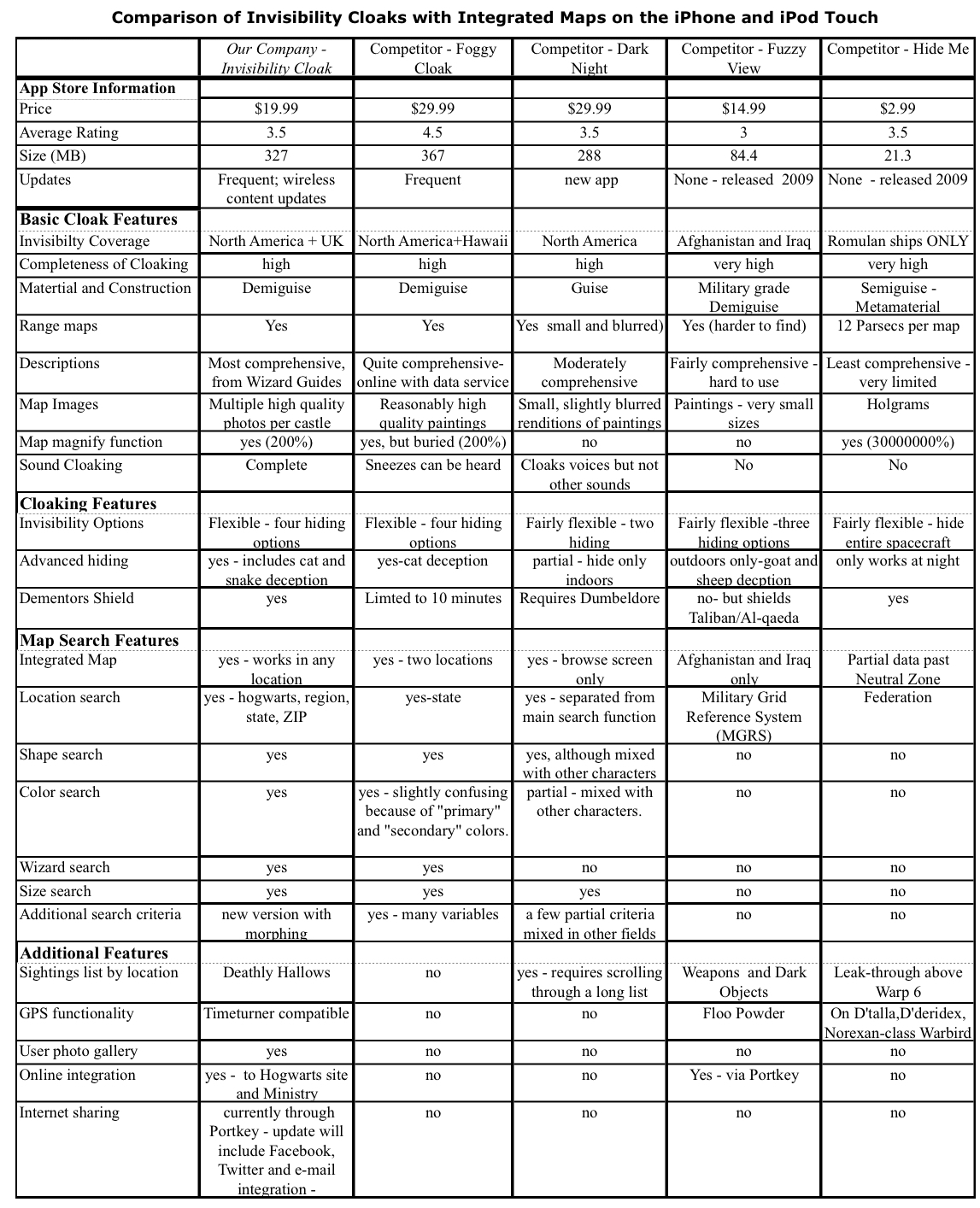
Trading emails with a startup CEO building an iPhone app, I asked him why potential customers would buy his product.  In response he sent me a competitive analysis. It looked like every competitive analysis I had done for 20 years, (ok maybe better.)

And it made me sad. Looking at the spreadsheet, I realized that competitive analysis tables are one of the ways professional marketers screw up startups from day one. And I had done my share.

Here’s why.

Prove What I Already Believe
Most competitive analyses are: 1) sales documents for investors and/or 2) an attempt to rationalize the founders assumptions.

It’s Part of the Plan
Most investors require you to write a business plan which includes a section called a “competitive analysis” in which you tell potential investors how your product compares to products other companies trying to develop and sell to the same customers. While most investors don’t actually read your business plan for a first meeting, a summary of your competitive analysis usually ends up as a slide or two in your PowerPoint presentation.

Your goal in this slide is to tell investors: 1) you understand the market you are selling to, 2) you understand the other companies selling in your market, and 3) you understand how and why you are better than any of the products currently in the market. You are also implicitly telling potential investors, “These features on our competitive slide mean we will sell a lot of what we are planning to build so invest in us.”

Death by Analysis
I looked at the competitive analysis this startup CEO sent to me. This guy was experienced, he worked at lots of large companies, so the table was thorough, it had lots of rows and mentioned all the competitors.

Not only was it wrong, it would set his company back months and possibly even kill them.

Why?

Competitive Analysis Drives Feature Sprawl
In most startups the competitive analysis feature comparison ends up morphing into the Marketing Requirements Document that gets handed to engineering. The mandate becomes; “Our competitors have these features so our startup needs them too. Get to work and add all of these for first customer ship.”

Product development salutes and gets to work building the product. Only after the product ships does the company find out that customers couldn’t have cared less about most of the bells and whistles.

Instead of optimizing for a minimum feature set (that had been defined by customers) a competitive analysis drives a maximum feature set.

This is not good.

Where Are the Customers?
Here’s the problem: How did the founder know which features to choose on the competitive analysis table? When I was running marketing, the answer usually was, “We’ll put up whatever axes or feature comparisons that make us look best in this segment to potential investors. What else would you choose?”

At its best a competitive analysis assumes that you know why customers are going to buy your product.  At its worst it exists to rationalize the founder’s assumptions about what they are building. This is a mistake – and it is a contributing factor (if not a root cause) of why most startups get their initial feature set wrong.

If you are building a competitive analysis table, do so only after you understand that the features you are listing matter to customers. Most marketers are happy to build feature comparisons. But customers don’t buy features, they usually buy something that solves a real or perceived need. That’s the comparison you and your investors should be looking at –  what do customers say they need or want?

The answer to that question is almost never in your building.

How to Make A Competitive Analysis Useful
A competitive analysis makes sense when your startup is entering an Existing market –  where the competitors are known, the customers are known, and most importantly – the basis of competition is known.

(The basis of competition are the features that customers in an existing market have said, “Yes, this is what is extremely important to me. I will dump my current supplier/manufacturer for your new product because yours is smaller/faster/easier to buy/get to/tastes better, etc.)

You win in an existing market when you are better or faster on those metrics that customers have told you are the basis of competition. Your competitive analysis must be around those metrics.

But most startups are not entering an Existing market. They may be trying to:

  • Take a segment of an existing market by offering a product that
    1) costs less (trading fewer features for a lower price) or
    2) addresses the specific needs of a customer segment that the existing suppliers have failed to address
  • Or they may be creating an entirely new market with a disruptive innovation that never existed before.

In a Resegmented market, a competitive analysis starts with the hypothesis of “Here’s the problem we are solving for customers.” The competitive analysis chart highlights the product features that differentiate your startup from the existing market incumbents because of your understanding of specific customer needs (not your opinion) in this niche.

In a New market a competitive analysis starts with the hypothesis of “We are creating something that never existed before for customers.” The competitive analysis table highlights the product features that show what customers could never do before. It compares your company to groups of products or services.

I asked the CEO to go back to the competitive analysis and tell me whether he really knew what features matter most to potential customers. If not, he should get out of the building and find out.

Lessons Learned

  • Too often competitive analysis drives product requirements in startups.
  • This can lead engineering to build the maximum feature set rather than minimum feature set.
  • You need to get outside the building and figure out what features matter to most customers.
  • No feature lists without facts.

Add to FacebookAdd to DiggAdd to Del.icio.usAdd to StumbleuponAdd to RedditAdd to BlinklistAdd to TwitterAdd to TechnoratiAdd to Yahoo BuzzAdd to Newsvine

Customer Development for Web Startups

Customer Development is a technique startups use to quickly iterate and test each part of their business model.  How you execute Customer Development varies, depending on your type of business. In my book, “The Four Steps to the Epiphany” I use enterprise software as the business model example.

Ash Maurya, the CEO of WiredReach, has extended my work by building a model of Customer Development for Web Startups.

I think his process models are pretty good. Go read both of his posts on Discovery and Validation for web startups. His two key slides are at the end of this post but the details on his blog are worth reviewing.

Customer Development In Context
Your startup is an organization built to search for a repeatable and scalable business model.


Your job as a founder is to quickly validate whether the model is correct by seeing if customers behave as your model predicts. Most of the time the darn customers don’t behave as you predicted.

Customer Development is the process startups use to quickly iterate and test each element of their business model. Agile Development is the way startups quickly iterate their product as they learn. A Lean Startup is Eric Ries’s description of the intersection of Customer Development, Agile Development and if available, open platforms and open source.

Diving into the Customer Development diagram inside the diagram above, we see that the first two steps, Customer Discovery and Customer Validation are all about iteration and testing of your business model.

How you actually do Customer Discovery and Validation depends on what type of business you are in. What makes sense for startups selling Enterprise Software may not work for startups on the web. Therefore you need different versions of the actual steps of Customer Development for different types of businesses.

The Customer Discovery step for Enterprise Software Startups
The first step in the Customer Development is Customer Discovery: testing your hypotheses. The flow for Customer Discovery for an enterprise software company was described in the Four Steps to the Epiphany. It looked like this:


.

The Customer Discovery step for Web Startups
Ash Maurya‘s version of the Discovery step of Customer Development for a web startup looks like this:

.

Customer Validation for Enterprise Software Startups
The next step in the Customer Development process is Customer Validation – making sure that there really is a repeatable and scalable revenue and business model before you turn up your cash burn rate.  My version of Customer Validation for an enterprise software company looked liked this:

.

Customer Validation for Web Startups
Ash Maurya‘s version of the Valdiation step of Customer Development for a web startup looks like this:

Lessons Learned

  • A startup is an organization built to search for a repeatable and scalable business model.
  • Customer Development is a technique startups use to quickly iterate and test each part of their business model.
  • You need different versions of the actual steps of Customer Development for different types of businesses.
  • This post illustrates a version of Customer Development for startups on the web.

Add to FacebookAdd to DiggAdd to Del.icio.usAdd to StumbleuponAdd to RedditAdd to BlinklistAdd to TwitterAdd to TechnoratiAdd to Yahoo BuzzAdd to Newsvine

No Accounting For Startups

Startups that are searching for a business model need to keep score differently than large companies that are executing a known business model.

Yet most entrepreneurs and their VC’s make startups use financial models and spreadsheets that actually hinder their success.

Here’s why.

Managing the Business
When I ran my startups our venture investors scheduled board meetings each month for the first year or two, going to every six weeks a bit later, and then moving to quarterly after we found a profitable business model.

One of the ways our VC’s kept track of our progress was by taking a monthly look at three financial documents: Income Statement, Balance Sheet and Cash Flow Statement.

If I knew what I knew now, I never would have let that happen.  These financial documents were worse than useless for helping us understand how well we were (or weren’t) doing.  They were an indicator of “I went to business school but don’t really know what to tell you to measure so I’ll have you do these.”

To be clear – Income Statements, Balance Sheets and Cash Flow Statements are really important at two points in your startup.  First, when you pitch your idea to VC’s, you need a financial model showing VC’s what your company will look like after you are no longer a startup and you’re executing the profitable model you’ve found.  If this sounds like you’re guessing – you’re right – you are.  But don’t dismiss the exercise.  Putting together a financial model and having the founders understand the interrelationships of the variables that can make or break a business is a worthwhile exercise.

The second time you’ll need to know about Income Statements, Balance Sheets and Cash Flow Statements is after you’ve found your repeatable and profitable business model.  You’ll then use these documents to run your business and monitor your company’s financial health as you execute your business model.

The problem is that using Income Statement, Balance Sheets and Cash Flow Statements any other time, particularly in a startup board meeting, has the founding team focused on the wrong numbers.  I had been confused for years why I had to update an income statement each board meeting that said zero for 18 months before we had any revenue.

But What Does a Business Model Have to Do With Accounting in My Startup?
A startup is a search for a repeatable and scalable business model.  As a founder you are testing a series of hypotheses about all the pieces of the business model: Who are the customers/users? What’s the distribution channel? How do we price and position the product? How do we create end user demand? Who are our partners? Where/how do we build the product? How do we finance the company, etc.

An early indication that you’ve found the right business model is when you believe the cost of getting customers will be less than the revenues the customers will generate. For web startups, this is when the cost of customer acquisition is less than the lifetime value of that customer.  For biotech startups, it’s when the cost of the R&D required to find and clinically test a drug is less than the market demand for that drug.  These measures are vastly different from those captured in balance sheets and income statements especially in the near term.

What should you be talking about in your board meeting? If you are following Customer Development, the answer is easy.  Board meetings are about measuring progress measured against the hypotheses in Customer Discovery and Validation. Do the metrics show that the business model you’re creating will support the company you’re trying to become?

Startup Metrics
Startups need different metrics than large companies.  They need metrics to tell how well the search for the business model is going, and whether at the end of that search is the business model you picked worth scaling into a company. Or is it time to pivot and look for a different business model?

Essentially startups need to “instrument” all parts of their business model to measure how well their hypotheses in Customer Discovery and Validation are faring in the real world.

For example, at a minimum, a web based startup needs to understand the Customer Lifecycle, Customer Acquisition Cost, Marketing Cost, Viral Coefficient, Customer Lifetime Value, etc.  Dave McClure’s AARRR Model is one illustration of the web sales pipeline.

At a web startup, our board meetings were discussions of the real world results of testing our hypotheses from Customer Discovery.  We had made some guesses about the customer pipeline and now we had a live web site.  So we put together a spreadsheet that tracked these actual customer numbers every month.  Every month we reported to our board progress on registrations, activations, retained users, etc. They looked like this:

User Base

  • Registrations (Customers who completed the registration process during the month)
  • Activations (Customers who had activity 3 to 10 days after they registered.  Measures only customers that registered during that month)
  • Activation/Registrations %
  • Retained 30+ Days
  • Retained 30+/ Total Actives %
  • Retained 90+ Days
  • Retained 90+/Total Actives %
  • Paying Customers (How many customers made $ purchases that month)
  • Paying/(Activations + Retained 30+)

Financials

  • Revenue
  • Contribution Margin

Cash

  • Burn Rate
  • Months of cash left

Customer Acquisition

  • Cost Per Acquisition Paid
  • Cost Per Acquisition Net
  • Advertising Expenses
  • Viral Acquisition Ratio

Web Metrics

  • Total Unique Visitors
  • Total Page Views
  • Total Visits
  • PV/visit

A startup selling via a direct sales force will want to understand: average order size, Customer Lifetime Value, average time to first order, average time to follow-on orders, revenue per sales person, time to salesperson becomes effective.

Regardless of your type of business model you should be tracking cash burn rate, months of cash left, time to cash flow breakeven.

Tell Them No
If you have venture investors, work with them to agree what metrics matter.  What numbers are life and death for the success of your startup?  (These numbers ought to be the hypotheses you’re testing in Customer Discovery and Validation.) Agree that these will be the numbers that you’ll talk about in your board meeting.  Agree that there will come times that the numbers show that the business model you picked is not worth scaling into a company. Then you’ll all agree it’s time to pivot and look for a different business model.

You’ll all feel like you’re focused on what’s important.

Lessons Learned

  • Large companies need financial tools to monitor how well they are executing a known business model.
  • Income Statements, Balance Sheets and Cash Flow Statements are good large company financial monitoring tools.
  • Startups need metrics to monitor how well their search for a business model is going.
  • Startups need metrics to evaluate wither the business model you picked is worth scaling into a company.
  • Using large company financial tools to measure startup progress is like giving the SAT to a first grader.  It may measure something in the future but can only result in frustration and confusion now.

Add to FacebookAdd to DiggAdd to Del.icio.usAdd to StumbleuponAdd to RedditAdd to BlinklistAdd to TwitterAdd to TechnoratiAdd to Yahoo BuzzAdd to Newsvine