Solving the Innovator’s Dilemma – Customer Development in a Big Company

One of the ways I learn is to teach. My students ask questions I can’t answer and challenge me to solve problems I never considered. At times I’ll do what I consider an extension of teaching; a two-day Customer Discovery/Validation intensive session with a large corporation serious about Customer Development at my ranch on the California Coast.

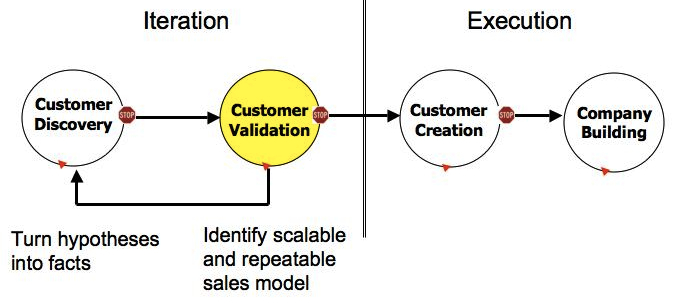
My last session was with a passionate, smart, entrepreneurial team from a Fortune 100 company. (And if I told you who they were I’d have to kill you.) Their copies of the Four Steps were dog-eared and marked with sticky notes. We spent two days of analyzing and exploring their customer discovery visits just completed across South America, Africa and Asia. Learning which hypotheses survived these visits were eye-openers for all of us. We used what they learned to plan their next steps for additional Discovery, and ultimately Customer Validation.

It reminded me of the differences in Customer Discovery between a scalable startup and a big company. Here’s what we observed:

It’s Easier for Big Companies to Get Meetings – But It’s Not Always a Blessing
When a big company calls prospective customers to set up Discovery meetings, their datebook fills up fast. Execs at higher levels than you’d expect join the meeting eager to hear what the big company has to say about their industry. That’s the good news. The bad news is that the meetings become far more formal and more crowded, than one that a startup would have. This crowd actually dampens the opportunity for learning. Since the meetings attract senior execs everyone around the table waits for the big boss to speak and follows his or her lead. This stifles or shuts down the important “outlier” conversations that drive pivots and iterations in the discovery process.

Solution: try to get a blend of one-on-one meetings along with the group session. And be sure to set expectations for the meeting before it happens.

We’re Not Here for a Sales Call
If someone from a large company is flying halfway around the world to visit your company, your presumption is they have something to sell you. Crucial in the Customer Discovery process is not selling…it’s listening. The exploring, probing, gaining reactions is why you’re there. (Of course, if someone forces a purchase order on you and you reject it, you’ve just failed miserably at entrepreneurship.)  Disabusing the audience of the notion that the visit is a sales call is vital to the customer discovery mission. Followers of the Customer Development process know that you can’t start selling until you have transformed product, customer and other hypotheses into a validated business model and sales roadmap. (Short-circuiting that process is a major “foul” that often leads to premature business models and suboptimal sales results.)

To potential customers who’ve never been asked for their opinion before, the purpose of a Discovery meeting can be confusing. There are business cultures where the vendor/customer interactions are limited to “here’s what I have to sell, do you want to buy it.”

Solution: spend more time on the “setup” for the meeting. Tell potential customers before you meet, “We’re working on an interesting product and we’d be happy to share where we are in exchange for some feedback. But we are not here for a sales call.”

Getting the Customer to Talk is Even More Challenging
There’s no more important skill in Customer Discovery than “good listening.” When a big company shows up, everyone expects an important formal presentation, which is hardly your Discovery mission at all.  Structuring the conversation in a way that elicits feedback before you reveal the product hypothesis is essential to getting honest reactions, good or bad. Yet just reading your questions from a list is a real-turnoff. Insert them casually into a conversation and don’t try too hard to get every one of them answered in every meeting.

Solution: One of our favorite hints, from a great post by ash maurya, is to pose problems to the group in a randomized list. “We see these three problems in your industry.  Do you agree?  Could you rank them in order of importance to you?”  This literally forces a discussion and prioritization and is repeatable again and again. “We believe the most important features you need in a supersonic transporter are….” or “Our research tells us that female consumers most want a, b, and c.”

Big Companies are Bred for Large Scale Success
When you’re doing disruptive innovation in a multi-billion dollar company, a $10Million dollar/year new product line doesn’t even move the needle. So to get new divisions launched large optimistic forecasts are the norm. Ironically, one of the greatest risks in large companies is high pressure expectations to make these first pass forecasts that subvert an honest Customer Development process. The temptation is to transform the vision of a large market into a solid corporate revenue forecast – before Customer Development even begins.

Solution: Upper management needs to understand that a new division pursuing disruptive innovation is not the same as a division adding a new version of an established product. Rather, it is a organization searching for a business model (inside a company that’s executing an existing one.) That means you may find that revenue appears later than the plan called for, or that there are no customers or fewer than the plan suggests.

Customer Development Without Agile Engineering Is A Plan For Failure
Beleving in Customer Development but still retaining waterfall development for engineering and manufacturing is a setup for problems if not outright failure. Even in a large company you can’t do Customer Development without aligning some part of engineering to respond to unexpected customer needs and findings.

Solution: Get engineering buy-in by. Make sure the engineering and manufacturing plans “before” Customer Development don’t look the same as “after” Customer Development.

Spend your Way to Success Usually Results in the Opposite
Ironically large revenue goals may lead to largesse in overfunding the new division, with the implicit assumption that dollars can “buy your way to success.” All the money in the world doesn’t negate the painful search for a business model, or the lack of a scalable/profitable one. And new divisions in large companies operate just like startups who get overfunded – somehow their expense budgets always equal at least their funding.

Solution: Eight and nine digit funding before Customer Discovery is a curse not a blessing. Take the money in tranches (equivalent to VC “rounds”) predicated on milestones in finding a repeatable and scalable business model.

There’s an Overhead Cost to Being an Entrepreneur in a big, established corporation
Large companies are just plain organized – with rules, HR, finance and more importantly, are built around process and procedures for execution. It’s why so few big companies succeed at true entrepreneurship.

Solution: Assume as a given that as a new division head at least 15% of your time will be spent managing up and protecting down. Few in your own company will understand what you’re up to.

Lessons Learned

  • Customer Development in large companies has it’s own unique challenges
  • Some parts of being a big company make it easier, others make being a startup even riskier

Add to FacebookAdd to DiggAdd to Del.icio.usAdd to StumbleuponAdd to RedditAdd to BlinklistAdd to TwitterAdd to TechnoratiAdd to Yahoo BuzzAdd to Newsvine

How Customer Development Failed Us

One of the attributes of great entrepreneurs is that they are tenacious and relentless. This guest post is from Andrew Elliott of Lottay. Andrew read the Four Steps to the Epiphany, tracked me down at California Coastal Commission hearing in Santa Barbara, and had me meeting with him in a stairwell during a break in my day-long meeting.

Here’s his story of when Customer Development failed.

——–

Hi, we’re Lottay!  We’ve been a startup for the past two years or so and we’ve come to a critical point on this crazy roller coaster ride.  Here’s our story:

We started like most entrepreneurs — an idea, an opportunity, and very little money. Our vision was to radically change the gift card industry. We were lucky to learn about Customer Development early on in the life of our startup.  It made more sense than our 60 page business plan predicated on a B-school class and a supernatural ability to predict the future. More importantly, we’d witnessed Customer Development’s massive success at another local startup.

We bought Steve’s book, started product development and began reaching out to customers ins search of our first earlyvangelists. Along the way we were fortunate to meet Steve, develop strategic partnerships, and raise a series A round of investment.  Confident we were Doing It Right, we pressed forward.  We even had some pretty monumental successes.  So how did Customer Development fail us?  Well, perhaps it’s more accurate to say that we failed customer development.

In retrospect, our mistakes fell mainly into one of two categories:

(1) Failure to follow the process

(2) Failure to be honest with ourselves

If we could travel back in time to that fateful meeting at the Coffee Cat and give ourselves a good talking to, what would we say?  Well, it just so happens that we’ve fitted Ross’s 2001 Subaru with a flux capacitor, gotten our hands on some plutonium and we’re about to hit eighty eight miles per hour!  Here’s what we plan to say:

Write it Down
This seems so obvious, yet it must be said: write down and track the evolution of your hypotheses. It’s something that’s almost too easy to gloss over — keeping track of your hypotheses and the results of your customer development work are vital. Failure to keep track of our hypotheses meant we were never quite clear on what was working and what was not.  This meant we had a hard time focusing our development.

It’s your vision damn it!
The customer does not define the product or vision for the company. The founders do. In Four Steps to the Epiphany Steve says you’re looking for a niche – he means that you’re going to hear a lot of “No’s” and that’s okay. What’s not okay is letting these non-customers define your vision daily.

Failure to maintain a coherent vision allowed us to pitch one thing, “It’s a virtual gift card you can spend on anything!” while selling something else, “It’s an ecard + money!”  After a while even we didn’t know which was our actual vision.

Make Money or Take Money?
Focus on revenue from day one.  It’s the only reliable metric for success. You may think you’ve found your earlyvangelists but you can only be sure when they start making you money.

Taking outside investment gives you options. But with this money comes temptation. Temptation to focus on growth and worry about revenue later.  Temptation to stay the course when your gut tells you it’s time to change.  Making revenue your first priority does so many good things for you as an entrepreneur – saves cash, validates customers, and tells you if you have a real business. It’s only a business if you make money.

Fail Fast and Move On
Being honest with yourself is perhaps the hardest part of being an entrepreneur. You’ve sold your friends, your investors, and yourself on your vision. You wouldn’t be putting yourself and your family through this if you didn’t believe in your idea. So who keeps you honest and tells you when you don’t have a business? Your customers and your hypotheses.

There may come a time you need to face the fact that the earlyvangelists you thought you had are actually just very polite users.  Face the fact that your product won’t be able to make money or scale.  Face the fact that your hypotheses are all wrong.  And ultimately, face that fact that it’s time to majorly rewrite your vision. The sooner you face these facts the more chances you’ll have to course-correct and win.

The Future?
Now that we’re back from the past, how are we moving forward?  Well, we’re back to customer discovery.  And this time we’re writing it down. In fact, we’re creating a simple software solution that guides us through documenting customer interactions and validating our hypotheses (let us know if you’re interested in testing it). We’re also charging customers and partners right off the bat for our services.  And we’re using that money to do more customer discovery and validation. Finally, we’re holding ourselves accountable to our vision and hypotheses.

Disclaimer
Keep in mind that our opinions are just that. We may have no idea what we’re talking about. After all we’re just some guys trying to make it in this crazy startup world.  We’d love to know what you think. Do these ring true to you?  How do you keep track of your vision and hypotheses?Leave a comment or email us at contact@lottay.com.

Lessons Learned

  • Customer Development is like being Agile.  It’s easy to say you’re doing it. Hard to actually do it.
  • Add to FacebookAdd to DiggAdd to Del.icio.usAdd to StumbleuponAdd to RedditAdd to BlinklistAdd to TwitterAdd to TechnoratiAdd to Yahoo BuzzAdd to Newsvine

    The Rise of the Lean VC – Consumer Internet Gets Its Own Investors

    Consumer Internet investing seems to have split off from traditional Venture Capital, and is creating a new category of VC’s: Lean VC’s.  I think you can blame Customer and Agile Development for a small part of it.

    Here’s why.

    Electron-based Venture Capital
    When I first came to Silicon Valley the world of Venture Capital looked pretty simple. VC’s invested in things that ran on electrons: hardware, software and silicon.  While individual VC’s inside venture firms specialized in particular domains (PC’s, peripherals, semiconductors, test equipment, operating systems, applications, etc.,) their investments had roughly the same time horizon and were focused around things that used electrons – primarily computing and computing infrastructure.

    The VC business took off with the rapid growth of the semiconductor business. Fairchild Semiconductor became the progenitor of a flood of Silicon Valley chip companies and at the same time the adoption of the limited partnership as the model for Venture Firms gave VC’s their own profitable business model. The personal computer business was built on top of the semiconductor business about the same time that the last of the pieces of Venture Capital were falling into place – the 1979 change in the EISRA “prudent man” rule allowing pension funds to pour billions into Venture Funds.

    Here’s what the start of Valley chip business looked like on a genealogy map, tracing most all of its DNA back to the first Silicon Valley chip company, Schockley Semiconductor.

    Cell-based Venture Capital – The Birth of Biotech Venture Capital
    In 1980 Genentech became the first IPO of a venture funded biotech company. The fact that serious money could be made in companies investing in life sciences wasn’t lost on the venture community.  But the knowledge that VC’s had built investing in electron-based companies didn’t translate to expertise in cell-based or cell-proximate companies.  The technologies were different, the time horizons were different, (2 to 5x longer to take a drug through FDA trials ~14 years,) and the regulatory environment was different (barely any in traditional VC investments compared to FDA trials for drugs and 510K approvals needed for medical devices.) Finally the amount of capital needed to take a drug to FDA trials could be enormously expensive, at least 10x more than startup costs at an electron-based company.

    The two watershed events for biotech startups were the Bayh-Dole Act of 1980 and the Orphan Drug Act of 1983. Bayh-Dole allowed for private ownership of government funded intellectual property developed in universities while the Orphan Drug Act created incentives for developing drugs for disorders afflicting fewer than 200,000 Americans.

    After a while, the only thing Biotech VC’s had in common with their compatriots who invested in electrons was that they both invest.  (In some Venture Capital firms they may share the same roof and overhead, but no one is confused, they’re in very different businesses.)

    The Rise of the “Lean VC’s” – Consumer Internet Gets Funded
    For a few reasons, I’ve been struggling to make sense of all the noise happening in what others have called the Super Angel arena. First, my students are confused about who to talk to and how to think about funding their consumer internet startups.  Second, and full disclosure, I’ve invested in a few of these funds; and third my teaching partner Ann Miura-Ko is a partner in one of these funds.

    My take is that we are watching an entirely new category of Venture Capital firms emerge.  It is as an important a split as when the biotech guys hung out their shingles.

    Consumer Internet startup investors are now their own category.  I call them “Lean VC’s” to emphasize why they’re different.

    (In his indomitable way, Dave McClure describes this shift best, but I have to screen-scrape his posts, paste them into Word and clear the formatting to read them.)

    One could argue that there’s nothing new here, as Internet distibution models started in 1995. But in reality they only became mainstream ~5-7 years ago. Most of the social and mobile channels (YouTube, Facebook, Twitter, iPhone, Android) have emerged in just the past 3-5 years. But these VC’s aren’t Lean because they fund startups with web-based distribution models. It’s because the startups are doing something very new that make them “Lean” :

    • These startups embrace customer and agile development that Eric Ries has been evangelizing.
    • They build a minimum feature set.
    • Quickly iterate the product in front of customers.
    • Drive for a repeatable and scalable business model (revenue in Dave McClure’s investment thesis, “network of scale” in Union Square’s.)
    • Their capital needs are low at the front end. The advantage of commodity software stacks drops initial startup costs for Internet Commerce companies. (But scaling customer acquisition may take the same amount of dollars as a traditional software startup.)

    Lean VC’s are Different
    The skills needed to succeed as a “Lean VC” are different from those needed for traditional software investing. Previous experience of investing in software companies that hire direct sales organizations and take years to build the product using waterfall development doesn’t translate to expertise in Consumer Internet startups. The technologies are different, the speed of execution, iteration and pivots are different and the time horizons for exits are different, (2 to 5x shorter for a consumer Internet company.)

    Finally, the “death of the IPO” and the emergence of the “small market M&A” changes Consumer Internet economics. One of the interesting characteristics of these new “Lean VC” funds is that they can be smaller than the traditional multi hundred million dollar VC fund. The small investments necessary to get a consumer internet startup going enables Lean VC’s to make lots of early bets and double-down when early results appear. (And the results do appear years earlier then in a traditional startup.)

    (BTW, just like the Biotech VC’s who may share a building with Electron-based VC’s, you may find a Lean Venture Capitalist sitting under the same roof as a traditional VC. Just make sure they get and embrace the Lean VC principles. The test is, ask them how they differ in their investing philosophy from the rest of their firm.)

    Lean Angels
    Along with Lean VC’s a new class of angel investors has emerged. YCombinator, Techstars, et al, have been described as incubators but in reality they are the new “Lean Angels.”  These angels “get” the sea change happening in Internet Commerce. The difference is that unlike Lean VC’s, these angels help their startups rapidly develop the product, but typically don’t add much help in developing the market/customers. And while they provide the initial investment they rarely follow-on with the Series A dollars needed for scale. They’re a great feeder system for the new class of Lean VC’s.

    Lessons Learned

    • Entrepreneurs in the consumer Internet space should look for funding from Lean Angels or Lean VC’s
    • Lean VC’s are expert in on-line distribution, Agile and Customer Development
    • They drive for early results inexpensively, and invest heavily when they see results
    • Their strategies for their startups differ – some focus on revenue, others build large networks of users

    Keeping Score

    One of the toughest problems for entrepreneurs is to keep score as they search for their business model.

    Keeping Score
    One of the key concepts of Customer Development is writing down your initial hypotheses (guesses) of all the parts of your business model, then updating them with the facts you find outside the building.

    Since I first wrote the book Four Steps to the Epiphany I’ve realized that an even better way to keep score is by diagramming each of your  business model hypotheses on a whiteboard and updating them as your iterate and pivot. I’ve been experimenting with how to best teach this idea to students in classroom and with startups. My favorite book of how to diagram your business is Business Model Generation written by Alexander Osterwalder.  It has the notion that any business model can be drawn with just 9 separate boxes.  It’s a great idea.

    The Real World
    My teaching partner Ann Miura-Ko and I both love the concept of Business Model Generation. However we find using the book to teach and in early stage venture problematic. It makes assumptions about the depth of knowledge about business models that we find that students and startups lack. For example, we find that the distinction between who’s a user and who’s a customer may be obvious to sophisticated strategists in large companies but is often overlooked in a startup. The same issues arise between understanding the difference between a distribution channel and the specific demand creation activities needed to drive customers into that channel. Being able to get these concepts is the difference between startup success and failure.  So while we love the book, Ann has been drawing her own business model diagrams you’ll see in the presentation below.

    Given Ann and I are such big fans of the Business Model Generation book we were happy to have coffee with Alexander Osterwalder and share our thoughts about what we thought was missing. In hindsight I think we were asking for the business model generation book for dummies (kind of like someone asking me for six steps to Customer Development rather than four,) but Alexander was not only was generous with his time but posted a thoughtful response to our comments.

    Business Plans Versus Business Models
    Given what I think of Business Plan competitions, it was ironic that I spoke last week at the Clean Tech Open business plan competition conference. I did appreciate the venue and shared my thoughts of how a startup goes from an idea to a business plan to business model to customer development and finally to a venture pitch, all in the presentation below.

    Lessons Learned

    • Gather all your hypotheses in Customer Discovery
    • Diagram all your hypotheses of your business model
    • Update the diagram as you gather facts outside the building
    • Minor iterations will make minor changes to the diagram
    • Pivots will have you changing major pieces

    Add to FacebookAdd to DiggAdd to Del.icio.usAdd to StumbleuponAdd to RedditAdd to BlinklistAdd to TwitterAdd to TechnoratiAdd to Yahoo BuzzAdd to Newsvine

    The Phantom Sales Forecast – Failing at Customer Validation

    Startup CEO’s can’t delegate sales and expect it to happen. Customer Validation needs to have the CEO actively involved.

    Here’s an example in a direct sales channel.

    Customer Development Diagnostics over Lunch
    A VC asked me to have lunch with the CEO of  a startup building cloud-based enterprise software. (Boy did I feel like Rip Van Winkle.) The board was getting nervous as the company was missing its revenue plan.

    These lunches always start with the CEO looking like they had much better things to do. Before lunch even came the CEO ticked off the names of forty or so customers he talked to during the company’s first nine months and gave me a great dissertation on the day-in-the-life of his target customers and what their problems were. He went through his product feature by feature and matched them to the customer problems. He talked about how his business model would make money and how the prospects he talked to seem to agree with his assumptions.

    It certainly sounded like he had done a great job of Customer Discovery.

    Sales Process
    Next, he took me through his sales process. They had five salespeople supported by two in marketing. (They had beta customers, using but not paying for the product.)

    Over lunch the CEO told me he had stopped talking to customers since he had been tied up helping get the product out the door and his VP of Sales (a successful sales executive from a large company) had managed the sales process for the last six months. In fact, the few times he had asked to go out in the field the VP of Sales said, “Not yet, I don’t want to waste your time.”

    Too Good to Be True
    For the first time I started squirming in my seat. He said, “I insist on getting weekly status reports with forecasted deal size and probability of close. We have a great sales pipeline.” When I asked how close any of the deals on the forecast were to getting closed, he assured me the company’s two beta customers—well-known companies that would be marquee accounts if they closed—were imminent orders.

    “How do you know this?” I asked. “Have you heard it personally from the customers?”

    Now it was his turn to squirm a bit. “No, not exactly,” he replied, “but our VP of Sales assures me we will have a purchase order in the next few weeks or so.”

    I put my fork down. Very few large companies write big checks to unknown startups without at least meeting the CEO. When I asked if he could draw the sales road map for these two accounts that were about to close, he admitted he didn’t know any of the details, given it was all in the VP of Sales’ head. Since we were running out of time, I said, “Your sales pipeline sounds great. In fact, it sounds too good to be true. If you really do close any of these accounts, my hat is off to you and your sales team. If, as I suspect they don’t close, do me a favor.”

    “What’s that?” He asked, looking irritated.

    “You need to pick up the phone and call the top five accounts on your sales pipeline. Ask them this question: if you gave them your product today for free, are they prepared to install and use it across their department and company? If the answer is no, you have absolutely no customers on your forecast who will be prepared to buy from you in the next six months.”

    He smiled and stuck me with the tab for lunch. I didn’t expect to hear from him ever again.

    What If the Price Were Zero?
    Less than two weeks later, I got a call and was surprised to hear the agitated voice of the CEO. “Steve, our brand-name account, the one we have been working on for the last eight months, told us they weren’t going to buy the product this year. They just didn’t see the urgency.” Listening, I got the rest of the story.

    “When my VP of Sales told me that,” he said, “I got on the phone and spoke to the account personally. I asked them your question—would they deploy the product in their department or company if the price were zero? I’m still stunned by the answer. They said the product wasn’t mission critical enough for their company to justify the disruption.”

    “Wow, that’s not good,” I said, trying to sound sympathetic.

    “It only gets worse,” he said. “Since I was hearing this from one of the accounts my VP of Sales thought was going to close, I insisted we jointly call our other ‘imminent’ account. It’s the same story as the first. Then I called the next three down the list and got essentially the same story. They all think our product is ‘interesting,’ but no one is ready to put serious money down now. I’m beginning to suspect our entire forecast is not real. What am I going to tell my board?”

    My not-so-difficult advice was that he was going to have to tell his board exactly what was going on. But before he did, he needed to understand the sales situation in its entirety, and then come up with a plan for fixing it. Then he was going to present both the problem and suggested fix to his board. (You never want a board to have to tell you how to run your company. When that happens, it’s time to update your resume.)

    The Phantom Sales Forecast
    The implications of a phantom sales forecast meant something fundamental was broken. In talking to each of his salespeople, he discovered the sales team had no standardized sales process. Each was calling on different levels of an account and trying whatever seemed to work best. This was just a symptom of something deeper –  while they thought they understood the target customer their initial hypotheses from Customer Discovery were wrong. But no one had told the CEO.

    He realized the company was going to have to start from scratch, Pivot back to Customer Discovery and find out how to develop a sales road map. He presented his plan to the board, fired the VP of Sales and kept his best salesperson and the marketing VP. Then he went home, kissed his family goodbye, and went out to the field to discover what would make a customer buy. His board wished him luck and started the clock ticking on his remaining tenure. He had six months to get and close customers.

    Customer Validation
    The CEO had discovered what happens when you do a good job on Customer Discovery but get too “busy” for to personally get involved in Customer Validation. It wasn’t that he didn’t need a VP of Sales, but he had entirely outsourced the Validation step to him. Until a scalable and repeatable business model is found the CEO needs to be intimately involved in the sales process.

    Lessons Learned

    • Ownership of Customer Validation belongs to the CEO.
    • A VP of Sales can assist but the CEO needs to answer:
    • Do I understand the sales process in detail?
    • Is the sales process repeatable?
    • Can I prove it’s repeatable? (Proof are multiple full-price orders in sufficient quantity.)
    • Can we get these orders with the current product and release spec?
    • Do we have a workable sales and distribution channel?
    • Am I confident we can scale a profitable business?

    Add to FacebookAdd to DiggAdd to Del.icio.usAdd to StumbleuponAdd to RedditAdd to BlinklistAdd to TwitterAdd to TechnoratiAdd to Yahoo BuzzAdd to Newsvine

    Nature versus Nurture in Entrepreneurs

    Taking Sides
    Are you are born with innate entrepreneurial talent or can you can be taught to operate like an entrepreneur?

    Fred Wilson of Union Square Ventures, Jason Calacanis, founder of Mahalo.com, and Mark Suster of GRP Partners, have all weighed in on the nature side – you’re born being an entrepreneur or you’re not.

    Vivek Wadhwa, Director of Research, Center for Entrepreneurship at Duke, the Kauffmann Foundation for Entreprenuership and others have the opposing view – you can teach people to be entrepreneurial.

    I weighed in on the subject in a previous post.

    Mark Suster, Vivek Wadhwa and Patrick Chung, Partner of New Enterprises Associates debated the subject on April 21st at Stanford. I’ll was the moderator (referee).

    Take a look at the video below.

    [vodpod id=Video.3671058&w=425&h=350&fv=config%3Dhttp%3A%2F%2Fecorner.stanford.edu%2Fembeded_config.xml%253Fmid%253D2434]

    I thought it was a pretty good talk and worth listening to.

    Add to FacebookAdd to DiggAdd to Del.icio.usAdd to StumbleuponAdd to RedditAdd to BlinklistAdd to TwitterAdd to TechnoratiAdd to Yahoo BuzzAdd to Newsvine

    How I Spent My Summer Vacation

    My summer has circled around serendipity and three presentations I’ve given.

    Full Circle from Yosemite
    Nine years ago I took my young daughters on a 7-day pack trip riding mules at 10,000 feet to the Yosemite High-Sierra camps. Granite mountains and alpine green meadows during the day, unblinking stars in the frigid August nights. At a campsite almost two miles high our daughters adopted a young couple, and over the campfire I found out they were Stanford MBA’s and entrepreneurs. Instead of ghost stories they were the first to hear the ideas of what would become Customer Development.

    Fast forward to today. One of those students, Shawn Carolan, is now a partner at Menlo Ventures. When we were looking for funding for IMVU (the company where Eric Ries first implemented Customer and Agile Development and where the Lean Startup was born,) I thought of Shawn. He became the first venture investor and “present at the creation.” If you’re doing Customer Development/Lean Startup, Shawn is a great guy to have as an investor.  He’s lived it and gets it.

    Recently, Shawn invited me to share the Customer Development story at Menlo Ventures annual CEO conference.

    (I’ll show you the slides a bit later in this post.)

    Let’s Get Together Every 15 Years
    About a month ago I got a phone call from Alan Patricof of Greycroft Partners who saw the article about Lean Startups in the NY Times and invited me to talk at their CEO conference. After a few minutes on the phone, Alan and I realized that we had met 15 years ago when his firm looked at investing in my last startup, E.piphany.

    It’s kind of hard not to know who Alan Patricof is. He built APAX Partners into one of the largest VC firms on the East Coast and in Europe. He started a new venture firm when he realized that that the rules had changed for the venture business – VC’s could no longer expect the same kind of returns they got in the past through an IPO. Instead, he realized that most VC-backed startups would exit through a merger or acquisition- at a sale price of $20 to $100 million.

    One of the benefits of speaking at this conference was getting to know VC’s on the east coast and LA. The Greycroft team and Mark Suster of GRP Partners provided lots of local color. (Mark had an amusing summary of the conference here.  Mark is the guy I would call if I was doing a deal in LA and his blog should be on your reading list.)

    You are Here
    When I was in a startup, I remember being so focused on my daily tasks of getting customers and running the business that I had no time to consider “why” I was doing what I was doing. I had even less time to consider how to differentiate what were the right things to do in startup versus a larger company. The talk I gave to the startup CEO’s at both Menlo Ventures and Greycroft Partners was a big picture perspective about how startups differ from large companies and where customer and agile development fit. The talk integrated a series of posts I’ve written since the beginning of 2010: “What is entrepreneurship? The Four types of entrepreneurial organizations, Innovation and entrepreneurship in large companies and The role Pivots play in Customer Development.

    18-Hour Flight for a 45 Minute Talk
    Truth be told, I went to NY for the Greycroft conference because I was already heading east to Tel Aviv for a 45 minute talk. While flying 18 hours to give a 45-minute talk might not seem rational, in fact it provided the rationale to visit a part of the world my wife and I had never seen. I turned the 45-minute invitation into a three week trip. New York to Cairo, Aswan, Abu Simbel, Luxor, Tel Aviv, Haifa, Tiberias and Jerusalem.

    As a country, Israel has the highest ratio of scalable startups per capita. A high percentage of Israeli startups are founded by entrepreneurs who served in Unit 8200 and military intelligence. They are agile, resourceful and aggressive. In the dot-com bubble Israel had more technology companies listed on the NASDQ exchange than all of Europe. Today Israeli companies solve technology problems then typically sell out to a larger U.S. firm.

    While this is an enviable track record, my talk observed that solving just the technology problems and selling out meant that Israeli companies did not become adept at understanding customer needs. (And in Israel you can’t just get out of the building to understand customers, you need to get out of the country.) Given the current Israeli economic and venture climate having great technology is no longer enough. I observed that this may be the time for Israel to take entrepreneurship to the next step and teach their startups the skills needed to grow from flipping technology startups to building enduring companies.

    I used the metaphor of fighter pilots (who have to constantly adapt in real-time) versus military intelligence (who have time to analyze and debate the right answer.) John Boyd of OODA Loop fame got a starring role in the talk.

    It went over like a lead balloon.

    (Slides 43-49 and 81-89 are the ones that differ from the Greycroft presentation.)

    BTW, the schedule of my future talks are now on Plancast.

    Add to FacebookAdd to DiggAdd to Del.icio.usAdd to StumbleuponAdd to RedditAdd to BlinklistAdd to TwitterAdd to TechnoratiAdd to Yahoo BuzzAdd to Newsvine

    When Big Companies Are Dead But Don’t Know It

    It is a rare company that realizes it is time to fire the CEO when the financials are good but the business is fundamentally heading for a cliff.  For me, I learned this lesson first hand. I had joined the board of a $200million public company that 15 years earlier had single-handily created an industry. The company had innovated, found a business model, grown successfully but now even as revenues continued to grow, the company was slowly but surely dying.

    There’s nothing harder than making radical changes when the numbers look great.

    Lifecycle
    The company’s two co-founders had created a new technology and an innovative business strategy. The engineering co-founder had created a consumer electronics security product that created an entirely new category. The other founder, the business guy, managed to get its product legislated into consumer electronics devices. After the initial few years of technical innovation, they found their business model in licensing and over the next decade and a half grew into a $200 million company.

    As the revenues grew, engineering continued to pursue sustaining innovations– incremental improvements on its core technologies.

    At the same time its business strategy became operational execution focused on licensing and legal to collect royalties.

    Execution
    Over time the co-founder responsible for the original business innovations departed. While a large loss, it wasn’t fatal as the company now was executing a repeatable business model.  The new CEO was promoted from inside the company and did an excellent job of running the company. Even though the company was in Silicon Valley, he ran it like it was in Kansas: no frills, no hype, no crazy expenditures, just year after year of increasing revenue and profits. And year after year he managed to come out on top renewing the licensing contracts with Hollywood studios, (who were no pushovers in negotiations). It was impressive.

    We Think We Need Some Technology Advice
    To their credit, the board and CEO realized that this business model couldn’t continue forever. They acquired a small, innovative company in what they thought was an adjacent market. The acquisition turned out to be a culture clash of titanic proportions, kind of like the irresistible force meets the immovable object, as the great startup founder ran headlong into the excellent operating guy. Neither company really understood what it would take to integrate such different worldviews. (More on this in another post.)

    In the middle of this acquisition, both the board (who were finance and Hollywood executives) and the CEO realized that while they were physically in Silicon Valley, they were missing someone familiar with business innovation in technology companies.

    This is when I joined the board.

    Distracted
    After a few months on the board trying to understand the difficulties of integrating the new acquisition, I realized that this was just a side-show. The real issue was that was that the instincts of the board and CEO were right. There were tectonic shifts happening outside the company – changes in markets, technology, platforms, regulations, etc -and outside their control. Worse, these shifts were outside the company’s control, because unlike the original co-founder, now gone, who managed to get their technology written into legislation, no one was working the same magic on the next generation of digital standards online or in the cloud.

    We realized that the company had three to five years left before its licensing business would drop by half. As a board we slowly came to the conclusion we’d have to reinvent the company, and we didn’t have much time. The CEO agreed.

    Reinvention
    Over the next few years, the company built an internal engineering department, and expanded its business development team in search of a new strategy and new companies to acquire.

    To the outside world, things still looked great; year over year, revenue and profits were still increasing.

    At each board meeting, we’d hear about new products and approve new acquisitions while we were increasingly worrying about when revenues of our core product would start declining.

    The world outside the company was changing faster than we could. The new strategies and acquisitions ended up as slight variations on the ones we were already executing.

    We seemed to be out of big ideas.

    Time For a Change
    The problem was, the company needed to think like a startup again. The current team was too focused and ironically too steeped in our current business to imagine radical reinvention.

    We concluded that we needed a new CEO and new board members.

    There’s nothing harder than changing strategy with a CEO who the board admires, with revenues seemingly increasing. Yet the consequences of ignoring the shifts in the market, technology and regulation is a going out of business strategy.

    This was a tough call for the board as we liked the CEO, and he was the one who had asked us to join the board.

    As one could imagine, the existing CEO didn’t agree. “I’ve done everything you guys have asked. Our revenue is still growing and we are acquiring all the new companies.”

    While the CEO is the responsible executive for operating the company on a daily basis, ultimately it’s the responsibility of the board of the directors to hire and fire the CEO. The board is responsible to the shareholders and all the stakeholders for the ultimate survival of the company. Our call was that it was going to take a new set of eyes to get the elephant to dance.

    Postscript
    The new CEO turned the company on its head, divested most of the acquisitions, made other acquisitions worth billions of dollars, refocused the company, changed out most of the board and senior management.

    And he even renamed the company.

    Revenue doubled in the last 3 years and the market cap is approaching $4 billion as he reinvented the company.

    A tough call but the right one for the shareholders.

    Lessons Learned

    • Just because a company is profitable doesn’t mean its core businesses isn’t crumbling under its feet.
    • Big companies are dead long before they close the doors.
    • Ultimately it’s because the board of directors doesn’t act in time.
    • The dilemma is how to make sure that the board is not just a cheerleader for the CEO when the CEO is the primary recruiter for the board.
    • Microsoft fits this description.  Their failures in multiple markets is no longer just a failure of management but a failure of board governance. (Hard to fix when the major shareholder is the lifelong friend of his handpicked replacement.)

    Add to FacebookAdd to DiggAdd to Del.icio.usAdd to StumbleuponAdd to RedditAdd to BlinklistAdd to TwitterAdd to TechnoratiAdd to Yahoo BuzzAdd to Newsvine

    The Search For the Fountain of Youth – Innovation and Entrepreneurship in the Enterprise

    It’s not the strongest of the species that survive, nor the most intelligent, but the one that is most responsive to change.
    Charles Darwin

    Companies have a fairly predictable life cycle. They start with an innovation, search for a repeatable business model, build the infrastructure for a company, then grow by efficiently executing the model.

    Over time, innovations outside the company (demographic, cultural, new technologies, etc.) outpace an existing company’s business model. The company loses customers, then revenues and profits decline and it eventually gets acquired or goes out of business.  (Looking at the Dow-Jones component companies over time is a graphic example of this.)

    Creative Destruction
    If you’re an entrepreneur, you spend your time worrying about how to get out of the box on the left and move to the right.  You want to start executing the business model.

    Ironically, the best CEO’s in the box on the right are constantly worrying not only how to execute but also how to remain innovative and entrepreneurial.

    Innovation and Entrepreneurship in the Enterprise
    How large companies can stay innovative and entrepreneurial has been the Holy Grail for authors of business books, business schools, consulting firms, etc.  There’s some great work from lots of authors in this area.  (A short list at the end of this post.)

    Over 15 years ago, Clayton Christensen observed that there are two types of innovative strategies for a large company – sustaining and disruptive innovation.  He believed that large companies handle sustaining innovation – evolutionary changes in their markets, products, etc. valued by their existing customers – fairly well.  But most large companies find it hard to deal with disruptive innovation – radical shifts in technology, customers, regulatory changes, etc, that create new markets.

    Sustaining Innovation and Entrepreneurship in the Enterprise
    If we use our “startup to large company,” diagram, we can see that sustaining innovations occur within a large company’s existing management structures. I’ll offer that the diagram looks something like this.

    If you’ve been reading my book on Customer Development and follow my work on Market Type, this type of innovation is best for adding new products to existing markets.

    Disruptive Innovation and Entrepreneurship in the Enterprise
    Yet most research has shown that disruptive innovation, that is innovations that go after new markets, new customers, new technologies, etc. are best built outside a large company’s existing organization.

    This type of organization is best for finding new niches in existing markets or creating entirely new markets.  Why? Disruptive innovation in a large company is attempting to solve two simultaneous unknowns: the customer/market is unknown, and the product feature set is unknown. Just like a startup.

    The diagram for managing disruptive innovation in large company looks suspiciously like starting from square one as a startup.

    What’s Missing in Innovation and Entrepreneurship in the Enterprise?
    After growing past their scrappy startup roots, large companies trying to master disruptive innovation face the ultimate irony; “the Innovator’s DNA” that’s needed has more than likely been purged from the organization. Mastering disruptive innovation in a large company requires:
    – different people
    – different processes
    In fact the people a large firm needs for this kind of innovation looks suspiciously like startup founders and the processes needed look like Customer Development.

    Customer and Agile Development (and the Lean Startup) may be the emerging methodologies large companies need to build innovative new products.

    More in future posts.

    Lessons Learned

    • Innovation in large company’s come in two forms; sustaining and disruptive
    • Disruptive innovation in a large company may require processes and individuals that look a lot like those in a startup.
    • Customer and Agile Development may be the methodologies that large companies need to build innovative new products

    Further Reading:
    Harvard Business Review Articles
    – Meeting the Challenge of Disruptive Change, Clayton Christensen/Michael Overdorf: March/April 2000
    – The Quest for Resilience, Gary Hamel/Liisa Valikangas: Sept 2003
    – The Ambidextrous Organization, Charles O’Reilly/Michael Tushman: April 2004
    – Darwin and the Demon: Innovating Within Established Enterprises, Geoffrey Moore: July/August 2004
    – Meeting the Challenge of Corporate Entrepreneurship, David Garvin/Lynne Levesque: Oct 2006
    – The Innovators DNA, Jeffrey Dyer, Hal Gregersen, Clayton Christensen: Dec 2009

    Books
    – Innovators Dilemma & Innovator Solution, Clayton Christensen
    – Winning Through Innovation: a Practical Guide to Leading Organizational Change and Renewal, Charles O’Reilly

    Add to FacebookAdd to DiggAdd to Del.icio.usAdd to StumbleuponAdd to RedditAdd to BlinklistAdd to TwitterAdd to TechnoratiAdd to Yahoo BuzzAdd to Newsvine

    Consultants Don’t Pivot, Founders Do

    Consultants can help startups leverage their limited resources.  But startups can shoot themselves in the foot when founders use consultants at the wrong time or in the wrong way.  Here’s why.

    Your Process Doesn’t Work
    A friend of mine asked me to chat with a startup he’d invested in.  “They’re deep into Customer Development,” he said.  I waited for the shoe to drop – and it did, as he continued carefully, “But they don’t seem to be making much progress.  I think your process doesn’t work.”

    So I met the entrepreneur and asked him how his search for a business model was going.  “Great, but we’re having a bit of a problem getting traction.”  (Anytime I hear an entrepreneur talking in euphemisms, I get nervous.) After a bit more discussion, I discovered the “problem in getting traction” meant revenue was zero.

    “We’re in Customer Validation but we can’t seem to close a deal.”  Hmm, I asked, “Can you go back to the beginning and tell me about your Customer Discovery process? What were your original hypotheses and what did you find?”  I wanted to smack him when he said, “well our consultants said…”

    The rest of his story was mostly a blur. Honestly I didn’t hear much detail other than a long litany of how other people who didn’t work for the company got out of the building and talked to customers. I started paying attention to the words again when he concluded with, “I just don’t know what we’re doing wrong?”

    You Can’t Outsource Personal Experience
    Here’s what I told him:

    A startup exists to search for a scalable and repeatable business model.

    Customer Development is the process of how you get out of the building and search for the model. Customer Development is designed so that you the founder(s) gather first hand experience about customer and market needs.

    It can’t be delegated.

    Let me say it again: Getting customer feedback can not be delegated.

    Why?  Founders get out of the building (physically or virtually) to test their hypotheses against reality. There are times when customers are going to tell you something that you don’t want to hear.  Or you’re going to hear something completely unexpected or orthogonal to what you expected.

    Consultants Don’t Pivot, Founders Do
    It’s hearing this first-hand data that makes a founder decide to Pivot (the process of iteration in search of the successful business model.)

    Pivots need to happen quickly, rapidly and often. Consultants can not do that for you.  In fact, startups that use consultants almost never pivot fast enough. Why?  Because it’s easy to ignore what consultants say and remain deluded by your own passion. Couple that with consultants that can’t and don’t understand the business deeply enough to know when to pivot.  You have the vision, they don’t.

    The breakthroughs and aha moments can be random, unpredictable—but only the founders can find and make them.

    Coming out of my daze, I asked: “Why weren’t you the one talking to customers?” The answer, “Well I was too busy coding and building the product. But I knew getting customer input was important so I hired this great consultant who told me all about the features customers need.“  Ouch.

    Using consultants as your proxy when you were supposed to be out there learning means you’re not really doing Customer Development and don’t understand the process.

    When Do I Use a Consultant?
    So should your startup ever use a consultant? Of course.

    Consultants can add tremendous value to your start up once you believe you have found a scalable business model – i.e. you think you have product/market fit.

    Sean Ellis, a consultant who works with early stage companies, believes that “the cost of a consultant’s time can never be justified working with startups pre product/market fit – the failure rate is just too high.”

    Sean believes that, “Consultants can improve the growth trajectory after your first business model is found. (In reality, once you think you found the right model, most startups will go through multiple iterations on optimizing revenue and their business model.) This help in finding the optimal model, (which can easily result in millions of dollars in incremental valuation) is where a consultant can help.  At that point it is easy to find a win/win on the cost of the consultant’s time.”

    I couldn’t agree more.

    Lessons Learned

    • No consultants as you search for your business model
    • Get all the help you need after you found a repeatable model
    • If your too busy coding to get out of the building yourself find a co-founder.

    Add to FacebookAdd to DiggAdd to Del.icio.usAdd to StumbleuponAdd to RedditAdd to BlinklistAdd to TwitterAdd to TechnoratiAdd to Yahoo BuzzAdd to Newsvine