The LeanLaunch Pad at Stanford – Class 5: Customer Relationship Hypotheses

The Stanford Lean LaunchPad class was an experiment in a new model of teaching startup entrepreneurship. This post is part five. Parts one through four are here, Syllabus is here. 

Week 5 of the class.
Last week the teams were testing their hypotheses about their Customers (who are the users, payers, buyers, etc.)  This week they were testing one of the most confusing sections of a company’s business model – Customer Relationships – the activities used to “Get, Keep and Grow” customers in a physical or virtual (web or mobile) channel. (Internet investor Dave McClure coined the acronym “AARRR,” to remember the parts of Customer Relationships on the web.)

Many of the students had heard phrases that fall under Customer Relationships before; “customer acquisition, SEO/SEM, public relations, Social Network, Advertising, Loyalty programs, cross-sell and up-sell” etc., but now they were actually trying to implement it. (If their team was a web or mobile app they actually had to buy Google or Facebook ads and create demand.)

For some of the teams their expectation was if they built the product customers will come. Filing into the classroom I could tell that for some reality had just come crashing down on them. Seeing the lack of customer interest for the first time is always depressing. (The goal of the class was to get them to understand that in a startup, that was the norm not the exception. And to teach them a methodology of what to do about it.) It was making some of the teams question other parts of their business model (did they have the right customer, did they have the right product features to meet customer needs, etc.)

The Nine Teams Present
The first team to present was D.C. Veritas, the team building a low cost, residential wind turbine. During the week they interviewed 7 more companies and consultants, developed case studies for 20 different cities in 5 states, and finalized the bill of materials for the wind turbine. But the big project for the week was testing and analyzing Customer Acquisition Costs.  The team put together their sales funnel and started testing demand.

The results were disappointing. The most optimistic estimates showed that the residential wind turbine market was less than $20m in year 5 and the costs to acquire the customers made this a money-losing business.

After regrouping the team decided that a major pivot was in order. Perhaps residential customers were the wrong target?  Maybe the wind turbine they were building was better suited to a different customer segment?  They had gotten feedback from consultants and industry experts that cities and utilities might be a more receptive audience. What if they redesigned the wind turbine to be embedded into street and highway light poles?  Then they could serve cities, lighting companies and utilities. Using the business model canvas, the changes to their business were obvious.

(BTW, our definition of a Pivot: it’s when you significantly modify one or more of the business model building blocks.)

Three more weeks to go.  Can the D.C. Veritas team discover whether there’s a real opportunity for their wind turbine in cities? The teaching team observed that the next few weeks are going to be interesting. Time to dig in and find out.

Our next team up was Autonomow, the robot lawn mower farm weeder. Last week they had pivoted from customers who needed large areas mowed, to organic farmers who needed lower costs for weeding. In this weeks foray into farm country they spoke to five farm implement dealers and interviewed yet another farmer. However, their primary focus was thinking through how they would “get” their initial customers. In talking to farmers and farm equipment dealers they learned the farm-specific places to create demand; trade shows like the World Ag Expo and magazines such as Vegetable Grower, Ag Source, Farm Equipment and Tractor House. The team then put together a specific budget for initial demand creation.

The teaching team suggested that was the research to date was great, but until they built a robot that could actual tell the difference between a weed and a plant, this would just be a paper exercise. They were engineers, certainly they could do better than that? The Autonomow team started thinking how they could prove that their paper business model was real.

If you can’t see the slides above, click here.

PersonalLibraries
Last week we asked the PersonalLibraries team: are there enough customers to make this a business?  So during the week they ran more hands-on user testing, A/B tests, landing page conversion tests, and bought Google Adwords.
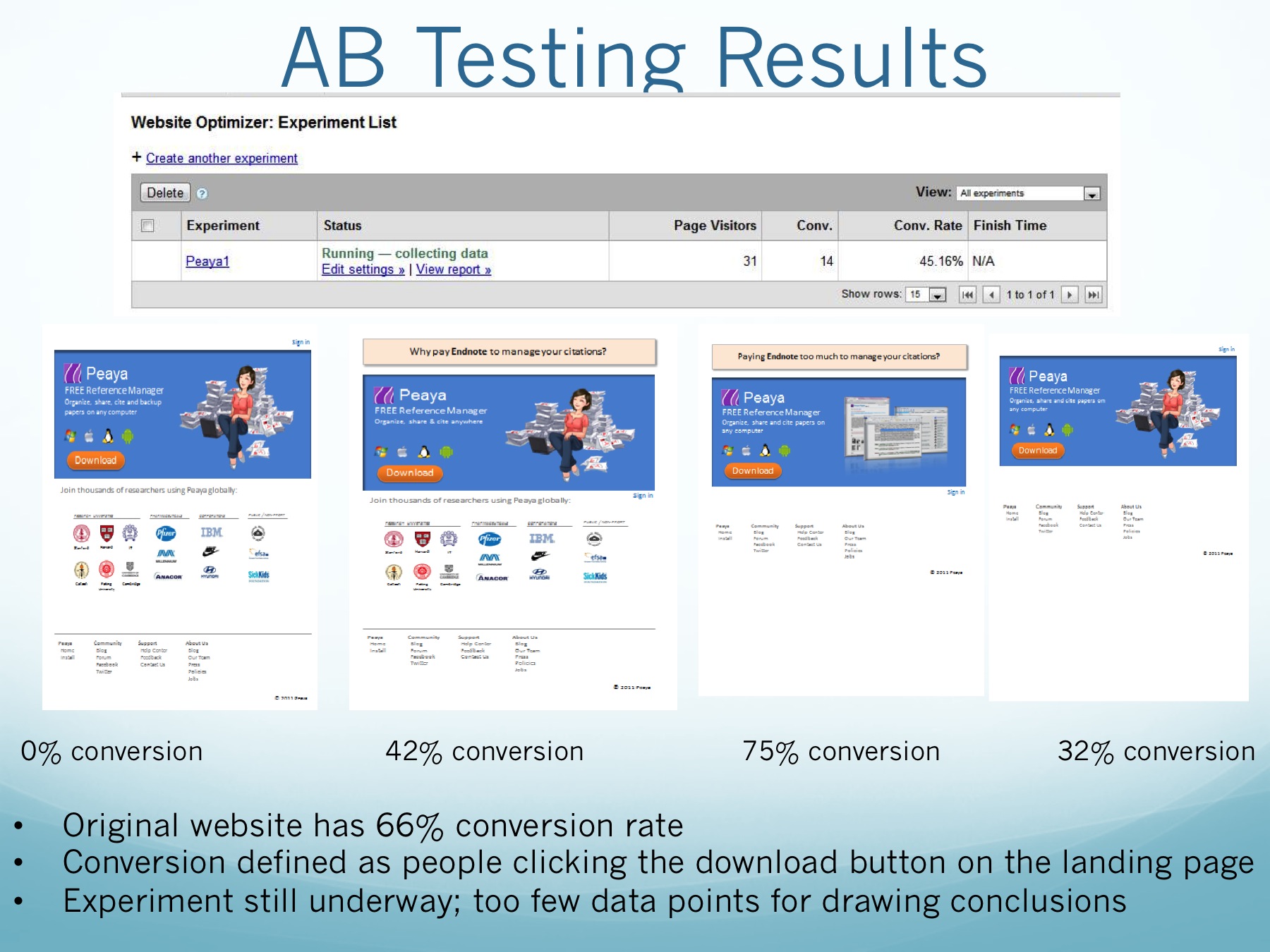
The results were not impressive. The feedback they were getting was that the product was a “nice to have” but not a “hair-on-fire” product.

Our feedback was, that their data seemed to say that their current users don’t want to spend money and will incur infinite support and infinite cost. Our suggestion was, “run away from the academic researcher market as fast as possible.” We offered that the team  might want to expand their user research to think about new features and verticals (document management, law firms, lab managers with discretionary budget, etc.)

If you can’t see the slides above, click here.

Agora Cloud Services
The Agora team ended last week wondering whether they were 1) a true marketplace for cloud computing, where they provide both matching and exchange capabilities for real-time trading. Or were they 2) an information exchange, providing matching services for cloud computing buyers and sellers, providing matching services.  This week they answered the question by “punting.”  They decided they were going to start as a information services, move to brokering, then prediction and finally evolve into a true market.  They interviewed another 8 buyers/sellers/industry experts.

Their results on whether they could acquire with Google Adwords was a bit sobering. Their first effort didn’t get much traffic: 6 clicks out of ~2000 impressions.  Worse yet, each of these clicks cost about a $1.00.  Reason? They had been bidding on keywords that are too generic (e.g. cloud, ec2, Amazon Web Services, etc.)

Their ads of “Cloud Demand Prediction” hadn’t been catching the eyes of people searching for these keywords.  So they picked more specific keywords such as, (cloud comparison, best cloud providers, etc).  And they created ads with specific headlines, such as “Too many cloud providers?”, “Reduce your cloud spend”, etc).  They also increased their daily campaign budget to $20.00.  What they found was that the keywords that did have traffic volume are extremely expensive. Depending on the keyword, the first page bids were between $5.00 to $25.00 per click! Ouch.

The team concluded that AdWords may not be the best channel to create demand.

If you can’t see the slides above, click here.

The Week 5 Lecture: Channel
Channels are how a company delivers its value proposition (i.e. its product or service) to its customers. There are two major channels – virtual (web/mobile) and physical channels – and the difference is dramatic. In one, physical goods move from a loading dock to a customer or a retail outlet. In another the product is offered and sold online. (If the product is itself bits, it may not only be sold online but is often also delivered or used on-line.)

Our lecture talked out how to choose the right sales channel, how the channel makes money, how they’re motivated, and the economics of a sales channel.

If you can’t see the slide above, click here.

———

The lesson for the students this week was failure. What we wanted to teach them wasn’t how to fail fast – any idiot can do that. We wanted to teach them how to recognize failure, learn from it, and pivot.  It’s not about failing fast – it’s about learning faster. That’s the lesson at the heart of the search for a repeatable and scalable business model.

Now deep into the class most of the teams are starting to rethink their initial assumptions. Which teams will continue to Pivot?  Will any completely abandon their current business and pick a new one?

Stay tuned.

Next week – Class 6 – Distribution Channel Hypothesis

74HGZA3MZ6SV
Listen to the post here: Download the Podcast here

Risk and Culture in Silicon Valley

Om Malik runs Gigaom, probably the most interesting and accurate site on the blogosphere.

Om was kind enough to have me in for an interview. We covered a wide range of topics. This talk on Risk and Culture in Silicon Valley is a small  1 minute snippet of a longer interview on his blog.

Entrepreneurs Are Artists

I wrote about entrepreneurs as artists in a previous post.

The FounderLy team interviewed me and got me to give a better explanation of what I was trying to say in this 2 minute video clip.

If you can’t see the video click here.

Flowery Words – True Ventures Founders Camp

The team at True Ventures was kind enough to invite me to speak at their Founders Camp. They pull in the founders of all their startups for 24 hours of activities, speakers, and discussions. I was blown away by the raw talent of these teams.

They had someone translating my words into a diagram as I spoke. (Click on it for the full effect.)


Listen to the post here: Download the Podcast here.

One Hand Clapping – Entrepreneurship In Ann Arbor, Michigan

I spent a few days in March in Ann Arbor Michigan as a guest of Professor Thomas Zurbuchen, Associate Dean for Entrepreneurial Programs, and Doug Neal, Director of Center for Entrepreneurship in the Engineering School at the University of Michigan. I gave a keynote on entrepreneurship to MPowered, the student Entrepreneurship Organization, spoke on a panel on Entrepreneurship and the Aerospace Industry, and gave another keynote at the Ann Arbor New Tech Meetup and A2Geeks, the regional startup network. I got smarter about engineering and innovation in “flyover country”, met some wonderful people and shared some thoughts about what it might take to spark an innovation cluster in Ann Arbor.

This post is a personal view of what I saw in Ann Arbor — in no way does it represent the views of the fine institutions I teach at. Read this with all the usual caveats: visiting a place for a few days doesn’t make you an expert, I’m not an economist, and the odds are I misunderstood or misinterpreted what I saw or just didn’t see enough.

One Hand Clapping – Creating an Innovation Cluster – The Ann Arbor Experiment
In my short time in Ann Arbor, I spent time meeting with:

The good news:
Entrepreneurship and innovation has been embraced big time at U of M. The Engineering School has 5,600 undergrads and 3,000 graduate students. It’ s probably no coincidence that the Dean of the Engineering School founded a company and gets what “startup” means first hand. The Center for Entrepreneurship in the Engineering School is akin to Stanford’s STVP program. It offers 35 entrepreneurship courses. Everyone I met in this program “gets” the principles of Agile, Lean and Customer Development big time. The TechArb is the engineering student accelerator/incubator (cofounded by the local VC) and also embraces these ideas. Finally, I was impressed to find a robust local entrepreneurial community centered around A2Geeks and the Tech Brewery (after I met Dug Song I understood why.) (I didn’t have enough time to connect with the entrepreneurial groups working on medical devices and life sciences, but they are another big component of the startup pool coming out of the University.)

What needs work:
It’s been 33 years since I was last in Ann Arbor. (I call it the best school I was ever thrown out of.)  I was incredibly impressed with how far the University has inculcated innovation into the fabric of the Engineering School. However the challenges that still needed to be addressed were pretty apparent.

You Can’t Start a Fire Without A SparkA Lack of Venture Capital
For an Engineering School so focused on innovation and startups the lack of sufficient numbers of venture capitalists in the local community for Cleantech, hardware, Web/Mobile apps and aerospace was noticeable. Given the interesting things going on in the engineering labs I visited and the startups I met, one would have thought the school would have been crawling with VC’s fighting over deals. Instead it seems that students who graduate simply pick up a plane ticket with their diploma. (Of course, some do stay. The spin-outs from Center of Entrepreneurship are impressive. Many of those companies are still Ann Arbor, but the ecosystem is a limiting factor.)

While one can’t recreate all the happy accidents that made Silicon Valley, it doesn’t take a rocket scientist to realize that it’s the combination of technology entrepreneurs and risk capital that are two of the essential ingredients in any cluster.  (I list some of the others in the diagram below.)

Innovation Cluster – What’s Missing in Ann Arbor

Therefore the lack of critical mass in Venture Investors in Ann Arbor was palpable – and incomprehensible. This place could support at least one or two seed funds like 500 Startups, and a couple of True Venture/Floodgate-type of VC’s as well as more Cleantech investors. Getting them in Ann Arbor would solve the other missing piece; the lack of a startup culture.

A Lack of a Startup Culture in the Community
Visiting Silicon Valley you can’t mistake that its primary business is innovation. In Ann Arbor and southeast Michigan entrepreneurship is a small part of a more diverse business culture. One of the characteristics of a cluster is that it isn’t hard to find other like-minded individuals. In Ann Arbor, they’re scattered in between the auto industry, biotech, hospital workers, etc. As a consequence Ann Arbor lacks the culture of risk-taking and respect for failure critical in an innovation cluster. You see it in the existing angel groups and VC’s. They feel more like banks than risk capital. And that lack of tolerance for failure and comfort with the status quo gets fed back to the entrepreneurs. Getting a few experienced super-angels and/or VC’s seeding 5-10 Lean Startup deals here a year, with a couple of Cleantech/energy deals as well, could kickstart the culture.

Not My Problem
The interesting thing is that no one seems to own the problem. The University of Michigan tech transfer office has an incubator but 1) mixes software, hardware, med devices and life sciences deals in the same program, and 2) takes no ownership of figuring out how to get a risk capital ecosystem in place. Surprisingly, the same with the entrepreneurship center in the Business School. I would have thought they’d be leading the charge.
The new governor of Michigan, Rick Snyder was a venture capitalist in Ann Arbor, so I’m surprised he hasn’t jawboned some combination of Michigan alumni working in venture capital in Silicon Valley to return, and paired them with the old-school money from the Auto industry, that’s hiding under mattresses. —- The real test of a cluster “catching fire” is not when it provides local employment, but when people from outside the area start coming to work and invest there. These guys are this close to making it happen. It would be a shame if it didn’t.

Lessons Learned

  • U of M has a College of Engineering dean who “gets it”
  • He’s turned the school into an outward facing school, fostering an entrepreneurial and innovation culture
  • The Center for Entrepreneurship is on board with passionate faculty, innovative curriculum and excited students
  • The area has almost no experienced Angel, super Angel or Venture Capital (as we know it in Silicon Valley) for web/mobile apps, hardware and software
  • The lack of experienced risk capital means a lack of experienced mentors, coaches, and infrastructure.

Listen to the post here: Download the Podcast here

The LeanLaunch Pad at Stanford – Class 4: Customer Hypotheses

The Stanford Lean LaunchPad class was an experiment in a new model of teaching startup entrepreneurship. This post is part four. Part one is here, two is here and three is here. Syllabus is here.

Week 4 of the class.
Last week the teams were testing their hypotheses about their Value Proposition (their company’s product or service.) This week they were testing who the customer, user, payer for the product will be (and discovering if they have a multi-sided business model, one with both buyers and sellers.) Many of them had heard the phrase “product/market fit” before, but now they were living it. And for some of the teams the halcyon days of “we’re taking this class so we can just build our great product and get credit for it” had come to a screeching halt. The news from customers was not good.

Let the real learning begin.

The Nine Teams Present
This week, our first team up was PersonalLibraries (the team that had software to help researchers manage, share and reference the thousands of papers in their personal libraries.) Going into the first four weeks their business model hypotheses looked like this:Last week we told them team: 1) see if the market size was really large enough to support a business, and 2) to find that out they were going to have to 
talk to more customers
 outside of Stanford. So during the past week, the team got feedback from >60 researchers from 
cold calls, in-person interviews, and a web survey.  (We were impressed when we found that they did the in-person interviews by hiring usertesting.com for $39 to set up test scenarios, gave the users specific tasks to accomplish with their minimum viable product, videotaped the customer interactions and summarized customer likes and dislikes.) The good news was that customers said that their minimum viable product (easily organizing research papers) was correct. The bad news was that users would play with their product on-line for a while and leave and never return.  Politely it was described as “poor customer retention” but in reality it was because the product was really hard to use.

But it was their market size survey that had the team (and us) even more concerned; last weeks “hot” market of biomed researchers looked like it was only $30m market, and the total available reference manager market was another $80M.The question was, even if they got the product right, were there enough customers to make it a business?

If you can’t see the slides above, click here.

For next week, they decided to improve the product by adding more tutorials, do a 2nd Customer Survey and begin to create demand for their product with AdWords Value Prop Testing and Landing Page A/B Testing.

The feedback from the teaching team was that customer feedback seems to be saying that this product is a “nice to have” versus “got to have.” Is the lack of excitement the MVP? Users?  Is this a hobby or a business?

Agora Cloud Services
The Agora team started the week wondering whether they were 1) a true marketplace for cloud computing, where they provide both matching and exchange capabilities for real-time trading. Or were they 2) an information exchange, providing matching services for cloud computing buyers and sellers, providing matching services.

They began with a set of questions:

  • What are our new hypothesized value propositions?
  • Which segments have we identified and which do we want to narrow in on?
  • Which value added services do public clouds want to attract customers for?
  • Is there a certain segment of buyers that continually makes purchasing decisions (as opposed to only once at the very beginning of a company).
  • How can we attract buyers to our channel before they make purchasing decisions?
  • Longer-term work/planning: what other experiments should we be constructing
  • Sales process: buyer/ user/ influencer etc.?  Demand generation?

The Agora team decided to formalize the customer discovery process by coming up with a set of Customer Discovery principles and questions that were as good as any I’ve seen.

They had 16 interviews with target customers (Zynga, Yahoo, VMware, Walmart,  Zeconder, etc.) as well as channel partners and cloud industry technology consultants.

Agora was in a classic two-sided market (having both buyers and sellers. The Business Model Canvas is a great way to diagram it out. Each side of a market has it’s own Value Proposition, Customer Segment and Revenue Model.) They learned that one their core customer hypothesis about their buyers, “startups would want to buy computing capacity on a “spot market” was wrong. Startups were actually happy with Amazon Web Services. The Agora team was beginning to believe that perhaps their ideal buyers are the companies that have to handle variable and unpredictable workloads.

If you can’t see the slides above, click here.

The Agora team left the week thinking that it was time for a Pivot: find cloud buyers and sellers who need to better predict demand.  Perhaps in market segment: medium-large companies that do 3D modeling and life sciences simulations

The feedback from the teaching team “great Pivot” and very clear Lessons Learned presentation. Keep at it.

(For the teaching team one of the most important ways to track the teams progress was through the weekly blogs we made each team keep. This of this as their on-line diary. They hated doing it, but for us it added a window into their thinking process, allowed us to monitor how much work they were doing, and more importantly let us course correct when needed.

BTW, If I was on the board of a startup with a first time CEO I might even consider asking for this in the first year as they went through Customer Discovery. Yes it takes time, but I bet it’s less than time than you would spend having coffee with an advisor each week.)

D.C. Veritas, was the team building a low cost, residential wind turbine that average homeowners could afford. From a slow start of customer interaction they made major progress in getting out for the building. This week they refined their target market by building a map of potential customers in the U.S. by modeling wind speed, energy costs, homeownership density and green energy incentives. The result was a density map of target customers. They then did face-to-face interviews with 20 customers and got data from 36 more who fit their archetype.  They also interviewed two companies – Solar City and Awea in the adjacent market (residential photovoltaic’s.)

If you can’t see the slide presentation above, click here.

The teaching team offered that unlike solar panels which work anywhere, they’ve narrowed down the geographic areas where their wind turbine was economical. We observed that their total available market was getting smaller daily. After the next week figuring out demand creation costs, they ought to see if the homeowners were still a viable target market for residential wind turbines.

Autonomow, the robot lawn mower, came in with a major Pivot. Instead of a robotic lawn mower, they were now going to focus on robotic weeding and drop mowing as a customer segment. (Once you use the Business Model Canvas to keep score of Customer Discovery a Pivot is easy to define. A Pivot is when you substantively change one or more of the Business Model Canvas boxes.)

Talking to customers convinced the team that the need for robotic weeding was high, there was a larger potential market (organic crop production is doubling every 4 years and accelerating,) and they could make organic produce more affordable (labor cost reduction of 100 to 1) – and could possibly change the organic farming industry!  And as engineers they believed weed versus crop recognition, while hard, was doable.

During the week the team drove the 160 miles round-trip to the Salinas Valley and had on-site interviews with two organic farms. They walked the fields with the farmers, hand-picked weeds with the laborers and got down into the details of the costs of brining in an organic crop.

They also talked by phone to organic farmers in Nebraska and the Santa Cruz mountains.

They acquired quantitative data by going through the 2008 Agricultural Census. Most importantly their model of the customer began to evolve.

If you can’t see the slide above, click here.

Our feedback: could they really build a robot to recognize and weeds and if so how will they kill the weeds without killing the crops?  And are farmers willing to take a risk on untested and radical ideas like robots replacing hand weeding?

The Week 4 Lecture: Customer Relationships
Our lecture this week covered Customer Relationships (a fancy phrase for how will your company create end user demand by getting, keeping and growing customers.) We pointed out that get, keep and grow customers are different for physical versus virtual channels. Then different again for direct and indirect channels. We offered some examples of what a sales funnel looked like. And we described the difference between creating demand for products that solve a problem versus those that fulfill a need.

If you can’t see the slide above, click here.

———

The biggest lesson for the students this week was the entire reason for the class – no business plan survives first contact with customers – as customers don’t behave as per theory. As smart as you are, there’s no way to predict that from inside your classroom, dorm room or cubicle. Some of the teams were coming to grips with it. Others would find reality crashing down harder a bit later.

Next week, Class 5 – each team tests its demand creation hypotheses. The web-based teams needed to have their site up and running and be driving demand to the site with real Search Engine Optimization and Marketing tests.

Listen to the post here: Download the Podcast here

Entrepreneurship is an Art not a Job

Some men see things as they are and ask why.
Others dream things that never were and ask why not.
George Bernard Shaw

Over the last decade we assumed that once we found repeatable methodologies (Agile and Customer Development, Business Model Design) to build early stage ventures, entrepreneurship would become a “science,” and anyone could do it.

I’m beginning to suspect this assumption may be wrong.

Where Did We Go Wrong?
It’s not that the tools are wrong, I think the entrepreneurship management stack is correct and has made a major contribution to reducing startup failures. Where I think we have gone wrong is the belief that anyone can use these tools equally well.

Entrepreneurship is an Art not a Job
For the sake of this analogy, think of two types of artists: composers and performers (think music composer versus members of the orchestra, playwright versus actor etc.)

Founders fit the definition of a composer: they see something no one else does. And to help them create it from nothing, they surround themselves with world-class performers. This concept of creating something that few others see – and the reality distortion field necessary to recruit the team to build it – is at the heart of what startup founders do. It is a very different skill than science, engineering, or management.

Entrepreneurial employees are the talented performers who hear the siren song of a founder’s vision. Joining a startup while it is still searching for a business model, they too see the promise of what can be and join the founder to bring the vision to life.

Founders then put in play every skill which makes them unique – tenacity, passion, agility, rapid pivots, curiosity, learning and discovery, improvisation, ability to bring order out of chaos, resilience, leadership, a reality distortion field, and a relentless focus on execution – to lead the relentless process of refining their vision and making it a reality.

Both founders and entrepreneurial employees prefer to build something from the ground up rather than join an existing company. Like jazz musicians or improv actors, they prefer to operate in a chaotic environment with multiple unknowns. They sense the general direction they’re headed in, OK with uncertainty and surprises, using the tools at hand, along with their instinct to achieve their vision. These types of people are rare, unique and crazy. They’re artists.

Tools Do Not Make The Artist
When page-layout programs came out with the Macintosh in 1984, everyone thought it was going to be the end of graphic artists and designers. “Now everyone can do design,” was the mantra. Users quickly learned how hard it was do design well (yes. it is an art) and again hired professionals. The same thing happened with the first bit-mapped word processors. We didn’t get more or better authors. Instead we ended up with poorly written documents that looked like ransom notes. Today’s equivalent is Apple’s “Garageband”. Not everyone who uses composition tools can actually write music that anyone wants to listen to.

“Well If it’s Not the Tools Then it Must Be…”
The argument goes, “Well if it’s not tools then it must be…” But examples from teaching other creative arts are not promising. Music composition has been around since the dawn of civilization yet even today the argument of what “makes” a great composer is still unsettled. Is it the process (the compositional strategies used in the compositional process?) Is it the person (achievement, musical aptitude, informal musical experiences, formal musical experiences, music self-esteem, academic grades, IQ, and gender?)  Is it the environment (parents, teachers, friends, siblings, school, society, or cultural values?) Or is it constant practice (apprenticeship, 10,000 hours of practice?)

It may be we can increase the number of founders and entrepreneurial employees, with better tools, more money, and greater education. But it’s more likely that until we truly understand how to teach creativity, their numbers are limited.

Lessons Learned

  • Founders fit the definition of an artist: they see – and create– something that no one else does
  • To help them move their vision to reality, they surround themselves with world-class performers
  • Founders and entrepreneurial employees prefer operating in a chaotic environment with multiple unknowns
  • These type of people are rare, unique and crazy
  • Not everyone is an artist

Listen to this post here: Download the Podcast here

Napkin Entrepreneurs

Faith is taking the first step even when you don’t see the whole staircase.
Martin Luther King, Jr.

The barriers for starting a company have come down. Today the total available markets for new applications are hundreds of millions if not billion of users, while new classes of investors are popping up all over (angels, superangels, archangels, and even seraphim and cherubim have been spotted.)

Entrepreneurship departments are now the cool thing to have in colleges and universities, and classes on how to start a company are being taught over a weekend, a month, six weeks, and via correspondence course.

If the opportunity is so large, and the barriers to starting up so low, why haven’t the number of scalable startups exploded exponentially? What’s holding us back?

It might be that it’s easier than ever to draw an idea on the back of the napkin, it’s still hard to quit your day job.

Napkin Entrepreneurs
One of the amazing consequences of the low cost of creating web and mobile apps is that you can get a lot of them up and running simultaneously and affordably. I call these app development projects “science experiments.”

These web science experiments are the logical extension of the Customer Discovery step in the Customer Development process. They’re a great way to brainstorm outside the building, getting real customer feedback as you think through your ideas about value proposition/customer/demand creation/revenue model.

They’re the 21st century version of a product sketch on a back of napkin. But instead of just a piece of  paper, you end up with a site that users can visit, use and even pay for.

Ten of thousands of people who could never afford to start a company can now start several over their lunch break. And with any glimmer of customer interest they can decide whether they want to:

  • run it as a part-time business
  • commit full-time to build a “buyable startup” (~$5-$25 Million exit)
  • commit full-time and try to build a scalable startup

But it’s important to note what these napkin projects/test are not. They are not a company, nor are they are a startup. Running them doesn’t make you a founder. And while they are entrepreneurial experiments, until you actually commit to them by choosing one idea, quitting your day job and committing yourself 24/7 it’s not clear that the word “founder or entrepreneur” even applies.

Lessons Learned

  • The web now allows you to turn your “back of the napkin” ideas into live experiments
  • Running lots of app experiments is a great idea
  • But these experiments are not a company and you’re not a “founder”. You’re just a “napkin entrepreneur.”
  • Founding a company is an act of complete commitment

Listen to this post here: Download the Podcast here

The LeanLaunch Pad at Stanford – Class 3: Value Proposition Hypotheses

The Stanford Lean LaunchPad class was an experiment in a new model of teaching startup entrepreneurship. This post is part three. Part one is here, two is here. Syllabus is here.

Week 3 of the class and our teams in our Stanford Lean LaunchPad class were hard at work using Customer Development to get out of the classroom and test the first key hypotheses of their business model: The Value Proposition. (Value Proposition is a ten-dollar phrase describing a company’s product or service. It’s the “what are you building and selling?”)

The Nine Teams Present
This week, our first team up was PersonalLibraries (the team that made software to help researchers manage, share and reference the thousands of papers in their personal libraries.) To test its Value Proposition, the team had face-to-face interviews with 10 current users and non-users from biomedical, neuroscience, psychology and legal fields.
What was cool was they recorded their interviews and posted them as YouTube videos. They did an online survey of 200 existing users (~5% response rate). In addition, they demoed to the paper management research group at the Stanford Intellectual Property Exchange project (a joint project between the Stanford Law School and Computer Science department to help computers understand copyright and create a marketplace for content). They met with their mentors, and refined their messaging pitch by attending a media training workshop one of our mentors held.

If you can’t see the slides above, click here.

In interviewing biomed researchers, they found one unmet need: the ability to cite materials used in experiments. This is necessary so experiments can be accurately reproduced. This was such a pain point, one scientist left a lecture he was attending to find the team and hand them an example of what the citations looked like.

The team left the week excited and wondering – is there an opportunity here to create new value in a citation tool? What if we could help scientists also bulk order supplies for experiments? Could we help manufacturers, as well, to better predict demand for their products, or perhaps to more effectively connect with purchasers?

The feedback from the teaching team was a reminder to see if the users they were talking to constitute a large enough market and had budgets to pay for the software.

Agora Cloud Services
The Agora team (offering a cloud computing “unit” that Agora will buy from multiple cloud vendors and create a marketplace for trading) had 7 face-to-face interviews with target customers, and spoke to a potential channel partner as well as two cloud industry technology consultants.

They learned that their hypothesis that large companies would want to lower IT costs by selling their excess computing capacity on a “spot market” didn’t work in the financial services market because of security concerns.  However sellers in the Telecom industries were interested if there was some type of revenue split from selling their own excess capacity.

On the buyers’ side, their hypothesis that there were buyers who were interested in reduced cloud compute infrastructure cost turned out not to be a high priority for most companies. Finally, their assumption that increased procurement flexibility for buying cloud compute cycles would be important turned out to be just a “nice to have,” not a real pain. Most companies were buying Amazon Web Services and were looking for value-added services that simplified their cloud activities.

If you can’t see the slides above, click here.

The Agora team left the week thinking that the questions going forward were:

  • žHow do we get past Amazon as the default cloud computing service provider?
  • How viable is the telecom market as a potential seller of computing cycles?
  • We need to further validate buyer & seller value propositions
  • How do we access the buyers and sellers? What sort of sales structure and salesforce does it require?
  • Who is the main buyer(s) and what are their motivations?
  • Is a buying guide/matching service a superior value proposition to marketplace?

The feedback from the teaching team was a reminder that at times you may have a product in search of a solution.

D.C. VeritasD.C. Veritas, the team that was going to build a low cost, residential wind turbine that average homeowners could afford, wanted to provide a renewable source of energy at affordable price.  They started to work out what features a minimum viable product their value proposition would have and began to cost out the first version. The Wind Turbine Minimum Viable Product would have a: Functioning turbine, Internet feedback system, energy monitoring system and have easy customer installation.
The initial Bill of Material (BOM) of the Wind Turbine Hardware Costs looked like: Inverter (1000W): $500 (plug and play), Generator (1000W): $50-100, Turbine: ~$200, Output Measurement: ~$25, Wiring: $20 = Total Material Cost: ~$800-$850

The team also went to the whiteboard and attempted a first pass at who the archetypical customer(s) might be.

To get customer feedback the team posted its first energy survey here and received 27 responses. In their first attempt at face-to-face customer interviews to test their value proposition and problem hypothesis (would people be interested in a residential wind turbine), they interviewed 13 people at the local Farmer’s Market.

If you can’t see the slide presentation above, click here.

The teaching team offered that out of 13 people they interviewed only 3 were potential customers. Therefore the amount of hard customer data they had collected was quite low and they were making decisions on a very sparse data set. We suggested (with a (2×4) that were really going to have to step up the customer interactions with a greater sense of urgency.The teaching team offered that out of 13 people they interviewed only 3 were potential customers. Therefore the amount of hard customer data they had collected was quite low and they were making decisions on a very sparse data set. We suggested (with a 2×4) that were really going to have to step up the customer interactions with a greater sense of urgency.

Autonomow
The last team up was Autonomow, the robot lawn mower. They were in the middle of trying to answer the question of  “what problem are they solving?” They were no longer sure whether they were an autonomous mowing company or an agricultural weeding company.

They spoke to 6 people with large mowing needs (golf course, Stanford grounds keeper, etc.) They traveled to the Salinas Valley and Bakersfield and interviewed 6 farmers about weeding crops. What they found is that weeding is a hugeproblem in organic farming. It was incredibly labor intensive and some fields had to be hand-weeded multiple times per year.

They left the week realizing they had a decision to make – were they a  “Mowing or Weeding” company?

If you can’t see the slide above, click here.

Our feedback: could they really build a robot to recognize and kill weeds in the field?

The Week 3 Lecture: Customers
Our lecture this week covered Customers – what/who are they?  We pointed out the difference between a user, influencer, recommender, decision maker, economic buyer and saboteur. We also described the differences between customers in Business-to-business sales versus business-to-consumer sales.  We talked about multi-sided markets and offered that not only are there multiple customers, but each customer segment has their own value proposition and revenue model.

If you can’t see the slide above, click here.

Getting Out of the Building
Five other teams presented after these four. All of them had figured out the game was outside the building, with some were coming up to speed faster than others. A few of the teams ideas still looked pretty shaky as businesses. But the teaching team held our opinions to ourselves, as we’ve learned that you can’t write off any idea too early. Usually the interesting Pivots happens later. The finish line was a ways off. Time would tell where they would all end up.

———

Next week – Class 4 each team tests their Customer Segment hypotheses (who are their customers/users/decision makers, etc.) and report the results of face-to-face customer discovery. That will be really interesting.
Listen to this post here: Download the Podcast here

The Democratization of Entrepreneurship

I gave a talk at the Stanford Graduate School of Business as part of Entrepreneurship Week on the Democratization of Entrepreneurship. The first 11 minutes or so of the talk covers the post I wrote called “When It’s Darkest, Men See the Stars.”

In it I observed that the barriers to entrepreneurship are not just being removed. In each case they’re being replaced by innovations that are speeding up each step, some by a factor of ten.

My hypotheses is that we’ll look back to this decade as the beginning of our own revolution. We may remember this as the time when scientific discoveries and technological breakthroughs were integrated into the fabric of society faster than they had ever been before. When the speed of how businesses operated changed forever. As the time when we reinvented the American economy and our Gross Domestic Product began to take off and the U.S. and the world reached a level of wealth never seen before.  It may be the dawn of a new era for a new American economy built on entrepreneurship and innovation.

If you can’t see the video above, click here.)

If you’ve seen my other talks, after the first 11 minutes you can skip to ~1:04 with the Sloan versus Durant story and some interesting student Q&A. You can follow the talk along with the slides I used, below.

(If you can’t see the slide presentation above, click here.)

You can listen to this post here: You can download the Podcast here