Lean LaunchPad for Life Sciences – Revenue Streams

We’re teaching a Lean LaunchPad class for Life Sciences and Health Care (therapeutics, diagnostics, devices and digital health) at UCSF with a team of veteran venture capitalists. The class has talked to 2,056 customers to date.

This post is an update of what we learned about life science revenue models.

Life Science/Health Care revenue streams differ by Category
For commercialization, the business model (Customers, Channel, Revenue Model, etc.) for therapeutics, diagnostics, devices, bioinformatics and digital health have very little in common.

This weeks topic was revenue streams – how much cash the company can generate from each customer segment. Revenue streams have two parts: the revenue strategy and the pricing tactics.

Figuring out revenue strategy starts by gaining a deep understanding of the target customer(s). Setting a revenue strategy starts with understanding the basics about the customer segments:

  • who’s the user, the recommender, buyer, and payer
  • How the target customer currently purchases goods and services and how much they currently pay for equivalent products
  • Their willingness to pay for value versus lowest cost?
  • How much budget they have for your type of product?

Revenue strategy asks questions like, “Should we offer cost-based or value-based pricing.  How about demand-based pricing? Freemium? Do we price based on hardware sales or do we offer hardware plus consumables (parts that need to be disposed or replaced regularly)? Do we sell a single software package or a subscription?  These strategy hypotheses are tested against the target customer segment(s).

Once you’ve established a revenue strategy the pricing tactics follow. Pricing is simply “how much can I charge for the product using the selected revenue strategy?”  Pricing may be as simple as setting a dollar value for hardware or software, or as complicated as setting a high price and skimming the market or setting a low price as a loss leader.

You can get a feel for how each of the cohorts address the Revenue Streams by looking at the Revenue lectures below – covering the therapeutics, diagnostics, devices and digital health cohorts.

At the end of the lectures you can see a “compare and contrast” video and a summary of the differences in distribution channels.

Diagnostics

Week 5 Todd Morrill Instructor 

If you can’t see the presentation above click here

Digital Health

Week 5 Abhas Gupta Instructor 

If you can’t see the presentation above click here

Devices

Week 5 Allan May Instructor 

If you can’t see the presentation above click here

Therapeutics

Week 5 Karl Handelsman Instructor 

If you can’t see the presentation above click here

Life Science and Health Care Differences in Revenue Streams
”
This weeks lecture and panel was on Revenue; how much cash the company can generate from each customer segment – and the strategy and tactics to do so. Therapeutics, diagnostics, devices and digital health use different Revenue Strategies and Pricing Tactics, in the video and the summary that follows the instructors compare and contrast how they differ.

If you can’t see the video above click here

Therapeutics (Starting at 0:30)

  • Therapeutics revenue is from drug companies not end users
  • 18 months to first revenue from a deal
  • Predicated on delivering quality data to a company
  • Deal can be front-end or back-end loaded
  • Quality of the data has to be extremely high for a deal

Diagnostics (Starting at 4:10)

  • Diagnostic revenue is from end users: a hospital or clinical lab
  • You need to figure out value of your product but…
  • Pricing is capped by your reimbursement (CPT) code limits
  • Reimbursement strategy is paramount, design to good codes avoid bad ones
  • Find a reimbursement code consultant
  • Don’t do cost-based pricing… go for value-based pricing

Medical Devices (Starting at 8:23)

  • There really is no such thing as a perfect First Generation Medical Device
    • So Medical Device companies often start with a Volkswagen product and then build to the Ferrari product
  • Revenue models are typically direct product sales
  • Don’t do cost-based pricing… go for value-based pricing, especially where your device lowers the treatment costs of the patient
  • In most cases, pricing is capped by your reimbursement (CPT) code limits
    • Or pricing can be capped by what competitors offer, unless you can demonstrate superior cost savings
    • In a new market there is no reimbursement code but if you show high cost-savings you can get a high reimbursement rate
  • A risk in device hardware is getting trapped in low-volume manufacturing with low margins and run out of cash

Digital Health (Starting at 10:35)

  • Digital Health revenue models are often subscription models to a company per month across a large number of users
    • Intermediation fees – where you broker a transaction – are another source of revenue (i.e. HealthTap)
    • Advertising is another digital health revenue model, but requires at least 10 million users to have a meaningful model, but can be lower if you have higher value uses like specialist physicians because  you can charge dollars not cents
  • Don’t do cost-based pricing… go for value-based pricing
    • Value-based pricing is based on the needs you’ve learned from the customer segment and the strength of your product/market fit
      • the sum of customer needs + product/market fit = the pricing you can achieve

Lessons Learned

  • Each of these Life Science domains has a unique revenue strategy and pricing tactic
  • In therapeutics revenue comes in lump milestone payments from drug companies based on quality data
  • Diagnostics revenue comes value pricing to hospital or clinical lab
    • capped by reimbursement (CPT) code limits
  • Device pricing starts by offering an initial value-priced base product and then following up with a fully featured product
    • capped by reimbursement (CPT) code limits
  • Digital health products use subscription value pricing. Alternatively may use advertising revenue model

Listen to the podcast here [audio http://traffic.libsyn.com/albedrio/steveblank_clearshore_131118.mp3]

Download the podcast here

Well They “Should” be Our Customers

When scientists and engineers who’ve been working in the lab for years try to commercialize their technology they often get trapped by their own beliefs  – including who the customers are, what features are important, pricing etc.


——–

One the key tenets of the Lean LaunchPad class is that every week each team gets out of the building and talks to 10+ customers/partners to validate a new part of their business model.  Back in class they present their findings to their peers and teaching team in a 10 minute Lessons Learned presentation. One of the benefits of the class is that the teams get immediate unvarnished feedback on their strategy.

For researchers and clinicians who’ve been working on a project in the lab for years, getting out of the building and talking to customers at times creates cognitive dissonance.  While they’ve been in the lab they had a target customer in mind. However when they leave the building and start talking to these  supposed customers there’s almost always a surprise when the customer is not interested in the product.

Often when they consistently hear that their expected customers aren’t interested the first reaction is “the customers just don’t get it yet.”  Rather than testing a new customer segment they keep on calling on the same group – somehow thinking that “we just need to explain it better.”

Some times it takes a nudge from the teaching team to suggest that perhaps looking at another customer segment might be in order.

They Should be Our Customers
The Mira Medicine Team is trying to accelerate the path to the right treatment for each patient in complex Central Nervous System diseases. They spent years building their first tool MS Bioscreen, which was developed for the physicians at the UCSF Dept of Neurology. So they naturally believed that their first customers would be neurologists.

This was a very smart team who ran into the same problem almost every smart researcher attempting to commercialize science faces.  Here’s what happened.

If you can’t see the video click here.

Listen for:

0:35 “Our primary customer we built this app for was neurologists…

1:00 “(but neurologists have told us) your prototype is interesting… and probably some features are nice to haves…

2:26 “What’s special about neurology?  Doesn’t cardiology and oncology have problems like this?

3:00 “Is neurology a key component of what you’re trying to do?

3:15 “I’ve worked on this for two years…”

3:24 “You’ve already done too much prototyping work. You’re hung up on the prototype.”

3:29 “You have a square peg you’er trying to jam in a round hole…”

3:43 “Don’t be afraid to think laterally”

Postscript: 70 customers later they no longer talking to neurologists.

Lessons Learned

  • Don’t get trapped by your own beliefs
  • When reality outside the building doesn’t match your hypotheses – test alternate hypotheses
  • Most of the time your vision is just a hallucination

Listen to the podcast here [audio http://traffic.libsyn.com/albedrio/steveblank_clearshore_131113.mp3]

Download the podcast here

Lean LaunchPad for Life Sciences – Distribution Channels

We’re teaching a Lean LaunchPad class for Life Sciences and Health Care (therapeutics, diagnostics, devices and digital health) at UCSF with a team of veteran venture capitalists. The class has talked to 1,780 customers to date.

This post is an update of what we learned about life science distribution channels.

Life Science/Health Care distribution channels differ by Category
It turns out that for commercialization, the business model (Customers, Channel, Revenue Model, etc.) for therapeutics, diagnostics, devices, bioinformatics and digital health have very little in common.

This weeks topic was distribution channels; how your product gets from your company to your potential customer segments. You can get a feel for how each of the cohorts address the channel by looking at the distribution channel lectures below – covering the therapeutics, diagnostics, devices and digital health cohorts.

At the end of the lectures you can see a “compare and contrast” video and a summary of the differences in distribution channels.

Diagnostics

Week 3 Todd Morrill Instructor 

If you can’t see the presentation above click here

Digital Health

Week 3 Abhas Gupta Instructor 

If you can’t see the presentation above click here

Devices

Week 3 Allan May Instructor 

If you can’t see the presentation above click here

Therapeutics

Week 3 Karl Handelsman Instructor 

If you can’t see the presentation above click here

Life Science and Health Care Differences in Distribution Channels
This weeks lecture and panel was on distribution channels; how your product gets from your company to your potential customer segments. Therapeutics, diagnostics, devices and digital health use different different channels, in the video and the summary that follows the instructors compare and contrast how they differ.

If you can’t see the video above click here

Medical Devices (Starting at 0:50)

  • Medical Device Distribution Channels in general are a sales team hired directly by the company.
    • A sales team typically includes a sales person and clinical applications specialists.
    •  The specialists help train and educate physician users. They assist with the sale and work with marketing to create demand.
  • Some device industries are controlled by distributors (indirect sales.)
    • Distributors tend to resell commodity products from multiple suppliers.
  • Channel Cost =  $350-400,000 per sales team. On average there’s 1 clinical applications specialist to 2 salespeople.  A lean rollout for a startup would be 4-5 sales people plus 2-3 clinical applications specialists at a cost of ~$2.5 million/year
    • Increasing the number of sales people much past 4-5 for a rollout does not proportionally increase revenue in most cases, because you are on the front end of early adopters and wrestling to overcome and reduce the sales learning curve
    • Travel and Entertainment is a big part of the sales budget since they are all flying weekly to cover accounts
  • 90-180 days for salespeople to become effective
  • Expect little or no revenue for 2- 3 quarters after they start
  • Major reason for failure = hiring sales and marketing staff too quickly
  • Generally an Educational Sale – Hire sales and clinical people first to help early adopters, such as Key Opinion Leaders (KOL’s), master the learning curve with your device so they can write and present papers to influence their peers 

Diagnostics (Starting at 5:16)

  • Diagnostic Channels = Direct sales in the US, with limited Distributor options
    • Many Distributors in Europe and in Asia
    • Sold to hospital laboratories, reference laboratories, or performed in CLIA labs
  • Channel Cost = $350,000+ per supported salesperson
  • Direct to consumer is a (rapidly) growing channel

Digital Health (Starting at 7:25)

  • Digital Health Channels = Direct Sales but you’re selling software to both end users and enterprises
  • Can use existing tech channels and new emerging channels such as Wellness platforms. (Audax Health, Humana Vitality, ShapeUp, Redbrick Health, Limeade)
  • Cloud-based Electronic Medical Records (EMR) are quickly becoming another distribution platform
  • App Stores, and Box are also channels for consumers and enterprise customers, respectively

Therapeutics (Starting at 10:17)

  • Therapeutics Channel = what you’re selling in the early stage is data and Intellectual Property to the pharmaceutical and biotech companies
  • Complicated Sales process – takes 18 months
  • Led by the CEO with a dedicated business development person and your science team
  • You need to define the data they need – this is influenced by how they view their pipeline, and how your technology can fill gaps in their pipeline
  • Pharmaceutical and biotech companies have therapeutics heads, technology scouts and business development people all searching for technology deals to fill their pipeline
  • This is a bound problem – there’s probably 80 people you need to know that make up your channel

Lessons Learned

  • Each of these Life Science domains has a unique distribution channel
  • In Devices innovative products require hiring direct sales people
    • but for commodity device products you may use a distributor
  • Diagnostics requires a direct sales force in the U.S.
    • Distributors in Europe and in Asia
  • In Digital Health direct sales is a possible channel, as are traditional software channels (App Stores, Box, etc.)
    • other DHealth channels such as Wellness Platforms, and cloud-based EMR’s are also emerging
  • In therapeutics it’s a direct sale of data and Intellectual property
    • led by the CEO with a dedicated business development person and your science team

Listen to the podcast here [audio http://traffic.libsyn.com/albedrio/steveblank_clearshore_131111.mp3]

Download the podcast here

A New Way to Look at Competitors

Every startup I see invariably puts up a competitive analysis slide that plots performance on a X/Y graph with their company in the top right.

Competitive XY

The slide is a holdover from when existing companies launched products into crowded markets. Most of the time this graph is inappropriate for startups or existing companies creating new markets.

Here’s what you need to do instead.

——-

The X/Y axis competitive analysis slide is a used by existing companies who plan to enter into an existing market.  In this case the basis of competition on the X/Y axes are metrics defined by the users in the existing market.

This slide typically shows some price/performance advantage.  And in the days of battles for existing markets that may have sufficed.

But today most startups are trying to ressegment existing markets or create new markets. How do you diagram that? What if the basis of competition in market creation is really the intersection of multiple existing markets?  Or what if the markets may not exist and you are creating one?

We need a different way to represent the competitive landscape when you are creating a business that never existed or taking share away from incumbents by resegmenting an existing market.

Here’s how.

The Petal Diagram
I’ve always thought of my startups as the center of the universe. So I would begin by putting my company in the center of the slide like this.

Slide1In this example the startup is creating a new category –  a lifelong learning network for entrepreneurs. To indicate where their customers for this new market would come from they drew the 5 adjacent market segments: corporate, higher education, startup ecosystem, institutions, and adult learning skills that they believed their future customers were in today. So to illustrate this they drew these adjacent markets as a cloud surrounding their company. (Unlike the traditional X/Y graph you can draw as many adjacent market segments as you’d like.)

Slide2Then they filled in the market spaces with the names of the companies that are representative players in each of the adjacent markets.companies updated

Then they annotated the private companies with the amount of private capital they had raised. This lets potential investors understand that other investors were interested in the space and thought it was important enough to invest. (And plays on the “no VC wants to miss a hot space” mindset.)

Slide4

Finally, you could show the current and projected market sizes of the adjacent markets which allows the startups to have a “how big can our new market be?” conversation with investors.  (If you wanted to get fancy, you could scale the size of the “petals” relative to market size.)

Slide5

The Petal Diagram drives your business model canvas
What the chart is saying is, “we think our customers will come from these markets.”  That’s handy if you’re using a Lean Startup methodology because the Petal Chart helps you identify your first potential customer segments on the business model canvas.add the canvasYou use this chart to articulate your first hypotheses of who are customers segments you’re targeting.  If your hypotheses about the potential customers turn out to be incorrect, and they aren’t interested in your product, then you go back to this competitive diagram and revise it.

Lessons Learned

  • X/Y competitive graphs are appropriate in an existing market
  • Mapping potential competitors in new or resegmented markets require a different view – the Petal diagram
  • The competitive diagram is how develop your first hypotheses about who your customers are

Update: I’ve heard from a few entrepreneurs who used the diagram had investors tell them “”it looks like you’re being surrounded, how can you compete in that market?”

Those investors have a bright future in banking rather than venture capital.

Seriously, I would run away fast from a potential investor who doesn’t or can’t understand that visualizing the data doesn’t increase or decrease the likelihood of success. It only provides a better way to visualize potential customer segments.
Download the podcast here

Lean Goes Better with Coke – the Future of Corporate Innovation

In 2012 I got together with Alexander OsterwalderHenry Chesbrough and Andre Marquis to think about the Lean and the future of corporate innovation. We had some radical thoughts how companies were going to have change to remain competitive in the 21st century in a blog post. What we didn’t envision was that one creative corporate VP would take that post and build a world-class corporate innovation program around it.

David Butler is the VP of Innovation and Entrepreneurship of at The Coca-Cola Company – responsible for finding breakthrough innovation and building an entrepreneurial culture.  Here’s how he’s shaping the future of corporate innovation.

Coke logo————–

Innovation isn’t the destination it’s the Journey. What CEOs, management teams and shareholders care about is growth—revenue growth, greater user adoption, increased market share, bigger margins, etc. So the first step for any corporate  “innovation” organization is to tie the word, “innovation,” to the more tangible concept of “growth.” That single step can create a lot of clarity and direction for the organization.

Breakthrough Innovation.” Innovation can create 2 kinds of growth: sustaining innovation (small and incremental growth yet predictable) and disruptive innovation (explosive exponential growth yet highly uncertain). Like most big companies, we’re pretty good at the kind of innovation that creates incremental growth. We know how to fund it, how to staff it, how to measure it, etc.

For the past year or so, we’ve been focused on disruptive “breakthrough” innovation (game-changing, etc.) to create exponential growth.

Innovation sounds easy. It never is. In our case, we’re local in over 200 countries with operations in basically every city on the planet. We have a portfolio of more than 500 brands and 4000 products and people invite us into their lives more 1.8 billion times a day. Our market cap is around $170B. For most big, established companies like us, our business models were developed years—even decades ago. We’ve built up strength in executing our business model, not creating new ones. So, if you’re Coca-Cola, where do you begin?

It didn’t take us very long to connect the dots between exponential growth, business model innovation and the “Lean Startup” movement. The Lean Startup movement is almost a decade old now and it’s now easier than ever for anyone to learn “Lean Startup” methods and become more entrepreneurial. In fact, I believe the movement is now mainstream—startups, VCs, accelerators, are no longer “new.”

There are co-working spaces in basically every city in the world—from Nepal to New York. Almost every large organization has some kind of incubator or accelerator program. And this has created a global entrepreneurial ecosystem.

But most big companies are still in the shallow-end of the entrepreneurial ecosystem pool. And this is ironic because big companies have so much to add. Big companies know how to scale—most have a lot to learn about starting (as in Lean Startup) but they know how to leverage assets, use network effects, plan and execute. Big companies with big brands have a lot to learn from startups but together, they can do things neither one of them could do alone. And that has become our vision—to make it easier for starters to be scalers and scalers to be starters.

So this is where my head was when I read Steve’s “The Future of Corporate Innovation and Entrepreneurship” post last year. At the time, we were definitely in the shallow-end. Now, a year later, (and A LOT of learning), we’re moving into the deep-end and Steve’s 8 strategies are more relevant than ever. Based on our experience, here’s are our Lessons Learned from Steve’s 8 corporate innovation strategies and then four more from Coke for consideration:

Lessons Learned

  1. 21st century corporate survival requires companies to continually create a new set of businesses by inventing new business models. What is sometimes missed is the opportunity for big companies to leverage their enormous assets (brands, relationships, routes-to-market, etc.) in developing these new models. Most startups can only dream of the kinds of assets most big companies have.
    We believe that using the customer development process to monetize these assets through new business models can create huge competitive advantage and more speed to market for us and other big companies.
  2. Most of these new businesses need to be created outside of the existing business units. We’ve found that this can only happen if it’s just on the edge of a business unit. Startups need to be close enough to the BU to validate assumptions and leverage BU resources (people, funding, relationships, etc.) but just far enough out to be able to use different processes and systems to move fast, pivot, etc. But there’s no one-size fits all approach to this—every company will have to figure out what works for them.
  3. The exact form of the new business models is not known at the beginning. It only emerges after an intense business model design and search activity based on the customer development process. This is so true but so foreign for most big companies. And why wouldn’t it be? All of their internal systems are designed to keep doing what they’ve always done best. They are also under huge pressure to deliver quarterly earnings for shareholders and meet analysts expectations. Using an alternative process including different systems and metrics is key.
  4. Companies will have to maintain a portfolio of new business model initiatives, not unlike a venture capital firm, and they will have to accept that maybe only 1 out 10 initiatives might succeed. We’re hoping for 1 out of 10 but hedging our bets by launching and networking  “Accelerators” around the world in both developing and developed economies—from Bangalore to Buenos Aires. We call this our Accelerator Program but our goal is to create new startups, not really invest in existing startups like most traditional accelerator programs. When we need to mash-up with a startup to do something neither of us could do alone, we’re doing that but or goal is to really build new companies.
  5. To develop this new portfolio, companies need to provide a stable innovation funding mechanism for new business creation, one that is simply thought of as a cost of doing business. Absolutely, but it’s not just about a new “innovation” fund—that’s almost the easy part. The hard part is designing all of the systems to enable the success of the startups. From Tax to Legal to Finance to HR, designing the new systems requires enormous amount of collaboration, transparency and trust.
  6. Many of the operating divisions can and should provide resources to the new businesses inside the company. That’s the only way this works. Everybody has to have “skin-in-the-game.” But again, when you get this right, it can create enormous engagement and excitement inside the Business Unit and across the company.
  7. We need a new organizational structure to manage the creation of new businesses and to coordinate the sharing of business model resources. Again, absolutely true. But in our case, creating the new structure and systems has been almost like starting a startup. Pitching to senior management, using minimum viable products (MVPs), validating assumptions through lots and lots of testing, pivoting hard when you need to—all of this is required in setting up the structure and systems to do this inside of a big company.
  8. Some of these new businesses might become new resources to the existing operating units in the company or they could grow into becoming the new profit generating business units of the company’s future. We’re betting on the latter. Our goal is to create new, high-growth companies outside of the NARTD industry (non-alcoholic ready-to-drink) through this program. We have literally hundreds of thousands of people focused on our core business. We’re hoping to use this opportunity to leverage our assets in new, fast-growing industries.
  9. In building capability, the company should look for “starters,” not “scalers.” Starters have a completely different mindset and skills than scalers have. We found we needed to hire expert starters—people who knew how to bootstrap, build MVPs, find a free or very low-cost way of testing a hypothesis, pitch, pivot, etc. We also learned that creating the same kinds of conditions that enable co-founders to thrive on the “outside” is very important to maintain on the “inside.” We had to design a whole new hiring process, compensation model, operating model, co-working spaces, etc. to find, attract and retain “starters.”
  10. But it’s not only about creating new revenue streams—creating new behaviors across the company’s culture is key. Getting everyone on the same page with the same language and familiar with new methods and tools is key to making this stick. So along with our Accelerator Program, we’ve also introduced a new “Open Entrepreneurship” program to give everyone inside our company the opportunity to learn Lean Startup methods and tools. This is what we mean by making it easier for “scalers” to be “starters.”
  11. Finding the balance between transparency and opacity is critical. Inside the company, the person or team or group that’s been asked to lead this effort must be completely transparent—function agnostic, open, inclusive, freely sharing everything. This is so new for everyone involved, that there can’t be any kind of “black box” or “cool club” perception around this or it won’t work. On the flip side, just like it is for every startup, there is so much iteration, learning, testing, etc. going on that even if you wanted to talk about what you’re doing in detail, it would sort of depend on the day as things change so frequently. We’ve found it best to take a “more is more” approach internally and a “less is more” approach externally.
  12. Nobody, no matter how smart they are, can do this alone. Forming informal networks, both internally and externally, is key. It’s really important for the co-founders of the internal startups to build relationships across the company. And in the same way it’s equally important for the company to authentically connect with the startup community. Being very open and honest with what they’re trying to do is key. And we’ve found that once we built this bridge, we’ve been able to count on a lot of help from the startup community (and visa versa). And as the relationship grows, so does the trust.

These are still early days for us at Coke and we have a lot to learn. But we feel that if we and other big companies can get this right, it could be really big.Butler Fast Company
Listen to the podcast here
Download the podcast here

Lean LaunchPad for Life Sciences – Value Proposition and Customers

We’re deep into teaching a Lean LaunchPad class for Life Sciences and Health Care (therapeutics, diagnostics, devices and digital health) at UCSF with a team of veteran venture capitalists. (The class has talked to 1,440 customers to date.)

One of the objectives of the class was to become a Life Science Center of Excellence for the National Science Foundation Innovation Corps. This meant capturing domain specific commercialization expertise for therapeutics, diagnostics, devices and digital health so others can teach this.

Part 1 of this post described the issues in the therapeutics drug discovery pipeline. Part 2 covered medical devices and digital health. Part 3 described what we’re going to do about it.  Part 4 gave a snapshot of what one our teams found the first week outside the building.

This is an update of our progress.

It Takes A Village
We’re teaching 110 students in 28 teams across therapeutics, diagnostics, devices and digital health. Teams are made up of clinicians, researchers, and post docs, (some of the team members include the Chief of  UCSF General Surgery, the inventor of Fetal Surgery, etc.)

Each of the four cohorts is taught by an experienced life science venture capitalist. Alan May for devices, Karl Handelsman for therapeutics Abhas Gupta for digital health and Todd Morrill for diagnostics.

Jerry Engel and Jim Hornthal, both who taught the National Science Foundation I-Corps classes, are the senior instructors. The UCSF Office of Innovation and Technology (Erik Lium and Stephanie Marrus) is the reason the program exists.

Each of the teams is assigned a mentor to match their domainv(Head of device R&D of Phillips, Genetech, Crescendo, CTO of UCSF, venture capitalists from Sofinnova, Burrill, Lightstone, M34, etc.)

Class Organization – Lots of Moving Parts
Our class meets weekly. We first meet as one group and then we break out the therapeutics, diagnostics, devices and digital health into their own cohorts. The teams present what they learned talking to 10-15 customer/week, and get comments, suggestions and critiques from their teaching team.  The instructor then presents  a cohort specific lecture explaining how the business model for their area (therapeutics, diagnostics, devices and digital health) builds on and/or differs from the canonical business model in the online Udacity lectures (which the students had to watch as homework.)

We get back together as one group and the instructors share what they learned as they compare and contrast the differences between therapeutics, diagnostics, devices and digital health.  We’ve recorded these panels for each part of the business model canvas.

The framework of the class looks like this:

Lean LaunchPad for Life Sciences

Life Science/Health Care is not a single Category
One of the reasons I teach is because of how much I learn. One of early surprises of this class for me is finding out that the broad category of “Life Sciences” fails to provide the important nuances of each category to entrepreneurs, investors, educators, policy makers, etc. It turns out that for commercialization, the business model (Customers, Channel, Revenue Model, etc.) for therapeutics, diagnostics, devices, bioinformatics and digital health have very little in common.

You can get a feel for how different by looking at the first two weeks of lectures – covering value proposition and customer segment – from each of the therapeutics, diagnostics, devices and digital health cohorts.

Then at the end of the lectures you can see a “compare and contrast” video and a summary of the differences.

Diagnostics

Week 1 Todd Morrill Instructor 

If you can’t see the presentation above click here

Week 2 Todd Morrill Instructor

If you can’t see the presentation above click here

Digital Health

Week 1 Abhas Gupta Instructor 

If you can’t see the presentation above click here

Week 2 Abhas Gupta Instructor

If you can’t see the presentation above click here

Devices

Week 1 Allan May Instructor 

If you can’t see the presentation above click here

Week 2 Allan May Instructor

If you can’t see the presentation above click here

Therapeutics

Week 1 Karl Handelsman Instructor 

If you can’t see the presentation above click here

Week 2 Karl Handelsman Instructor

If you can’t see the presentation above click here

Life Science and Health Care Differences

Once we realized that the four cohorts of therapeutics, diagnostics, devices and digital health were so different we decided to have the instructors compare and contrast how they’re different for each part of the business model. We’ll be posting these “compare and contrast” videos for every week of the class.

If you can’t see the video above click here

Therapeutics (Starting at 0:30)

  • Therapeutics customer = pharma and biotech companies
  • Therapeutics Pain & gain = be better than what these companies have in their own drug development pipeline
  • Therapeutics Validation =  18 months to a first deal with a potential customer – well before FDA trials, and even before preclinical stage

Digital Health (Starting at 2:40)

  • Digital Health Customer = typically consumer end users
  • Digital Health Pain & gain = product/market fit needs to be a need, and the value proposition must address it.  “Nice to have’s” do not equal a customer need.
  • Digital Health Validation = large scale adoption

Medical Devices (Starting at 6:00)

  • Medical Device customers = short term: physicians in private practice and hospital, long term: medical device companies
  • Medical Device Customer Goal – figure out the Minimal Viable Product.  No such thing as a perfect first generation product that targets a specific physician/customer segment.
  • Medical Device Validation= 95% of device startups are acquired by a medical device company, 5% build a large standalone company

Diagnostics (Starting at 10:45)

  • Diagnostic Customers = short term In vitro diagnostics are sold to a hospital laboratory or standalone lab, long-term you’ll be bought by Abbott, Roche, etc.

Lessons Learned

  • Each of these Life Science domains has a unique business model
  • Commercialization of therapeutics, diagnostics, devices and digital health all require the Principal Investigators / founders outside their building talking to customers, partners, regulators
  • Only the Principal Investigators / founders have the authority and insight to pivot when their hypotheses are incorrect
  • The Lean Startup process and the Lean LaunchPad class can save years in commercialization in these domains
  • This can be taught

Listen to the podcast here

Download the podcast here

300 Teams in Two Years

This is the start of the third year teaching teams of scientists (professors and their graduate students) in the National Science Foundation Innovation Corps (I-Corps). This month we’ve crossed ~300 teams in the first two years through the program.

I-Corps is the  accelerator that helps scientists bridge the commercialization gap between their research in their labs and wide-scale commercial adoption and use.

I-Corps bridges the gap between public support of basic science and private capital funding of new commercial ventures. It’s a model for a government program that’s gotten the balance between public/private partnerships just right.

While a few of the I-Corps teams are in web/mobile/cloud, most are working on advanced technology projects that don’t make TechCrunch. You’re more likely to see their papers (in material science, robotics, diagnostics, medical devices, computer hardware, etc.) in Science or Nature. The program pays scientists $50,000 to attend the program and takes no equity.

Currently there are 11 U.S. universities teaching the Lean LaunchPad curriculum organized as I-Corps “nodes” across the U.S.  The nodes are now offering their own regional versions of the Lean LaunchPad class under I-Corps.

The NSF I-Corps uses everything we know about building Lean Startups and Evidence-based Entrepreneurship to connect innovation to entrepreneurship. It’s curriculum is built on a framework of business model design, customer development and agile engineering – and its emphasis on evidence, Lessons Learned versus demos, makes it the worlds most advanced accelerator. It’s success is measured not only by the technologies that leave the labs, but how many U.S. scientists and engineers we train as entrepreneurs and how many of them pass on their knowledge to students. I-Corps is our secret weapon to integrate American innovation and entrepreneurship into every U.S. university lab.

Every time I go to Washington and spend time at the National Science Foundation or National Institute of Health I’m reminded why the U.S. leads the world in support of basic and applied science.  It’s not just the money we pour into these programs (~$125 billion/year), but the people who have dedicated themselves to make the world a better place by advancing science and technology for the common good.

I thought it was worth sharing the progress report from the Bay Area (Berkeley, Stanford, UCSF) I-Corps node so you can see what just one of the nodes was accomplishing. Multiply this by the NSF regional nodes across the U.S. and you’ll have a feeling for the scale and breadth of the program.

If you can’t see the presentation above click here

Glad to a part of it.

Lessons Learned

  • The U.S. government has built an accelerator for scientists and engineers
  • It’s scaled across the U.S.
  • The program has taught ~300 teams
  • Balance between public/private partnerships

Listen to the podcast here Download the podcast here
BTW, NCIIA is offering other accelerators and incubators a class to learn how to build their own versions of I-Corps here.

This Will Save Us Years – Lean LaunchPad for Life Science

We’re deep into week 2 of teaching a Lean LaunchPad class for Life Sciences and Health Care (therapeutics, diagnostics, devices and digital health) this October at UCSF with a team of veteran venture capitalists.

Part 1 of this post described the issues in the drug discovery. Part 2 covered medical devices and digital health. Part 3  described what we’re going to do about it.

This is post is a brief snapshot of our progress.

Vitruvian is one of the 28 teams in the class. The team members are:

  • Dr. Hobart Harris  Chief of  General Surgery, Vice-Chair of the Department of Surgery, and a Professor of Surgery at  UCSF. Dr. Harris is also a Principal Investigator in the UCSF Surgical Research Laboratory at San Francisco General Hospital.
  • Dr. David Young,  Professor of Plastic Surgery at UCSF. His area of expertise includes wound healing, microsurgery, and reconstruction after burns and trauma. His research interests include the molecular mechanisms of wound healing and the epidemiology and treatment of soft tissue infections.
  • Sarah Seegal is at One Medical Sarah is interested in increasing the quality and accessibility of healthcare services. Sarah worked with Breakthrough.com to connect individuals with professional therapists for online sessions.
  • Cindy Chang is a Enzymologist investigating novel enzymes involved in biofuel and chemical synthesis in microbes at LS9

Vitruvian’s first product, MyoSeal, promotes wound repair via biocompatible microparticles plus a fibrin tissue sealant that has been shown to prevent incisional hernias through enhanced wound healing.  The team believed that surgeons would embrace the product and pay thousands to use it.  In week 2 of the class 14 of their potential customers (surgeons) told the team otherwise.

Watch this 90 second clip and find out how the Lean LaunchPad class saved them years.

(If you can’t see the clip above click here.)

Lessons Learned

  • Get out of the building

Listen to the post here
Download the post here

The Air Force Academy Gets Lean

I can always tell when one of my students has been in the military. They’re focused, they’re world-wise past their years, and they don’t break a sweat in the fast pace and chaotic nature of the class and entrepreneurship. Todd Branchflower took my Lean LaunchPad class having been entrepreneurial enough to convince the Air Force send him to Stanford to get his graduate engineering degree.

In class I teased Todd that while the Navy had me present my Secret History of Silicon Valley talk in front of 4,000 cadets at the Naval Post Graduate School, I had yet to hear from the Air Force Academy.  He promised that one day he would fix that.

True to his word, fast-forward three years and Todd is now Captain Todd Branchflower, teaching computer engineering at the Air Force Academy.  He extended an invitation to me to come out to the Air Force Academy to address the cadets and meet the faculty. Besides the talk I brainstormed with Todd and other faculty on how to integrate the Lean LaunchPad into the Air Force Academy Capstone engineering class (a Capstone class puts together all the pieces that a students has learned in his or her major.)

Here’s Todd’s story of how we got there and progress to date.

——-

Not That Long Ago
In 2007, I graduated United States Air Force Academy as a computer engineer and entered the Air Force’s acquisition corps, excited and confident about my ability to bring technology to bear for our airmen.

Graduation day with classmate Joseph Helton (right), killed in action in Iraq in 2009

Graduation day with classmate Joseph Helton (right), killed in action in Iraq in 2009

And I couldn’t have been put in a better place: testing the Air Force’s newest network security acquisitions. I was their technical man on the inside – making sure big defense contractors delivered on their promises. We were modernizing datacenters, buying vulnerability-scanning software, and adding intrusion detection appliances – all things typical of anyone running an enterprise-scale network..46th test sqd

I was in the thick of it – chairing telecons, tracking action items, and drafting test plans. I could recite requirements and concepts of operations from memory. I was jetsetting to team meetings and conferences across the country. I was busy.

Sure, I wasn’t working very closely with the airmen who were going to use the equipment.  But they called into the weekly telecons, right? And they were the ones who had given the program office the requirements from the outset. (Well, their bosses had.) And I’d distilled those requirements into system characteristics we could measure. Well, more measurable versions of the original requirements. And meeting the requirements was the most important thing, right?

Doing it Wrong
Here’s what I learned: I was doing it wrong. The way our process worked, customers were just a stakeholder that provided input – not drivers of the process. That meant that program offices were only accountable to a list of requirements, which were locked early. Success only consisted of passing tests against these requirements, not delighting our airmen. I began to wonder – how could we learn about user needs earlier?  How could we deliver them solutions more quickly?  More cheaply?

It was only after returning to Stanford and taking the Lean Launchpad class that I became convinced that a radically different, customer-centric approach was the solution. I returned to the Air Force Academy as an instructor in the Electrical and Computer Engineering Department, intent on spreading the gospel of Customer Development and Lean.academy ee

Our existing Capstone senior engineering design course followed the defense acquisition process; the focus of defense acquisition is to “nail down requirements” early and manage customer expectations to “avoid requirements creep”. I saw this as counter to the joint, iterative discovery process between entrepreneurs and customers I had experienced on my Lean Launchpad team.

I kept in touch with Steve as I started teaching. We discussed how the Lean Launchpad approach might find a place in our curriculum, and how it might be adapted to fit the unique Air Force Academy / military environment. We grew excited about how showing success here might prove a good model for how it could be done in the broader Air Force; how exposing future officers to the Lean philosophy might bring about change from within.

So when I invited Steve out to the Air Force Academy to speak last spring, there was more at stake than the talk.  We set up a meeting with our department head, Col Jeff Butler, and Capstone course director, LtCol Charlie Gaona, to pitch the idea.  They shared our enthusiasm about the impact it could have on our future design projects and how it might bring a change in perspective to our acquisition corps. They gave the go-ahead to send a pilot team through the program in the Fall semester, with the potential for it to be applied across the entire course if we delivered results.

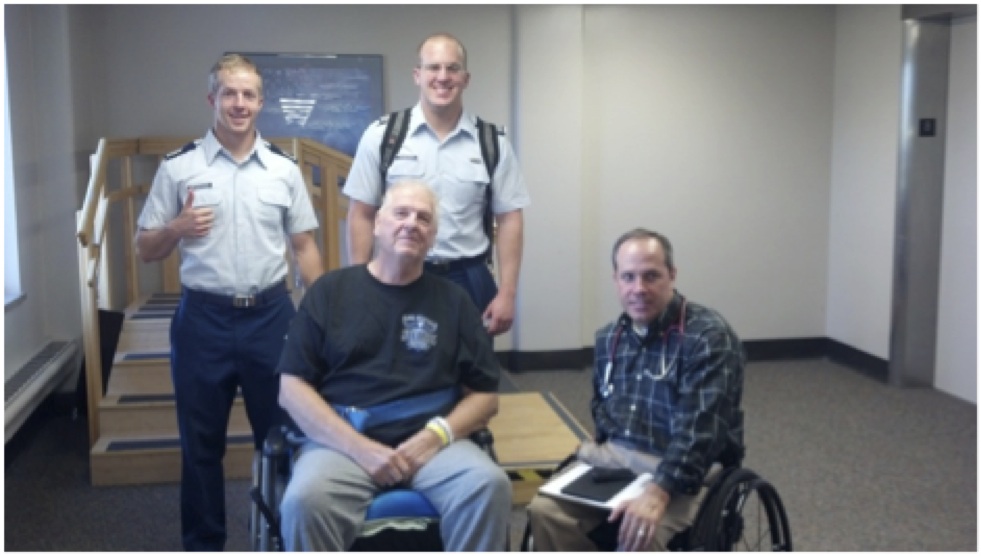
I found a willing co-conspirator in Capt Ryan Silva, a star instructor who mentors a project named Neumimic, using technology to aid in the rehabilitation of patients with chronic loss of limb motion.  In the first year, they had developed a proof of concept around the Xbox Kinect – and Ryan had high hopes for the future. But he found some elements of the traditional systems engineering process cumbersome and frustrating to cadets. Ryan signed on to lead our test class.

V-Model of Systems Engineering
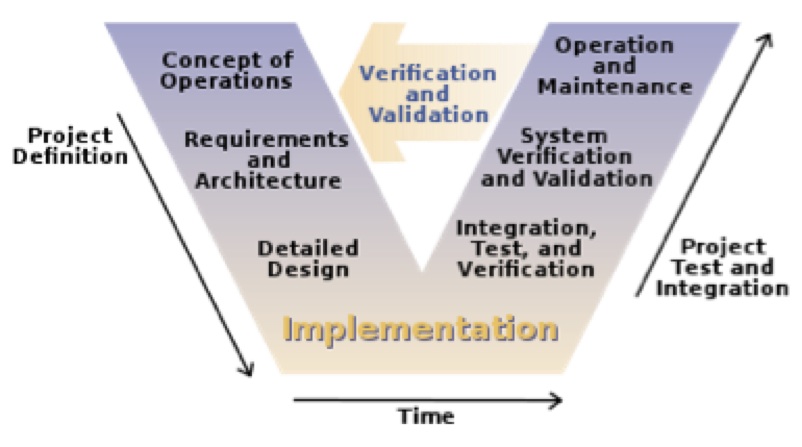
The current Capstone class follows the V-Model of Systems Engineering, with teams creating a detailed system design throughout the Fall semester and building their design in the Spring.

Vmodel

There are a series of formal reviews throughout the two semesters, in line with the Air Force acquisitions process.  Requirements and a concept of operations are presented at the first, the System Requirements Review.  Cadets receive instruction on the process in about a quarter of the course lessons.

What we decided to do instead was have semi-weekly informal reviews Lean Launchpad style, focusing on product hypotheses, customer interactions, learning, and validation / refinement.  We emphasize customer interaction via “getting out of the building” and rapid iteration through “cheap hacks”.  We’ve removed most of the structure and firm requirements from the original course in favor of a “whatever it takes” philosophy.  Instruction is presented in tandem with the reviews, focusing on areas we see as problematic.

Last year’s team meeting with Dr. Glen House at Penrose-St. Francis Hospital

Last year’s team meeting with Dr. Glen House at Penrose-St. Francis Hospital

Back to the Present
We’re about a quarter of the way through the fall semester. Team Neumimic consists of nine sharp cadets across multiple academic disciplines. Based on initial customer interactions, they divided themselves into two complementary but standalone teams. One will focus on design, execution, and measurement of therapy sessions – building on the original Xbox Kinect work.  The other will work on adjustable restriction of patient motion – forcing patients to use the proper muscles for each movement.

Here’s Ryan on the impact of the process change:

“Last year the team found themselves handcuffed to a process that required a 100% design solution on paper before we could even think about touching hardware…crazy right?! We spent the entire first semester nailing down requirements for a system that was supposed to meet the needs of stroke and traumatic brain injury patients as prescribed by their occupational therapists. For five months we slogged our way through the process emerged with a complete design for our system, custom-built to meet the needs of patients and doctors alike. Our design was flawless. We had nuts-and-bolts details all the way down to the schematic level. We were ready to build! The fact that we had yet to even see a patient or spend any real time with an occupational therapist had not even registered to us as a problem, until we were invited to watch a therapy session.

Our entire team walked out of the hospital ashen-faced and silent. We knew we had just wasted half the course designing a system that wouldn’t work. We were back to square one. The remainder of the course was spent in a frenzy of phone calls with doctors and therapists paired with many design reviews, but this time with our customers in the room. We were able to iterate a few solutions before we ran out of time, but the customers were thrilled with what they saw. I could only imagine what we could have accomplished if we didn’t waste the first half of the course on a solution that ultimately wasn’t what the customers wanted. I was fired up when Todd approached me with his idea to fundamentally change the way we did business.

So far the results have been incredible compared to last year. The team has learned more about the problem in a month than last year’s team learned in an entire semester. I’m not saying this year’s cadets are any more capable than last year’s; just that I believe this year’s team has been given a better chance to succeed.  They’re freed of a lot of stifling overhead and are embracing a process where requirements are derived from those who will actually use the system…imagine that! I’m excited to see what the team does with their remaining eight months.”

Current team members observing Dr. House conduct a therapy session

Current team members observing Dr. House conduct a therapy session

But we have experienced challenges in implementing this approach. Here’s what we’ve noticed so far:

In typical Lean Launchpad classes, students apply as teams with their own idea.  There’s also the potential for teams to pursue the opportunity beyond the class if they’re successful. In our Capstone, projects are predetermined and cadets are assigned based on preference and skill set.  Cadets will graduate and be commissioned as officers, doing various jobs throughout the Air Force. It’s highly unlikely they’ll be able to continue their project. These factors might make the initial motivation of our team less than that of other Lean Launchpad teams.  We found that early interactions with customers excited about their work went a long way to remedy this.

We’re offering cadets much less structure than they’re used to. Some cadets are uncomfortable with the ambiguity of the requirements (“What are you looking for?  What do I have to do to get an A?”).  I’d imagine this is typical of most high-performing students.

We’re trusting cadets with more freedom and less oversight than they’re used to.  There’s the potential for our trust to be abused.  I’m hopeful that our cadets rise to this challenge.  I think they’ll feel ownership of the project and empowerment, rather than see an opportunity to shirk responsibilities.

Since this course is a senior design experience, cadets expect to be “using their major”.  There’s the tendency for some to sit on the sideline if the pressing work isn’t directly related to their area of expertise.  It has taken some prodding for cadets to embrace the “hustler” mindset – to take any job necessary to move the team forward.

These are challenges we can overcome.  I know we’re moving in the right direction.  I know we have the right team and project to be successful.  I know our cadets will make us proud.

Up the hill!

Listen to post here
Download the post here

Why Real Learning is Outside the Building, Not Demo Day

Over the last three years our Lean LaunchPadNSF Innovation Corps classes have been teaching hundreds of entrepreneurial teams a year how to build their startups by getting out of the building and testing their hypotheses behind their business model.  While our teams have mentors, socialize a lot and give great demos, the goal of our class final presentations is “Lessons Learned”  – about product/market fit, pricing, acquisition/activation costs, pricing, partners, etc.  We think teaching teams a formal methodology around the Lean Framework (Business Model design, Customer Development and Agile Engineering) is a natural evolution of how successful incubators/accelerators will build startups.

Here’s the story of one such team; Jonathan Wylie, Lakshmi Shivalingaiah and the Evoke team.

—–

Imagine if, in the course of ten rollercoaster weeks, your customer segment changed from executives on corporate campuses to moms on playgrounds, a tool that was just part of your product turned into the killer product, and the value of the problem you were solving went from number 47 to customers trying to give you money when you demo’d.  Here’s how that happened.

We came to the Lean LaunchPad class wanting to build a mobile/web research management system aimed at helping qualitative researchers better manage the media they captured in the field. We were ready to learn, but pretty confident we would end the journey in the same market space in which we started.  We had a killer team and all the right skillsets.  I was a consultant and ethnographer, another teammate was a market researcher, and two others had the software engineering skills to build what the market needed.  And what the market needed would, of course, be exactly what we had envisioned. After all, there must be a huge number of researchers struggling with the exact same problems we had, right?  Not quite…

Out of the Building
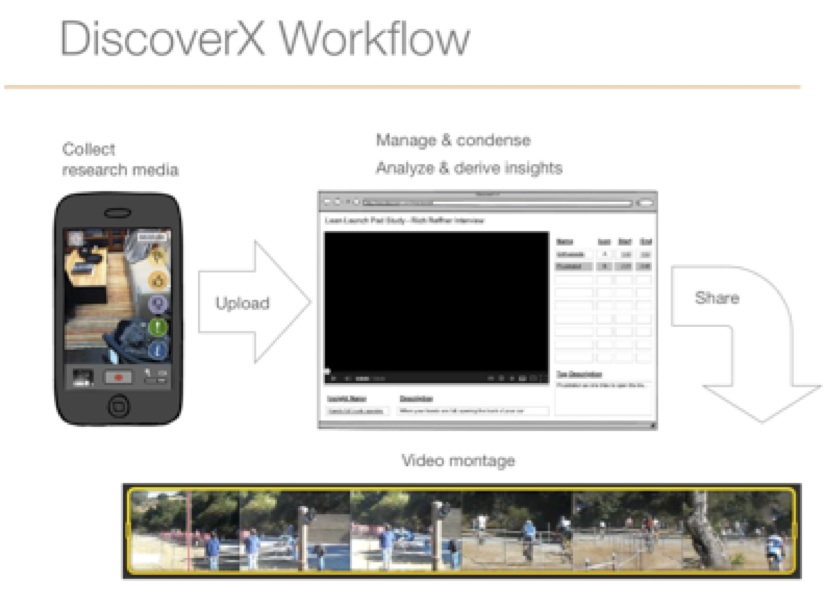
In the first 4 weeks, our team got out of the building and spoke with employees at 42 different companies.  We spoke with people at all levels, from front line user experience researchers at large tech firms to the CMO of a fortune 500 consumer goods company. Discover X WorkflowFrom the first 10 interviews, we learned that video is a big problem for researchers who use that medium.  It takes an average of 4 hours to mine every hour of video for the relevant 10 seconds of insight that matters.  Thus, we focused our early minimum viable product on helping researchers save money and time in finding insight in market research videos.

Wireframes
We built wireframes as a Minimum Viable Product to elicit feedback and began showing them to customers during our interviews.  At this point, things got real…and a bit ugly.  Given something tangible, customers were able to start gauging their willingness to use and pay.  Discover X wireframeTurns out, researchers were “just not that into us.”  We heard consistently that the product looked good and solved a problem, but it was not an important problem.  It was number 47 on their list, and there was no way they could justify paying to solve that problem.

First Pivot
As disappointing as this was, we dug deeper with our questioning.  To our surprise, customers started offering ideas on where there might be a true need; one of which was the legal market, specifically the deposition process. We thought this would be perfect for our product. There is a lot of video being recorded, and attorneys need to be able to pull out the insights quickly. After a solid week of speaking with lawyers and attending webinars on real-time deposition software, we had mapped both the technology and the buying relationships.  What we learned was that, we would just be an incremental feature to the incumbents and would need to integrate our solution with theirs. This, combined with regulation from the courts, a 2-year sales cycle, and the realization that e-discovery groups are not early adopters, made this an unattractive market.

Technology in search of a market
By this point, we were a technology in search of a market…not a good place to be.   The next customer segment we tried was startup founders.  After all, they are just like us – researching their markets and needing a way to share insights and keep their teams connected to customers. However, we found that most just assume that what they are building will have a market. The few who did get it felt uncomfortable using video during the interview process.

Pivot Two
While at times we felt like we wanted to give up, we began to hear a positive signal in the noise of all the customer rejections.  Evoke BrainstormingAt first it was faint.  While customers in all three markets were lukewarm for use at work, they got visibly excited telling us that it would definitely solve a problem at home. Say what??  They told us “too bad we weren’t making a consumer product so they could document their kids… they would pay a lot of money for that product.”  Whoah…were customers telling us we are a consumer product rather than B-to-B??

We settled on a small-scale experiment to test the consumer market. We decided to speak with 10 parents over the course of a week. If 5 had a similar problem, we would dive deeper. What we got was a landslide of interest.  All 10 parents had the problem.  Even more amazing to us, 9 of them liked our solution!

We learned that parents capture moments with their families to:

  1. remember and relive later
  2. share with those closest to them
  3. pass along a memoir to their kids

To our surprise, it turns out that none of these are being accomplished well with existing products, and parents are stressed because they feel like they are failing in an important responsibility.

Eureka!
Since that initial experiment in class, we’ve validated these findings (and many others) during over 200 hour-long interviews.

1st evoke wireframes

We even partnered with the university on a 112-person design workshop to learn more about how photos and videos fit into people’s lives.  It’s always an incredible experience to be invited into someone’s home to learn about how they capture their most precious family moments.  Sometimes, the learning is immediate and conclusive. Other times, we have to do multiple rounds before we arrive at an answer to an important question.

The result of all this effort is that we have found a large and underserved market in hidden in plain sight, right in the middle of an area that gets a lot of attention – photos and videos!

Lessons Learned
There’s no way we would have learned any of this unless we were out of the building and in the trenches, with parents over an extended period.

Knowing our customers and their problems first hand has given us a huge head start and a competitive advantage. Most entrepreneurs seem to just make this stuff up for a pitch deck or to please stakeholders, but the validated learning that we gained through these interviews and other methods of business model experimentation is not something that can be easily replicated.

As for our current status, we are building the product, continuing customer development, exploring and validating other aspects of our business model, and…oh yeah…hitting the pavement to raise our first round of funding!  If you want to talk to us about that, or if you know parents that we should be speaking to, please feel free to reach out.

For all the parents out there, relief (and much more) is on its way… http://www.evokeapp.com

Listen the post here
Download the audio here