Tesla and Adobe: Why Continuous Deployment May Mean Continuous Customer Disappointment

For the last 75 years products (both durable goods and software) were built via Waterfall development. This process forced companies to release and launch products by model years, and market new and “improved” versions.

In the last few years Agile and “Continuous Deployment” has replaced Waterfall and transformed how companies big and small build products. Agile is a tremendous advance in reducing time, money and wasted product development effort – and in having products better match customer needs.

But businesses are finding that Continuous Deployment not only changes engineering but has ripple effects on the rest of its business model. And these changes may have unintended consequences leading to customer dissatisfaction and confusion.

Smart companies will figure out how to educate their customers and communicate these changes.

—-

The Old Days – Waterfall Product Development
(skip this part of you’re conversant in Waterfall and Lean.)

Waterfall

In the past both hardware and software were engineered using Waterfall development, a process that moves through new product development one-step-at-a-time.

  • Marketing delivers a “requirements” document to engineering.
  • Then engineering develops a functional specification and designs the product.
  • Next comes the work of actually building the product – implementation.
  • Then validation ensures the product was built to spec.
  • After the product ships, it’s maintained by fixing flaws/bugs.

Customers would get their hands on a product only after it had gone through a lengthy cycle that could take years – enterprise software 1-2 years, new microprocessors 2-4 years, automobiles 3-5 years, aircraft a decade.

Waterfall – The Customer View
When customers purchased a product they understood that they were buying this year’s model.  When next year’s model arrived, they did not expect that  the Ford station wagon or Maytag washer they purchased last year would be updated to match all the features in the new model. (Software at times had an upgrade path, often it required a new purchase.)

Waterfall allowed marketers to sell incremental upgrades to products as new models. First starting in the fashion business, then adopted by General Motors in the 1920’s annual model year changeovers turned into national events. (The same strategy would be embraced 75 years later by Microsoft for Windows and then Apple for the iPhone.)

As the press speculated about new features, companies added to the mystique by guarding the new designs with military secrecy. Consumers counted the days until the new models were “unveiled”.

With its punctuated and delineated release cycles, waterfall development led consumers to understand the limited rights they had to future product upgrades and enhancements (typically none.) In other words, consumer expectations were bounded.

Waterfall Releases

At the same time, manufacturers used new model changeovers to generate excitement over new features/versions convincing consumers to obsolete perfectly functional products and buy new ones.

Agile Development: Continuous Delivery and Deployment
In contrast to Waterfall development, Agile Development delivers incremental and iterative changes on an ongoing basis.

Agile Dev

Agile development has upended the familiar consumer expectations and company revenue models designed around the release cycles of Waterfall engineering. In a startup this enables deployment of Minimum Viable products at a rapid pace. For companies already in production, Continuous Deployment can eliminate months or years in between major releases or models. Companies can deliver product improvements via the cloud so that all customers get a better product over time.

While continuous delivery is truly a better development process for engineering, it has profound impacts on a company’s business model and customer expectations.

Continuous Delivery/Deployment – The Marketers View
Cloud based products has offered companies an opportunity to rethink how new business models would work. Adobe and Tesla offer two examples.

Tesla
While most of the literature talks about continuous Delivery/Deployment as a software innovation for web/mobile/cloud apps, Tesla is using it for durable goods – $100,000 cars – in both hardware and software.

Tesla Model S on the road

First, Tesla’s Model S sedan downloads firmware updates on a regular basis. These software changes go much further than simply changing user interface elements on the dashboard. Instead, they may modify major elements of the car from its suspension to its acceleration and handling characteristics.

Secondly, in a break from traditional automobile practices, rather than waiting a year to roll out annual improvements to its Model S, Tesla has been continuously improving its product each quarter on the assembly line.  There are no model years to differentiate a Tesla Model S built in 2012 from one built this year. (The last time this happened in auto manufacturing was the Ford Model T.)

Adobe
Adobe, which for decades sold newer versions of its products – Photoshop, Illustrator, etc. – has now moved all those products to the cloud and labeled them the Adobe Creative Cloud. Instead of paying for new products, customers now buy an annual subscription.

Photoshop package

The move to the cloud allowed Adobe to implement continuous delivery and deployment. But more importantly the change from a product sale into a subscription turned their revenue model into a predictable annuity. From an accounting/Wall Street perspective it was a seemingly smart move.

Continuous Delivery/Deployment – The Customer View
But this shift had some surprises for consumers, not all of them good.

As many companies are discovering, incremental improvement doesn’t have the same cachet to a consumer as new and better. While it may seem irrational, inefficient and illogical, the reality is that people like shiny new toys. They want newer things. Often. And they want to be the ones who own them, control them and decide when they want to change them.

Adobe
While creating a predictable revenue stream from high-end users, Adobe has created two problems. First, not all Adobe customers believe that Adobe’s new subscription business model is an improvement for them. If customers stop paying their monthly subscription they don’t just lose access to the Adobe Creative Suite software (Photoshop, Illustrator, etc.) used to create their work, they may lose access to the work they created.

Second, they unintentionally overshot the needs of students, small business and casual users, driving them to “good-enough” replacements like Pixelmator, Acorn, GIMP for PhotoShop and Sketch, iDraw, and ArtBoard for Illustrator.

The consequence of discarding low margin customers and optimizing revenue and margin in the short-term, Adobe risks enabling future competitors. In fact, this revenue model feels awfully close to the strategy of the U.S. integrated steel business when they abandoned their low margin business to the mini-mills.

Tesla
What could go wrong with making a car incrementally better over time? First, Tesla’s unilateral elimination of features already paid for without consumers consent is a troubling precedent for cloud connected durable goods.

Second, Telsa’s elimination of model years and its aggressive marketing of the benefits of continuous development of hardware and software have set its current customers expectations unreasonably high. Some feel entitled to every new hardware feature rolled into manufacturing, even if the feature (i.e. faster charging, new parking sensors,) was not available when they bought their cars – and even if their car isn’t backwards compatible.

Model years gave consumers an explicit bound of what to expect. This lack of boundaries results in some customer disappointment.

Lessons Learned

  • Continuous Delivery/Deployment is a major engineering advance
  • It enables new business models
  • Customers don’t care about your business model, just it’s effect on them
  • While irrational, inefficient and illogical, people like shiny new toys
  • Subscription revenue models versus new purchases require consumer education
  • If your subscription revenue model “fires” a portion of your customers, it may enable new competitors
  • Companies need to clearly communicate customer entitlements to future features

Listen to the blog post here
Download the podcast here

Lessons Learned in Diagnostics

This post is part of our series on the National Science Foundation I-Corps Lean LaunchPad class in Life Science and Health Care at UCSF. Doctors, researchers and Principal Investigators in this class got out of the lab and hospital talked to 2,355 customers, tested 947 hypotheses and invalidated 423 of them. The class had 1,145 engagements with instructors and mentors. (We kept track of all this data by instrumenting the teams with LaunchPad Central software.)

Mira Medicine is one of the 26 teams in the class. The team members are:
  • Pierre-Antoine Gourraud – PhD, MPH UCSF neuroscientist and c0-leader of the MS BioScreen project
  • Jason Crane – PhD UCSF Manager Scientific Software Development
  • Raphaelle Loren – Managing Director – Health Practice at the Innovation Management Institute

Todd Morrill was the diagnostics cohort instructor. Matt Cooper CEO of Carmenta BioSciences was the Mira Medicine team mentor.

Multiple Sclerosis – MS
Multiple Sclerosis – MS – is an immune system disease that attacks the myelin, the fatty sheath that surrounds and protects nerve fibers of the central nervous system (brain, spinal cord, and optic nerve). T-cells, (a type of white blood cell in the immune system,) become sensitized to myelin and cross the blood-brain barrier into the central nervous system (CNS). Once in the CNS, these T-cells injure myelin, and secrete chemicals that damage nerve fibers (axons) and recruit more damaging immune cells to the site of inflammation. multiple sclerosis and therapeutic targets

There are currently ten FDA approved MS medications for use in relapsing forms of MS. None of these drugs is a cure, and no drug is approved to treat the type of MS that shows steady progression at onset. MS disease management decisions are complex and requires a patients neurologist to figure out what drugs to use.

Mira Medicine and Multiple Sclerosis
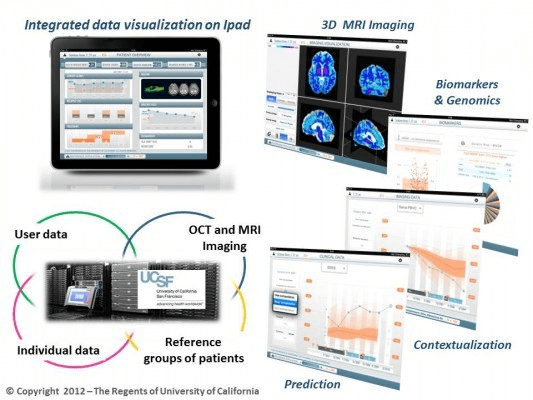
The team came to class with the thought of commercializing the UCSF Multiple Sclerosis BioScreen Project a Precision Medicine application that integrates a patients medical records with the latest population-based data from hundreds of other Multiple Sclerosis patients, (including their 3D MRI scans,) and using predictive algorithms makes it possible to chart a unique course of treatment for each patient. (Mira Medicine team member Pierre-Antoine Gourraud was the project co-leader.) MS BioScreen

Mira wanted to commercialize the UCSF Multiple Sclerosis Bioscreen project and to add additional neurological diseases which require multiple types of data  (including biomarkers, clinical, and imaging). They wanted to help medical centers and large providers assess disease progression to guide therapeutic decision-making.  Over the course of the class Mira Medicine team spoke to over 80 customers, partners and payers.

Here’s their 2 minute video summary

If you can’t see the video above, click here.

Then reality hit. First, the team found that their Multiple Sclerosis Bioscreen application (which they used as their MVP) was just a “nice-to-have”, not a “must-have”. In fact, the “must have features” were their future predictive algorithms. Next, they found that if their tool can enable a diagnosis, (even without claiming it could) then it was likely that the FDA would require a  510(k) medical device clearance. Then they found to get reimbursed they need a CPT code (and they had to decide whether to code stack – using multiple codes for “one” diagnosis, and thereby getting multiple reimbursements for one test. (The rules have changed so that code stacking is hard or impossible), Or get a new CPT code, or use miscellaneous code.) To get a new CPT and a 510(k) they would have to perform a some sort of clinical study. At a minimum a 1-year prospective study (a study to see if the neurologists using the application had patients with a better outcome then those who didn’t have access to the app). Getting approval to use an existing (aka old) CPT code means showing equivalence to an existing dx process or test, and the requirements are code-specific. Finally, to get access to data sources of other MS patients they would need to have HIPPA Business Associate Agreement.

Watch their Lessons Learned video below and find out how they pivoted and what happened.

If you can’t see the video above click here

Look at their Lesson Learned slides below If you can’t see the presentation above, click here

Lessons Learned

  • Researchers and PI’s come in believing “My science/project/data are so good that people will immediately see the value and be willing to pay for it.  It will “sell itself”.
  • A business is much more than just good science: it is about customers seeing value and being willing to pay and proper validation and reimbursement coding and
  • A successful business is the sum (and integration!) of all the parts of the business model canvas.
    • It includes reimbursement, regulation, IP, validation, channel access, etc.

Listen to the blog post here [audio http://traffic.libsyn.com/albedrio/steveblank_hplewis_140102_FULL.mp3]

Download the podcast here

Lessons Learned in Therapeutics

This post is part of our series on the National Science Foundation I-Corps Lean LaunchPad class in Life Science and Health Care at UCSF. Doctors, researchers and Principal Investigators in this class got out of the lab and hospital talked to 2,355 customers, tested 947 hypotheses and invalidated 423 of them. The class had 1,145 engagements with instructors and mentors. (We kept track of all this data by instrumenting the teams with LaunchPad Central software.)

We are redefining how translational medicine is practiced.

Traditional view of translational medicineWe’ve learned that translational medicine is not just about the science.

More on this in future blog posts.

Lean view of translational medicine

Vitruvian Therapeutics is one of the 26 teams in the class. The team members are:
  • Dr. Hobart Harris  Chief of  General Surgery, Vice-Chair of the Department of Surgery, and a Professor of Surgery at  UCSF.
  • Dr. David Young,  Professor of Plastic Surgery at UCSF. His area of expertise includes wound healing, microsurgery, and reconstruction after burns and trauma. 
  • Cindy Chang is a Enzymologist investigating novel enzymes involved in biofuel and chemical synthesis in microbes at LS9

Karl Handelsman was the therapeutics cohort instructor. Julie Cherrington CEO of Pathway Therapeutics was the team mentor.

Vitruvian Therapeutics is trying to solve the Incisional hernia problem. An incisional hernia happens in open abdominal surgery when the area of the wound doesnt heal properly and bulges outward. This requires a second operation to fix the hernia.Ventral Herniaincisional hernia

Hobart Harris’s insight was what was needed wasn’t one more new surgical technique or device to repair the hernias, but something to prevent the hernia from occurring in the first place. Vitruvian Therapeutics first product, MyoSeal, does just that. It promotes wound repair via biocompatible microparticles plus a fibrin tissue sealant. So far in 300 rats it’s been shown to prevent incisional hernias through enhanced wound healing.

Here’s their 2 minute video summary

If you can’t see the video above, click here.

Two weeks into the class and interviews with 14 of their potential customers (surgeons) reality intruded on their vision of how the world should work. We happened to catch that moment in class in this 90 second clip.

Watch  and find out how talking to just the first 14 customers in the Lean LaunchPad class saved Hobart Harris and the Vitruvian Therapeutics team years.

If you can’t see the clip above click here.

The Vitruvian Therapeutics Lessons Learned Presentation is a real-eyeopener. Given that this product could solve the incisional hernia problem, Hobart and his team naturally assumed that insurance companies would embrace this and their fellow surgeons viewed the problem as they did and would leap at using the product. Boy were they in for a surprise. After talking to 74 surgeons, insurance companies and partners appeared that no one – insurance companies or surgeons – owned the problem. Listen to their conclusions 8-weeks after the first video.

Watch the video and find out how they pivoted and what happened.

Don’t miss Karl Handelsman comments on their Investment Readiness Level at the end. Vitruvian is a good example of a great early stage therapeutics idea with animal data missing and many key components of the business model still needed to verify.

If you can’t see the video above click here

Look at their Lesson Learned slides below

If you can’t see the presentation above, click here

Market Type
During the class the Vitruvian Therapeutics class struggled with the classic question of visionaries: are we creating a New Market (one which doesn’t exist and has no customers)? In Vitruvian’s case preventive measures to stop incisional hernias before they happen.  Or should we position our product as one that’s Resegmenting an Existing Market? i.e. reducing leakage rates.  Or is there a way to get proof that the vision of the New Market is the correct path.

When Hobart Harris of Viturvian asked, “… what if you’re a visionary, and no one but you sees the right solution to a problem” we had a great in-class dialog. Karl Handelsman‘s comments at 3:15 and 4:16 and Allan May at 4:35 were incredibly valuable. See the video below for the dialog.

If you can’t see the video above, click here

Further Reading

Lessons Learned

  • Principal Investigators, scientists and engineers can’t figure out commercialization sitting in their labs
  • You can’t outsource commercialization to a proxy (consultants, market researchers, etc.)
  • Experiential Learning is integral to commercialization
  • You may be the smartest person in your lab, but your are not smarter than the collective intelligence of your potential customers, partners, payers and regulators

Listen to the blog post here [audio http://traffic.libsyn.com/albedrio/steveblank_hplewis_131226_FULL.mp3]

Download the podcast here

Moneyball and the Investment Readiness Level-video

Eric Ries was kind enough to invite me to speak at his Lean Startup Conference.

In the talk I reviewed the basic components of the Lean Startup and described how we teach it. I observed that now that we’ve built software to instrument and monitor the progress of new ventures (using LaunchPad Central), that we are entering the world of evidence-based entrepreneurship and the Investment Readiness Level.

This video is a companion to the blog post here. Read it for context.

If you can’t see the video above, click here

You can follow the talk along using the slides below

If you can’t see the slides above, click here

Additional videos here

Startup Tools here

Listen the blog post here [audio http://traffic.libsyn.com/albedrio/steveblank_clearshore_131221.mp3]

Download the podcast here

Lessons Learned in Medical Devices

This post is part of our series on the National Science Foundation I-Corps Lean LaunchPad class in Life Science and Health Care at UCSF. Doctors, researchers and Principal Investigators in this class got out of the lab and hospital talked to 2,355 customers, tested 947 hypotheses and invalidated 423 of them.  The class had 1,145 engagements with instructors and mentors. (We kept track of all this data by instrumenting the teams with LaunchPad Central software.)

We are redefining how translational medicine is practiced. It’s Lean, it’s fast, it works and it’s unlike anything else ever done.

—–

Sometimes teams win when they fail.

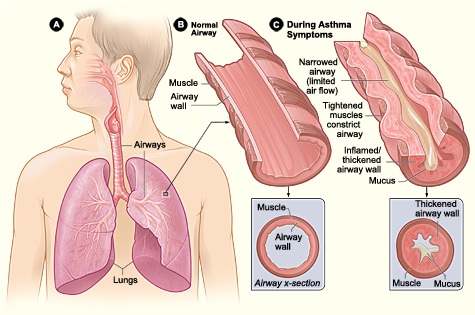
Knox Medical Devices was building a Spacer which contained a remote monitoring device to allow for intervention for children with Asthma . (A Spacer is a tube between a container of Asthma medicine (in an inhaler) and a patient’s mouth.The tube turns the Asthma medicine into an aerosol.)Asthma

Knox’s spacer had sensors for basic spirometry measurements (the amount of air and how fast it’s inhaled and exhaled) to see how well the lung is working. It also had a Nitrous Oxide sensor to provide data on whether the lungs airways are inflamed, an inhaler attachment and a GPS tracking device.

Knox SpacerThe Spacer hardware was paired with data analysis software for tracking multiple facets of asthma patients.

The Knox team members are:

Allan May founder of Life Science Angels was the Medical Device cohort instructor. Alex DiNello CEO at Relievant Medsystems was their mentor.

The Knox team was a great mix of hands-on device engineers and business development. They used agile engineering perfectly to continually test variants of their Minimum Viable Product (MVP’s) in front of customers often and early to get immediate feedback.

Knox was relentless about understanding whether their device was a business or whether it was technology in search of a market. In 10 weeks they had face-to-face meetings with 117 customers, tested 33 hypotheses, invalidated 19 of them and 53 instructor and mentor interactions.

Here’s Knox Medical’s 2 minute video summary

If you can’t see the video above, click here

Knox was a great example of having a technology in search of a customer. The initial hypothesis of who would pay for the device – parents of children with asthma – was wrong and resulted in Knox’s first pivot in week 4. By week 6 they had discovered that; 1) Peak Flow Meters are not as heavily prescribed as they thought, 2) Insurance company reimbursement is necessary for anything upwards of $15, 3) Nitrous Oxide testing isn’t currently used to measure asthma conditions.

After the pivot they the found that the most likely users of their device would be low income Asthma patients who are treated at Asthma clinics funded by federal, state or county dollars. These clinics reduce hospitalization but Insurers weren’t paying to cover clinic costs nor would they cover the use of the Knox device. The irony was that those who most needed the Knox device were those who could least afford it and wouldn’t be able get it.

Watch their Lesson Learned presentation below. Listen to the comments from Allan May the Device instructor at the end.

If you can’t see the video above, click here

In the end Knox, like a lot of startups in Life Science and Health Care, discovered that they had a multi-sided market.  They realized late in the class the patients (and their families) were not their payers – their payers were the insurance companies (and the patients were the users.)  If they didn’t have a compelling value proposition for the insurers (cost savings, increased revenue, etc.) it didn’t matter how great the technology was or how much the patients would benefit.

The Knox Medical Device presentation slides are below. Don’t miss the evolution of their business model canvas in the appendix. It’s a film strip of the entrepreneurial process in action.

If you can’t see the slides above, click here

Knox is a great example of how the Lean LaunchPad allows teams to continually test hypotheses and fail fast and inexpensively. They learned a ton. And saved millions.

Lessons Learned

  • In medical devices, understanding reimbursement, regulation and IP is critical
  • Sometimes teams win when they fail
Download the podcast here

Lessons Learned in Digital Health

This post is part of our series on the National Science Foundation I-Corps Lean LaunchPad class in Life Science and Health Care at UCSF.

Our Lean LaunchPad for Life Science class talked to 2,355 customers, tested 947 hypotheses and invalidated 423 of them.  They had 1,145 engagements with instructors and mentors. (We kept track of all this data by instrumenting the teams with LaunchPad Central software.)

This post is one of a series of the “Lessons Learned” presentations and videos from our class.

Sometimes a startup results from a technical innovation. Or from a change in regulation, declining costs, changes in consumers needs or an insight about customer needs. Resultcare, one of the 26 teams in the class started when a resident in clinical medicine at UCSF watched her mother die of breast cancer and her husband get critically injured.

The team members are:

  • Dr. Mima Geere  Clinical Medicine at UCSF.
  • Dr. Arman Jahangiri HHMI medical fellow at UCSF, Department of Neurological Surgery
  • Dr. Brandi Castro in Neuroscience at UCSF
  • Mitchell Geere product design
  • Kristen Bova MBA, MHS
  • Nima Anari PhD in Data Science

Abhas Gupta was the Digital Health cohort instructor. Richard Caro was their mentor.

ResultCare is a mobile app that helps physicians take the guesswork out of medicine. It enables physicians to practice precision medicine while reducing costs.precision medicine

Here’s Resultcare’s 2 minute video summary

If you can’t see the video above, click here.

Watch their Lesson Learned presentation below. The first few minutes of the talk is quite personal and describes the experiences that motivated Dr. Geere to address this problem.

If you can’t see the video above, click here

The Resultcare presentation slides are below.

If you can’t see the presentation above, click here

Listen to the blog post here [audio http://traffic.libsyn.com/albedrio/steveblank_clearshore_131219.mp3]

Download the podcast here

We’ve seen the Future of Translational Medicine and it’s Disruptive

A team of 110 researchers and clinicians, in therapeutics, diagnostics, devices and digital health in 25 teams at UCSF, has just shown us the future of translational medicine.  It’s Lean, it’s fast, it works and it’s unlike anything else ever done.

It’s going to get research from the lab to the bedside cheaper and faster.

Welcome to the Lean LaunchPad for Life Sciences and Healthcare (part of the National Science Foundation I-Corps).

This post is part of our series on the Lean Startup in Life Science and Health Care.

——–

Our class talked to 2,355 customers, tested 947 hypotheses and invalidated 423 of them.  They had 1,145 engagements with instructors and mentors. (We kept track of all this data by instrumenting the teams with LaunchPad Central software.)

In a packed auditorium in Genentech Hall at UCSF, the teams summarized what they learned after 10 weeks of getting out of the building. This was our version of Demo Day – we call it “Lessons Learned” Day. Each team make two presentations:

  • 2 minutes YouTube Video: General story of what they learned from the class
  • 8 minute Lessons Learned Presentation: Very specific story about what they learned in 10 weeks about their business model

In the next few posts I’m going to share a few of the final “Lessons Learned” presentations and videos and then summarize lessons learned from the teaching team.

Magnamosis
Magnamosis is a medical device company that has a new way to create a magnetic compression anastomosis (a surgical connection between two tubular structures like the bowel) with improved outcomes.

anastomosis

Team Members were: Michael Harrison (the father of fetal surgery), Michael Danty, Dillon Kwiat, Elisabeth Leeflang, Matt Clark.  Jay Watkins was the team mentor. Allan May and George Taylor were the medical device cohort instructors.

Their initial idea was that making an anastomosis that’s better, faster and cheaper will have surgeons fighting to the death to get a hold of their device.  magnamosisThey quickly found out that wasn’t the case.  Leak rates turned out to a bigger issue with surgeons and a much larger market.

Here’s their 2 minute video summary

If you can’t see the video above, click here.

Watch their Lessons Learned video below and see how a team of doctors learned about product/market fit, channels and pricing.

If you can’t see the video above, click here

Their slide deck is below. Don’t miss the evolution of their business model in the Appendix.

If you can’t see the presentation above, click here

The best summary of why Scientists, Engineers and Principal Investigators need to get out of the building was summarized by Dr. Harrison below. After working on his product for a decade listen to how 10 weeks of the Lean LaunchPad class radically changed his value proposition and business model.

If you can’t see the video above, click here.

For further reading:

Listen to the blog post here [audio http://traffic.libsyn.com/albedrio/steveblank_clearshore_131217.mp3]

Download the podcast here

How Do You Want to Spend Your Next 4 Years of Your Life?

As our Lean LaunchPad for Life Sciences class winds down, a good number of the 26 teams are trying to figure out whether they should go forward to turn their class project into a business.

Given that we’ve been emphasizing Evidence-based entrepreneurship and the Investment Readiness Level, I guess I shouldn’t have been surprised when someone asked, “After we figure all this data out, should we pursue our idea based on the numbers?”

Ouch.

I pointed out that the “data” you gather in 10 weeks (talking to 100+ customers, partners, payers, etc.,) are not the first thing you should look at. There are three more important things you should worry about.

(see 0:30 in the video below)

turning point

——–

1. Do you want to spend the next 3 or 4 years of your life doing this?

(See 1:03 in the video below)

Now that you’ve gotten to know your potential channel and customers, regardless of how much money you’re going to make, will you enjoy working with these customers for the next 3 or 4 years?

One of the largest mistakes in my career was getting this wrong. I used to be in startups where I was dealing with engineers designing our microprocessors or selling supercomputers to research scientists solving really interesting technical problems. But in my next to last company, I got into the video game business.

My customers were 14-year old boys. (see 1:30 in the video)  I hated them. It was a lifelong lesson that taught me to never start a business where you hate your customers. It never goes well. You don’t want to talk to them. You don’t want to do Customer Development with them. You just want them to go away.  And in my case they did – they didn’t buy anything.

So you and your team need to feel comfortable being in this business with these customers.

2. Is this a scalable business?  And if not, are you Ok with something small?

(See 2:03 in the video below)

Is it a lifestyle business while you’re keeping your other job?  Is it a small business that hits $4 million in revenue in four years and $8 million in ten years?  Or is it something that can grow to a size that will result in an acquisition or some liquidity event?

You need to decide what your personal goal is and how it matches what you think this business can grow into.  And you and your cofounders need to have that discussion to make sure that all the co-founders’ interests are aligned – before you make any decision to start the company.  If one of you are happy making $500K/year and the other has visions of selling the company to Roche for a billion dollars, you have very different goals. Without clear alignment, one or both of you will be really unhappy later when you try to make decisions.

3. If I Didn’t Make Any Money After 4 Years, Did I Still Have A Great Time?

(See 4:36 in the video below)

If your company fails, would you still say you had one hell of a ride? Founders don’t do startups because they’re searching for a huge financial windfall. They do it because it’s the greatest invention they can imagine. Most of the time you will fail. So if you’re not going to have a great time with your team and learn and build something you are truly excited about – don’t do it.

If you can’t see the video above, click here

Lessons Learned

  • Do you want to spend the next 3 or 4 years of your life doing this business?
  • Is this a scalable business?  And if not, are you Ok with something small?
  • If you didn’t make any money after 4 years, did you have a great time?

Listen to the podcast here [audio http://traffic.libsyn.com/albedrio/steveblank_clearshore_131209.mp3]

Download the podcast here

When Customers Make You Smarter

We talk a lot about Customer Development, but there’s nothing like seeing it in action to understand its power. Here’s what happened when an extraordinary Digital Health team gained several critical insights about their business model. The first was reducing what they thought was a five-sided market to a simpler two-sided one.

But the big payoff came when their discussions with medical device customers revealed an entirely new way to think about pricing —potentially tripling their revenue.

——

We’re into week 9 of teaching a Lean LaunchPad class for Life Sciences and Health Care (therapeutics, diagnostics, devices and digital health) at UCSF teaching with a team of veteran venture capitalists. The class has talked to ~2,200 customers to date. (Our final – not to be missed – Lessons Learned presentations are coming up December 10th.)

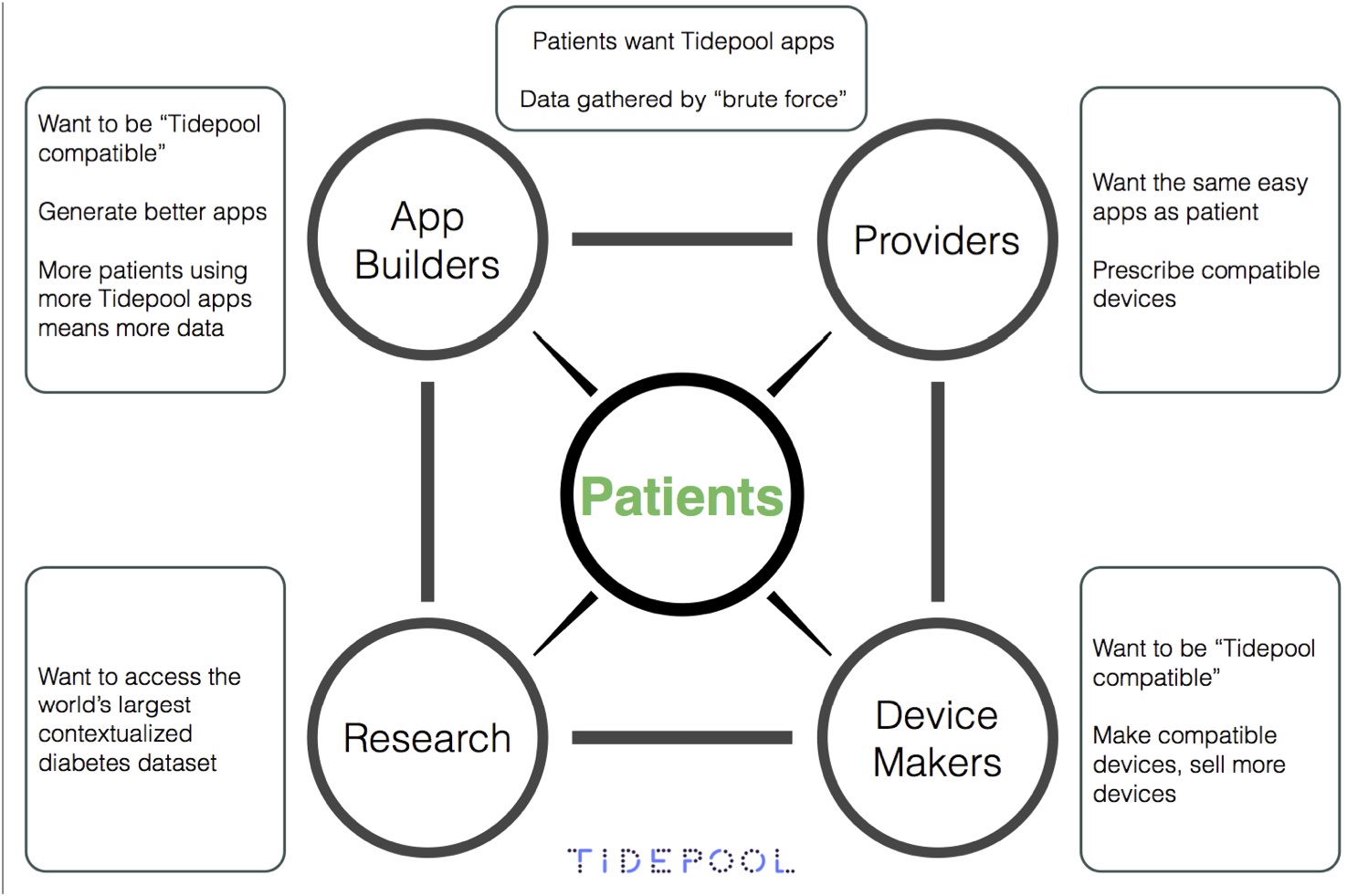
Among the 28 startups in the Digital Health cohort is Tidepool. They began the class believing they were selling an open data and software platform for people with Type 1 Diabetes into a multi-sided market comprised of patients, providers, device makers, app builders and researchers.

tidepool website

The Tidepool team members are:

  • Aaron Neinstein MD  Assistant Professor of Clinical Medicine, Endocrinology and Assistant Director of Informatics at UCSF. He’s an expert in the intersection between technological innovations and system improvement in healthcare. His goal is to make health information easier to access and understand.
  • Howard Look, CEO of Tidepool, was VP of Software and User Experience at TiVo. He was also VP of Software at Pixar, developing Pixar’s film-making system, and at Amazon where he ran a cloud services project. At Linden Lab, delivered the open-sourced Second Life Viewer 2.0 project. His teenage daughter has Type 1 diabetes.
  • Brandon Arbiter was a VP at FreshDirect where he built the company’s data management and analytics practices. He was diagnosed at age 27 with Type 1 Diabetes. He developed a new generation diabetes app, “nutshell,” that gives patients the information they need to make the right decisions about their dosing strategies.
  • Kent Quirk was director of engineering at Playdom and director of engineering at Linden Labs.

A Five-sided Market
In Week 1 the Tidepool team diagramed its customer segment relationships like this:

Tidepool ecosystem

Using the business model canvas they started with their value proposition hypotheses, articulating the products and services they offered for each of the five customer segments. Then they summarized what they thought would be the gain creators and pain relievers for each of these segments.

Tide pool value prop week 1

Next, they then did the same for the Customer Segment portion of the canvas. They listed the Customer Jobs to be done and the Pains and Gains they believed their Value Proposition would solve for each of their five customer segments.

Tide pool cust week 1

It’s Much Simpler
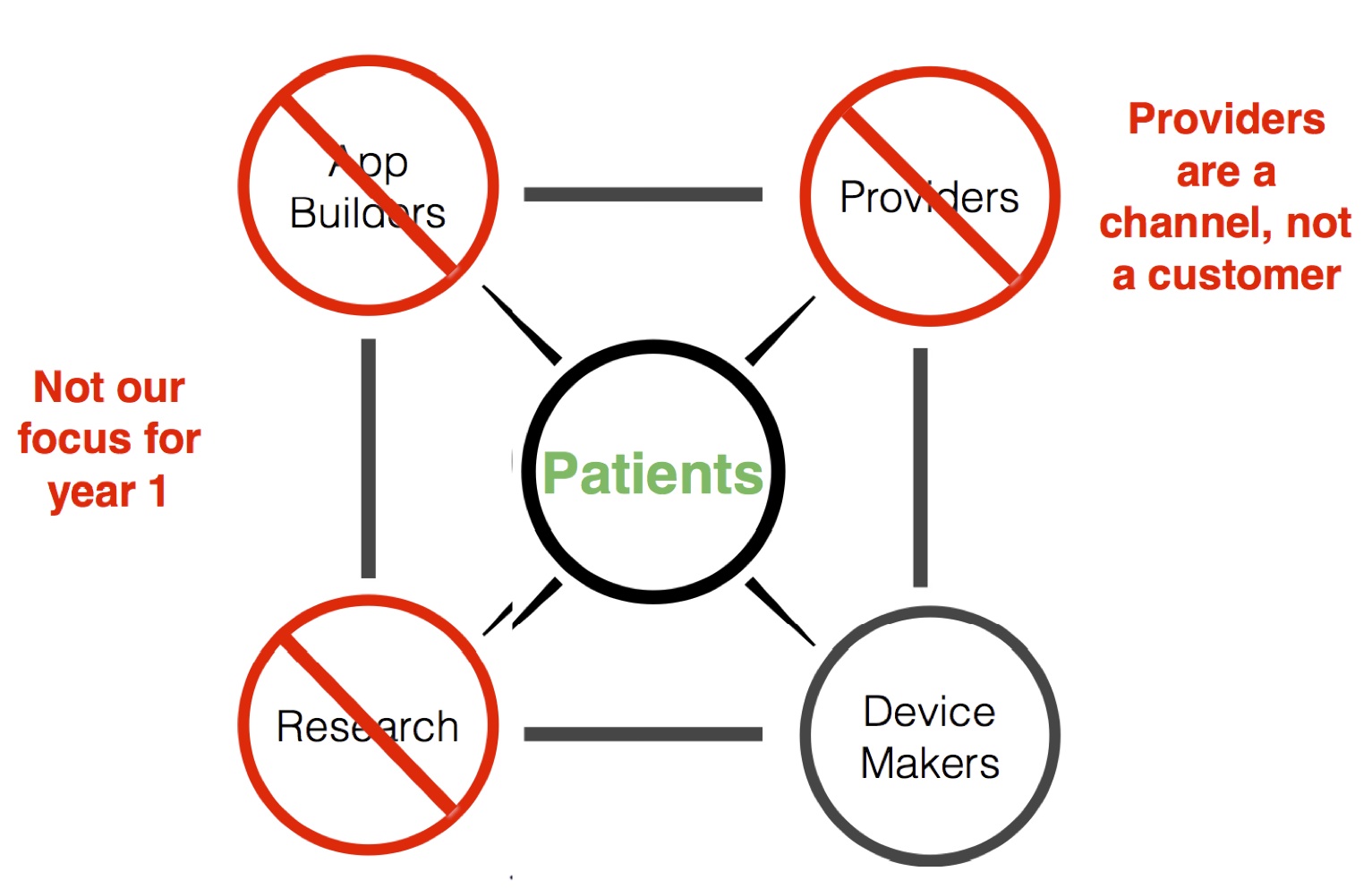
Having a multisided market with five segments is a pretty complicated business model. In some industries such as medical devices its just a fact of life. But after talking to dozens of customers by week 3, Tidepool discovered that in fact they had a much simpler business model – it was a two-sided market.

tidepool simplification

They discovered that the only thing that mattered in the first year or two of their business was building the patient-device maker relationship. Everything else was secondary. This dramatically simplified their value proposition and customer segment canvas.

So they came up with a New Week 3 Value Proposition Canvas:

Tide pool value prop week 3

And that simplified their New Week 3 Customer Segment Canvas

Tide pool cust week 3

Cost-based Pricing versus Value-based Pricing
While simplifying their customer segments was a pretty big payoff for 3 weeks into the class, the best was yet to come.

As part of the revenue streams portion of the business model canvas, each team has to diagram the payment flows.

Tide pool market pricing

The Tidepool team originally believed they were going charge their device partners “market prices” for access to their platform. They estimated their Average Revenue per User (ARPU) would be about $36 per year.

Tide pool market pricing ARPU

But by week 6 they had spoken to over 70 patients and device makers. And what they found raised their average revenue per user from $36 to $90.

When talking to device makers they learned how the device makers get, keep and grow their customers.  And they discovered that:

  • device makers were spending $500-$800 in Customer Acquisition Cost (CAC) to acquire a customer
  • device makers own customers would stay their customers for 10 years (i.e. the Customer Life Time (CLT))
  • and the Life Time Value (LTV) of one customer over those 10 years to a device maker is $10,000

Tide pool market pricing device cac

These customer conversations led the Tidepool team to further refine their understanding of the device makers’ economics.  They found out that the device makers sales and marketing teams were both spending money to acquire customers.  ($500 per sales rep per device + $800 marketing discounts offered to competitors’ customers.)

Tide pool device economics

Once they understood their device customers’ economics, they realized they could help these device companies reduce their marketing spend by moving some of those dollars to Tidepool. And they realized that the use of the Tidepool software could reduce the device companies’ customer churn rate by at least 1%.

This meant that Tidepool could price their product based on the $1,800 they were going to save their medical device customers.  Read the previous sentence again. This is a really big idea.

Tide pool value pricing big idea

The Tidepool team went from cost-based pricing to value-based pricing. Raising their average revenue per user from $36 to $90.

Tide pool value pricing $90 ARPU

There is no possible way that any team, regardless of how smart they are could figure this out from inside their building.

If you want to understand how Customer Discovery works and what it can do in the hands of a smart team, watch the video below. The team ruthlessly dissects their learning and builds value-pricing from what they learned.

This short video is a classic in Customer Discovery.

If you can’t see the video click here.

Lessons Learned

  • Most startups begin by pricing their product based on cost or competition
  • Smart startups price their product based on value to the customer
  • You can’t guess how your product is valued by customers
  • Customer Development allows you to discover the economics needed for value pricing your product

Listen to the podcast here [audio http://traffic.libsyn.com/albedrio/steveblank_clearshore_131202.mp3]

Download the podcast here

It’s Time to Play Moneyball: The Investment Readiness Level

Investors sitting through Incubator or Accelerator demo days have three metrics to judge fledgling startups – 1) great looking product demos, 2) compelling PowerPoint slides, and 3) a world-class team.

We think we can do better.

We now have the tools, technology and data to take incubators and accelerators to the next level. Teams can prove their competence and validate their ideas by showing investors evidence that there’s a repeatable and scalable business model. And we can offer investors metrics to play Moneyball – with the Investment Readiness Level.

Here’s how.

————–

We’ve spent the last 3 years building a methodology, classes, an accelerator and software tools and we’ve tested them on ~500 startups teams.

  • A Lean Startup methodology offers entrepreneurs a framework to focus on what’s important: Business Model Discovery. Teams use the Lean Startup toolkit: the Business Model Canvas + Customer Development process + Agile Engineering. These three tools allow startups to focus on the parts of an early stage venture that matter the most: the product, product/market fit, customer acquisition, revenue and cost model, channels and partners.

Lean moneyball

  • An Evidence-based Curriculum (currently taught in the Lean LaunchPad classes and NSF Innovation Corps accelerator). In it we emphasize that a) the data needed exists outside the building, b) teams use the scientific method of hypothesis testing c) teams keep a continual weekly cadence of:
    • Hypothesis – Here’s What We Thought
    • Experiments – Here’s What We Did
    • Data – Here’s What We Learned
    • Insights and Action – Here’s What We Are Going to Do Next

Evidence moneyball

  • LaunchPad Central software is used to track the business model canvas and customer discovery progress of each team. We can see each teams hypotheses, look at the experiments they’re running to test the hypotheses, see their customer interviews, analyze the data and watch as they iterate and pivot.

LPC

We focus on evidence and trajectory across the business model. Flashy demo days are great theater, but it’s not clear there’s a correlation between giving a great PowerPoint presentation and a two minute demo and building a successful business model. Rather than a product demo – we believe in a “Learning Demo”. We’ve found that “Lessons Learned” day showing what the teams learned along with the “metrics that matter” is a better fit than a Demo Day.

“Lessons Learned” day allows us to directly assess the ability of the team to learn, pivot and move forward. Based on the “lessons learned” we generate an Investment Readiness Level metric that we can use as part of our “go” or “no-go” decision for funding.

Some background.

NASA and the Technology Readiness Level (TRL)
In the 1970’s/80’s NASA needed a common way to describe the maturity and state of flight readiness of their technology projects.  They invented a 9-step description of how ready a technology project was.  They then mapped those 9-levels to a thermometer.NASA TRL

What’s important to note is that the TRL is imperfect. It’s subjective. It’s incomplete.  But it’s a major leap over what was being used before.  Before there was no common language to compare projects.

The TRL solved a huge problem – it was a simple and visual way to share a common understanding of technology status.  The U.S. Air Force, then the Army and then the entire U.S. Department of Defense along with the European Space Agency (ESA) all have adopted the TRL to manage their complex projects. As simple as it is, the TRL is used to manage funding and go/no decisions for complex programs worldwide.

We propose we can do the same for new ventures – provide a simple and visual way to share a common understanding of startup readiness status. We call this the Investment Readiness Level . 

The Investment Readiness Level (IRL)
The collective wisdom of venture investors (including angel investors, and venture capitalists) over the past decades has been mostly subjective. Investment decisions made on the basis of “awesome presentation”, “the demo blew us away”, or “great team” is used to measure startups. These are 20th century relics of the lack of data available from each team and the lack of comparative data across a cohort and portfolio.

Those days are over.

Hypotheses testing and data collection
We’ve instrumented our startups in our Lean LaunchPad classes and the NSF I-Corps incubator using LaunchPad Central to collect a continuous stream of data across all the teams.  Over 10 weeks each team gets out and talks to 100 customers. And they are testing hypotheses across all 9 boxes in the business model canvas.

We collect this data into a Leaderboard (shown in the figure below) giving the incubator/accelerator manager a single dashboard to see the collective progress of the cohort. Metrics visible at a glance are number of customer interviews in the current week as well as aggregate interviews, hypotheses to test, invalidated hypotheses, mentor and instructor engagements. This data gives a feel for the evidence and trajectory of the cohort as a whole and a top-level of view of each teams progress.

leaderboard moneyball

Next, we have each team update their Business Model Canvas weekly based on the 10+ customer interviews they’ve completed.

canvas updates moneyball

The canvas updates are driven by the 10+ customer interviews a week each team is doing. Teams document each and every customer interaction in a Discovery Narrative. These interactions provide feedback and validate or invalidate each hypothesis.

disovery 10 moneyball

Underlying the canvas is an Activity Map which shows the hypotheses tested and which have been validated or invalidated.

activty updates moneyball

All this data is rolled into a Scorecard, essentially a Kanban board which allows the teams to visualize the work to do, the work in progress and the work done for all nine business model canvas components.

scorecard update moneyball

Finally the software rolls all the data into an Investment Readiness Level score.

IRL

MoneyBall
At first glance this process seems ludicrous. Startup success is all about the team. Or the founder, or the product, or the market – no metrics can measure those intangibles.

Baseball used to believe that as well. Until 2002 – when the Oakland A’s’ baseball team took advantage of analytical metrics of player performance to field a team that competed successfully against much richer competitors.

Statistical analysis demonstrated that on-base percentage and slugging percentage were better indicators of offensive success, and the A’s became convinced that these qualities were cheaper to obtain on the open market than more historically valued qualities such as speed and contact. These observations often flew in the face of conventional baseball wisdom and the beliefs of many baseball scouts and executives.

By re-evaluating the strategies that produce wins on the field, the 2002 Oakland A’s spent $41 million in salary, and were competitive with the New York Yankees, who spent $125 million.

Our contention is that the Lean Startup + Evidence based Entrepreneurship + LaunchPad Central Software now allows incubators and accelerators to have a robust and consistent data set across teams. While it doesn’t eliminate great investor judgement, pattern recognitions skills and mentoring – it does provide them the option to play Moneyball.

if you can’t see the video above click here

Last September Andy Sack, Jerry Engel and I taught our first stealth class for incubator/accelerator managers who wanted to learn how to play Moneyball.

We’re offering one again this January here.

Lessons Learned

  • It’s not clear there’s a correlation between a great PowerPoint presentation and two minute demo and building a successful business
  • We now have the tools and technology to take incubators and accelerators to the next step
  • We focus on evidence and trajectory across the business model
  • The data gathered can generate an Investment Readiness Level score for each team
  • the Lean Startup + Evidence based Entrepreneurship + LaunchPad Central Software now allows incubators and accelerators to play Moneyball

Listen to the podcast here [audio http://traffic.libsyn.com/albedrio/steveblank_clearshore_131125.mp3]

Download the podcast here