Why Big Companies Can’t Innovate

My friend Ron Ashkenas interviewed me for his blog on the Harvard Business Review. Ron is a managing partner of Schaffer Consulting, and is currently serving as an Executive-in-Residence at the Haas School of Business at UC Berkeley. He is a co-author of The GE Work-Out and The Boundaryless Organization. His latest book is Simply Effective.  For what I had thought were a few simple ideas about taking what we’ve learned about startups and applying it to corporate innovation, the post has gotten an amazing reaction. Here’s Ron’s blog post.

———–

What’s striking about Fast Company’s 2013 list of the world’s 50 most innovative companies is the relative absence of large, established firms. Instead the list is dominated by the big technology winners of the past 20 years that have built innovation into their DNA (Apple, Google, Amazon, Samsung, Microsoft), and a lot of smaller, newer start-ups. The main exceptions are Target, Coca Cola, Corning, Ford, and Nike (the company that topped the list).

It’s not surprising that younger entrepreneurial firms are considered more innovative. After all, they are born from a new idea, and survive by finding creative ways to make that idea commercially viable. Larger, well-rooted companies however have just as much motivation to be innovative — and, as Scott Anthony has argued, they have even more resources to invest in new ventures. Sowhy doesn’t innovation thrive in mature organizations?

To get some perspective on this question, I recently talked with Steve Blank, a serial entrepreneur, co-author of The Start-Up Owner’s Manual, and father of the “lean start-up” movement. As someone who teaches entrepreneurship not only in universities but also to U.S. government agencies and private corporations, he has a unique perspective. And in that context, he cites three major reasons why established companies struggle to innovate.

First, he says, the focus of an established firm is to execute an existing business model — to make sure it operates efficiently and satisfies customers. In contrast, the main job of a start-up is to search for a workable business model, to find the right match between customer needs and what the company can profitably offer. In other words in a start-up, innovation is not just about implementing a creative idea, but rather the search for a way to turn some aspect of that idea into something that customers are willing to pay for.

Finding a viable business model is not a linear, analytical process that can be guided by a business plan. Instead it requires iterative experimentation, talking to large numbers of potential customers, trying new things, and continually making adjustments. As such, discovering a new business model is inherently risky, and is far more likely to fail than to succeed. Blank explains that this is why companies need a portfolio of new business start-ups rather than putting all of their eggs into a limited number of baskets. But with little tolerance for risk, established firms want their new ventures to produce revenue in a predictable way — which only increases the possibility of failure.

Finally, Blank notes that the people who are best suited to search for new business models and conduct iterative experiments usually are not the same managers who succeed at running existing business units. Instead, internal entrepreneurs are more likely to be rebels who chafe at standard ways of doing things, don’t like to follow the rules, continually question authority, and have a high tolerance for failure. Yet instead of appointing these people to create new ventures, big companies often select high-potential managers who meet their standard competencies and are good at execution (and are easier to manage).

The bottom line of Steve Blank’s comments is that the process of starting a new business — no matter how compelling the original idea — is fundamentally different from running an existing one. So if you want your company to grow organically, then you need to organize your efforts around these differences.

Listen to the post here: or download the podcast here

Qualcomm’s Corporate Entrepreneurship Program – Lessons Learned (Part 2)

I ran into Ricardo Dos Santos and his amazing Qualcomm Venture Fest a few years ago and was astonished with its breath and depth.  From that day on, when I got asked about which corporate innovation program had the best process for idea selection, I started my list with Qualcomm.

This is part 2 of Ricardo’s “post mortem” of the life and death of Qualcomm’s corporate entrepreneurship program.  Part 1 outlining the program is here. Read it first.

———

What Qualcomm corporate innovation challenges remained?
Ironically, our very success in creating radically new product and business ideas ran headlong into cultural and structural issues as well as our entrenched R&D driven innovation model:

  • Cultural Issues:  Managers approved their employees sign-up for the bootcamp, but became concerned with the open-ended decision timelines that followed for most of the radical ideas.  Employees had a different concern – they simply wanted more clarity on how to continue to be involved, since formal rules of engagement ended with the bootcamp.
  • Structural Issues:  Most of the radical ideas coming out of the 3-month bootcamp possessed a high hypotheses-to-facts ratio.  When the teams exited the bootcamp, however, it was unclear which existing business unit should evaluate them. Since there weren’t corporate resource for further evaluation, (one of our programs’ constraints was not to create new permanent infrastructures for implementation,) we had no choice but to assign the idea to a business unit and ask them to perform due diligence the best they could. (By definition, before they had a chance to fully buy into the idea and the team).

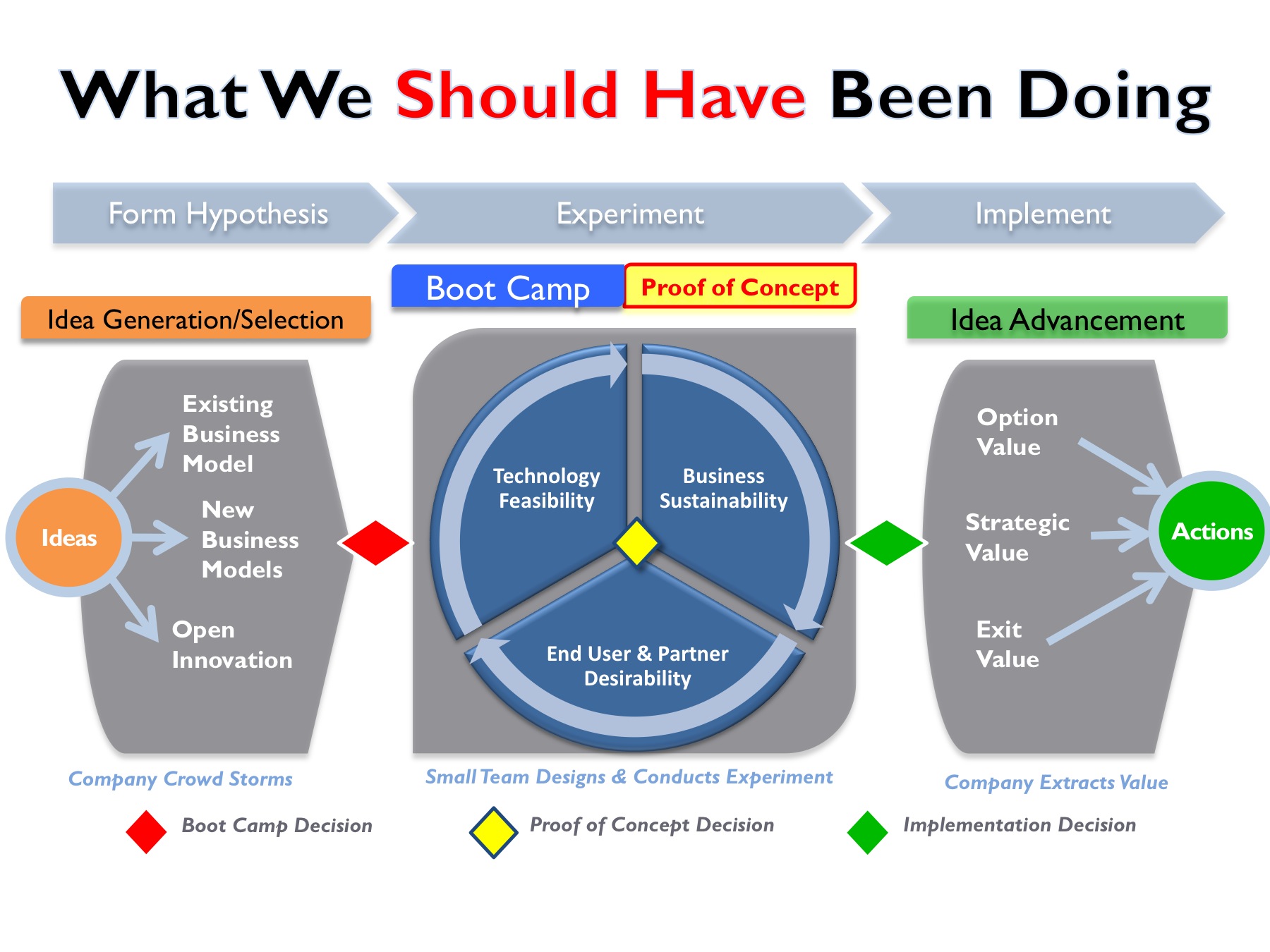
With hindsight we should have had “proof of concepts” tested in a corporate center (think ‘pop-up incubator’) where they would do extensive Customer Discovery. We should had done this before assigning the teams to a particular business unit (or had the ability to create a new business unit, or spin the team out of the company).

The last year of the program, we tried to solve this problem by requiring that the top 20 teams first seek a business unit sponsor before being admitted into the bootcamp (and we raised a $5 million fund from the BUs earmarked for initial implementation ($250K/team.) Ironically this drew criticism from some execs fearing we might have missed the more radical, out-of-the box ideas!

  • Entrenched Innovation Model Issues:  Qualcomm’s existing innovation model – wireless products were created in the R&D lab and then handed over to existing business units for commercialization – was wildly successful in the existing wireless and mobile space. Venture Fest was not integral to their success. Venture Fest was about proposing new ventures, sometimes outside the wireless realm, by stressing new business models, design and open innovation thinking, not proposing new R&D projects.These non-technical ideas ran counter to the company’s existing R&D, lab-to-market model that built on top of our internally generated intellectual property.  The result was that we couldn’t find internal homes for what would have been great projects or spinouts. (Eventually Qualcomm did create a corporate incubator to handle projects beyond the scope of traditional R&D, yet too early to hand-off to existing business unit).

We were asking the company’s R&D leads, the de-facto innovation leaders, who had an existing R&D process that served the company extremely well, to adopt our odd-ball projects. Doing so meant they would have to take risks for IP acquisition and customer/market risks outside their experience or comfort zone. So when we asked them to embrace these new product ideas, we ran into a wall of (justified) skepticism. Therefore a major error in setting up our corporate innovation program was our lack of understanding how disruptive it would be to the current innovation model and to the executives who ran the R&D Labs.

What could have been done differently?
We had relative success flowing a good portion of ideas from the bootcamp into the business and R&D units for full adoption, partial implementation or strategic learning purposes, but it was a turbulent affair.  With hindsight, there were four strategic errors and several tactical ones:

1)   We should have recruited high level executive champions for the program (besides the CEO). They could have helped us anticipate and solve organizational challenges and agree on how we planned to manage the risks.

2)   We should have had buy-in about the value of disruptive new business models, design and open innovation thinking.

3)   We unknowingly set up an organizational conflict on day one. We were prematurely pushing some of the teams in the business units. The ‘elephant in the room’ was that the Venture Fest program didn’t fit smoothly with the BU’s readiness for dealing with unexpected ‘bottoms up’ innovation, in a quarterly- centric, execution environment.

4)   Our largest customer should have been the R&D units, but the reality was that we never sold them that the company could benefit by exploring multiple innovation models to reduce the risks of disruption – we had taken this for granted and met resistance we were unprepared to handle.

Qualcomm Lessons Learned

Qualcomm Lessons Learned

  • The Venture Fest program truly was ground breaking.  Yet we never told anyone outside the company about it. We should have been sharing what we built with the leading business press, highlighting the vision and support of the program’s originator, the CEO.
  • We should have asked for a broader innovation time off and incentive policy for employees, managers, and executives.  Entrepreneurial employees must have clear opportunities to continue to own ideas through any stage of funding – that’s the major incentive they seek.  Managers and execs should be incentivized for accommodating employee involvement and funding valuable experiments.
  • We needed a for a Proof of Concept center.  Radical ideas seldom had an obvious home immediately following the bootcamp.  We lacked a formal center that could help facilitate further experiments before determining an implementation path.  A Proof of Concept center, which is not the same as a full-fledged incubator, would also be responsible to develop a companywide core competence in business model and open innovation design and a VC-like, staged-risk funding decision criteria for new market opportunities.
  • It’s hard to get ideas outside of a company’s current business model get traction (given that the projects have to get buy-in from operating execs) – encouraging spin-offs is a tactic worth considering to keep the ideas flowing.

Epilogue
The program became large enough that it came time to choose between expanding the program or making it more technology focused and closely tied to corporate R&D. In the end my time in the sun eventually ran out.

I had the greatest learning experience of my life running Qualcomm’s corporate entrepreneurship program and met amazingly brave and gracious employees with whom I’ve made a lifetime connection.  I earnestly believe that large corporations should emulate Lean Startups (Business model design, Customer Development and Agile Engineering.)  I am now eager to share and discuss the insights with other practitioners of innovation – I can be reached at ricardo_dossantos@alum.mit.edu

Lessons Learned

  • We now have the tools to build successful corporate entrepreneurship programs.
  • However, they need to match a top-level (board, CEO, exec staff) agreement on strategy and structure.
  • If I were starting a corporate innovation program today, I’d use the Lean LaunchPad classes as the starting framework.
  • Developing a program to generate new ideas is the easy part.  It gets really tough when these projects are launched and have to fight for survival against current corporate business models.

Listen to the post here: Download the Podcast here

Designing a Corporate Entrepreneurship Program – A Qualcomm Case Study (part 1 of 2)

I ran into Ricardo Dos Santos and his amazing Qualcomm Venture Fest a few years ago and was astonished with its breath and depth.  From that day on, when I got asked about which corporate innovation program had the best process for idea selection, I started my list with Qualcomm.

This is Ricardo’s “post mortem” account of the life and death of a corporate entrepreneurship program.  Part 1 outlining the program is here.  Part 2 describing the challenges and “lessons learned” will follow.

———-

The origin
In 2006, as a new employee of the Fortune 100 provider of wireless technology and services, San Diego’s Qualcomm, I volunteered to salvage a fledging idea management system (fancy term for an online suggestion box) by turning into a comprehensive corporate entrepreneurship program.

Qualcomm’s visionary CEO, Paul Jacobs, wanted to use internal Qualcomm ideas to find breakthrough innovation that could be turned into products, (not simply a suggestion box for creative thoughts or improving sustaining innovation.)  He gave my innovation team free reign on designing a new employee innovation program. His only request was that we keep two of the original program’s goals:

1. The program had to remain fully open to employees from all divisions.
2. The ideas were to be implemented by existing business or R&D units – i.e., no need to create new permanent infrastructures for innovation.

And he added a third goal that would ensure his greater involvement and support going forward.

3. The program had to have an efficient mechanism to bubble-up the best ideas (and their champions) to the timely attention of the top executive team.

The design challenge

We wanted to transform our simple online suggestion box into a program that encouraged employees to behave like intrapreneurs (and their managers and executives as enablers).  Our challenge was to design a program that could:

  • Teach participants on how to turn their ideas into fundable experiments.
  • Educate employees who submit ideas that in corporations, there is no magic innovation leprechaun at the end of the rainbow that turn their unsolicited suggestions into pots of gold – they themselves had to take ownership and fight for their ideas.

All while keeping in mind that employees, managers and executives have day jobs – so how could we ask them to spend significant time on new ideas while not sacrificing their present obligations?

Thus began our search for a program that would properly balance the focus on the present with the need to increase our options for the future.

Qualcomm Innovation Process

Qualcomm Innovation Process

Qualcomm’s Corporate Entrepreneurship Program – Venture Fest
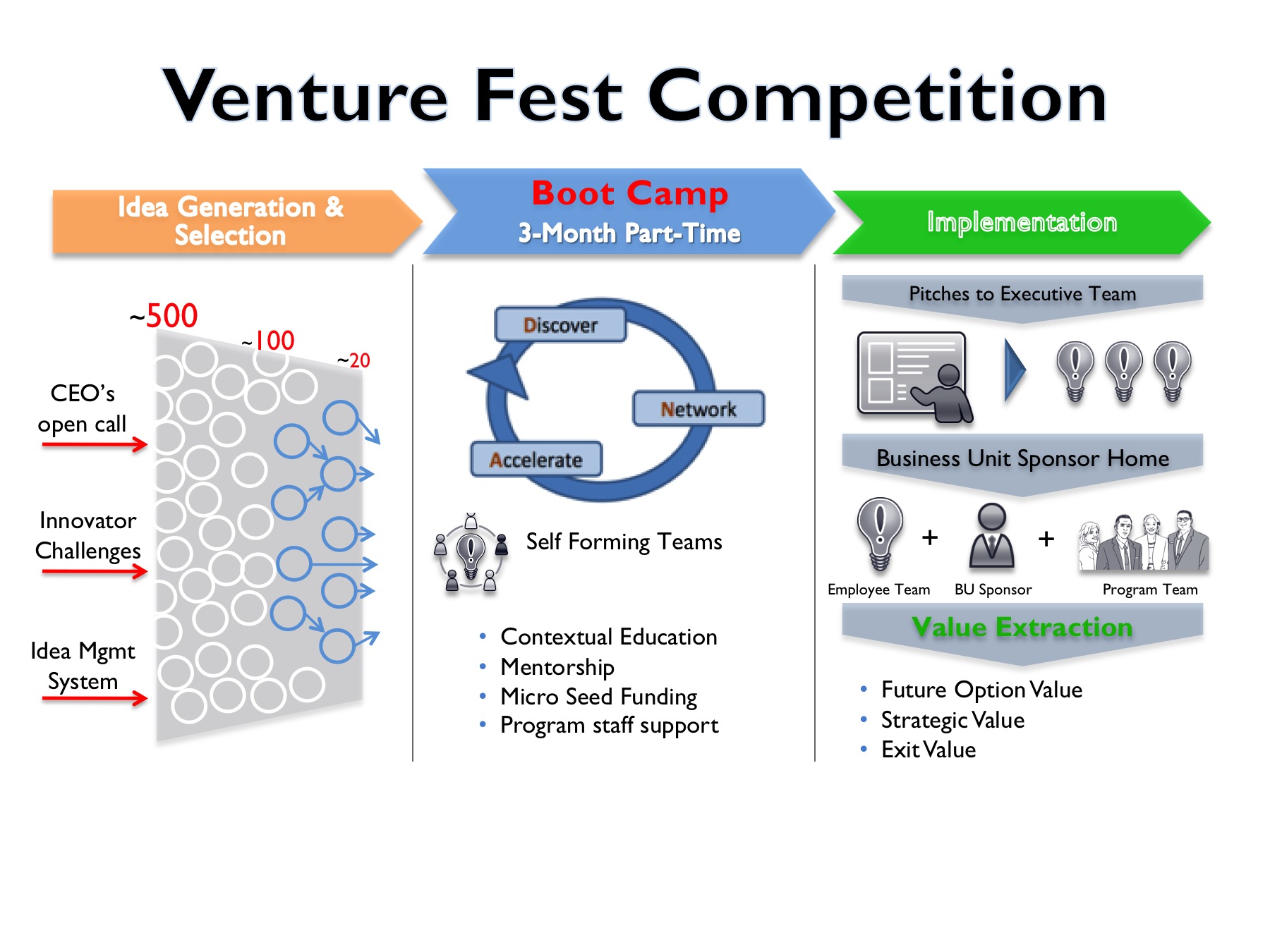
In 2006 we searched outside of Qualcomm for other similar entrepreneurship programs where participants also had to balance other obligations.  We realized this mechanism had been occurring for years at University’s startup competitions, such as the MIT 100K Accelerate Contest.   In these competitions, multidisciplinary self-forming teams of students work part time to pitch new companies.  The program we implemented inside of Qualcomm ended up being very similar.  We dubbed the program Qualcomm’s Venture Fest and the process, “Collective Entrepreneurship”, a three-phase program combining crowdsourcing with entrepreneurial techniques for startup creation.

The first phase of the program leveraged the idea management system to collect a large number of competing entries then ultimately down-selected to the top 10-20 concepts with the most breakthrough potential, according to peer and expert reviews.

Qualcomm Venture Fest

Qualcomm Venture Fest

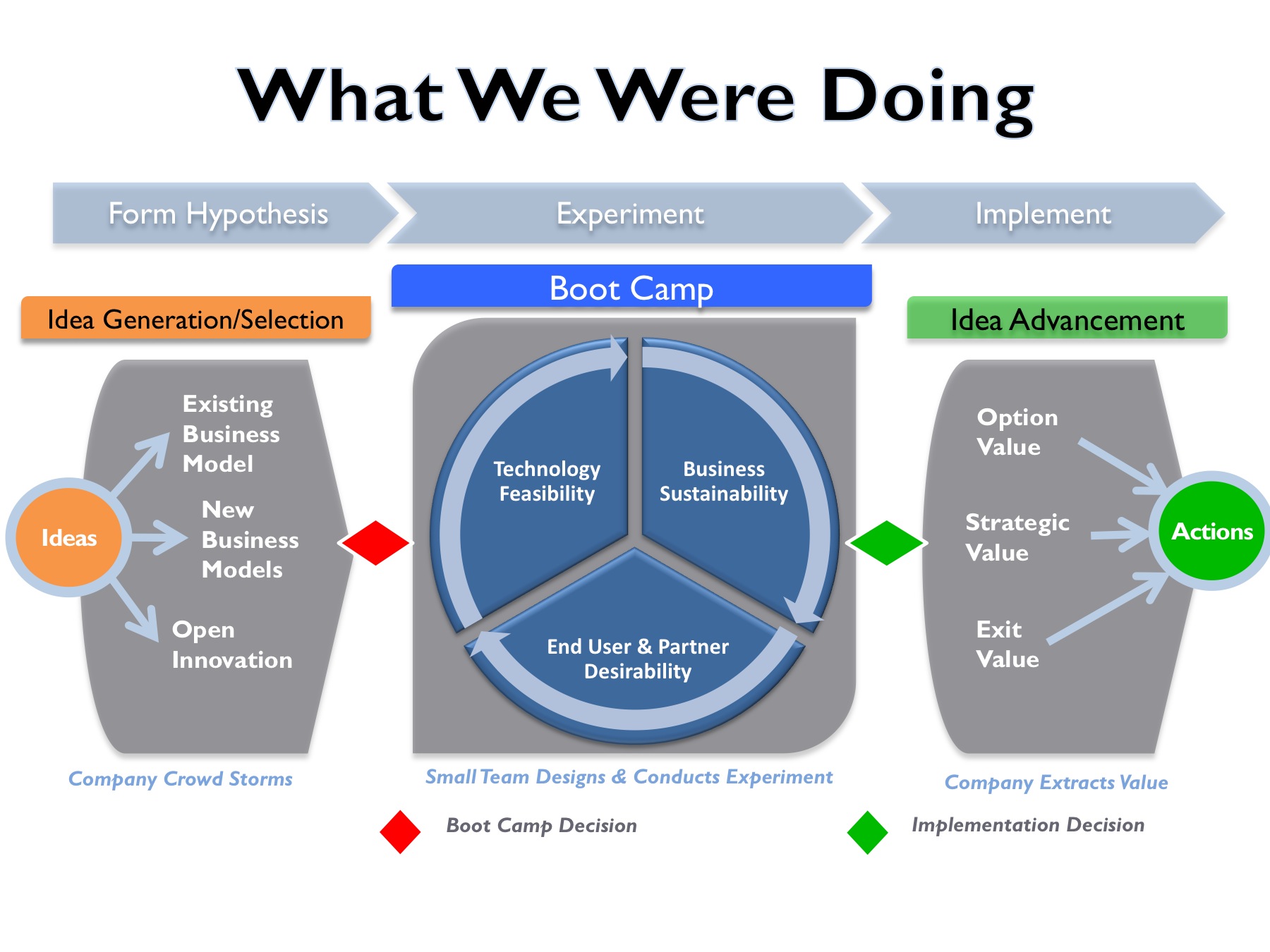
The second phase, and heart of the program, was a three-month, part time bootcamp that would prepare idea champions for the internal funding battle that followed.  The bootcamp requested that participants do what entrepreneurs do before requesting seed funding  – Discover, Network and Accelerate.  (In hindsight we were having our employees get out of the building to talk to customers, build prototypes and generate partner interest – essentially doing Customer Discovery years before Steve Blank taught his Lean LaunchPad class at Stanford and the National Science Foundation!). Our employees faced the typical impediments to corporate entrepreneurship – lack of employee time, skills, connections, pre-seed money, and official sources to discuss and manage the risk/rewards tradeoffs of sticking your neck-out. So our program staff built a support system of contextual education, mentorship, micro-funding, and hands-on coaching.

Finally, the third phase of the program, implementation, began with the top team’s pitches to the C-level executive team, which determined the competition winners, prize money and directed other promising teams to target business unit sponsors. Our program staff facilitated the handoff and disseminated the value extracted from any funded experiments, including future option, strategic and exit value.

In retrospect we designed something akin to a startup accelerator, the Lean LaunchPad classes or the National Science Foundation’s Innovation Corps, although none of these existed in 2006.

What went right?
We had C-level support. The CEO of the company embraced the program and supported the process, especially since it brought novel and thought provoking ideas to his executive team’s attention.

The program steadily generated healthy interest from Qualcomm employees – submissions grew from 82 in the first year to over 500 in its fifth and final year.  Several ideas were fully or partially implemented, (with hundreds of millions of USD invested), with a couple of genuine breakthrough successes, and hundreds of related patents were filed.  Employees reported noticeable gains in entrepreneurial skills and attitude, and the CEO seemed happy with how his baby was being raised.

—-

Part 2 – challenges and lessons learned – is here.
Listen to the post here: Download the Podcast here

The Future of Corporate Innovation and Entrepreneurship

Almost every large company understands it needs to build an organization that deals with the ever-increasing external forces of continuous disruption, the need for continuous innovation, globalization and regulation.

But there is no standard strategy and structure for creating corporate innovation.

We outline the strategy problem in this post and will propose some specific organizational suggestions in follow-on posts.

—-

I’m sitting at the ranch with Alexander OsterwalderHenry Chesbrough and Andre Marquis listening to them recount their lessons-learned consulting for some of the world’s largest corporations. I offered what I just learned from spending a day at the ranch with the R&D group of a $100 billion corporation along with the insights my Startup Owners Manual co-author Bob Dorf who has several Fortune 100 clients.Osterwalder Chesbrough Marquis

(Full disclosure. I’m recovering from a reading spree of Chandlers Strategy and Structure, Gary Hamel’s The Future of Management and The Other Side of Innovation by Trimble and Govindarajan, Henry Chesbrough’s Open Innovation, as well as The Innovator’s DNA from Dyer, Gregersen and Christensen. So some or most of this post might be that I’ve overdosed on business books for the month.)

Collectively we’re beginning to see a pattern and we want to offer some concrete suggestions about Corporate Management and Innovation strategy and the structural (i.e. organizational) changes corporations need to make.

If we’re right, it will give 21st companies a way to deal with innovation – both sustaining and disruptive – as a normal course of business rather than by exception or crisis. Companies will be organized around Continuous Innovation.

Strategy and Structure in the 21st Century
While companies have existed for the last 400 years, their modern form is less than 150 years old. In the U.S. the growth of railroads, telegraph, meat packers, steel and industrial equipment forced companies to deal with the strategies of how to organize a complex organization. In turn, these new strategies drove the need for companies to be structured around functions (manufacturing, purchasing, sales, etc.)

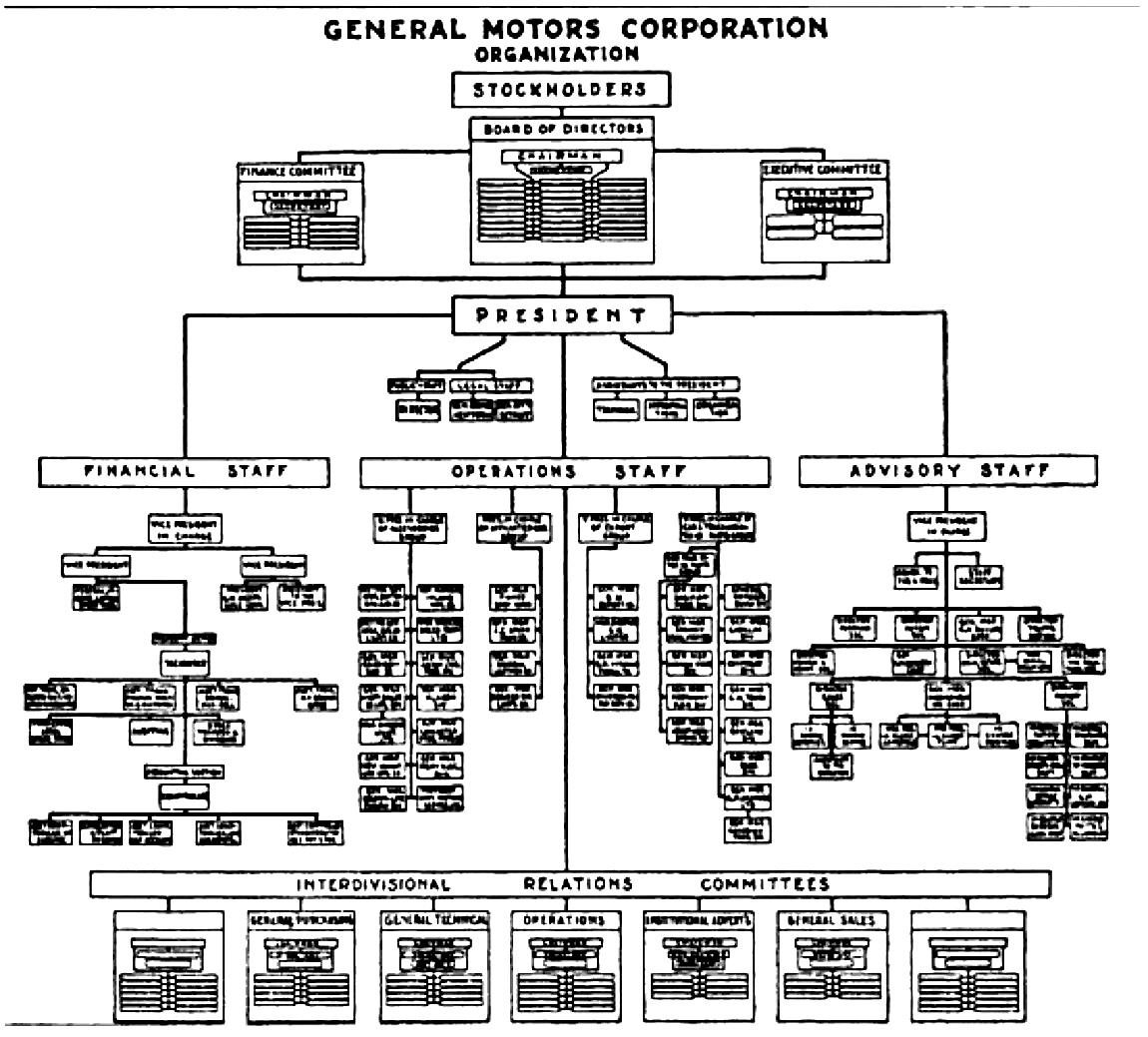
90 years ago companies faced new strategic pressures as physical distances in the United States limited the reach of day-to-day hands-on management. In addition, firms found themselves now managing diverse product lines. In response, another structural shift in corporate organization occurred. In the 1920’s companies restructured from monolithic functional organizations (sales, marketing, manufacturing, purchasing, etc.) and reorganized into operating divisions (by product, territory, brand, etc.) each with its own profit and loss responsibility. This strategy-to-structure shift from functional organizations to operating divisions was led by DuPont and popularized by General Motors and quickly followed by Standard Oil and Sears.

GM 1925 org chart

General Motors Organization Chart ~1925

In each case, whether it was organizing by functions or organizing by operating divisions, the diagram we drew for management was an organization chart. Invented in 1854 by Daniel McCallum, superintendent of the New York and Erie railroad, the org chart became the organizing tool for how to think about strategy and structure.   It allowed companies to visually show command and control hierarchies – who’s responsible, what they are responsible for and who they manage underneath them, and report to above them.  (The irony is that while the org chart may have been new for companies, the hierarchies it described paralleled military organization and had been around since the Roman Legion.)

While org charts provided the “who” of a business, companies were missing a way to visualize the “how” of a business. In the 1990’s Strategy Maps provided the “How.” Evolved from Balanced Scorecards by Kaplan and Norton, Strategy Maps are a visual representation of an organization’s strategy. Strategy Maps are a tool to translate the strategy into specific actions and objectives to measure the progress of how the strategy gets implemented (but offer no help on how to create new strategies.).

Strategy Maps from Robert Kaplan

Strategy Maps from Robert Kaplan

By the 21st century, organizations still lacked a tool to create and formulate new strategies.  Enter the Business Model Canvas. The canvas describes the rationale of how an organization creates, delivers, and captures value (economic, social, or other forms of value). The canvas ties together the “who and how” and provides the “why”. External to the canvas are the environmental influences (industry forces, market forces, key trends and macro-economic forces.)  With the business model canvas in hand, we can now approach rethinking corporate innovation strategy and structure.

Business Model Canvas

Management Innovation in the 21st Corporation
Existing companies and their operating divisions implement known business models. Using the business model canvas, they can draw how their organization is creating, delivering, and capturing value. A business model for an existing company or division is not filled with hypotheses, it is filled with a series of facts. Operating divisions execute the known business model. Plans and processes are in place, and rules, job specifications, revenue, profit and margin goals have been set. Forecasts can be based on a series of known conditions.

BusinessModel Innovation in existing companies

Inside existing companies and divisions, the business model canvas is used as a tool to implement and continuously improve existing business models incrementally. This might include new products, markets or acquisitions.

A New Strategy for Entrepreneurship in the 21st Corporation

Yet, simply focusing on improving existing business models is not enough anymore. To assure their survival and produce satisfying growth, corporations need to invent new business models. This challenge requires entirely new organizational structures and skills.

This is not unlike the challenges corporations were facing in the 1920’s. Companies then found that their existing strategy and structures (organizations) were inadequate to respond to a changing world. We believe that the solution for companies today is to realize that what they are facing is a strategy and structure problem, common to all companies.

The video below (from Strategyzer.com) emphasizes that companies will need to have an organization that can do two things at the same time:  executing and improving existing models and inventing  – new and disruptive – business models.

We propose that corporations equipped for the challenges of the 21st century think of innovation as a sliding scale between execution and search.

  1. For companies to survive in the 21st century they need to continually create a new set of businesses, by inventing new business models.
  2. Most of these new businesses need to be created outside of the existing business units.
  3. The exact form of the new business models is not known at the beginning. It only emerges after an intense business model design and search activity based on the customer development process.
  4. Companies will have to maintain a portfolio of new business model initiatives, not unlike a venture capital firm, and they will have to accept that maybe only 1 out 10 initiatives might succeed.
  5. To develop this new portfolio, companies need to provide a stable innovation funding mechanism for new business creation, one that is simply thought of as a cost of doing business
  6. Many of the operating divisions can and should provide resources to the new businesses inside the company
  7. We need a new organizational structure to manage the creation of new businesses and to coordinate the sharing of business model resources.
  8. Some of these new businesses might become new resources to the existing operating units in the company or they could grow into becoming the new profit generating business units of the company’s future.

In future blog posts we’ll propose a specific structure for Entrepreneurship and Continuous Innovation in the 21st Corporation.

Lessons Learned

  • Continuous disruption will be the norm for corporations in the 21st century
  • Continuous innovation – in the form of new businesses-  will be the path for long term corporate survival
  • Current corporate organizational models are inadequate for the task
  • We will propose some alternatives

Listen to the post here: Download the Podcast here

Startup Communities – Building Regional Clusters

How to build regional entrepreneurial communities has just gotten it’s first “here’s how to do it” book. Brad Feld’s new book Startup Communities joins the two other “must reads,” (Regional Advantage and Startup Nation) and one “must view” (The Secret History of Silicon Valley) for anyone trying to understand the components of a regional cluster.

There’s probably no one more qualified to write this book then Brad Feld (startup founder, co founder of two VC firms – Mobius and Foundry, and founder of TechStars.)

Leaders and Feeders
Feld’s thesis is that unlike the common wisdom, it is entrepreneurs that lead a startup community while everyone else feeds the community.

Feld describes the characteristics of those who want to be regional Entrepreneurial Leaders; they need to be committed to their region for the long term (20+ years), the community and its leaders must be inclusive, play a non-zero sum game, be mentorship-driven and be comfortable experimenting and failing fast.

Feeders include the government, universities, investors, mentors, service providers and large companies. He points out that some of these, government, universities and investors think of themselves as the leaders and Feld’s thesis is that we’ve gotten it wrong for decades.

This is a huge insight, a big idea and a fresh way to view and build a regional ecosystem in the 21st century. It may even be right.

Activities and Events
One of the most surprising (to me) was the observation that a regional community must have continual activities and events to engage all participants. Using Boulder Colorado as an example, (Feld’s home town) this small entrepreneurial community runs office hours, Boulder Denver Tech Meetup, Boulder Open Coffee ClubIgnite Boulder, Boulder Beta, Boulder Startup Digest, Startup Weekend events, CU New Venture Challenge, Boulder Startup Week, Young Entrepreneurs Organization and the Entrepreneurs Foundation of Colorado. For a city of 100,000 (in a metro area of just 300,000 people) the list of activities/events in Boulder takes your breath away. They are not run by the government or any single organization. These are all grassroots efforts by entrepreneurial leaders. These events are a good proxy for the health and depth of a startup community.

Incubators and Accelerators
One of the best definitions in the book is when Feld articulates the difference between an incubator and an accelerator. An incubator provides year-round physical space, infrastructure and advice in exchange for a fee (often in equity.) They are typically non-profit, attached to a university (or in some locations a local government.) For some incubators, entrepreneurs can stay as long as they want. There is no guaranteed funding. In contrast, an accelerator has cohorts going through a program of a set length, with funding typically provided at the end.

Feld describes TechStars (founded in 2006 with David Cohen) as an example of how to build a regional accelerator. In contrast to other accelerators TechStars is mentor-driven, with a profound belief that entrepreneurs learn best from other entrepreneurs. It’s a 90-day program with a clear beginning and end for each cohort. TechStars selection criteria is to first focus on picking the right team then the market. They invest $118,000 ($18k seed funding + $100K convertible note) in 10 teams per region.

Role of Universities
To the entrepreneurial community Stanford and MIT are held up as models for “outward-facing” research universities. They act as community catalysts, as a magnet for great entrepreneurial talent for the region, and as teachers and then a pipeline for talent back into the region. In addition their research offers a continual stream of new technologies to be commercialized.

Feld’s observation is that that these schools are exceptions that are hard to duplicate. In most universities entrepreneurial engagement is not rewarded, there’s a lack of resources for entrepreneurial programs and cross-campus collaboration is not in the DNA of most universities.

Rather than thinking of the local university as the leader, Feld posits a more effective approach is to use the local college or university as a resource and a feeder of entrepreneurial students to the local entrepreneurial community. He uses Colorado University’ Boulder as an example of of a regional university being as inclusive as possible with courses, programs and activities.

Finally, he suggests engaging alumni for something other than fundraising – bringing back to the campus, having them mentor top students and celebrating their successes.

Role of Government
Feld is not a big fan of top-down government driven clusters. He contrasts the disconnect between entrepreneurs and government. Entrepreneurs are painfully self-aware but governments are chronically not self-aware.  This makes government leaders out of touch on how the dynamics of startups really work. Governments have a top-down command and control hierarchy, while entrepreneurs work in a bottoms-up networked world. Governments tend to focus on macro metrics of economic development policy while entrepreneurs talk about lean, startups, people and product. Entrepreneurs talk about immediate action while government conversations about policy do not have urgency.  Startups aim for immediate impact, while governments want to control. Startup communities are networked and don’t lend themselves to a command and control system.

Community Culture
Feld believes that the Community Culture, how individuals interact and behave to each other, is a key part of defining and entrepreneurial community. His list of cultural attributes is an  integral part of Silicon Valley. Give before you get, (in the valley we call this the “pay it forward” culture.) Everyone is a mentor, so share your knowledge and give back. Embrace weirdness, describes a community culture that accepts differences. (Starting post World War II the San Francisco bay area became a magnet for those wanting to embrace alternate lifestyles. For personal lifestyles people headed to San Francisco. For alternate business lifestyles they went 35 miles south to Silicon Valley.)

I was surprised to note that the biggest cultural meme of Silicon Valley didn’t make his Community Culture chapter – failure equals experience.

Broadening the Startup Community
Feld closes by highlighting some of the issues faced by a startup community in Boulder.  The one he calls Parallel Universes notes that there may be industry specific (biotech, clean tech etc.) startup communities sitting side-by-side and not interacting with each other.

He then busts the myths clusters tell themselves; “lets be like Silicon Valley” and the “there’s not enough capital here.”

Quibbles
There’s data that that seems to indicate a few of Feld’s claims about about the limited role of venture, universities and governments might be overly broad (but doesn’t diminish his observation that they’re feeders not leaders.) In addition, while Silicon Valley was a series of happy accidents, other national clusters have extracted its lessons and successfully engineered on top of those heuristics. And while I might have misread Feld’s premise about local venture capital, but it seems to be, “if there isn’t a robust venture capital in your region it’s because there isn’t a vibrant entrepreneurial community with great startups. As venture capital exists to service startup when great startups are built investors will show up.” Wow.

Finally, local government top-down initiatives are not the only way governments can incentivize entrepreneurial efforts. Some like the National Science Foundation Innovation Corps have had a big bang for little bucks.

Summary
Entrepreneurship is rising in almost every major city and region around the world. I host at least one region a week at the ranch and each of these regions are looking for a roadmap. Startup Communities is it. It’s a strategic, groundbreaking book and a major addition to what was missing in the discussion of how to build a regional cluster. I’m going to be quoting from it liberally, stealing from it often, and handing it out to my visitors.

Buy it.

Lessons Learned

  • Entrepreneurs lead a startup community while everyone else feeds the community
  • Feeders include the government, universities, investors, mentors, service providers and large companies
  • Continual activities and events are essential to engage all participants
  • Top-down government-driven clusters are an oxymoron
  • Building a regional entrepreneurial culture is critical

Listen to the post here: Download the Podcast here

Why Innovation Dies

Faced with disruptive innovation, you can be sure any possibility for innovation dies when a company forms a committee for an “overarching strategy.”

—–

I was reminded how innovation dies when the email below arrived in my inbox. It was well written, thoughtful and had a clearly articulated sense of purpose. You may have seen one like it in your school or company.

Skim it and take a guess why I first thought it was a parody. It’s a classic mistake large organizations make in dealing with disruption.

The Strategy Committee

Faculty and Staff:

We believe online education will become increasingly important at all levels of the educational experience. If our school is to retain its current standards in terms of access and excellence we think it is of paramount importance that we develop an overarching campus strategy that enables and supports online innovation.

We believe our Departments play an essential leadership role in the design and implementation of online offerings. However, we also want to provide guidance and support and ensure that campus goals are met, specifically ensuring that our online education efforts align with our mission, values and operational requirements.

To this end, we are convening a Strategy Committee that is charged with overseeing our efforts and accelerating implementation. The responsibilities of the group will be to provide overall direction to campus, make decisions concerning strategic priorities and allocate additional resources to help realize these priorities. Because we anticipate that most of the innovation in this area will occur at the school/unit level we underscore that the purpose of the Strategy Committee is to provide campus-level guidance and coordination, and to enable innovation. The Strategy Committee will also be responsible for reaching out to and receiving input from the Presidents Staff and the Faculty Senate.

The Strategy Committee will be comprised of Mark Time, Nick Danger, Ralph Spoilsport, Ray Hamberger, Audrey Farber, Rocky Rococo, George Papoon, Fred Flamm, Susan Farber, and Clark Cable.

A Policy Team, which is charged with coordinating with the schools/unit to develop detailed implementation plans for specific projects, will report to the Strategy Committee. The role of the Policy Team will be to develop a detailed strategic framework for the campus, oversee the development of shared resources, disseminate best practices, create an administrative infrastructure that provides consistent financial and legal expertise, and consult with relevant campus groups: and the the Budget Office. The Policy Team will be led by two senior campus leaders, one from the academic side and one from the administration side.

We are extremely pleased that Dean TIrebiter has accepted the administrative lead role of the Policy Team. Dean Tirebiter brings to this position a deep knowledge of the online environment.  He will be helping to identify a member of our Faculty to serve as the academic lead of the Policy Team.

The Strategy Committee will be meeting for a half-day retreat at Morse Science Hall in the coming weeks to begin work. We will be sending out an update to faculty and following this retreat, so stay tuned for further updates.

Sincerely,

President Peter Bergman

We Can Figure it Out in A Meeting
The memo sounds thoughtful and helpful. It’s an attempt to get all the “right” stakeholders in the room and think through the problem.

One useful purpose a university committee could have had was figuring out what the goal of going online was.  It could have said “the world expects us to lead so lets get together and figure out how we deal with online education.”  Our goal(s) could be:

  • Looking good
  • Doing good for all [or at least citizens of California]
  • Doing well by our enrolled students
  • Fixing our business model to fix our budget crisis
  • Having a good football team – or at least filling the stadium
  • Attracting donations
  • Attracting faculty
  • Oh and yes – building an efficient, high quality education machine
But the minute the memo started talking about a Policy Team developing detailed implementation plans, it was all over.

The problem is that the path to implementing online education is not known. In fact, it’s not a solvable problem by committee, regardless of how many smart people in the room. It is a “NP complete” problem – it is so complex that figuring out the one possible path to a correct solution is computationally incalculable. (See the diagram below.)

If you can’t see the diagram above click here.

Innovation Dies in Conference Rooms
The “lets put together a committee” strategy fails for four reasons:

  1. Online education is not an existing market. There just isn’t enough data to pick what is the correct “overarching strategy”.
  2. Making a single bet on a single strategy, plan or company in a new market is a sure way to fail. After 50-years even the smartest VC firms haven’t figured out how to pick one company as the winner.  That’s why they invest in a portfolio.
  3. Committees protect the status quo. Everyone who has a reason to say “No” is represented.
  4. Dealing with disruption is not solved by committee. New market problems call for visionary founders, not consensus committee members.
My bet is that there will be more people involved in this schools Strategy Committee then in the startups that find the solution.

In a perfect world, the right solution would be a one page memo encouraging maximum experimentation with the bare minimum of rules (protecting the schools brand and the applicable laws.)

 Lessons Learned

  • Innovation in New Markets do not come from “overarching strategies”
  • It comes out of opportunity, chaos and rapid experimentation
  • Solutions are found by betting on a portfolio of low-cost experiments
    • With a minimum number of constraints
  • The road for innovation does not go through committee

Listen to the post here: Or download the Podcast here

Search versus Execute

One of the confusing things to entrepreneurs, investors and educators is the relationship between customer development and business model design and business planning and execution.

When does a new venture focus on customer development and business models? And when do business planning and execution come into play?

Here’s an attempt to put this all in context.

Don’t Throw the Tomatoes
I was in Washington D.C. last week presenting at the ARPA-E conference. I spent the next day working with the National Science Foundation on the Innovation Corps, and talking to congressional staffs about how entrepreneurial educational programs can reshape our economy. (And I even found time to go to the Spy Museum.)

One of the issues that came up is whether the new lexicon of entrepreneurial ideas – Customer Development, Business Model Design, Lean, Lean LaunchPad class, etc. – replace all the tools and classes that are currently being taught in entrepreneurship curriculums and business schools.  I was a bit surprised since most of what I’ve been advocating is complementary to existing courses. However, I realize I’ve primarily written about business model design and customer development. Given that I’m speaking this month in front of entrepreneurship educators at the NCIIA conference, I thought I should put it in context before they throw tomatoes at me.

Search Versus Execution
One of the things startups have lacked is a definition of who they were. For years we’ve treated startups like they are just smaller versions of a large company. However, we now know that a startup is a temporary organization designed to search for a repeatable and scalable business modelWithin this definition, a startup can be a new venture or it can be a new division or business unit in an existing company.

If your business model is unknown – that is just a set of untested hypotheses- you are a startup searching for a repeatable business model. Once your business model (market, customers, features, channels, pricing, Get/Keep/Grow strategy, etc.) is known, you will be executing it. Search versus execution is what differentiates a new venture from an existing business unit.

Strategy


The primary objective of a startup is to validate its business model hypotheses (and iterate and pivot until it does.) Then it moves into execution mode. It’s at this point the business needs an operating plan, financial forecasts and other well-understood management tools.

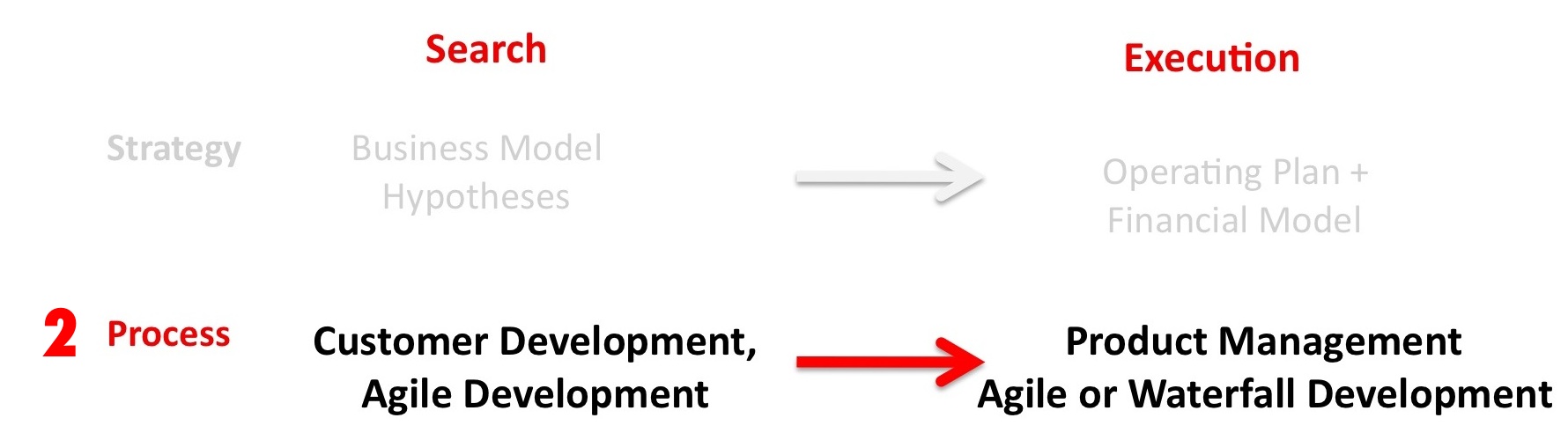
Process

The processes used to organize and implement the search for the business model are Customer Development and Agile Development. A search for a business model can be in any new business – in a brand new startup new or in a new division of an existing company.

In search, you want a process designed to be dynamic, so you work with a rough business model description knowing it will change. The model changes because startups use customer development to run experiments to test the hypotheses that make up the model. And most of the time these experiments fail. Search embraces failure as a natural part of the startup process. Unlike existing companies that fire executives when they fail to match a plan, we keep the founders and change the model.

Once a company has found a business model (it knows its market, customers, product/service, channel, pricing, etc.), the organization moves from search to execution.

The product execution process – managing the lifecycle of existing products and the launch of follow-on products – is the job of the product management and engineering organizations. It results in a linear process where you make a plan and refine it into detail. The more granularity you add to a plan, the better people can execute it: a Business Requirement document (BRD) leads to a Market Requirements Document (MRD) and then gets handed off to engineering as a Functional Specifications Document (FSD) implemented via Agile or Waterfall development.

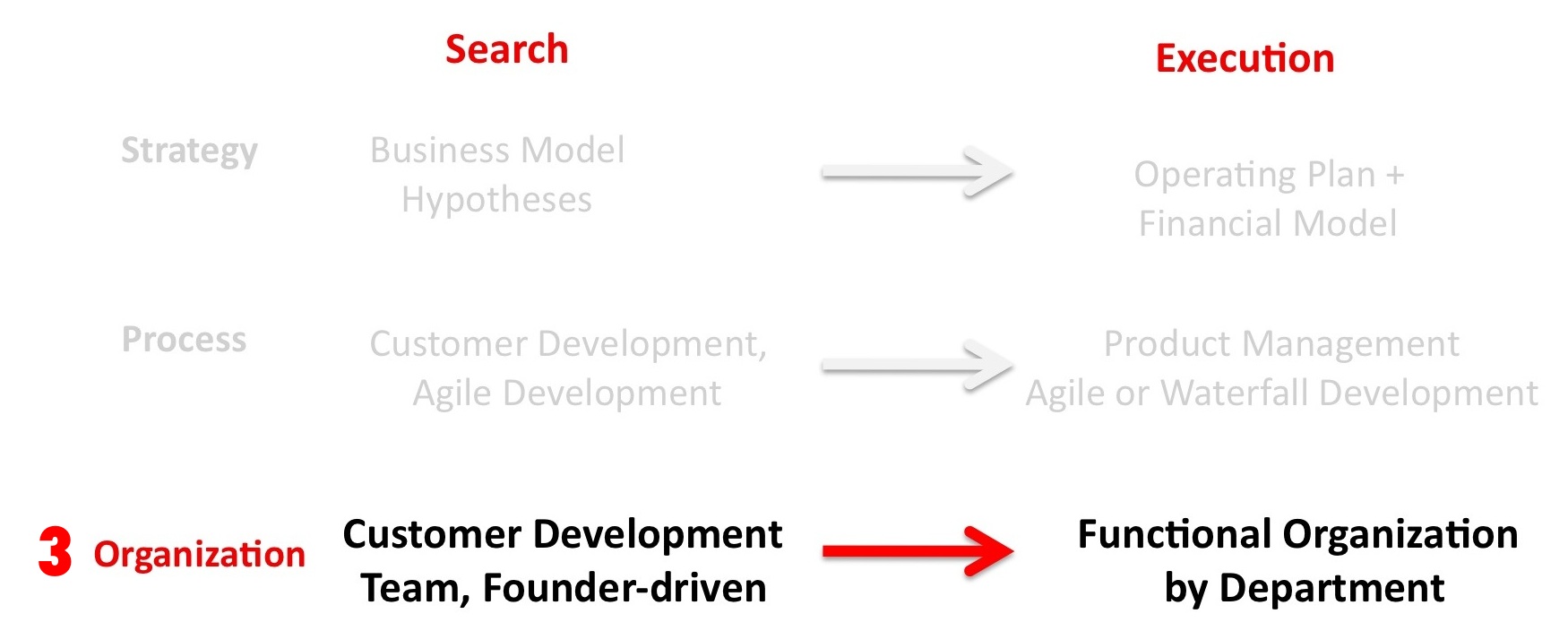
Organization

Searching for a business model requires a different organization than the one used to execute a plan. Searching requires the company to be organized around a customer development team led by the founders. In contrast, execution, (which follows search) requires the company to be organized by function (product management, sales, marketing, business development, etc.)

Companies in execution suffer from a “fear of failure culture“, (quite understandable since they were hired to execute a known job spec.) Startups with Customer Development Teams have a “learning and discovery” culture for search. The fear of making a move before the last detail is nailed down is one of the biggest problems existing companies have when they need to learn how to search.

The idea of not having a functional organization until the organization has found a proven business model is one of the hardest things for new startups to grasp. There are no sales, marketing or business development departments when you are searching for a business model.  If you’ve organized your startup with those departments, you are not really doing customer development.  (It’s like trying to implement a startup using Waterfall engineering.)

Education
Entrepreneurship curriculums are only a few decades old. First taught as electives and now part of core business school curriculums, the field is still struggling to escape from the bounds of the business plan-centric view that startups are “smaller versions of a large company.” VC’s who’ve watched as no startup business plan survived first contact with customers continue to insist that startups write business plans as the price of entry to venture funding. Even as many of the best VCs understand that the business ‘planning’ and not the ‘plan’ itself, are what is important.

The trouble is that over time – this key message has gotten lost. As business school professors, many of whom lack venture experience, studied how VCs made decisions, they observed the apparently central role of the business plan and proceeded to make the plan [not the planning], the central framework for teaching entrepreneurship. As new generations of VCs with MBA’s came into the business, they compounded the problem (“that’s how we always done it” or “that’s what I learned (or the senior partners learned) in business school.”)

Entrepreneurship educators have realized that plan-centric curriculum may get by for teaching incremental innovation but they’re not turning out students prepared for the realities of building new ventures. Educators are now beginning to build their own E-School curriculum with a new class of management tools built around “search and discovery.” Business Model Design, Product/Service Development, Customer Development, Startup Team-Building, Entrepreneurial Finance, Marketing, Founder Transition, etc. all provide the startup equivalent of the management tools MBAs learn for execution.

Instructional Strategy

Entrepreneurial education is also changing the focus of the class experience from case method to hands-on experience. Invented at Harvard, the case method approach assumes that knowledge is gained when students actively participate in a discussion of a situation that may be faced by decision makers.

The search for a repeatable business model for a new product or service is not a predictable pattern. An entrepreneur must start with the belief that all her assumptions are simply hypotheses that will undoubtedly be challenged by what she learns from customers. Analyzing a case in the classroom removed from the realities of chaos and conflicting customer responses adds little to an entrepreneur’s knowledge. Cases can’t be replicated because the world of a startup too chaotic and complicated. The case method is the antithesis of how entrepreneurs build startups – it teaches pattern recognition tools for the wrong patterns –  and therefore has limited value as an entrepreneurship teaching tool.

The replacement for cases are not better cases written for startups. Instead, it would be business model design – using the business model canvas as a way to 1) capture and visualize the evolution of business learning in a company, and 2) see what patterns match real world iterations and pivots. It is a tool that better matches the real-world search for the business model.

An entrepreneurial curriculum obviously will have some core classes based on theory, lecture and mentorship. There’s embarrassing little research on entrepreneurship education and outcomes, but we do know that students learn best when they can connect with the material in a hands-on way – personally making the mistakes and learning from them directly.

As much as possible the emphasis ought to be on experiential, learner-centric and inquiry-based classes that help to develop the mindset, reflexes, agility and resilience an entrepreneur needs to search for certainty in a chaotic world.

Lessons Learned

  • The search for the business model is the front end of the startup process
  • This is true in the smallest startup or largest company
  • The goal is to find a repeatable/scalable model, and then execute
  • Execution requires operating plans and financial forecasts
  • Customer and Agile Development are the processes to search and build the model
  • Product management is the process for executing the model
  • Entrepreneurial education needs to develop its own management stack
    • Starting with how to design and search for a business model
    • Adding all the other skills startups needs
    • The case-method is the antitheses of an entrepreneurial teaching method

Listen to the post here: Download the Podcast here

Two Giant Steps Forward For Entrepreneurs

While entrepreneurship is in the news fairly regularly, I seldom make news myself.  Today, however there are two important updates for entrepreneurs everywhere.  Let me be brief…

The “Startup Owner’s Manual” goes On Press Tuesday 2/14
Two years in the making and literally ten years in development, I’m proud to announce that my new book, The Startup Owners Manual, goes onto the printing press next Tuesday.  This 608-page work is, as its subtitle says, “the step-by-step guide for building a great company.”  It’s the result of a decade of me learning from 1,000’s of entrepreneurs, corporate partners, students and scientists the best practices of what wins in startups. I’ve spent the last two years cramming knowledge into this new book.

In brief, the The Startup Owners Manual is far more detailed and more readable than Four Steps to the Epiphany, (most of the sentences are even finished!).  In fact, you could say that all that remains from my last book are the four steps of Customer Development.  Briefly, the new book:

  • Integrates Alexander Osterwalders “Business Model Canvas” as the front-end and “scorecard” for the customer discovery process.
  • Provides separate paths and advice for web/mobile products versus physical products
  • Offers a ton of detail and great tips on how to get, keep, and grow customers, recognizing that this happens very differently between web and physical channels.
  • and finally it teaches a “new math” for startups: “metrics that matter.”
While MBA’s have had a stack of texts to help them “execute” a business model, this book joins the growing library of books for practitioners for the “search” for the business model.

The Lean LaunchPad Online Class
My online Lean LaunchPad class has created a lot of buzz this week. As you may have heard, I was deep into the production of the lectures when I realized I was producing the wrong class.  The online class was originally based on my book The Four Steps to the Epiphany.

Only when I held the draft of my latest book, The Startup Owners Manual, in my hands, did it dawn on me that my online students deserved all the latest best practices of entrepreneurship and Customer Development. Not the stuff I taught a decade ago, but all that I’ve learned teaching the Lean LaunchPad in front of students at Stanford, Berkeley, Columbia and the National Science Foundation in the last year.  And I particularly wanted to incorporate everything I’ve spent two years integrating into The Startup Owners Manual into the class.

So apologies to all of you who were expecting the class this month.  I hope to get the updated version online in the next 60 days.  I’ll keep you updated on this blog as we record our lectures.

In the meantime, if you want to prepare for the class…or get a jump on your startup competition, you can start reading the “recommended text” for the online class right now by ordering my new book.  It is recommended—not required—reading for the free online course, and I believe it will be immensely helpful to the startup community at large.

Lessons Learned

  • Startups search for business models, exisitng companies execute them
  • There are tons of texts about execution, but a paucity of practical ones for founders on how to search
  • The Startup Owners Manual is the definitive reference book for founders, investors and everyone interested in startups
  • The Lean Launchpad on-line class will be based on the new book

Why The Movie Industry Can’t Innovate and the Result is SOPA

This year the movie industry made $30 billion (1/3 in the U.S.) from box-office revenue.

But the total movie industry revenue was $87 billion. Where did the other $57 billion come from?

From sources that the studios at one time claimed would put them out of business: Pay-per view TV, cable and satellite channels, video rentals, DVD sales, online subscriptions and digital downloads.

The Movie Industry and Technology Progress
The music and movie business has been consistently wrong in its claims that new platforms and channels would be the end of its businesses. In each case, the new technology produced a new market far larger than the impact it had on the existing market.

  • 1920’s – the record business complained about radio. The argument was because radio is free, you can’t compete with free. No one was ever going to buy music again.
  • 1940’s – movie studios had to divest their distribution channel – they owned over 50% of the movie theaters in the U.S. “It’s all over,” complained the studios. In fact, the number of screens went from 17,000 in 1948 to 38,000 today.
  • 1950’s – broadcast television was free; the threat was cable television. Studios argued that their free TV content couldn’t compete with paid.
  • 1970’s – Video Cassette Recorders (VCR’s) were going to be the end of the movie business. The movie businesses and its lobbying arm MPAA fought it with “end of the world” hyperbole. The reality? After the VCR was introduced, studio revenues took off like a rocket.  With a new channel of distribution, home movie rentals surpassed movie theater tickets.
  • 1998 – the MPAA got congress to pass the Digital Millennium Copyright Act (DMCA), making it illegal for you to make a digital copy of a DVD that you actually purchased.
  • 2000 – Digital Video Recorders (DVR) like TiVo allowing consumer to skip commercials was going to be the end of the TV business. DVR’s reignite interest in TV.
  • 2006 – broadcasters sued Cablevision (and lost) to prevent the launch of a cloud-based DVR to its customers.
  • Today it’s the Internet that’s going to put the studios out of business. Sound familiar?
Why was the movie industry consistently wrong? And why do they continue to fight new technology?

Technology Innovation
The movie industry was born with a single technical standard – 35mm film, and for decades had a single way to distribute its content – movie theaters (which until 1948 the studios owned.) It was 75 years until studios had to deal with technology changing their platform and distribution channel. And when it happened (cable, VCR’s, DVD’s, DVR’s, the Internet,) it was a relentless onslaught. The studios responded by trying to shut down the new technology and/or distribution channels through legislation and the courts.

Regulation/Legislation
But why does the movie business think their solution is in Washington and legislation?

History and success.

In the 1920’s individual states were beginning to censor movies and the federal government was threatening to do so as well. The studios set up their own self censorship and rating system keeping most sex and politics off the screen for 40 years. Never again wanting to be at the losing side of a political battle they created the movie industry’s lobbying arm, MPAA.

By the 1960’s, the MPPA achieved regulatory capture (where an industry co-opts the very people who are regulating it,) when they hired Jack Valenti, who ran the studios’ lobbying efforts for the next 38-years. Ironically, it was Valenti’s skill in hobbling competitive innovation that negated any need for studios to develop agility, vision and technology leadership.

Management of Innovation
The introduction of new technology is always disruptive to existing markets, particularly to content/copyright owners whose sell through well-established distribution channels. The incumbents tend to have short-sighted goals and often fail to recognize that more money can be made on new platforms and new distribution channels.

In an industry facing constant technology shifts the exec staff and boards of the studios have lawyers, MBAs and financial managers, but no management skill in dealing with disruption. So they rely on lobbying ($110 million a year,) lawsuits, campaign contributions (wonder why the President won’t be vetoing SOPA?) and Public Relations.

Ironically, the six major movie studios have a great technology lab in Silicon Valley with projects in streaming rights, Video On Demand, Ultraviolet, etc. But lacking the support from the studio CEOs or boards, the lab languishes in the backwaters of the studios’ strategy.  Instead of leading with new technology, the studios lead with litigation, legislation and lobbying. (Imagine if the $110 million/year spent on lobbying went to disruptive innovation.)

Piracy
One of the claims that studios make is that they need legislation to stop piracy. The fact is piracy is rampant in all forms of commerce. Video games and software have been targets since their inception. Grocery and retail stores euphemistically call it shrinkage. Credit card companies call it fraud.  But none use regulation as often as the movie studios to solve a business problem. And none are so willing to do collateral damage to other innovative industries (VCRs, DVRs, cloud storage and now the Internet itself.)

The studios don’t even pretend that this legislation benefits consumers. It’s all about protecting short-term profit.

SOPA
When lawyers, MBAs and financial managers run your industry and your lobbyists are ex-Senators, understanding technology and innovation is not one of your core capabilities.

The SOPA bill (and DNS blocking) is what happens when someone with the title of anti-piracy or copyright lawyer has greater clout than your head of new technology. SOPA gives corporations unprecedented power to censor almost any site on the Internet. It’s as if someone shoplifts in your store, SOPA allows the government to shut down your store.

History has shown that time and market forces provide equilibrium in balancing interests, whether the new technology is a video recorder, a personal computer, an MP3 player or now the Net. It’s prudent for courts and congress to exercise caution before restructuring liability theories for the purpose of addressing specific market abuses, despite their apparent present magnitude.

What the music and movie industry should be doing in Washington is promoting legislation to adapt copyright law to new technology — and then leading the transition to the new platforms.

The U.S. State Department has been championing the Internet Freedom initiative across the world. Secretary of State Clinton said, “…when ideas are blocked, information deleted, conversations stifled, and people constrained in their choices, the Internet is diminished for all of us.”

It’s too bad the head of the MPAA – an ex Senator – made a mockery of her words when he wondered “why our online censorship can’t be like China?”

We wonder, “Why can’t the film industry innovate like Silicon Valley?”

Lessons Learned

  • Studios are run by financial managers who lack the skills to exploit disruptive innovation
  • Studio anti-piracy/copyright lawyers trump their technologists
  • Studios have no concern about collateral damage as long as it optimizes their revenue
  • Studios $110M/year lobbying and political donations trump consumer objections
  • Politicians votes will follow the money unless it will cost them an election

Listen to the post here: Download the Podcast here

American Entrepreneur Radio Interview

I was lucky enough to get interviewed by Ron Morris of American Entrepreneur Radio.

Ron Morris has a great “radio voice,” and actually seemed to understand what the heck I was talking about.  It made for a fun interview.

Click here to listen to the interview: Steve Blank American Entrepreneur Radio interview

The following week Ron Morris interviewed Regis McKenna, who for decades was the “gold standard” for high tech Public Relations in Silicon Valley. Click here to listen to the Regis interview.

.