

I’m off the web for the next week or so. I’m in a place with no cell or internet coverage.
Back blogging by the end of March.
steve
Share this:
Filed under: Uncategorized | 2 Comments »
I’m off the web for the next week or so. I’m in a place with no cell or internet coverage.
Back blogging by the end of March.
steve

Filed under: Uncategorized | 2 Comments »
One of the classes I teach in the engineering school at Stanford is E145: the Fundamentals of Technology Entrepreneurship, an introduction to building a scalable startup. While the class is open to everyone at the University, we want to teach science and engineering undergraduates how they can take a technical idea and turn it into a profitable and scalable company.
The class which was authored by Tom Byers, is offered every quarter and taught by four different professors. But thanks to Tom, we all get to teach it with a slightly emphasis.
I taught the class this semester with Ann Miura-Ko a partner at Maples Investments.
Teaching Goals
Our goal is to teach students the key concepts of the startup process and help them understand that a startup is a search for a profitable business model. We did this with twice weekly lectures and seven case studies. Most importantly we tied the lectures to a hands-on team project. Students formed 5-person teams, came up with a business idea then got out of the building to validate their business model. (And learn how to pivot their model as reality intrudes.)
Our goal was not to teach the students to write a business plan nor were we trying to teach them how to give a pitch to VC’s.
A Startup is a Search For A Business Model
As I’ve described in previous posts; a startup is an organization formed to search for a repeatable and scalable business model.
A business model describes how your company creates, delivers and captures value. It’s best understood as a diagram that shows all the flows between the different parts of your company. This includes how the product gets distributed to your customers and how money flows back into your company. And it shows your company’s cost structures, how each department interacts with the others and where your company can work with other companies or partners to implement your business.
We want to teach our students to think about how their “idea” for a business translated into a business model and then to see if that business model will survive first contact with customers.
In our class Ann and I offered the students a template of a business model diagram. Their job was to get out of the building and transform the boxes into real data. (I’ll show you some of their examples at the end of this post.)
 Class Lectures
We had ten weeks and an hour and fifty minutes twice a week to cover the basics of a startup.
Our lectures were organized as:
Interspersed among the lectures were seven “case studies”: Chegg, IMVU, WebTV. Nanogene, Wily, Solidworks and Barbara Arenson. Each case study was a real world example of an issue an entrepreneur might encounter as they were building a company.
Final Team Project – What’s the Business Model?
11 student teams of 5 were working outside of class on the Opportunity Assessment Project. Each team had to take an original idea, come up with the positioning and analyze the potential size of the opportunity, propose a Business Model, and analyze and explain each of the parts of their model.
Customer Discovery
Only 5 out of the 55 students had taken an entrepreneurial class before. None of the students were domain experts in their areas, and each team had to figure out how to contact potential customers and channel partners. Yet every team did figure out how to conduct extensive out of building Customer Discovery. (By design we didn’t give them too much Customer Development theory. The emphasis was on getting out of the building and testing their hypothesis.)
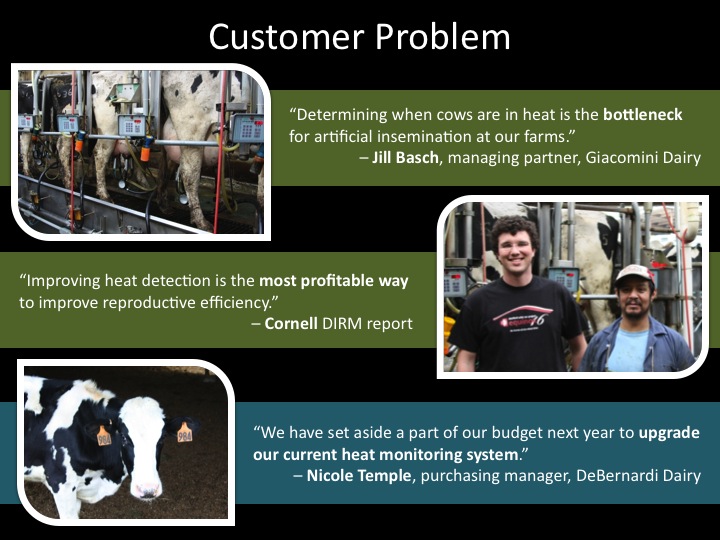
Here are some examples the “out of the building” work the students did.

Presenting the Project
As their final project, each of the 11 teams had 15 minutes to present their conclusions and then later submit a written summary. (We were equally happy if the students discovered this would not be a profitable business as we were if they found a killer idea.) The presentations were graded on:
Remember the goal was not a fundable pitch deck or a full business plan with pages of spreadsheets. Rather we wanted them to start with an idea and see what it would take to build a real business (and tell us in 15 minutes).
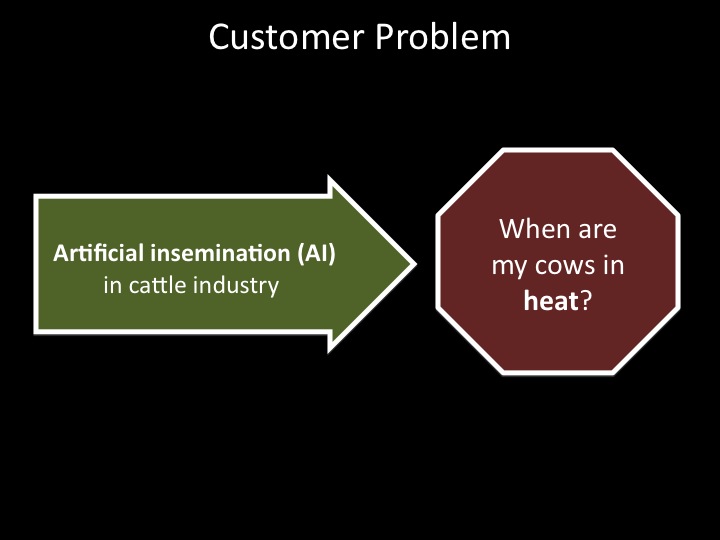
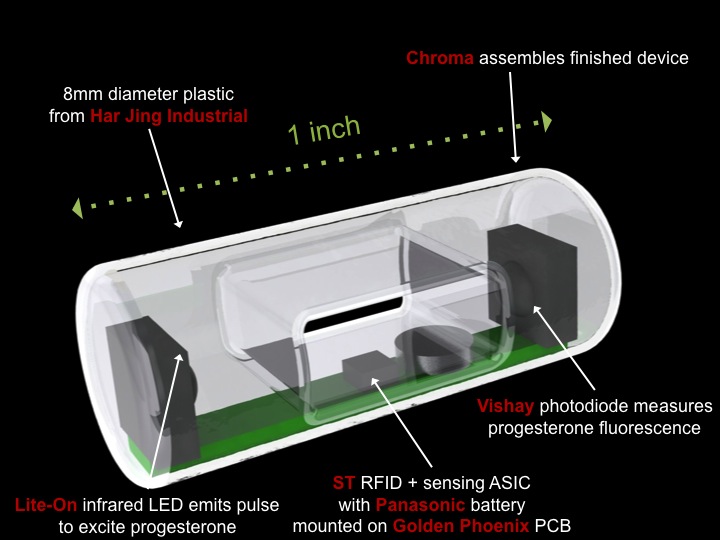
This post and the next will have a few of the final presentations (click on the thumbnails to enlarge.)

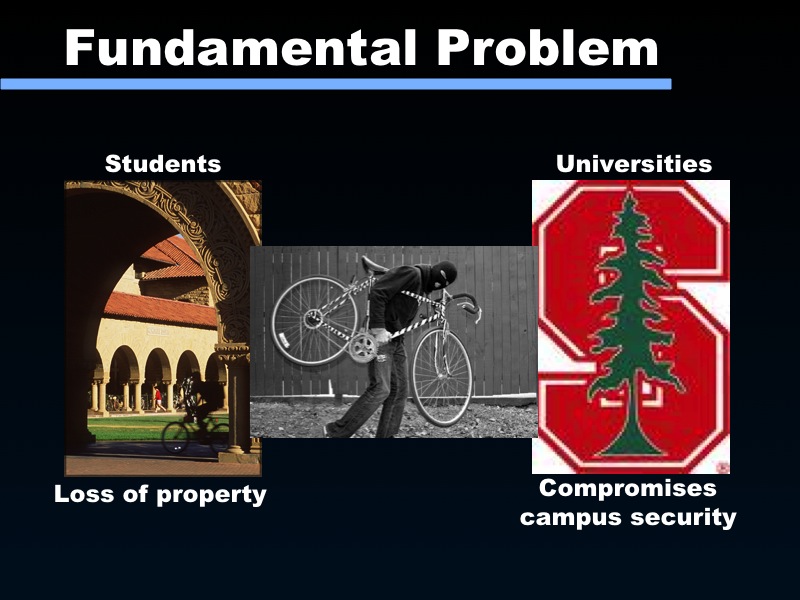
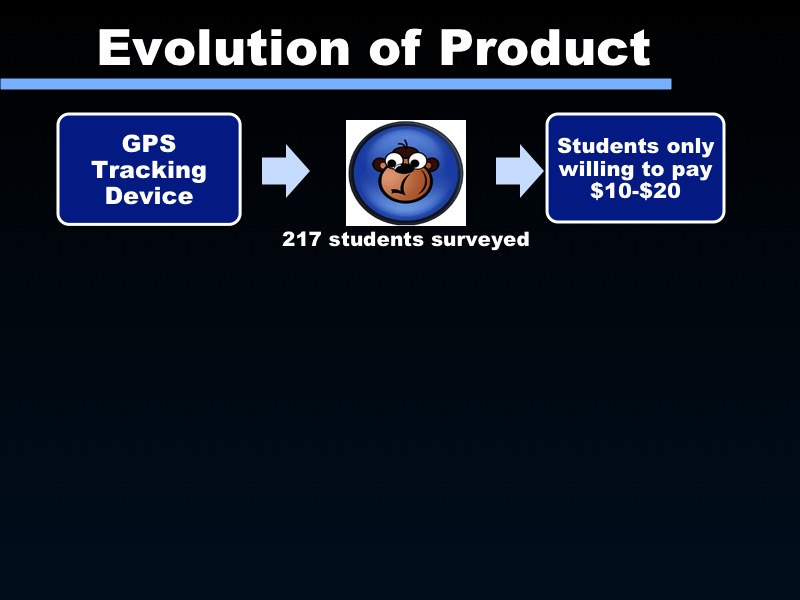
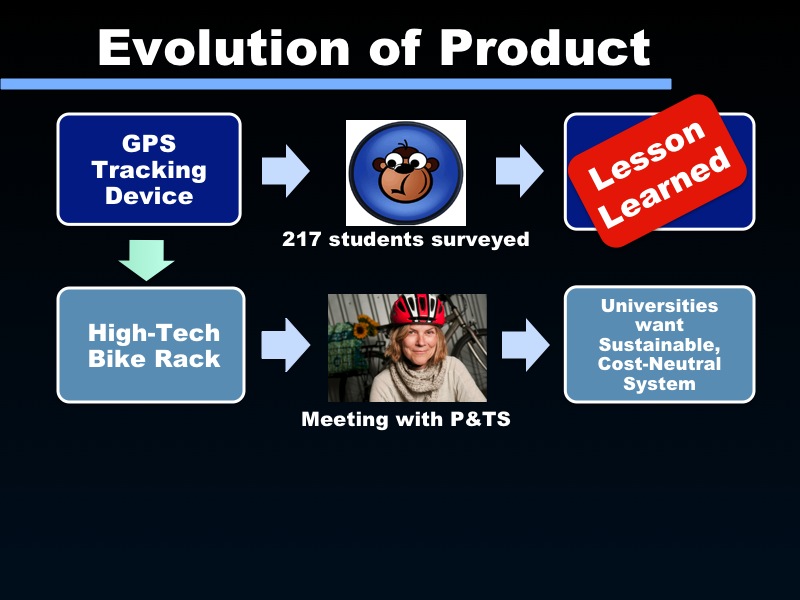
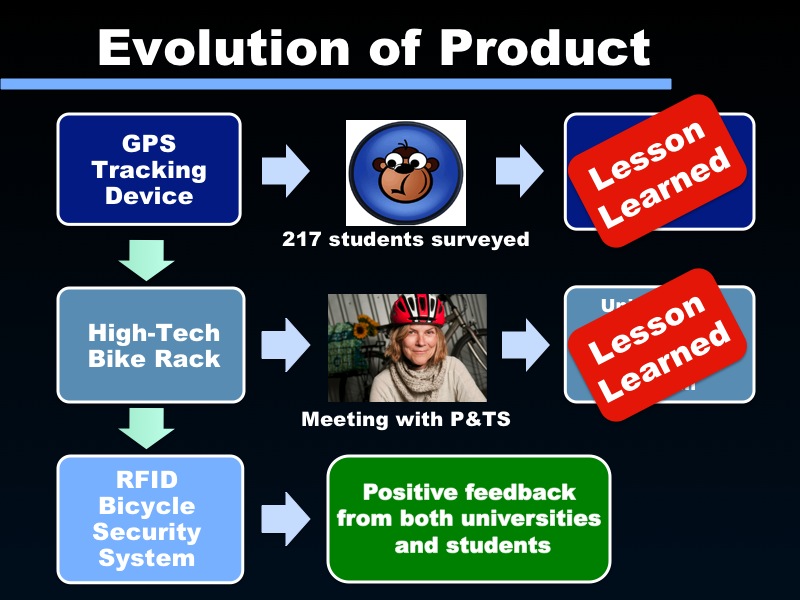
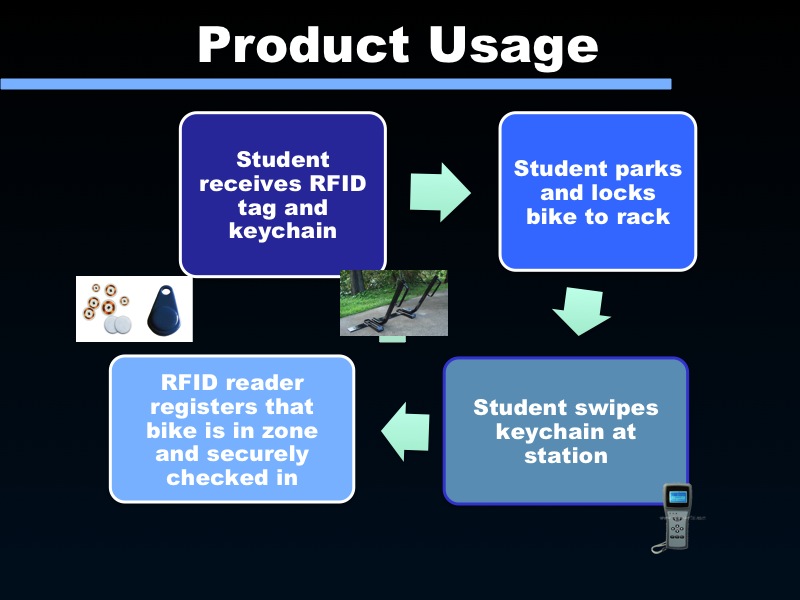
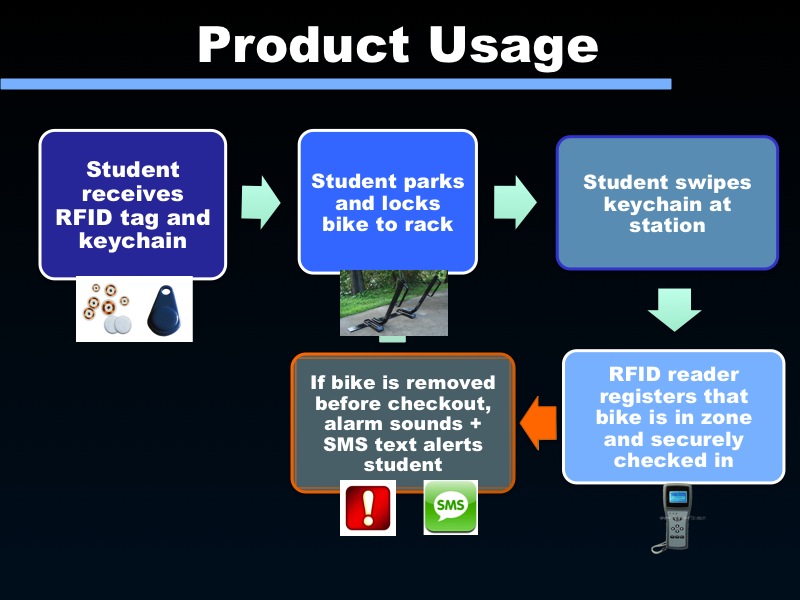
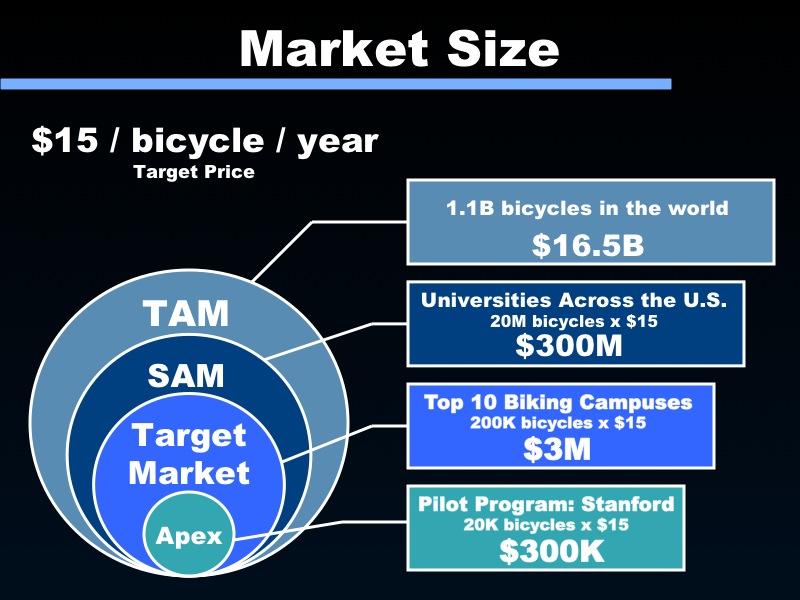
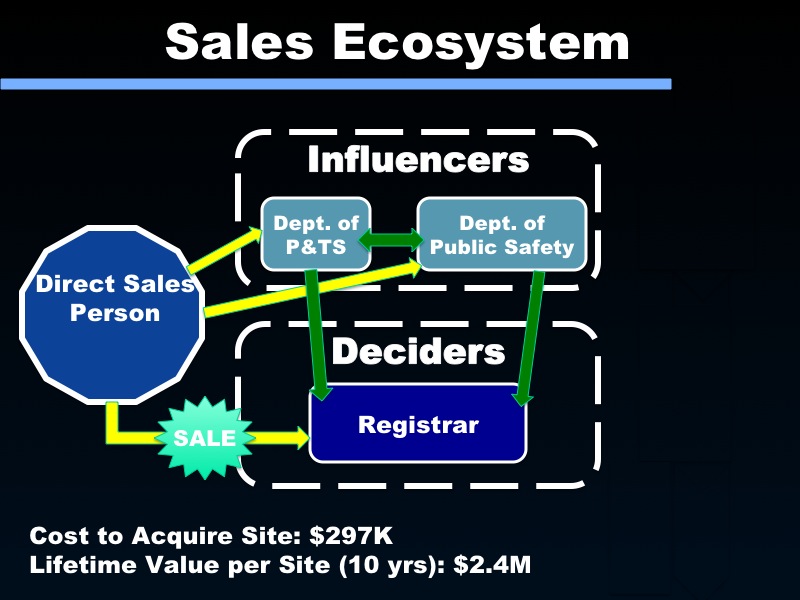
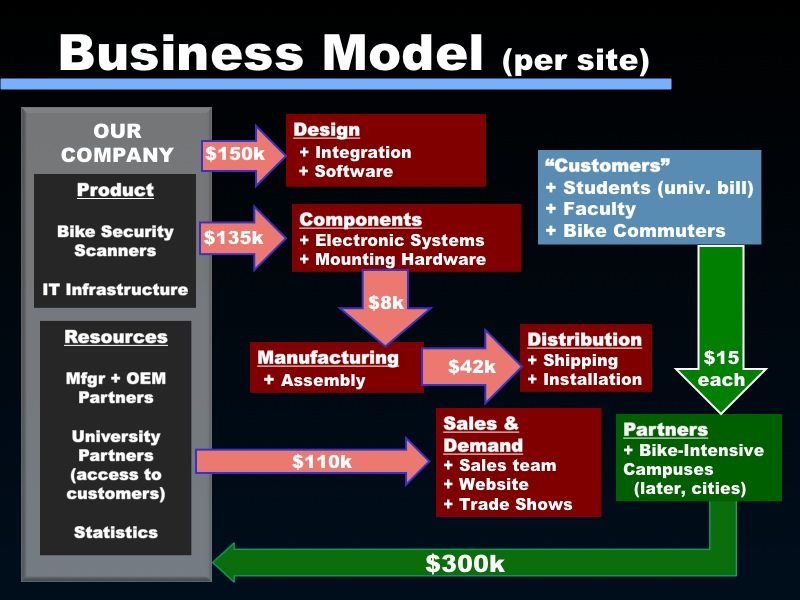
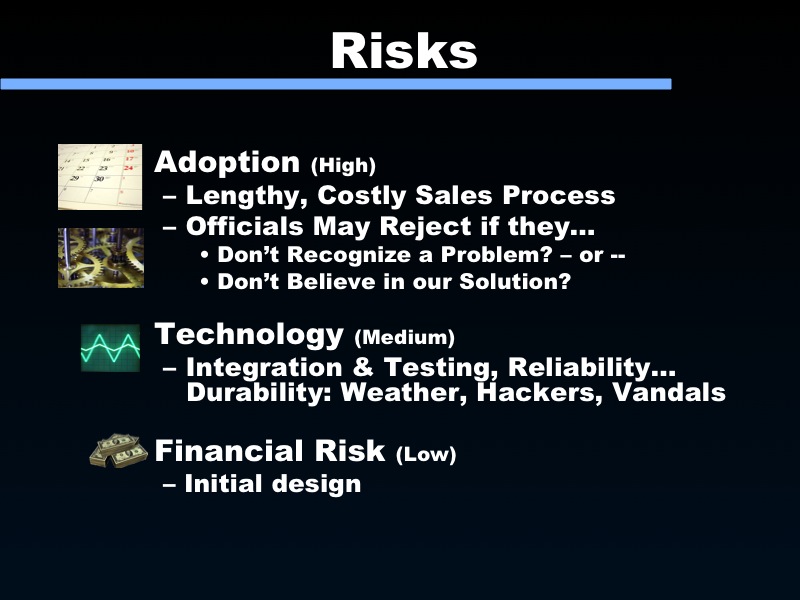
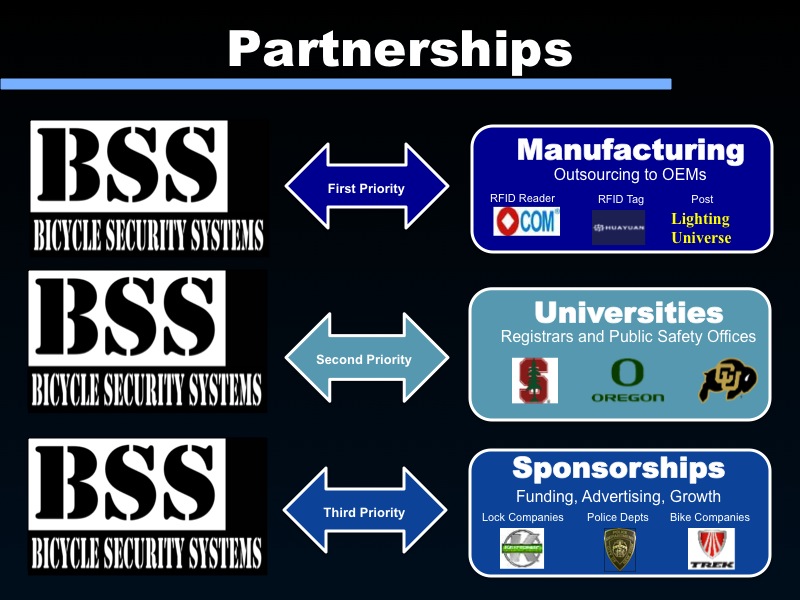
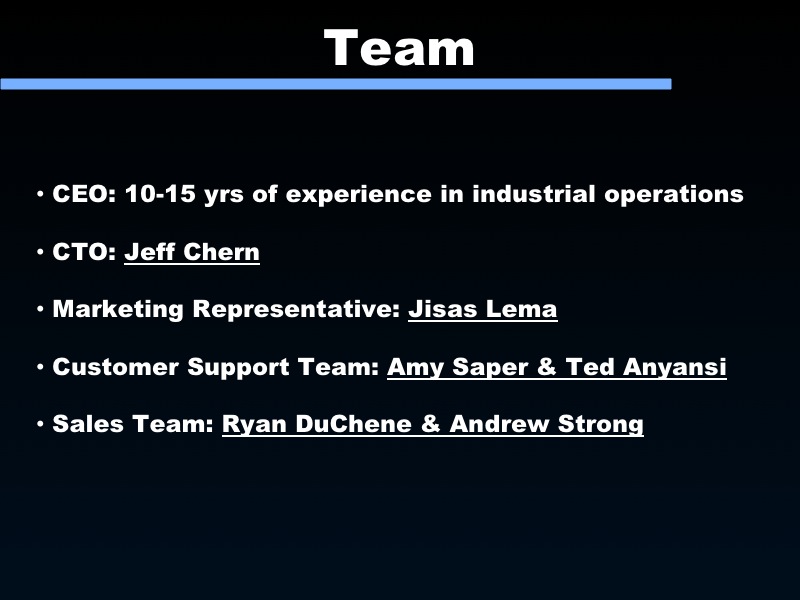
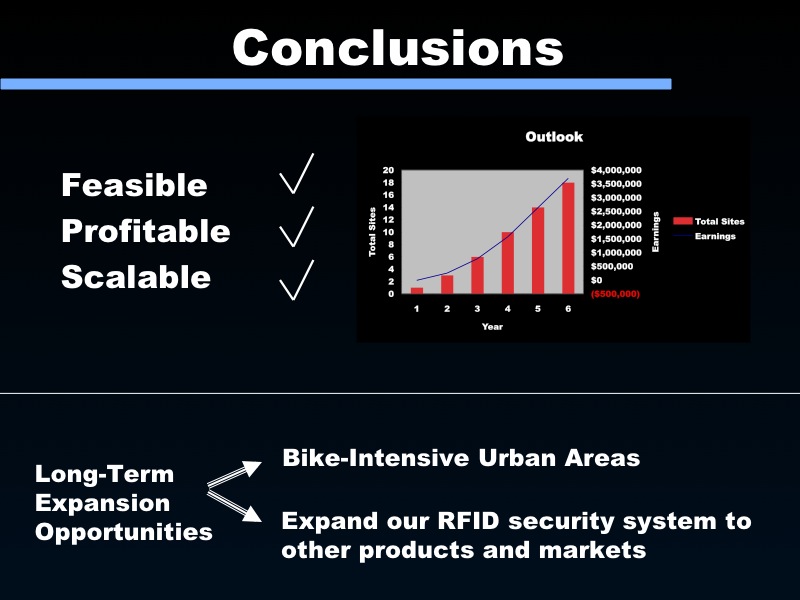
And here was another presentation in a very different market.





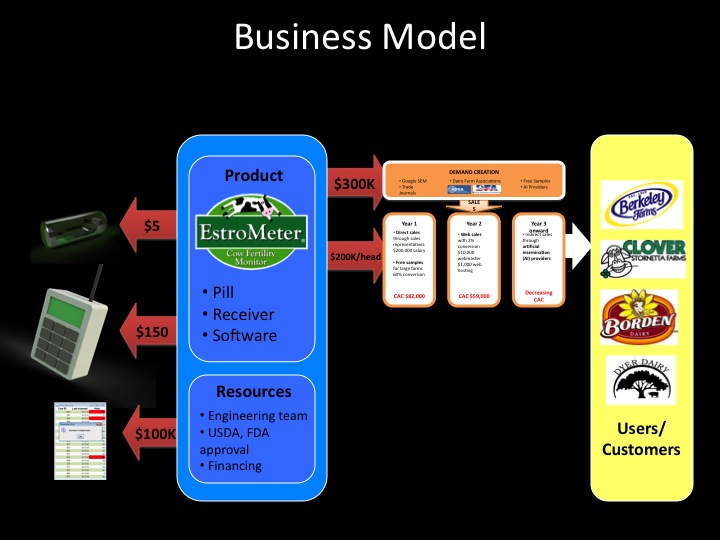
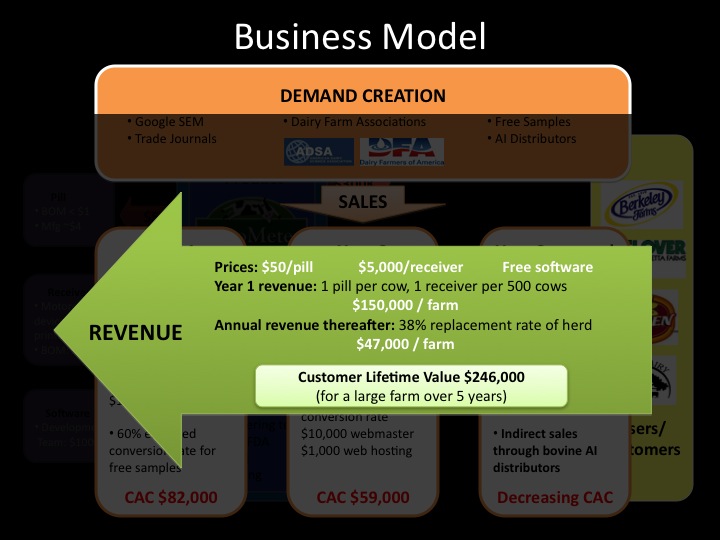
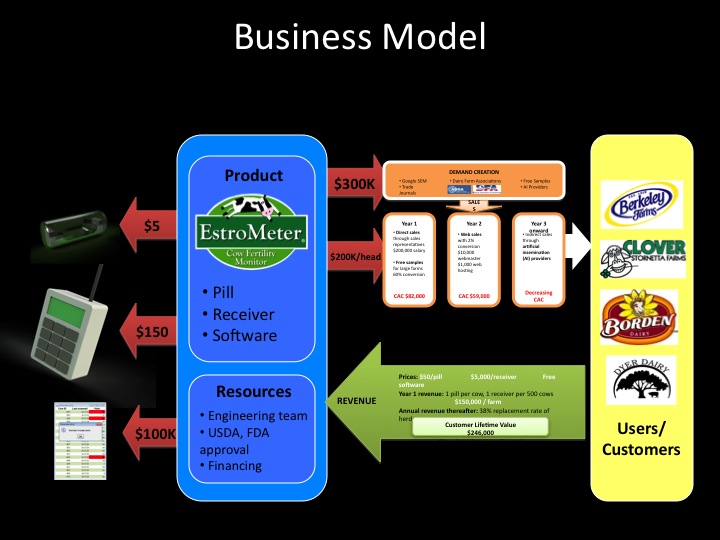
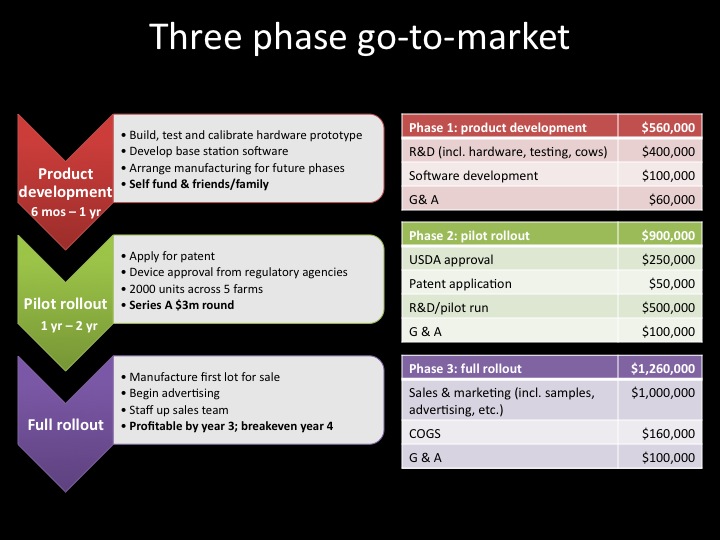
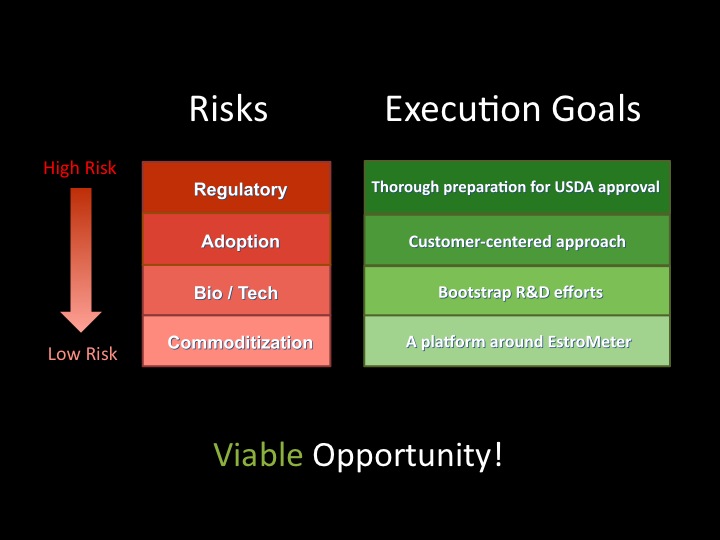
Lessons Taught


Filed under: Corporate/Gov't Innovation, Customer Development Manifesto, Teaching | 35 Comments »
This post is the latest in the “Secret History Series.” They’ll make much more sense if you read some of the earlier ones for context. See the Secret History video and slides as well as the bibliography for sources and supplemental reading.
————
By the early 1960’s Lockheed Missiles Division in Sunnyvale was quickly becoming the largest employer in what would be later called Silicon Valley. Along with its publically acknowledged contract to build the Polaris Submarine Launched Ballistic Missile (SLBM,) Lockheed was also secretly building the first photo reconnaissance satellites (codenamed CORONA) for the CIA in a factory in East Palo Alto.
It was only a matter of time before Stanford’s Applied Electronics Lab research on Electronic and Signals Intelligence and Lockheed’s missiles and spy satellites intersected. Here’s how.
Lockheed Agena

Thor/AgenaD w/Corona
In addition to the CORONA CIA reconnaissance satellites, Lockheed was building another assembly line, this one for the Agena – a space truck. The Agena sat on top of a booster rocket (first the Thor, then the Altas and finally the Titan) and had its own rocket engine that would help haul the secret satellites into space. The engine (made by Bell Aerosystems) used storable hypergolic propellants so it could be restarted in space to change the satellite’s orbit. Unlike other second stage rockets, once in orbit, the CORONA reconnaissance satellite would stay attached to the Agena which stabilized the satellite, pointed it in the right location, and oriented it in the right direction to send its recovery capsule on its way back to earth.
The Agena would be the companion to almost all U.S. intelligence satellites for the next decade. Three different models were built and for over a decade nearly four hundred of them (at the rate of three a month) would be produced on an assembly line in Sunnyvale, and tested in Lockheed’s missile test base in the Santa Cruz mountains.
Agena Ferrets – Program 11/Project 989
As Lockheed engineers gained experience with the Agena and the CORONA photo reconnaissance satellite, they realized that they had room on a rack in the back of the Agena to carry another payload (as well as the extra thrust to lift it into space.) By the summer of 1962, Lockheed proposed a smaller satellite that could be deployed from the rear of the Agena. This subsatellite was called Program 11, or P-11 for short (also called Project 989.) The P-11 subsatellite weighed up to 350lbs, had its own solid rockets to boost it into different orbits, solar arrays for power and was stabilized by either deploying long booms or by spinning 60-80 times a second.

Agena Internals
And they had a customer who couldn’t wait to use the space. While the CORONA reconnaissance satellites were designed to take photographs from space, putting a radar receiver on a satellite would enable it to receive, record and locate Soviet radars deep inside the Soviet Union. For the first time, the National Security Agency (working through the National Reconnaissance Office) and the U.S. Air Force could locate radars which would threaten our manned bombers as well as those that might be part of an anti-ballistic missile system. Most people thought the idea was crazy. How could you pick up a signal so faint while the satellite was moving so rapidly? Could you sort out one radar signal from all the other noise? There was one way to find out. Build the instruments and have them piggyback on the Agena/CORONA photo reconnaissance satellites.
But who could quickly build these satellites to test this idea?
 Stanford and Ferrets
Just across the freeway from Lockheed’s secret CORONA assembly plant in Palo Alto, James de Broekert was at Stanford Applied Electronics Laboratory. This was the Lab founded by Fred Terman from his WWII work in Electronic Warfare.
“This was an exciting opportunity for us,” de Broekert remembered. “Instead of flying at 10,000 or 30,000 feet, we could be up at 100 to 300 miles and have a larger field of view and cover much greater geographical area more rapidly. The challenges were establishing geolocation and intercepting the desired signals from such a great distance. Another challenge was ensuring that the design was adapted to handle the large number of signals that would be intercepted by the satellite. We created a model to determine the probability of intercept on the desired and the interference environment from the other radar signals that might be in the field of view, de Broekert explained.
“My function was to develop the system concept and to establish the system parameters. I was the team leader, but the payloads were usually built as a one-man project with one technician and perhaps a second support engineer. Everything we built at Stanford was essentially built with stockroom parts. We built the flight-ready items in the laboratory, and then put them through the shake and shock fall test and temperature cycling…”

Agena and Ferret Subsatellite credit: USAF
Like the cover story for the CORONA (which called them Discoverer scientific research satellites,) the first three P-11 satellites were described as “science” missions with results published in the Journal of Geophysical Research.
Just fifteen years after Fred Terman had built Electronic Intelligence and Electronic Warfare systems for bombers over Nazi Germany, Electronic Intelligence satellites were being launched in space to spy on the Soviet Union.
Close to 50 Ferret subsatellites were launched as secondary payloads aboard Agena photo reconnaissance satellites.
SAMOS/Project 102/698BK/Program 770 – Low Earth Orbit Agena “Heavy” Ferrets
Lockheeds Agena’s would play another role in overhead reconnaissance – they would carry Air Force heavy ferrets (Electronic Intelligence payloads) as part of the SAMOS program.
In the 1960’s the U.S. Air Force Strategic Air Command (SAC) needed to understand the electronic order of battle inside the Soviet Union so B-52 bombers could evade or jam those radars on the way to their targets. (Where were the Soviet early warning radars? The ground controlled intercept radars? What are their technical characteristics?) Other parts of the government wanted to know details about Soviet Anti Ballistic Missile (ABM) systems.
SAMOS originally was supposed to provide photo reconnaissance from space by developing film in orbit and electronically scanning it and beaming it to the ground. For the early 1960’s this approach turned out to be a technical bridge too far. (The U.S. wouldn’t beam down photo reconnaissance images until the KH-11 satellites in December 1976.) The CIA’s CORONA program, which dropped film canisters from space turned out to be a more efficient way to solve the problem. With CORONA successful, and results from the electronic intelligence sensors on P-11 program providing useful information, the Air Force pivoted from photo reconnaissance to electronic reconnaissance, which had already been a secondary SAMOS payload.
32 dedicated Agena heavy ferret missions were launched from the the early 1960’s to the end of the program in 1972.
Ferret Entrepreneur
After student riots in April 1969 at Stanford shut down the Applied Electronics Laboratory, James de Broekert left Stanford. He was a co-founder of three Silicon Valley military intelligence companies: Argo Systems, Signal Science, and Advent Systems,
In 2000 the National Reconnaissance Office recognized James de Broekert as a “pioneer” for his role in the “establishment of the discipline of national space reconnaissance.”
See part 16 “Balloon Wars” of the Secret History of Silicon Valley here

Filed under: Secret History of Silicon Valley | 6 Comments »
“By knowing things that exist, you can know that which does not exist.”
Book of Five Rings
I was having coffee with a former student who was complained that my idea of building a first product release with a minimum feature set was a bad idea. (One of the principles of Customer Development is to get out of the building and understand the smallest feature-set customers will pay for in the first release.)
“Steve, you’re wrong. I can’t get more than one of ten potential customers to think that this is something they’d buy.” I asked, “So what does the one who likes it say?” “Well he didn’t like it either.” he replied, “but when I started talking about our entire vision, he couldn’t wait to help get our product into his company.”
The Minimum Feature Set is Not The Goal
This minimum feature set (sometimes called the “minimum viable product”) causes lots of confusion. Founders act like the “minimum” part is the goal. Or worse, that every potential customer should want it. In the real world not every customer is going to get overly excited about your minimum feature set. Only a special subset of customers will and what gets them breathing heavy is the long-term vision for your product.
The reality is that the minimum feature set is 1) a tactic to reduce wasted engineering hours (code left on the floor) and 2) to get the product in the hands of early visionary customers as soon as possible.
You’re selling the vision and delivering the minimum feature set to visionaries not everyone.
Why A Minimum Feature Set?
The minimum feature set is the inverse of what most sales and marketing groups ask of their development teams. Usually the cry is for more features, typically based on “Here’s what I heard from the last customer I visited.”
In the Customer Development model, the premise is that a very small group of early visionary customers will guide your product features until you find a profitable business model. Rather than asking customers explicitly about feature X, Y or Z, one approach to defining the minimum features set is to ask, “What is the smallest or least complicated problem that the customer will pay us to solve?”
This rigor of “no new features until you’ve exhausted the search for a business model” counters a natural tendency of people who talk to customers – you tend to collect a list of features that if added, will get one additional customer to buy. Soon you have a ten page feature list just to sell ten customers. Your true goal is to have a feature list that’s just a single paragraph long that you can sell to thousands of customers. Your mantra becomes “Less is more.”
You’re Selling The Vision
Most startups following Customer Development and a Lean Startup methodology understand the idea of a minimal viable product. But they get it wrong in thinking that’s the point. It’s not.
Most customers will not want a product with a minimal feature set. In fact, the majority of customers will hate it. So why do it? Because you are selling the first version of your product to Earlyvangelists.
Earlyvangelists = Early Adopter + Internal Evangelist
Earlyvangelists are a special breed of customers willing to take a risk on your startup’s product or service. They can actually envision its potential to solve a critical and immediate problem—and they have the budget to purchase it. Unfortunately, most customers don’t fit this profile.
Earlyvangelists can be identified by these characteristics:
These Earlyvangelists are first buying the vision and then the product. They need to fall in love with the idea of your product. It’s the vision that will keep them committed the many times you screw up. You’ll have bugs, your product will eat their data, you’ll get the features wrong, performance will be bad, you’ll argue about pricing, etc.
But Earlyvangelists will stick with you through good and bad because they share your vision. In reality Earlyvangelists are now part of your team. If you’re selling to a business, your Earlyvangelists will end up using your slides and metrics to help sell your product inside their own company!
This means Earlyvangelists, particularly in corporations, will be buying into your entire vision, not just your first product release. They will need to hear what your company plans to deliver over the next 18 to 36 months.
That means your Product and Customer Development groups must agree that:
In Customer Development your goal is not to avoid spending money but to preserve your cash as you search for a repeatable and scalable business model. Seeing a repeatable pattern of sales to Earlyvangelists is a sign you may have found your first scalable business model.
Lessons Learned

Filed under: Customer Development | 46 Comments »
Trading emails with a startup CEO building an iPhone app, I asked him why potential customers would buy his product. In response he sent me a competitive analysis. It looked like every competitive analysis I had done for 20 years, (ok maybe better.)
And it made me sad. Looking at the spreadsheet, I realized that competitive analysis tables are one of the ways professional marketers screw up startups from day one. And I had done my share.
Here’s why.
Prove What I Already Believe
Most competitive analyses are: 1) sales documents for investors and/or 2) an attempt to rationalize the founders assumptions.
It’s Part of the Plan
Most investors require you to write a business plan which includes a section called a “competitive analysis” in which you tell potential investors how your product compares to products other companies trying to develop and sell to the same customers. While most investors don’t actually read your business plan for a first meeting, a summary of your competitive analysis usually ends up as a slide or two in your PowerPoint presentation.
Your goal in this slide is to tell investors: 1) you understand the market you are selling to, 2) you understand the other companies selling in your market, and 3) you understand how and why you are better than any of the products currently in the market. You are also implicitly telling potential investors, “These features on our competitive slide mean we will sell a lot of what we are planning to build so invest in us.”
Death by Analysis
I looked at the competitive analysis this startup CEO sent to me. This guy was experienced, he worked at lots of large companies, so the table was thorough, it had lots of rows and mentioned all the competitors.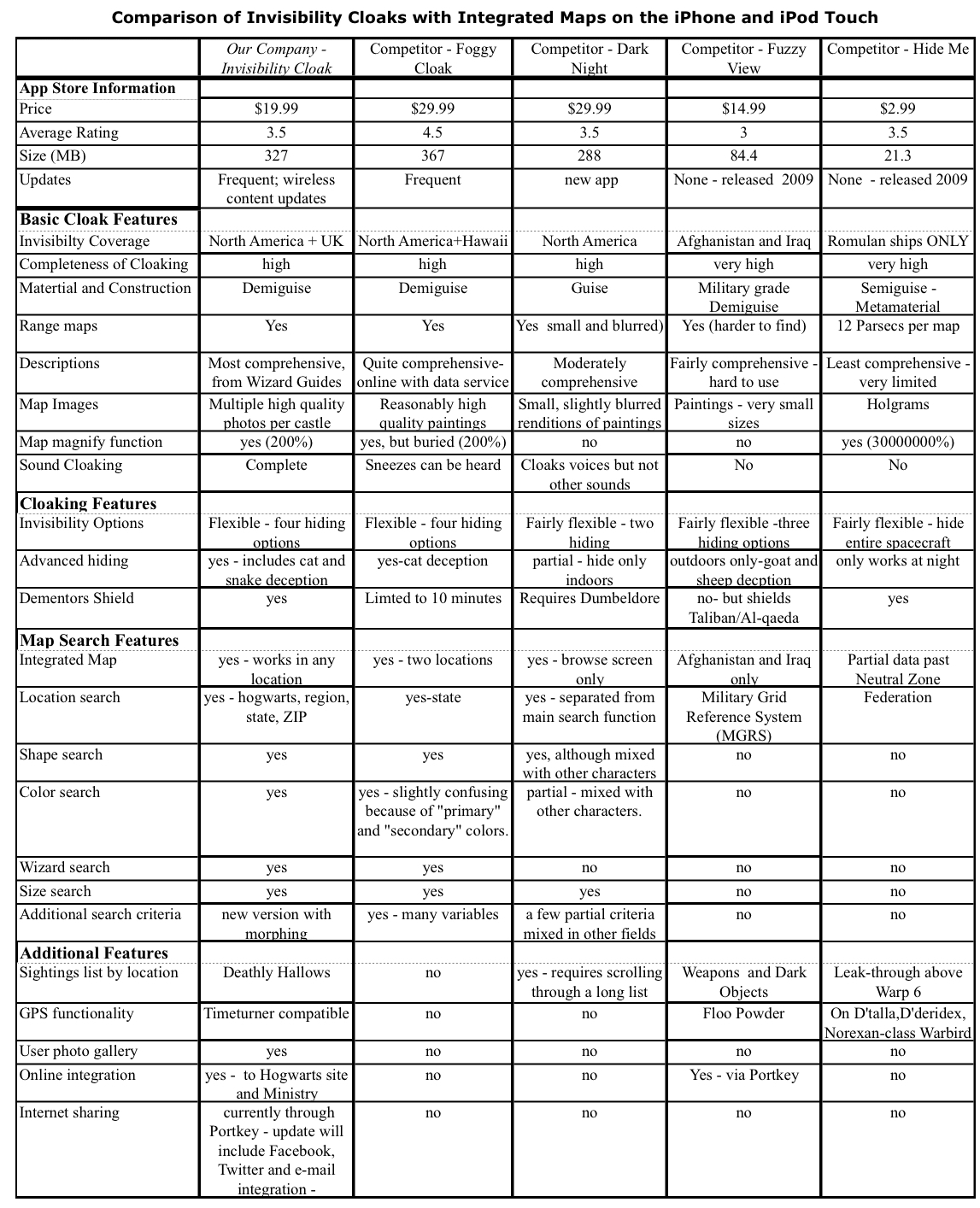
Not only was it wrong, it would set his company back months and possibly even kill them.
Why?
Competitive Analysis Drives Feature Sprawl
In most startups the competitive analysis feature comparison ends up morphing into the Marketing Requirements Document that gets handed to engineering. The mandate becomes; “Our competitors have these features so our startup needs them too. Get to work and add all of these for first customer ship.”
Product development salutes and gets to work building the product. Only after the product ships does the company find out that customers couldn’t have cared less about most of the bells and whistles.
Instead of optimizing for a minimum feature set (that had been defined by customers) a competitive analysis drives a maximum feature set.
This is not good.
Where Are the Customers?
Here’s the problem: How did the founder know which features to choose on the competitive analysis table? When I was running marketing, the answer usually was, “We’ll put up whatever axes or feature comparisons that make us look best in this segment to potential investors. What else would you choose?”
At its best a competitive analysis assumes that you know why customers are going to buy your product. At its worst it exists to rationalize the founder’s assumptions about what they are building. This is a mistake – and it is a contributing factor (if not a root cause) of why most startups get their initial feature set wrong.
If you are building a competitive analysis table, do so only after you understand that the features you are listing matter to customers. Most marketers are happy to build feature comparisons. But customers don’t buy features, they usually buy something that solves a real or perceived need. That’s the comparison you and your investors should be looking at – what do customers say they need or want?
The answer to that question is almost never in your building.
How to Make A Competitive Analysis Useful
A competitive analysis makes sense when your startup is entering an Existing market – where the competitors are known, the customers are known, and most importantly – the basis of competition is known.
(The basis of competition are the features that customers in an existing market have said, “Yes, this is what is extremely important to me. I will dump my current supplier/manufacturer for your new product because yours is smaller/faster/easier to buy/get to/tastes better, etc.)
You win in an existing market when you are better or faster on those metrics that customers have told you are the basis of competition. Your competitive analysis must be around those metrics.
But most startups are not entering an Existing market. They may be trying to:
In a Resegmented market, a competitive analysis starts with the hypothesis of “Here’s the problem we are solving for customers.” The competitive analysis chart highlights the product features that differentiate your startup from the existing market incumbents because of your understanding of specific customer needs (not your opinion) in this niche.
In a New market a competitive analysis starts with the hypothesis of “We are creating something that never existed before for customers.” The competitive analysis table highlights the product features that show what customers could never do before. It compares your company to groups of products or services.
I asked the CEO to go back to the competitive analysis and tell me whether he really knew what features matter most to potential customers. If not, he should get out of the building and find out.
Lessons Learned
- Too often competitive analysis drives product requirements in startups.
- This can lead engineering to build the maximum feature set rather than minimum feature set.
- You need to get outside the building and figure out what features matter to most customers.
- No feature lists without facts.


Filed under: Customer Development, Market Types | 30 Comments »
Customer Development is a technique startups use to quickly iterate and test each part of their business model. How you execute Customer Development varies, depending on your type of business. In my book, “The Four Steps to the Epiphany” I use enterprise software as the business model example.
Ash Maurya, the CEO of WiredReach, has extended my work by building a model of Customer Development for Web Startups.
I think his process models are pretty good. Go read both of his posts on Discovery and Validation for web startups. His two key slides are at the end of this post but the details on his blog are worth reviewing.
Customer Development In Context
Your startup is an organization built to search for a repeatable and scalable business model.

Your job as a founder is to quickly validate whether the model is correct by seeing if customers behave as your model predicts. Most of the time the darn customers don’t behave as you predicted.
Customer Development is the process startups use to quickly iterate and test each element of their business model. Agile Development is the way startups quickly iterate their product as they learn. A Lean Startup is Eric Ries’s description of the intersection of Customer Development, Agile Development and if available, open platforms and open source.

Diving into the Customer Development diagram inside the diagram above, we see that the first two steps, Customer Discovery and Customer Validation are all about iteration and testing of your business model.
How you actually do Customer Discovery and Validation depends on what type of business you are in. What makes sense for startups selling Enterprise Software may not work for startups on the web. Therefore you need different versions of the actual steps of Customer Development for different types of businesses.
The Customer Discovery step for Enterprise Software Startups
The first step in the Customer Development is Customer Discovery: testing your hypotheses. The flow for Customer Discovery for an enterprise software company was described in the Four Steps to the Epiphany. It looked like this:

.
The Customer Discovery step for Web Startups
Ash Maurya‘s version of the Discovery step of Customer Development for a web startup looks like this:

.
Customer Validation for Enterprise Software Startups
The next step in the Customer Development process is Customer Validation – making sure that there really is a repeatable and scalable revenue and business model before you turn up your cash burn rate. My version of Customer Validation for an enterprise software company looked liked this:

.
Customer Validation for Web Startups
Ash Maurya‘s version of the Valdiation step of Customer Development for a web startup looks like this:

- A startup is an organization built to search for a repeatable and scalable business model.
- Customer Development is a technique startups use to quickly iterate and test each part of their business model.
- You need different versions of the actual steps of Customer Development for different types of businesses.
- This post illustrates a version of Customer Development for startups on the web.


Filed under: Customer Development, Customer Development Manifesto | 43 Comments »
Startups that are searching for a business model need to keep score differently than large companies that are executing a known business model.
Yet most entrepreneurs and their VC’s make startups use financial models and spreadsheets that actually hinder their success.
Here’s why.
Managing the Business
When I ran my startups our venture investors scheduled board meetings each month for the first year or two, going to every six weeks a bit later, and then moving to quarterly after we found a profitable business model.
One of the ways our VC’s kept track of our progress was by taking a monthly look at three financial documents: Income Statement, Balance Sheet and Cash Flow Statement.
If I knew what I knew now, I never would have let that happen. These financial documents were worse than useless for helping us understand how well we were (or weren’t) doing. They were an indicator of “I went to business school but don’t really know what to tell you to measure so I’ll have you do these.”
To be clear – Income Statements, Balance Sheets and Cash Flow Statements are really important at two points in your startup. First, when you pitch your idea to VC’s, you need a financial model showing VC’s what your company will look like after you are no longer a startup and you’re executing the profitable model you’ve found. If this sounds like you’re guessing – you’re right – you are. But don’t dismiss the exercise. Putting together a financial model and having the founders understand the interrelationships of the variables that can make or break a business is a worthwhile exercise.
The second time you’ll need to know about Income Statements, Balance Sheets and Cash Flow Statements is after you’ve found your repeatable and profitable business model. You’ll then use these documents to run your business and monitor your company’s financial health as you execute your business model.
The problem is that using Income Statement, Balance Sheets and Cash Flow Statements any other time, particularly in a startup board meeting, has the founding team focused on the wrong numbers. I had been confused for years why I had to update an income statement each board meeting that said zero for 18 months before we had any revenue.
But What Does a Business Model Have to Do With Accounting in My Startup?
A startup is a search for a repeatable and scalable business model. As a founder you are testing a series of hypotheses about all the pieces of the business model: Who are the customers/users? What’s the distribution channel? How do we price and position the product? How do we create end user demand? Who are our partners? Where/how do we build the product? How do we finance the company, etc.

An early indication that you’ve found the right business model is when you believe the cost of getting customers will be less than the revenues the customers will generate. For web startups, this is when the cost of customer acquisition is less than the lifetime value of that customer. For biotech startups, it’s when the cost of the R&D required to find and clinically test a drug is less than the market demand for that drug. These measures are vastly different from those captured in balance sheets and income statements especially in the near term.
What should you be talking about in your board meeting? If you are following Customer Development, the answer is easy. Board meetings are about measuring progress measured against the hypotheses in Customer Discovery and Validation. Do the metrics show that the business model you’re creating will support the company you’re trying to become?
Startup Metrics
Startups need different metrics than large companies. They need metrics to tell how well the search for the business model is going, and whether at the end of that search is the business model you picked worth scaling into a company. Or is it time to pivot and look for a different business model?
Essentially startups need to “instrument” all parts of their business model to measure how well their hypotheses in Customer Discovery and Validation are faring in the real world.
For example, at a minimum, a web based startup needs to understand the Customer Lifecycle, Customer Acquisition Cost, Marketing Cost, Viral Coefficient, Customer Lifetime Value, etc. Dave McClure’s AARRR Model is one illustration of the web sales pipeline.
At a web startup, our board meetings were discussions of the real world results of testing our hypotheses from Customer Discovery.  We had made some guesses about the customer pipeline and now we had a live web site. So we put together a spreadsheet that tracked these actual customer numbers every month. Every month we reported to our board progress on registrations, activations, retained users, etc. They looked like this:
User Base
Financials
Cash
Customer Acquisition
Web Metrics
A startup selling via a direct sales force will want to understand: average order size, Customer Lifetime Value, average time to first order, average time to follow-on orders, revenue per sales person, time to salesperson becomes effective.
Regardless of your type of business model you should be tracking cash burn rate, months of cash left, time to cash flow breakeven.
Tell Them No
If you have venture investors, work with them to agree what metrics matter. What numbers are life and death for the success of your startup? (These numbers ought to be the hypotheses you’re testing in Customer Discovery and Validation.) Agree that these will be the numbers that you’ll talk about in your board meeting. Agree that there will come times that the numbers show that the business model you picked is not worth scaling into a company. Then you’ll all agree it’s time to pivot and look for a different business model.
You’ll all feel like you’re focused on what’s important.
Lessons Learned
- Large companies need financial tools to monitor how well they are executing a known business model.
- Income Statements, Balance Sheets and Cash Flow Statements are good large company financial monitoring tools.
- Startups need metrics to monitor how well their search for a business model is going.
- Startups need metrics to evaluate wither the business model you picked is worth scaling into a company.
- Using large company financial tools to measure startup progress is like giving the SAT to a first grader. It may measure something in the future but can only result in frustration and confusion now.

Filed under: Corporate/Gov't Innovation, Customer Development | 44 Comments »
It’s been a year since I’ve been blogging. The 100 or so posts add up to about 300 pages of text.
One of the downsides to a large number of blog posts is that older stories tend to get buried and hidden. Categories and indexes on the web pages aren’t quite the right metaphor or substitute for random access. So bowing to popular demand the 2009 blog posts are now available on Amazon on a portable device which provides instant and random access to any post and does not require power or an internet connection.

Recursive History
These blogs began as an attempt to explain why a “book” I wrote wasn’t a book. And now they’re a book of their own. (Confused? Read on.)
After I retired, I began teaching Customer Development, a theory of how to reduce early stage risk in entrepreneurial ventures. The first time I taught the class at the Haas Business School, U.C. Berkeley, I had a few hundred pages of course notes. Students began to ask for copies of the notes so I threw a cover on them and self-published the notes as a “book” at Cafepress.com.
As a pun on my last company as an entrepreneur, E.piphany, I called the book The Four Steps to the Epiphany.
Two years later, Eric Ries mentioned that I could list the book on Amazon. I never imagined more than a few hundred copies would be sold to my students. 15,000 copies later, the horrifically bad proofreading, design and layout is now a badge of honor. You most definitely read the book for the content. (Congratulations to all of you who actually managed to slog through it.)
You tell much better stories than you write
A few years later my teaching assistants at Stanford and Berkeley said, “You tell much better stories than you write.” They suggested that sharing those stories on the web was the best way to illustrate some of the more salient points of what even I will admit is a difficult text.
My blog also allowed me to indulge my interest in a few other subjects: The Secret History of Silicon Valley, thoughts on a career as an entrepreneur, observations about family and startups, etc.
It Wasn’t Just Me
It’s possible to read this past year of posts and think that I was the only one at these companies. Nothing could be further from the truth. I’ve been lucky enough to work with, around and near some extraordinary people: Bill Perry, Allen Michels, Rob Van Naarden, John Moussouris, John Hennessy, Skip Stritter, Jon Rubenstein, Gordon Bell, Glen Miranker, Cleve Moler, Tom McMurray, John Sanguinetti, Alvy Ray Smith, Chris Kryzan, Karen Dillon, Margaret Hughes, Peter Barrett, Bruce Leak, Jim Wickett, Karen Richardson, Ben Wegbreit, Greg Walsh, John McCaskey, Roger Siboni, Bob Dorf, Steve Weinstein, Fred Amoroso, Fred Durham, Maheesh Jain, Will Harvey, Eric Ries, Kathryn Gould, Jon Feiber, Mike Maples, Ann Miura-Ko and many, many more.
Getting Organized
These blog posts were written as I thought about them, with little thought about organization by topic.
This new “book,” Not All Those Who Wander Are Lost, attempts to remedy that by organizing the 2009 blog posts in a coherent fashion.
Table of Contents
Startup Culture
Am I a Founder? The Adventure of a Lifetime…………….. 3
Agile Opportunism – Entrepreneurial DNA………………..5
Faith-Based versus Fact-Based Decision Making……….. 8
The Sharp End of the Stick…………………………………… 12
Preparing for Chaos – the Life of a Startup……………….. 15
Speed and Tempo – Fearless Decision Making for Startups….. 16
Killing Innovation with Corner Cases and Consensus….. 18
The “Good” Student……….. 20
Touching the Hot Stove – Experiential versus Theoretical Learning……. 22
Burnout……….. 24
The Road Not Taken……….. 28
Ask and It Shall be Given……….. 31
Selling with Sports Scores……….. 34
Love/Hate Business Plan Competitions……….. 39
The Elves Leave Middle Earth – Sodas Are No Longer Free……….. 41Stories from the Trenches
Raising Money Using Customer Development……….. 47
Lessons Learned – A New Type of Venture Capital Pitch……….. 52
Can You Trust Any VC’s Under 40?………………. 56
Are Those My Initials?……………………………… 60
They Raised Money With My Slides?!……………. 62
The Best Defense is a Good IP Strategy………….. 65
Elephants Can Dance – Reinventing HP……….. 69Customer Development Manifesto
The Leading Cause of Startup Death: The Product Development Diagram. 75
Reasons for the Revolution (Part 1)……….. 79
Reasons for the Revolution (part 2)……….. 84
The Startup Death Spiral……….. 87
Market Type……….. 90
The Path of Warriors and Winners……….. 93Customer Development In the Real World
Customer Development is Not a Focus Group……….. 99
Lean Startups aren’t Cheap Startups……….. 102
Times Square Strategy Session – Web Startups and Customer Development……….. 105
Coffee With Startups……….. 108
He’s Only in Field Service……….. 110
Let’s Fire Our Customers……….. 113
Durant Versus Sloan……….. 116Family – This Life Isn’t Practice For the Next One
Lies Entrepreneurs Tell Themselves……….. 121
Epitaph for an Entrepreneur……….. 124
Thanksgiving Day……….. 129
Unintended Lessons……….. 137Ardent – Learning How To Get Out of the Building
Supercomputers Get Personal……….. 141
Get Out of My Building……….. 145
Supercomputer Porn……….. 148
You Know You’re Getting Close to Your Customers When They Offer You a Job……….. 151
The Best Marketers Are Engineers……….. 154
Listen more, talk less……….. 157
Closure……….. 160SuperMac – Learning How To Build A Startup Team
Joining SuperMac……….. 165
Facts Exist Outside the Building, Opinions Reside Within –……….. 167
Customer Insight Is Everyone’s Job……….. 174
Repositioning SuperMac – “Market Type” at Work……….. 176
Strategy versus Relentless Tactical Execution — the Potrero Benchmarks… 179
Building The Killer Team – Mission, Intent and Values……….. 184
Rabbits Out of the Hat – Product Line Extensions……….. 189
Cats and Dogs – Admitting a Mistake……….. 194
Sales, Not Awards……….. 196
The Video Spigot……….. 200
The Curse of a New Building……….. 205Rocket Science Games – Hubris and the Fall
Drinking the Kool-Aid……….. 211
Hollywood Meets Silicon Valley……….. 214
The Press is Our Best Product……….. 216
Who Needs Domain Experts……….. 219
Rocks in the Rocket Science Lobby……….. 223The Secret History of Silicon Valley
If I Told You I’d Have to Kill You……….. 227
Library Hours at an Undisclosed Location……….. 248
Happy 100th Birthday Silicon Valley……….. 254
Every World War II Movie was Wrong……….. 258
We Fought a War You Never Heard Of……….. 263
A Wilderness of Mirrors……….. 270
The Rise of Entrepreneurship……….. 271
Stanford Crosses the Rubicon……….. 279
The Rise of “Risk Capital” Part 1……….. 285
The Rise of “Risk Capital” Part 2……….. 289
“Not All Those Who Wander Are Lost” is now available on Amazon

Filed under: Customer Development | 14 Comments »
In my last post I described what happened when a company prematurely scales sales and marketing before adequately testing its hypotheses in Customer Discovery. You would think that would be enough to get wrong, but entrepreneurs and investors compound this problem by assuming that all startups grow and scale by executing the Revenue Plan. 
They don’t.
The Appendix of your business plan has one of the leading cause of death of startups: the financial spreadsheets you attached as your Income Statement, Balance Sheets and Cash Flow Statements.
Reality Meets the Plan
I got to see this first hand as an observer at a board meeting I wish I could have skipped.
We were at the board meeting of company building a radically new type of communication hardware. The company was going through some tough times. It had taken the company almost twice as long as planned to get their product out the door. But that wasn’t what the heat being generated at this board meeting was about. All discussion focused on “missing the revenue plan.”
Spread out in front of everyone around the conference table were the latest Income Statement, Balance Sheets and Cash Flow Statements. The VC’s were very concerned that the revenue the financial plan called for wasn’t being delivered by the sales team. They were also looking at the Cash Flow Statement and expressed their concern (i.e. raised their voices in a annoyed investor tone) that the headcount and its attendant burn rate combined with the lack of revenue meant the company would run out of money much sooner than anyone planned.
Lets Try to Make the World Match Our Spreadsheet
The VC’s concluded that the company needed to change direction and act aggressively to increase revenue so the company could “make the plan.” They told the CEO (who was the technical founder) that the sales team should focus on “other markets.” Another VC added that engineering should redesign the product to meet the price and performance of current users in an adjacent market.
The founder was doing his best to try to explain that his vision today was the same as when he pitched the company to the VC’s and when they funded the company. He said, “I told you it was going to take it least five years for the underlying industry infrastructure to mature, and that we had to convince OEMs to design in our product. All this takes time.” But the VC’s kept coming back to the lack of adoption of the product, the floundering sales force, the burn rate – and “the plan.”
Given the tongue-lashing the VC’s were giving the CEO and the VP of Sales, you would have thought that selling the product was something any high-school kid could have done.
What went wrong?
Revenue Plan Needs to Match Market Type
What went wrong was that the founder had built a product for a New Market and the VC’s allowed him to execute, hire and burn cash like he was in an Existing Market.
The failure of this company’s strategy happened almost the day the company was funded.
Make the VC’s Happy – Tell Them It’s a Big Market
There’s a common refrain that VC’s want to invest in large markets >$500Million and see companies that can generate $100M/year in revenue by year five. Enough entrepreneurs have heard this mantra that they put together their revenue plan working backwards from this goal. This may actually work if you’re in an existing market where customers understand what the product does and how to compare it with products that currently exist. The company I observed had in fact hired a VP of Sales from a competitor and staffed their sales and marketing team with people from an existing market.
Inconsistent Expectations
The VC’s had assumed that the revenue plan for this new product would look like a straight linear growth line. They expected that sales should be growing incrementally each month and quarter.
Why did the VC’s make this assumption? Because the company’s initial revenue plan (the spreadsheet the founders attached to the business plan) said so.
What Market Type Are We?
Had the company been in an Existing Market, this would have been a reasonable expectation.

Existing Market Revenue Curve
But no one (founders, management, investors) bothered to really dig deep into whether that sales and marketing strategy matched the technical founder’s vision or implementation. Because that’s not what the founders had built. They had designed something much, much better – and much worse.
The New Market
The founders had actually built a new class of communication hardware, something the industry had never seen before. It was going to be the right product – someday – but right now it was not the mainstream.
This meant that their revenue plan had been a fantasy from day one. There was no chance their revenue was going to grow like the nice straight line of an existing market. More than likely the revenue projection would resemble the hockey stick like the graph on the right.

New Market Revenue Curve
(The small hump in year 1 is from the early adopters who buy one of anything. The flat part of the graph, years 1 to 4 is the Death Valley many companies never leave.)
Companies in New Markets who hire and execute like they’re in an Existing Market burn through their cash and go out of business.
Inexperienced Founders and Investors
I realized I was watching the consequences of Catch 22 of fundraising. Most experienced investors would have understood new markets take time, money and patience. This board had relatively young partners who hadn’t quite grasped the consequences of what they had funded and had allowed the founder to execute a revenue plan that couldn’t be met.
Six months later the VC’s were still at the board table but the founder was not.
Lessons Learned
- Customers don’t read your revenue plan.
- Market Type matters. It affects timing of revenue, timing of spending to create demand, etc.
- Make sure your revenue and spending plan matches your Market Type.
- Make sure the founders and VC’s agree on Market Type strategy.

Filed under: Corporate/Gov't Innovation, Customer Development, Market Types | 13 Comments »
The Customer Development process is the way startups quickly iterate and test each element of their business model, reducing customer and market risk. The first step of Customer Development is called Customer Discovery. In Discovery startups take all their hypotheses about the business model: product, market, customers, channel, etc. outside the building and test them in front of customers.
At least that’s the theory. Helping out some friends I got to see firsthand the consequence of skipping Customer Discovery.
It’s A Marketing Problem
After I retired I would get calls from VC’s to help with “marketing problems” in their portfolio companies. The phone call would sound something like: “We have a company with great technology and a hot product but at the last board meeting we determined that they have a marketing problem. Can you take a look and tell us what you think?”
A week later I was in the conference room of the company having a meeting with the CEO.
We Have a Marketing Problem
“So VC x says you guys have a marketing problem. How can I help?” CEO – “Well, we’ve missed our sales numbers for the last six months.” Me – “I’m confused. I thought you guys have a marketing problem. What does this have to do with missing your sales plan? CEO – “Well our VP of Sales isn’t making the sales plan and he says it’s a marketing problem, and he’s a really senior guy.”
Now, I’m intrigued. The CEO asks the VP of Sales to join us in the conference room. (Note that most VP of Sales’ have world-class antenna for career danger. Being invited to chat with the CEO and an outside consultant that a board member brought in creates enough tension in a room to create static discharge.)
No One is Buying Our Product
“Tell me about the marketing problem.” VP of Sales – “Marketing’s positioning and strategy is all wrong.” Me – “How’s that?” VP of Sales – “No one is interested in buying our product.”
If you’ve been in marketing long enough you recognize the beginning of the sales versus marketing finger pointing. (It usually ends up bad for all concerned.) Sales’ is on the hook for making the numbers and things aren’t looking good.
Six is a Proxy for Burn Rate
“How many salespeople do you have?” VP of Sales – “Six in the field, plus me.” Later I realized six salespeople without revenue to match was a proxy for an out of control burn rate that now had the boards serious attention.
There’s Always One in Boston
“Is there a salesperson in Boston?” VP of Sales – “Sure.” Me – “What sales presentation is he using? VP of Sales – “The corporate presentation. What else do you think he’d be using?” Me – “Let’s get him on the phone and ask.”
Sure enough we’d get the sales person on the phone and find out that he stopped using the corporate presentation months ago. Why? The standard corporate presentation wasn’t working, so the Boston sales rep made up his own. (I asked for the Boston sales rep because in the U.S. they’re furthest from the Silicon Valley corporate office and any oversight.)
We call the five other sales people and find that they are also “winging it.”
Early Orders Were a Detriment
I learned that the founders received their initial product orders from their friends in the industry and through board members personal connections. These “friends and family orders” made the first nine months of their revenue plan. With that initial sales “success” they began to hire and staff the sales department per the ”plan.” That’s how they ended up with seven people in sales (plus three more in marketing.)
But now the bill had come due. It turned out that these “friends and family orders” meant the company really hadn’t understood how and why customers would buy their product. There was no deep corporate understanding about customers or their needs. The company had designed and built their product and assumed it was going to sell well based on their initial early orders. Marketing was writing presentations and data sheets without having a clue what real problems customers had. And without that knowledge, sales essentially was selling blind.
Advice You Don’t Want to Hear
My report back to the VC? Missing the sales numbers had nothing to do with marketing. The problem was much, much worse. The company had failed to do any Customer Discovery. Neither the CEO, VP of Sales or VP of Marketing had any idea what a repeatable sales model would look like before they scaled the sales force. Now they had a sales force in Brownian motion in the field, and a marketing department changing strategy and the corporate slide deck weekly. Cash was flowing out of the company and the VP of Sales was still hiring.
I suggested they cut the burn rate back by firing all the salespeople in the field, (keeping one in Silicon Valley,) and get rid of all of marketing. The CEO needed to get back to basics and personally get out of the building in front of customers to learn and discover what problems customers had and why the company’s product solved them.
The VC’s response? “Nah, it can’t be that bad, it’s a marketing problem.”
I’ll leave it to you to guess what the VC’s did six months later.
Lessons Learned
- Premature Scaling of sales and marketing is the leading cause of hemorrhaging cash in a startup.
- Scale sales and marketing after the founders and a small team have found a repeatable sales model.
- Early sales from board members or friends are great for morale and cash but may not be indicative of learning and discovering a business model.


Filed under: Corporate/Gov't Innovation, Customer Development, Venture Capital | 44 Comments »


 Get the Podcasts for Free
