Lean Launchpad at Stanford – 2025

The PowerPoints embedded in this post are best viewed on steveblank.com

We just finished the 15th<>annual Lean LaunchPad class at Stanford. The class had gotten so popular that in 2021 we started teaching it in both the winter and spring sessions.

During the 2025 spring quarter the eight teams spoke to 935 potential customers, beneficiaries and regulators. Most students spent 15-20 hours a week on the class, about double that of a normal class.

This Class Launched a Revolution in Teaching Entreprenurship
This class was designed to break out of the “how to write a business plan” as the capstone of entrepreneurial education. A business plan assumed that all startups needed to was to write a plan, raise money and then execute the plan. We overturned that orthodoxy when we pointed out that while existing organizations execute business models, startups are searching for them. And that a startup was a temporary organization designed to search for a repeatable and scaleable business model. This class was designed to teach startups how to search for a business model.
Several government-funded programs have adopted this class at scale. The first was in 2011 when we turned this syllabus into the curriculum for the National Science Foundation I-Corps. Errol Arkilic, the then head of commercialization at the National Science Foundation, adopted the class saying, “You’ve developed the scientific method for startups, using the Business Model Canvas as the laboratory notebook.”

Below are the Lessons Learned presentations from the spring 2025 Lean LaunchPad.

Team Cowmeter – early detection of cow infections through biological monitoring of milk.

If you can see the Team Cowmeter presentation click here

I-Corps at the National Institute of Health
In 2013 I partnered with UCSF and the National Institute of Health to offer the Lean LaunchPad class for Life Science and Healthcare (therapeutics, diagnostics, devices and digital health.) In 2014, in conjunction with the National Institute of Health, I took the UCSF curriculum and developed and launched the I-Corps @ NIH program.

Team NowPilot – AI copilot for enhancing focus and executive function.

If you can’t see the Team NowPilot presentation click here

I-Corps at Scale
I-Corps is now offered in 100 universities and has trained over 9,500 scientists and engineers; 7,800 participants in 2,546 teams at I-Corps at NSF (National Science Foundation), 950 participants in 317 teams at I-Corps at NIH, and 580 participants in 188 teams at Energy I-Corps (at the DOE).  15 universities in Japan now teach the class.

Team Godela – AI physics engine – with a first disruptive market in packaging.

If you can’t see the Team Godela presentation click here

$4 billion in Venture Capital For I-Corps Teams
1,380 of the NSF I-Corps teams launched startups raising $3.166 billion. Over 300 I-Corps at NIH teams have collectively raised $634 million. Energy I-Corps teams raised $151 million in additional funding.

Team ProspectAI – An AI sales development agent for lean sales teams.

If you can’t see the Team ProspectAI presentation click here

Mission Driven Entreprenurship
In 2016, I co-created both the Hacking for Defense course with Pete Newell and Joe Felter as well as the Hacking for Diplomacy course with Jeremy Weinstein at Stanford. In 2022, Steve Weinstein created Hacking for Climate and Sustainability. In 2024  Jennifer Carolan launched Hacking for Education at Stanford.

Team VLAB – accelerating clinical trials with AI orchestration of data.

If you can’t see the team VLAB presentation click here

Design of This Class
While the Lean LaunchPad students are experiencing what appears to them to be a fully hands-on, experiential class, it’s a carefully designed illusion. In fact, it’s highly structured. The syllabus has been designed so that we are offering continual implicit guidance, structure, and repetition. This is a critical distinction between our class and an open-ended experiential class. Guidance, Direction and Structure –
For example, students start the class with their own initial guidance – they believe they have an idea for a product or service (Lean LaunchPad/I-Corps) or have been given a clear real-world problem (Hacking for Defense). Coming into the class, students believe their goal is to validate their commercialization or deployment hypotheses. (The teaching team knows that over the course of the class, students will discover that most of their initial hypotheses are incorrect.)

Team Blix – IRB clinical trial compliance / A control layer for AI governance for financial services.

If you can’t see the team Blix presentation click here

The Business Model Canvas
The business model / mission model canvas offers students guidance, explicit direction, and structure. First, the canvas offers a complete, visual roadmap of all the hypotheses they will need to test over the entire class. Second, the canvas helps the students goal-seek by visualizing what an optimal endpoint would look like – finding product/market fit. Finally, the canvas provides students with a map of what they learn week-to-week through their customer discovery work. I can’t overemphasize the important role of the canvas. Unlike an incubator or accelerator with no frame, the canvas acts as the connective tissue – the frame – that students can fall back on if they get lost or confused. It allows us to teach the theory of how to turn an idea, need, or problem into commercial practice, week by week a piece at a time.

Team Plotline – A smart marketing calendar for author’s book launch.

If you can’t see the team Plotline presentation click here

Lean LaunchPad Tools
The tools for customer discovery (videos, sample experiments, etc.) offer guidance and structure for students to work outside the classroom. The explicit goal of 10-15 customer interviews a week along with the requirement for building a continual series of minimal viable products provides metrics that track the team’s progress. The mandatory office hours with the instructors and support from mentors provide additional guidance and structure.

Team Eluna/Driftnet  – Data Center data aggregation and energy optimization software.

If you can’t see the team Eluna/Driftnet presentation click here

AI Embedded in the Class
This was the first year where all teams used AI to help create their business model canvas, build working MVPs in hours, generate customer questions, analyze and summarizing interviews.

It Takes A Village
While I authored this blog post, this class is a team project. The secret sauce of the success of the Lean LaunchPad at Stanford is the extraordinary group of dedicated volunteers supporting our students in so many critical ways.

The teaching team consisted of myself and:

  • Steve Weinstein, partner at America’s Frontier Fund, 30-year veteran of Silicon Valley technology companies and Hollywood media companies. Steve was CEO of MovieLabs, the joint R&D lab of all the major motion picture studios.
  • Lee Redden – CTO and co-founder of Blue River Technology (acquired by John Deere) who was a student in the first Lean LaunchPad class 14 years ago!
  • Jennifer Carolan, Co-Founder, Partner at Reach Capital the leading education VC and author of the Hacking for Education class.

Our teaching assistants this year were Arthur C. Campello, Anil Yildiz, Abu B. Rogers and Tireni Ajilore.

Mentors helped the teams understand if their solutions could be a commercially successful business. Thanks to Jillian Manus, Dave Epstein, Robert Feldman, Bobby Mukherjee, Kevin Ray, Deirdre Clute, Robert Locke, Doug Biehn, and John Danner. Martin Saywell from the Distinguished Careers Institute joined the Blix team. The mentor team was led by Todd Basche.

Summary
While the Lean LaunchPad/I-Corps curriculum was a revolutionary break with the past, it’s not the end. In the last decade enumerable variants have emerged. The class we teach at Stanford has continued to evolve. Better versions from others will appear. AI is already having a major impact on customer discovery and validation and we had each team list the AI tools they used. And one day another revolutionary break will take us to the next level.

Lean LaunchPad @Stanford 2024 – 8 Teams In, 8 Companies Out

This post previously appeared in Poets and Quants.

We just finished the 14th annual Lean LaunchPad class at Stanford. The class had gotten so popular that in 2021 we started teaching it in both the winter and spring sessions.

During the quarter the eight teams spoke to 919 potential customers, beneficiaries and regulators. Most students spent 15-20 hours a week on the class, about double that of a normal class.

In the 14 years we’ve been teaching the class, we had something that has never happened before – all eight teams in this cohort have decided to start a company.

This Class Launched a Revolution in Teaching Entreprenurship
Several government-funded programs have adopted this class at scale. The first was in 2011 when we turned this syllabus into the curriculum for the National Science Foundation I-Corps. Errol Arkilic, the then head of commercialization at the National Science, adopted the class saying, “You’ve developed the scientific method for startups, using the Business Model Canvas as the laboratory notebook.”

Below are the Lessons Learned presentations from the spring 2024 Lean LaunchPad.

Team Neutrix – Making Existing Nuclear Reactors More Profitable By Upgrading Their Fuel

If you can’t see the Neutrix video, click here

If you can’t see the Neutrix Presentation, click here

I-Corps at the National Institute of Health
In 2013 I partnered with UCSF and the National Institute of Health to offer the Lean LaunchPad class for Life Science and Healthcare (therapeutics, diagnostics, devices and digital health.) In 2014, in conjunction with the National Institute of Health, I took the UCSF curriculum and developed and launched the I-Corps @ NIH program.

Team Virgil – Capturing Memoirs of Loved Ones (and Using AI to Do It Profitably)

If you can’t see the Virgil video, click here

If you can’t see the Virgil Presentation, click here.

I-Corps at Scale
I-Corps is now offered in 100 universities and has trained over 9,500 scientists and engineers; 7,800 in 2,546 teams in I-Corps at NSF (National Science Foundation), 950 participants at I-Corps at NIH in 317 teams, and 580 participants at Energy I-Corps (at the DOE) in 188 teams.

Team Claim CoPilot – Overturning Denied Healthcare Claims

If you can’t see the Claim Pilot Presentation, click here

If you can’t see the Claim CoPilot video of their demo click here

$4 billion in Venture Capital For I-Corps Teams
1,380 of the NSF I-Corps teams launched startups raising $3.166 billion. Over 300 I-Corps at NIH teams have collectively raised $634 million. Energy I-Corps teams raised $151 million in additional funding.

Team Emy.ai – Using Brainwaves to Biohack Moods

If you can’t see the Emy.ai video, click here

If you can’t see the Emy.ai Presentation, click here

Mission Driven Entreprenurship
In 2016, I co-created both the Hacking for Defense course with Pete Newell and Joe Felter as well as the Hacking for Diplomacy course with Jeremy Weinstein at Stanford. In 2022, Steve Weinstein created Hacking for Climate and Sustainability. This fall Jennifer Carolan will launch Hacking for Education at Stanford.

Team TeachAssist – Automating Student Assessments for Special Education Teachers

If you can’t see the TeachAssist video, click here

If you can’t see the TeachAssist Presentation, click here

Design of This Class
While the Lean LaunchPad students are experiencing what appears to them to be a fully hands-on, experiential class, it’s a carefully designed illusion. In fact, it’s highly structured. The syllabus has been designed so that we are offering continual implicit guidance, structure, and repetition. This is a critical distinction between our class and an open-ended experiential class.

Guidance, Direction and Structure
For example, students start the class with their own initial guidance – they believe they have an idea for a product or service (Lean LaunchPad/I-Corps) or have been given a clear real-world problem (Hacking for Defense). Coming into the class, students believe their goal is to validate their commercialization or deployment hypotheses. (The teaching team knows that over the course of the class, students will discover that most of their initial hypotheses are incorrect.)

Team Maurice.ai – A Home Robot for the GPT Era

If you can’t see the Maurice.ai video, click here

If you can’t see the Maurice.ai Presentation, click here

The Business Model Canvas
The business/mission model canvas offers students guidance, explicit direction, and structure. First, the canvas offers a complete, visual roadmap of all the hypotheses they will need to test over the entire class. Second, the canvas helps the students goal-seek by visualizing what an optimal endpoint would look like – finding product/market fit. Finally, the canvas provides students with a map of what they learn week-to-week through their customer discovery work.

I can’t overemphasize the important role of the canvas. Unlike an incubator or accelerator with no frame, the canvas acts as the connective tissue – the frame – that students can fall back on if they get lost or confused. It allows us to teach the theory of how to turn an idea, need, or problem into commercial practice, week by week a piece at a time.

Team Waifinder – Personalized Guidance For High School Students to Effectively Apply to College

If you can’t see the Waifinder video, click here

If you can’t see the Waifinder Presentation, click here

Lean LaunchPad Tools
The tools for customer discovery (videos, sample experiments, etc.) offer guidance and structure for students to work outside the classroom. The explicit goal of 10-15 customer interviews a week along with the requirement for building a continual series of minimal viable products provides metrics that track the team’s progress. The mandatory office hours with the instructors and support from mentors provide additional guidance and structure.

Team PocketDot – Gamified Braille Self-Learning Solution for Braille Learners

If you cant see the PocketDot video click here.

If you can’t see the PocketDot Presentation, click here

It Takes A Village
While I authored this blog post, this class is a team project. The secret sauce of the success of the Lean LaunchPad at Stanford is the extraordinary group of dedicated volunteers supporting our students in so many critical ways.

The teaching team consisted of myself and:

Our teaching assistants this year were Chapman Ellsworth, Francesca Bottazzini and Ehsan Ghasemi.

Mentors helped the teams understand if their solutions could be a commercially successful business. Thanks to Lofton Holder, Bobby Mukherjee, Steve Cousins, David Epstein, Kevin Ray, Rekha Pai, Rafi Holtzman and Kira Makagon. They were led by Todd Basche.

Summary
While the Lean LaunchPad/I-Corps curriculum was a revolutionary break with the past, it’s not the end. In the last decade enumerable variants have emerged. The class we teach at Stanford has continued to evolve. Better versions from others will appear. AI is already having a major impact on customer discovery and validation. And one day another revolutionary break will take us to the next level.

But today, we get to celebrate – 8 teams in – 8 companies out.

You’re Invited: Hacking for Defense and Lean LaunchPad Final Presentations

Join us for the final presentations of our two Stanford classes this Tuesday June 4th and Wednesday June 5th.

Tuesday = Hacking for Defense

Wednesday = Lean Launchpad

The presentations just get better every year.  Attend in person or via Zoom.

This year AI seems to be part of almost every team.

Zoom link and RSVP for Hacking for Defense here


Zoom link and RSVP for Lean LaunchPad here

Lean Meets Wicked Problems

This post previously appeared in Poets & Quants.

I just spent a month and a half at Imperial College London co-teaching a “Wicked” Entrepreneurship class. In this case Wicked doesn’t mean morally evil, but refers to really complex problems, ones with multiple moving parts, where the solution isn’t obvious. (Understanding and solving homelessness, disinformation, climate change mitigation or an insurgency are examples of wicked problems. Companies also face Wicked problems. In contrast, designing AI-driven enterprise software or building dating apps are comparatively simple problems.)


I’ve known Professor Cristobal Garcia since 2010 when he hosted my first visit to Catholic University in Santiago of Chile and to southern Patagonia. Now at Imperial College Business School and Co-Founder of the Wicked Acceleration Labs, Cristobal and I wondered if we could combine the tenets of Lean (get out of the building, build MVPs, run experiments, move with speed and urgency) with the expanded toolset developed by researchers who work on Wicked problems and Systems’ Thinking.

Our goal was to see if we could get students to stop admiring problems and work rapidly on solving them. As Wicked and Lean seem to be mutually exclusive, this was a pretty audacious undertaking.

This five-week class was going to be our MVP.

Here’s what happened.

Finding The Problems
Professor Garcia scoured the world to find eight Wicked/complex problems for students to work on. He presented to organizations in the Netherlands, Chile, Spain, the UK (Ministry of Defense and the BBC), and aerospace companies. The end result was a truly ambitious, unique, and international set of curated Wicked problems.

  • Increasing security and prosperity amid the Mapuche conflict in Araucania region of Chile
  • Enabling and accelerating a Green Hydrogen economy
  • Turning the Basque Country in Spain into an AI hub
  • Solving Disinformation/Information Pollution for the BBC
  • Creating Blue Carbon projects for the UK Ministry of Defense
  • Improving patient outcomes for Ukrainian battlefield injuries
  • Imagining the future of a low-earth-orbit space economy
  • Creating a modular architecture for future UK defense ships

Recruiting the Students
With the problems in hand, we set about recruiting students from both Imperial College’s business school and the Royal College of Art’s design and engineering programs.

We held an info session explaining the problems and the unique parts of the class. We were going to share with them a “Swiss Army Knife” of traditional tools to understand Wicked/Complex problems, but they were not going to research these problems in the library. Instead, using the elements of Lean methodology, they were going to get out of the building and observe the problems first-hand. And instead of passively observing them, they were going to build and test MVPs.  All in six weeks.

50 students signed up to work on the eight problems with different degrees of “wickedness”.

Imperial Wicked Problems and Systems Thinking – 2023 Class

The Class
The pedagogy of the class (our teaching methods and the learning activities) were similar to all the Lean/I-Corps and Hacking for Defense classes we’ve previously taught. This meant the class was team-based, Lean-driven (hypothesis testing/business model/customer development/agile engineering) and experiential – where the students, rather than being presented with all of the essential information, must discover that information rapidly for themselves.

The teams were going to get out of the building and talk to 10 stakeholder a week. Then weekly each team will present 1) here’s what we thought, 2) here’s what we did, 3) here’s what we learned, 4) here’s what we’re going to do during this week.

More Tools
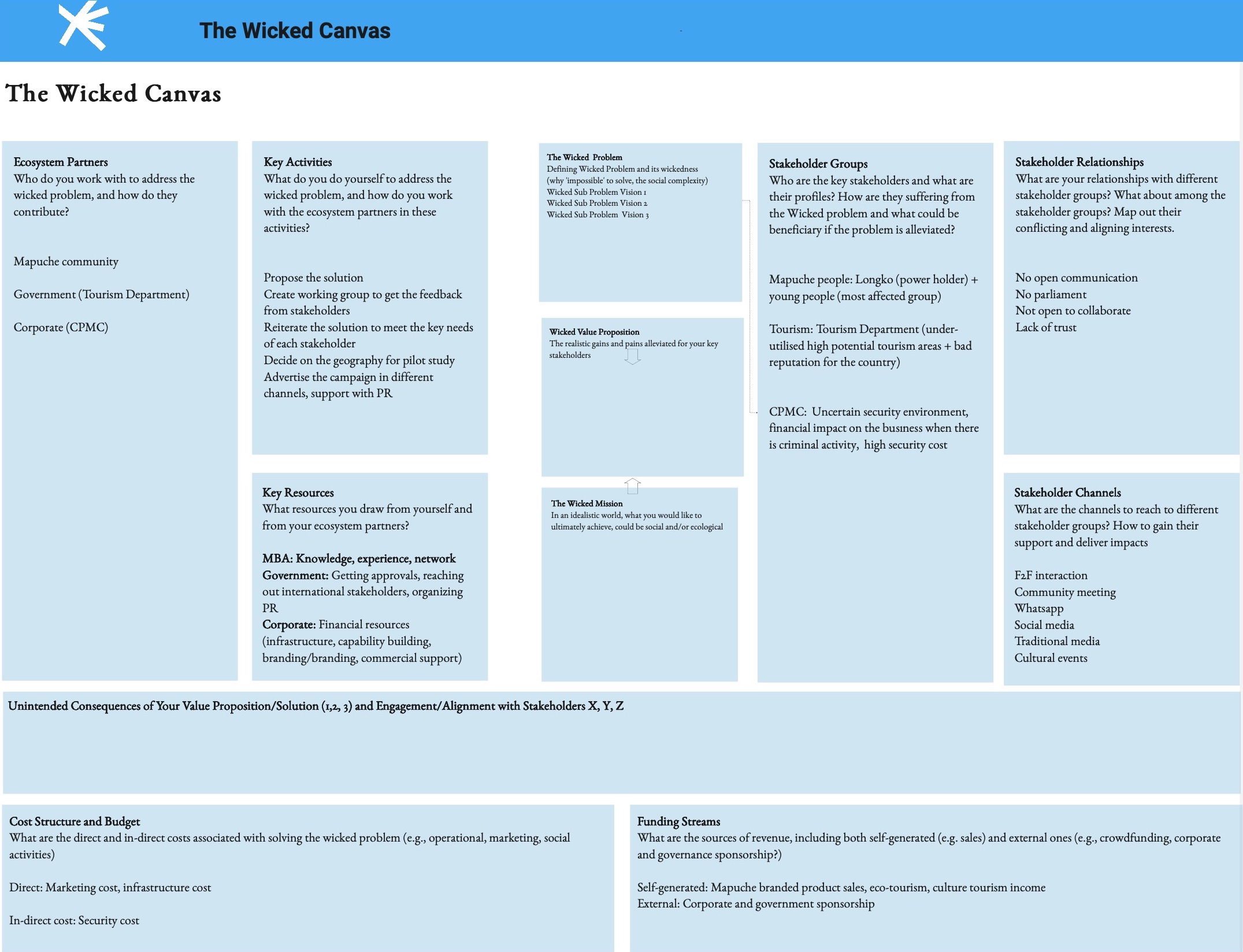
The key difference between this class and previous Lean/I-Corps and Hacking for Defense classes was that Wicked problems required more than just a business model or mission model to grasp the problem and map the solution. Here, to get a handle on the complexity of their problem the students needed a suite of tools –  Stakeholder Maps, Systems Maps, Assumptions Mapping, Experimentation Menus, Unintended Consequences Map, and finally Dr. Garcia’s derivative of the Alexander Osterwalder’s Business Model Canvas – the Wicked Canvas – which added the concept of unintended consequences and the “sub-problems” according to the different stakeholders’ perspectives to the traditional canvas.

During the class the teaching team offered explanations of each tool, but the teams got a firmer grasp on Wicked tools from a guest lecture by Professor Terry Irwin, Director of the Transition Design Institute at Carnegie Mellon (see her presentation here.) Throughout the class teams had the flexibility to select the tools they felt appropriate to rapidly gain an holistic understanding and yet to develop a minimum viable product to address and experiment with each of the wicked problems.

Class Flow
Week 1 

  • What is a simple idea? What are big ideas and Impact Hypotheses? 
    • Characteristics of each. Rewards, CEO, team, complexity, end point, etc. 
  • What is unique about Wicked Problems?
    • Beyond TAM and SAM (“back of the napkin”) for Wicked Problems
  • You need Big Ideas to tackle Wicked Problems: but who does it?
    •  Startups vs. Large Companies vs. Governments
    • Innovation at Speed for Horizon 1, 2 and 3 (Managing the Portfolio across Horizons)
  • What is Systems Thinking?
  • How to map stakeholders and systems’ dynamics?
  • Customer & Stakeholder Discovery: getting outside the building, city and country: why and how? 

Mapping the Problem(s), Stakeholders and Systems –  Wicked Tools

Week 2

  • Teams present for 6 min and receive 4 mins feedback
  • The Wicked Swiss Army Knife for the week: Mapping Assumptions Matrix, unintended consequences and how to run and design experiments
  • Prof Erkko Autio (ICBS and Wicked Labs) on AI Ecosystems and Prof Peter Palensky (TU Delft) on Smart Grids, Decarbornization and Green Hydrogen
  • Lecture on Minimal Viable Products (MVPs) and Experiments
  • Homework: getting outside the building & the country to run experiments

Assumption Mapping and Experimentation Type –  Wicked Tools

Week 3

  • Teams present in 6 min and receive 4 mins feedback
  • The Wicked Swiss Army Knife for the week: from problem to solution via “How Might We…” Builder and further initial solution experimentation
  • On Canvases: What, Why and How 
  • The Wicked Canvas 
  • Next Steps and Homework: continue running experiments with MVPs and start validating your business/mission/wicked canvas

The Wicked Canvas –  Wicked Tools

Experimentation Design and How We Might… –  Wicked Tools

Week 4

  • Teams present in 6 min and receive 5 mins feedback
  • Wicked Business Models – validating all building blocks
  • The Geography of Innovation – the milieu, creative cities & prosperous regions 
  • How World War II and the UK Started Silicon Valley
  • The Wicked Swiss Tool-  maps for acupuncture in the territory
  • Storytelling & Pitching 
  • Homework: Validated MVP & Lessons learned

Acupuncture Map for Regional System Intervention  – Wicked Tools


Week 5

  • Teams presented their Final Lessons Learned journey – Validated MVP, Insights & Hindsight (see the presentations at the end of the post.)
    • What did we understand about the problem on day 1?
    • What do we now understand?
    • How did we get here?
    • What solutions would we propose now?
    • What did we learn?
    • Reflections on the Wicked Tools

Results
To be honest, I wasn’t sure what to expect. We pushed the students way past what they have done in other classes. In spite of what we said in the info session and syllabus, many students were in shock when they realized that they couldn’t take the class by just showing up, and heard in no uncertain terms that no stakeholder/customer interviews in week 1 was unacceptable.

Yet, everyone got the message pretty quickly. The team working on the Mapuche conflict in the Araucania region of Chile, flew to Chile from London, interviewed multiple stakeholders and were back in time for next week’s class. The team working to turn the Basque Country in Spain into an AI hub did the same – they flew to Bilbao and interviewed several stakeholders. The team working on the Green Hydrogen got connected to the Rotterdam ecosystem and key stakeholders in the Port, energy incumbents, VCs and Tech Universities. The team working on Ukraine did not fly there for obvious reasons. The rest of the teams spread out across the UK – all of them furiously mapping stakeholders, assumptions, systems, etc., while proposing minimal viable solutions. By the end of the class it was a whirlwind of activity as students not only presented their progress but saw that of their peers. No one wanted to be left behind. They all moved with speed and alacrity.

Lessons Learned

  • Our conclusion? While this class is not a substitute for a years-long deep analysis of Wicked/complex problems it gave students:
    • a practical hands-on introduction to tools to map, sense, understand and potentially solve Wicked Problems
    • the confidence and tools to stop admiring problems and work on solving them
  • I think we’ll teach it again.

Team final presentations

The team’s final lessons learned presentations were pretty extraordinary, only matched by their post-class comments. Take a look below.

Team Wicked Araucania

Click here if you can’t see the Araucania presentation.

Team Accelerate Basque

Click here if you can’t see the Accelerate Basque presentation.

Team Green Hydrogen

Click here if you can’t see the Green Hydrogen presentation.

Team Into The Blue

Click here if you can’t see the Team Blue presentation.

Team Information Pollution

Click here if you can’t see the Team Information Pollution presentation.

Team Ukraine

Click here if you can’t see the Team Ukraine presentation.

Team Wicked Space

Click here if you can’t see the Team Wicked Space presentation.

Team Future Proof the Navy

Click here if you can’t see the Future Proof the Navy presentation.


The Class That Changed the Way Entrepreneurship is Taught

This article first appeared in Poets and Quants


Revolutions start by overturning the status quo. By the end of the 20th century, case studies and business plans had reached an evolutionary dead-end for entrepreneurs. Here’s why and what we did about it.


The Rise of Business Schools – Management as an Occupation
The business school was invented in the first decade of the 20th century in response to a massive economic transformation in the U.S. that took place in the last quarter of the 19th century. The country exited the Civil War as a nation of small businesses and ended the century with large national corporations (railroads, steel, oil, food, insurance, etc.). These explosions in company size and scale created a demand for professional managers. In 1908 Harvard Business School filled that need by creating a graduate degree – the Master of Business Administration. Its purpose was to educate management on best practices to run existing companies.

The MBA Curriculum – From Fieldwork to Case Studies
When Harvard started the MBA program there were no graduate-level business textbooks. The school used the “problem-method” which emphasized fieldwork – getting out of the classroom and visiting real companies– as an important part of the curriculum. Students observed how executives worked, interviewed them, and wrote up how real managers solved problems. Students then discussed these problems and solutions in class.

First Case Study-General Shoe

By the early 1920s a new dean changed the curriculum – shifting it from an industry orientation (steel, railroads, etc.) – to a functional one (marketing, factory and employment management (HR), etc.). This focus on a functional curriculum involved a switch to the case method; fieldwork now took second place. The case method assumes that students learn when they participate in a discussion of a theoretical situation they may face when they are a decision-maker rather than a real one they see in the field.

By 1923, 2/3rds of the courses at Harvard were taught with the case method, and the pattern was set for business education for the rest of the 20th century.

Entrepreneurship Becomes a Subject in Business Schools
While MBA programs proliferated during the first half of the 20th century, they focused on teaching management of existing companies. There were no classes on how to start a business. That is until 1947 when Myles Mace taught the first entrepreneurship course “Management of New Enterprises” at Harvard Business School. Soon others were created. In 1953 Peter Drucker offered an Entrepreneurship and Innovation class at New York University, and in 1954 Stanford’s business school offered “Small Business Management” its first small business course.

In 1967 the first contemporary MBA entrepreneurship courses were introduced at Stanford and NYU, and a year later Babson offered the first undergraduate entrepreneurship program. By 1970 sixteen schools were offering entrepreneurship courses, and in 1971 UCLA offered the first MBA in entrepreneurship. Entrepreneurship textbooks such as Small Business Management: Essentials of Entrepreneurship and Entrepreneurship: Playing to Win started to appear. In 1985 the University of Miami held the first national business plan competition. By 1991 there were 57 undergraduate and 22 MBA programs. Textbooks, papers, and journal articles proliferated.

By the end of the 20th century entrepreneurship education fell into two categories: 1) starting small businesses and 2) starting high-growth, high-risk scalable startups. But both types of entrepreneurship courses were taught using case studies and taught students how to write and execute a business plan. The curriculum of both types of courses were simply adaptations of what business schools were using to train managers for the administration and execution of existing organizations.

The case method and business plans are the antithesis of how entrepreneurs create startups
The case method assumes that students learn when they participate in a discussion of a situation they may someday face as a decision-maker. But the case method is the antithesis of how entrepreneurs create a startup. Cases teaches pattern recognition tools for static patterns—and has limited value as a tool for teaching entrepreneurship.  Analyzing a case in the classroom, removed from the realities of a new venture, adds little to an entrepreneur’s preparation for the chaos, uncertainty, and conflicting customer responses that all entrepreneurs face.

Business plans presume that building a startup is a series of predictable steps requiring execution of a plan which assumes a series of known facts: known customers, known features, known pricing, known distribution channel. As a serial entrepreneur turned educator, this didn’t make sense to me. In a new venture none of these things are truly known. The reality is that most business plans don’t survive first contact with customers.

Neither cases nor business plans replicate the actual startup experience. Cases and plans are useful for teaching managers of process, not founders. Founders of startups (and new ventures inside existing companies) are searching for product/market fit and a repeatable and scalable business model. Searching, unlike execution, is not a predictable pattern. An entrepreneur must start with the belief that all their assumptions are simply hypotheses that will undoubtedly be challenged by what they learn from customers.

Yet up until 10 years ago, schools were still teaching entrepreneurs how to build startups on the premise that they were simply smaller versions of large companies. Entrepreneurial education was trapped in the 20th century.

21st Century Entrepreneurship curriculums
At the start of the 21st century, after two decades and 8 startups, I retired and had time to think about how VCs directed their startups using business plans. I began formulating the key ideas around what became the Lean Startup – that startups and existing companies were distinctly different – companies execute business models while startups search for them. Consequently the methodologies for launching products in startups were different than for existing companies.

A decade later, I began to teach the foundations of Lean, first at UC Berkeley (Customer Development) and then at Stanford using cases and business plans. After a few years of trial and error in front of a lot of students, I realized that the replacement for the case method was not better cases written for startups and that the replacement for business plans was not how to write better business plans and pitch decks. (I did both!). Instead, we needed a new management stack for company creation.

I posited that teaching “how to write a business plan” might be obsolete.

With Lean LaunchPad, we were going to toss teaching the business plan aside and try to teach students a completely new, hands-on approach to starting companies – one which combines customer development, agile development, business models and pivots.

Let’s Teach Lean Via Experiential Learning
First I searched the academic literature trying to learn what methods would best convey information that entrepreneurship students could understand, retain, and put to practical use. There were five parts to consider:

  • What’s the level of ambiguity, realism and complexity of the course content
  • How structured are the tasks within the class?
  • What were the experiential techniques used to deliver the content?
  • What were the pedagogical components of the class?
  • How will we deliver feedback to the students?

For each of these parts of the course design we needed to consider where on the spectrum of directedversus experiential each of the five parts of the class would fall.

Direct Guidance Versus Experiential Classes
I concluded that best way to teach entrepreneurs (versus managers) was to create an experiential and inquiry-based class that would develop the mindset, reflexes, agility, and resilience needed to search for a business model certainty in a chaotic world.

Experiential learning (also called “active learning” or “learning by doing”) is designed to have a high degree of complexity and realism. It’s not about read and remember, but rather is about problem exploration, design and inventing and iterating solutions. This differs from a traditional class with directed learning where students are taught to remember facts, understand concepts, and perhaps apply procedures but not to discover these by themselves.

In contrast, experiential classes are designed with the theory that people learn best in an unguided or minimally guided environment, where the students, rather than being presented with all of the essential information, must discover, or construct that information rapidly for themselves.

This seemed to me to be the best way to teach entrepreneurship. Experiential learning is the core of how we teach the Lean LaunchPad/I-Corps/Hacking for X classes. Launched in 2011, the Lean LaunchPad capstone entrepreneurship class was unique in that it was:

  1. team-based
  2. experiential
  3. Lean-driven (hypothesis testing/business model/customer development/agile engineering).

The class aimed to mimic the uncertainty all startups face as they search for a business model while imparting an understanding of all the components of a business model, not just how to give a pitch or a demo.

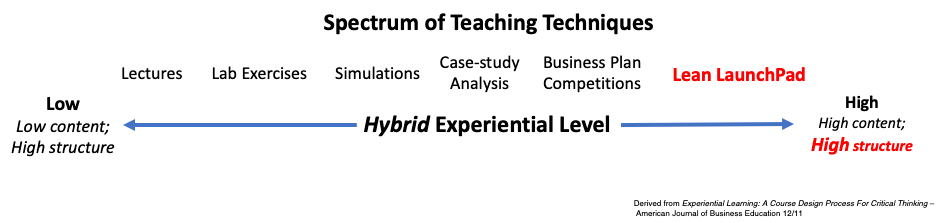
The figure below illustrates the spectrum of teaching techniques and shows where our class fits on the right.

The Syllabus
We were going to teach entrepreneurship like you teach artists – combining theory with intensive hands-on practice.

This Lean LaunchPad is built around the business model / customer development / agile development solution stack. Students start by mapping their initial assumptions (their business model). Each week they test these hypotheses with customers and partners outside the classroom (using customer development), then use iterative and incremental development (agile development) to build Minimal Viable Products.

The goal is to get students out of the building to test each of the 9 parts of their business model (or mission model for Hacking for Defense students), understand which of their assumptions were wrong, and figure out what they need to do to find product/market fit and then a validated business model.

Our objective is to get them using the tools that help startups test their hypotheses and adjust when they learn that their original assumptions are wrong.  We want them to experience faulty assumptions not as a crisis, but as a learning event called a pivot —an opportunity to change the model. (More than just for use in startups, these problem-solving skills are increasingly crucial in today’s increasingly complex world.)

Each week every team presents to the teaching team – “Here’s what we thought, here’s what we did, here’s what we learned, here’s what we’re going to do next week.”

Designing the Lean LaunchPad/I-Corps Class – the “Pedagogy”
While the Lean LaunchPad/I-Corps/H4X students are experiencing what appears to them to be a fully hands-on, experiential class, it’s a carefully designed illusion. In fact, it’s highly structured. The syllabus has been designed so that we are offering continual implicit guidance, structure, and repetition. This is a critical distinction between our class and an open-ended experiential class.

Guidance, Direction and Structure
For example, students start the class with their own initial guidance – they believe they have an idea for a product or service (Lean LaunchPad/I-Corps) or have been given a clear real-world problem (Hacking for Defense). Coming into the class, students believe their goal is to validate their commercialization or deployment hypotheses. (The teaching team knows that over the course of the class, students will discover that most of their initial hypotheses are incorrect.)

Next, the business/mission model canvas offers students guidance, explicit direction, and structure. First, the canvas offers a complete, visual roadmap of all the hypotheses they will need to test over the entire class. Second, the canvas helps the students goal-seek, by visualizing what an optimal endpoint would look like – product/market fit / mission success – would look like. Finally, the canvas provides students with a map of they what they learn week-to-week through their customer discovery work.

(I can’t overemphasize the important role of the canvas. Unlike an incubator or accelerator with no frame, the canvas acts as the connective tissue – the frame – that students can fall back on when they got lost or confused. It allows us to teach the theory of how to turn an idea, need, or problem into commercial practice, week by week a piece at a time.)

Third, the tools for customer discovery (videos, sample experiments, etc.) offer guidance and structure for students to work outside the classroom. The explicit goal of 10-15 customer interviews a week along with the requirement for building a continual series of minimal viable products, provides metrics that track the team’s progress. The mandatory office hours with the instructors and support from mentors provide additional guidance and structure.

Working Memory and Reflection
One of the challenges we wanted to avoid is overloading students’ short-term memory. If you give students minimal feedback and provide no structure or guidance, most of what students experience gets forgotten. To counter that, we’ve built three techniques in to reduce the cognitive load: regular summing up, repetition, and reflection. This allows students to transfer their weekly experiences into long-term memory and knowledge.

By design, each week we make students stop, reflect, and summarize their learning (here’s what we thought, here’s what we did, here’s what we found and here’s what we’re going to do next week.) The teams present these reflections, along with required specific deliverables for each week. These weekly presentations also provide reinforcement – students need to remember their learning from each of the prior components in the business/mission model canvas to provide a context for the current week.

In addition to the week-to-week summaries, we give students a reflection week at the end of the class to synthesize, process and integrate those week-to-week learnings. And we teach them how to turn that learning into a compelling story of their learning journey.

Ambiguity, Realism and Complexity
Ambiguity in a class means the subject can have multiple right answers. Or even no right answer. Searching for answers to the business and mission problems i.e. product/market fit has maximum ambiguity – there isn’t always a correct answer, nor will the same path get you to the same answer in different circumstances.

Realism in a class means, how well does the class content match an actual problem in practice? Learning accounting in a classroom is likely similar to doing accounting in an office. However, reading case studies about startup problems in a classroom has little connection to the real world and has low realism.

Complexity refers to the number of things that can change that may affect the outcome of a decision.  As the number of things that change goes up the so does the complexity of the learning process.

New ventures are ambiguous, real and complex. Teaching “how to write a business plan” as a method to build a startup assumes low ambiguity, low realism, and low complexity when the opposite is true. So we structured the class to model a startup; extremely ambiguous with multiple possible answers (or at times none,) realism in the pressures, chaos and uncertainty of a startup, and complex in trying to understand all parts of a business model.

The Flipped Classroom
Inside the classroom, we deliberately trade off lecture time for student/teaching team interaction. The class is run using a “flipped classroom.” Instead of lecturing about the basics during class time, we assign the core lectures, recorded as video clips, as homework.

Instructors then supplement the video lectures with their own in-class short lecture about this week’s business model topic.  This allows instructors to use the class time for review of the concepts or short lectures customized for specific domains (e.g., hardware, life sciences, etc.).

Emotional Investment
In an experiential class students must be fully immersed in the experience, not just doing what the syllabus says is required of them. Project-based learning engages and motivates students Having each team present weekly in front of their peers raises the commitment (and heart rate) of the students. No one wants to be shown up by another team.

Speed and Tempo Outside Their Comfort Zones
One of the goals of the class is to talk to 100 customers and partners. That may seem like an absurdly unreasonable goal, yet all teams manage to do so. Most case-based or project classes do not offer time and resource constraints. Our class is purposely designed to offer maximum ambiguity while pushing students to achieve extraordinary results under relentless pressure and time constraints.  We stress a relentless speed and tempo because we believe that learning is enhanced when students are given the opportunity to operate outside of their own perceived comfort zones.

Our objective is to have students experience what it’s like to operate in a real-world startup. Outside the classroom walls conditions will change so rapidly that their originally well thought out plans become irrelevant. If they can’t manage chaos and uncertainty, if they can’t bias themselves for action, and if they wait around for someone else to tell them what to do, then their investors and competitors will make their decisions for them and they will run out of money and their company will die.

Therefore, every successful founder needs a decisive mindset that can quickly separate the crucial from the irrelevant, synthesize the output, and use this intelligence to create islands of order in the all-out chaos of a startup. The class is designed to emulate that chaos and teach a bias for action.

Relentlessly Direct Feedback
There’s one last part of our pedagogy that might seem out of place in an experiential class – and that’s the relentlessly direct model of feedback.

The class moves at breakneck speed and is designed to create immediate action in time-, resource-, and cash-constrained environments. The teaching team practices Radical Candor – caring personally while challenging directly. At its core, Radical Candor is guidance and feedback that’s both kind and clear, specific, and sincere, and focused on helping the other person grow.

We give the students public feedback about the quality and quantity of their work in front of their peers weekly. For some, it’s the first time they’ve ever heard “not good enough.”

Class Design – Summary
The design of the class was a balance between ambiguity, complexity and uncertainty with structure and learning strategies.

While this process is extremely effective, it can be painful to watch. Our natural inclination (at least mine) is to offer specific guidance and solutions. (There are a few times in class when the team may need explicit directions such as, “It’s time to pivot” or “Your team needs to restart.”  But these should be exceptions.)

The genius of the class design was making the class look like it wasn’t designed.

Results
In the first decade of the Lean LaunchPad class we’ve trained hundreds of other educators around the world to teach the class at their universities. By now 100s of thousands of students have taken some form of the class, and 100’s of companies have been created.

In addition, two government-funded programs have adopted the class at scale. The first was the National Science Foundation I-Corps. Errol Arkilic the then head of commercialization at the National Science adopted the class saying, “You’ve developed the scientific method for startups, using the Business Model Canvas as the laboratory notebook.”  I-Corps which is now offered in 100 universities and has trained ~2,500 teams/7,500 scientists in 100 cohorts. The National Institute of Health also teaches a version, I-Corps @ NIH,  in the National Cancer Institute.

Today, this Lean LaunchPad/I-Corps syllabus is also the basis for a series of Mission-Driven Entrepreneurship classes– Hacking for Diplomacy, DefenseOceans, non-profits and cities. Hacking for Defense is now taught in over 55 universities in the U.S., with versions of the course offered in the UK and Australia.

While the Lean LaunchPad/I-Corps curriculum was a revolutionary break with the past, it’s not the end. In the last decade enumerable variants have emerged. The class we teach at Stanford has continued to evolve. Better versions from others will appear. And one day another revolutionary break will take us to the next level.

Lean LaunchPad – For Deep Science and Technology

We just finished the 11th annual Lean LaunchPad class at Stanford — our first version focused on deep science and technology.

I’ve always thought of the class as a minimal viable product – testing new ideas and changing the class as we learn. This year was no exception as we made some major changes, all of which we are going to keep going forward.

  1. A focus on scientists and engineers. We created an additional Spring section of the class with a focus on commercializing inventions from Stanford’s scientists and engineers. The existing winter quarter of the class remains the same as we taught for the last 10 years – taking all students’ projects – e-commerce, social media, web, and mobile apps. This newly created Spring section focuses on scientists and engineers who want to learn how to commercialize deep science and technology – life sciences (medical devices, diagnostics, digital health, therapeutics,) semiconductors, health care, sensors, materials, artificial intelligence/deep learning, et al.
    This allowed us to emphasize how to differentiate a technical spec from a value proposition and expand on the parts of the business model that are unique for science and engineering startups. For example, life sciences versus commercial applications have radically different reimbursement, regulatory, clinical trials, scientific advisory boards, demand creation, etc. In addition, we found we needed to add new material on Intellectual Property, how to license inventions from the university, and discussions about team dynamics.  Going forward we’ll continue to offer the class in two sections with the second class focused on science and technology.
  2. Remote Discovery – As the pandemic forced teaching remotely, we’ve learned that customer discovery is actually more efficient using video conferencing. It increased the number of interviews the students were able to do each week. When Covid restrictions are over, we plan to add remote customer discovery to the students’ toolkit. It remains to be seen whether customers will remain as available on Zoom as they were during the pandemic. (See here for an extended discussion of remote customer discovery.) Remote discovery also allowed a bigger pool of potential interviews not bounded by geography. The quality of interviewees seemed to improve by this larger pool.
  3. Class size/configuration – For the past decade our class size was 8 teams of 4. This year we accepted 12 teams of 4. Previously all teams needed to sit through all 8 weekly presentations. That was tough in person and not sustainable via Zoom. This year, by moving into two breakout sections, we cut the number of presentations that each team sat through by half.  The new format allowed students and teaching staff to devote greater attention to each presentation.
  4. Adopt a team – in past years all instructors had office hours with all the teams. This year each instructor adopted three teams and saw them weekly for a half hour. Students really appreciated building a closer working relationship with one faculty member.
  5. Alumni as guest speakers – Most weeks we invited a past student to guest speak about their journey through the class, highlighting “what I wish I knew” and “what to pay attention to.”

Below are the Lessons Learned presentations from the Lean LaunchPad for deep science and technology, as well as additional learnings from the class.

During the quarter the teams spoke to 1,237 potential customers, beneficiaries, regulators – all via Zoom. Most students spent 15-20 hours a week on the class, about double that of a normal class.

Team Gloflow

Started on Week 1 as a pathology slide digitization service.
Ended in Week 10 as response prediction for cancer treatments.

If you can’t see the Gloflow video, click here

If you can’t see the Gloflow slides, click here

Team Loomia

Started on Week 1 as flexible e-textile circuit looking for a problem.
Ended in Week 10 as easy-to-integrate components for automotive suppliers.

If you can’t see the Loomia video, click here

If you can’t see the Loomia slides, click here

Team Skywalk

Started on Week 1 as wearable gesture control device for real and virtual worlds.
Ended in Week 10 as a future-proof gesture control solution for AR headsets and the Department of Defense.

If you can’t see the Skywalk video, click here

If you can’t see the Skywalk slides, click here

Team EdgeAI

Started on Week 1 as a custom silicon chip with embedded memories and a Machine Learning accelerator targeting low-power, high-throughput, and low-latency applications.
Ended in Week 10 as a chip enabling AI vision applications on next generation battery powered surveillance cameras.

If you can’t see the EdgeAI video click here

If you can’t see the EdgeAI slides, click here

Team MushroomX

Started on Week 1 as Drone pollination of crops.
Ended in Week 10 as autonomous button mushroom harvesting.

If you can’t see the MushroomX video, see here

If you can’t see the MushroomX slides, click here

Team RVEX

Started on Week 1 as a Biomimetic Sleeve as a Left Ventricular Assist Device.
Ended in Week 10 as a Platform technology as a right heart failure device.

If you can’t see the RVEX video, click here

If you can’t see the RVEX slides, click here

Team Pause

Started on Week 1 as a Menopause digital health platform that connects women to providers and other women.
Ended in Week 10 as a D2C Menopause symptom tracking app and on-demand telehealth platform that offers women a personalized and integrative approach to menopause care.

If you can’t see the Pause video, click here

If you can’t see the Pause slides, click here

Team Celsius

Started on Week 1 as an IOT hardware sensor for environmental quality and human presence.
Ended in Week 10 as hybrid work collaboration + employee engagement.

If you can’t see the Celsius video, click here

If you can’t see the Celsius slides, click here

Team TakeCare

Started on Week 1 as a platform for finding and managing at-home senior care.
Ended in Week 10 as a B2C platform for scheduling on-demand at-home senior care.

If you can’t see the TakeCare video, click here

If you can’t see the Take Care slides, click here

Team CareMatch

Started on Week 1 as AI to Match Patients to Post-Acute Care.
Ended in Week 10 as Skilled Nursing Facility-at-Home for Wound Care.

If you can’t see the CareMatch video, click here

If you can’t see the CareMatch slides, click here

Team NeuroDB

Started on Week 1 as Unstructured data Tableau-like tool.
Ended in Week 10 as Cloud-based Pandas dataframe.

If you can’t see the NeuroDB video click here

If you can’t see the NeuroDB slides, click here

Team Drova

Started on Week 1 as a provider for autonomous drone delivery for restaurants and grocery stores.
Ended in Week 10 as Fleet management software for autonomous drone delivery.

If you can’t see the Drova video click here

If you can’t see the Drova slides, click here

Student Comments
I normally don’t include student comments in these summaries, but this year’s summarized why – after a decade – we still teach the class. The students find the class hard and exhausting, and say their instructors are tough and demanding. Yet in the end, the class and the work they invest in is highly rewarding to them.

  • “Awesome course- one of the best I’ve taken so far. You get out what you put into it, but find a team you like working with, get ready to hustle and work hard, and trust the process. A must-take for entrepreneurs!”
  • “Absolutely crucial to starting a company for a first-time founder. Couldn’t imagine a better teaching team or learning environment.”
  • “Very worth taking, whether you want to do a start-up your own or not.”
  • “Recommend to everyone considering entrepreneurship or want to learn about it.”
  • “Great class if you are interested in learning about the Customer Discovery Model, but takes a lot of time and work.”
  • “Intense course where you learn through experience on how to build a startup. I came with a product and I learned to find a solution and how to build from there.”
  • “Incredible experience – really glad I took the class and happy with the outcome.”
  • “Steve Blank tells you your slides are ugly”
  • “Take this course if you get a chance, especially if you are a PhD student. Super useful and a different kind of learning than most case-based classes. Extremely experiential.”
  • “A great class to learn about customer discovery and entrepreneurship methodologies! The teaching team is incredibly experienced and very honest in their feedback. It is quite time intensive and heavily based on your team. Make sure to clarify expectations with your team beforehand and communicate.”
  • “Definitely recommend this course, it’s a great experience and will give you tools to launch your idea.”
  • “A really excellent course to take to learn about entrepreneurship! An invaluable opportunity you might not find anywhere else. The instructors are extremely knowledgeable veteran entrepreneurs who give all the support and encouragement needed.”

Diversity
In past years, the students in the class were mostly men, reflecting the makeup of the applicants. While Ann Miura-Ko was part of the original teaching team, having all male instructors for the last five years didn’t help. Mar Hershenson joined the teaching team in 2018 and made an all-out effort to recruit women to apply. In this new Spring section of the class Heidi Roizen and Jennifer Carolan joined us as instructors. Mar, Heidi and Jennifer are all successful VC’s. They sponsored lunch sessions, mixers and meetings with women entrepreneurs and alumni for female students interested in the class and for male students looking to work with a more diverse team. I am happy to report that as a result of many people’s hard work the gender balance in the class substantially changed. Our Spring cohort focused on deep science and tech had 51 students — 25 were women.

The lessons for me were: 1) the class had been unintentionally signaling a “boys-only” environment, 2) these unconscious biases were easily dismissed by assuming that the class makeup simply reflected the applicant pipeline, and 3) when in fact it required active outreach by a woman to change that perception and bring more women into the pipeline and teams.

Teaching Assistants (TAs)
Our Teaching Assistants keep all the moving parts of the class running. This year their job was even more challenging running the class virtually and they made it run like clockwork.

Each year’s TAs have continued to make the class better (although I must admit it was interesting to watch the TAs remove any student uncertainty about what they need to do week-to-week by moving to a more prescriptive syllabus. Originally, I had designed a level of uncertainty into the class to mimic what a real-world startup feel like.) However, the art of teaching this class is remembering that it wasn’t designed by a focus group.

A Great Class Endures Beyond Its Author
I’ve always believed that great classes continue to thrive after the original teachers have moved on. While I created the Lean LaunchPad methodology and pedagogy (how to teach the class), over the past decade the Stanford class has had ten additional instructors, thirty-three wonderful TA’s and ninety volunteer mentors.

In addition to myself the teaching team has been:

2011 Instructors: Ann Miura-ko, Jon Feiber
Lead TA: Thomas Haymore, TA’s: Felix Huber, Christina Cacioppo

2012 Instructors: Ann Miura-ko, Jon Feiber
Lead TA: Thomas Haymore, TA:, Stephanie Glass

2013 Instructors: Ann Miura-ko, Jon Feiber
Lead TA: Rick Barber, TA: Stephanie Glass

2014 Instructors: Jeff Epstein, Jim Hornthal
Lead TA: Soumya Mohan, TA: Stephanie Zhan, Asst: Gabriel Garza, Jennifer Tsau

2015 Instructors: Jeff Epstein, Steve Weinstein
TA’s: Stephanie Zhan, Gabriel Garza TAs: Jennifer Tsau, Akaash Nanda, Asst: Nick Hershey

2016 Instructors: Jeff Epstein, Steve Weinstein
Lead TA: Jose Ignacio del Villar TA’s: Akaash Nanda, Nick Hershey, Zabreen Khan, Asst: Eric Peter

2017 Instructors: Jeff Epstein, Steve Weinstein
Lead TA: Eric Peter TA’s: Nick Hershey, Lorel Sim Karan Singhal Asst: Jenny Xia

2018 Instructors: Jeff Epstein, Steve Weinstein, Mar Hershenson, George John
Lead TA: Jenny Xia TA’s: Anand Upender, Marco Lorenzon, Lorel Sim Asst: Parker Ence, Trent Hazy, Sigalit Perelson

2019 Instructors: Jeff Epstein, Steve Weinstein, Mar Hershenson, George John, Tom Bedecarre
Lead TA: Parker Ence, Trent Hazy TA’s: Marco Lorenzon, Sigalit Perelson, Lorel Sim Asst:, Ashley Wu

2020 Instructors: Jeff Epstein, Steve Weinstein, Mar Hershenson, George John, Tom Bedecarre
Lead TA: Marco Lorenzon, Ashley Wu TA’s: Sigalit Perelson, Gopal Raman

2021 – Winter Instructors: Jeff Epstein, Mar Hershenson, George John, Tom Bedecarre
Lead TA: Erica Meehan, Anand Lalwani, TA’s: Gopal Raman, Andrew Hojel

2021 – Spring Instructors: Steve Weinstein, Heidi Roizen, Jennifer Carolan, Tom Bedecarre
Lead TAs: Sandra Ha, Lorenz Pallhuber TA: Manan Rai

Our Decade of Mentors
The mentors (industry experts) who volunteer their time have been supported and coordinated by Tom Bedecarre and Todd Basche. Each mentor’s contribution gets graded by the student team they coached.

Bryan Stolle, Charles Hudson, Dan Martell, David Feinlab, David Stewart, Doug Camplejohn, Eric Carr, George Zachary, Gina Bianchini, Heiko Hubertz, Hiten Shah, Jason Davies, Jim Greer, Jim Smith, Jonathan Ebinger, Josh Schwarzapel, Joshua Reeves, Justin Schaffer, Karen Richardson, Marianne Wu, Masheesh Jain, Ravi Belani, Rowan Chapman, Shawn Carolan, Steve Turner, Sven Strohbad, Thomas Hessler, Will Harvey, Ashton Udall, Ethan Bloch, Jonathan Abrams, Nick O’Connor, Pete Vlastellica, Steve Weinstein, Adi Bittan, Alan Chiu, George Zachary, Jeff Epstein, Kat Barr, Konstantin Guericke, Michael Borrus, Scott Harley, Jorge Heraud, Bob Garrow, Eyal Shavit, Ethan Kurzweil, Jim Anderson, George John, Dan Manian, Lee Redden, Steve King, Sunil Nagaraj, Evan Rapoport, Haydi Danielson, Nicholas O’Connor, Jake Seid, Tom Bedecarre, Lucy Lu, Adam Smith, Justin Wickett, Allan May, Craig Seidel, Rafi Holtzman, Roger Ross, Danielle Fong, Mar Hershenson, Heather Richman, Jim Cai, Siqi Mou, Vera Kenehan, Phil Dillard, Susan Golden, Todd Basche, Robert Locke, Maria Amundson, Freddy Dopfel, Don Peppers, Rekha Pai, Radhika Malpani, Michael Heinrich, MariaLena Popo, Jordan Segall, Mike Dorsey, Katie Connor, Anmol Madan, Kira Makagon, Andrew Westergren, Wendy Tsu, Teresa Briggs, Pradeep Jotwani.

And thanks to the continued support of Tom Byers, Tina Seelig, Kathy Eisenhardt, Ritta Katilla, Bob Sutton and Chuck Eesly at Stanford Technology Ventures Program (the entrepreneurship center in the Stanford Engineering School).

The Educators Summit: Adapting to the COVID Economy

In July 2020, 400+ educators gathered online to discuss and share best practices for Lean education in the virtual environment. We learned a ton.  And we’re going to do it again.

Join me, Jerry Engel, Pete Newell, and Steve Weinstein for the 3rd edition of Lean Innovation Educators Summit on December 16th, 1 – 4pm EST, 6 – 9pm UTC

Why
COVID-19 has dramatically altered the business landscape. Main Street businesses are severely affected. While many parts of the high-tech sector are growing, others are either contracting or shutting down. Amid these uncertain times we believe that Lean educators can prepare students for this new investing climate and help communities recover.

We’ll discuss how the pandemic has shifted not just the way we teach, but also what we teach about today’s investing climate and how we can use the Lean methodology to make an impact on our communities.

What
We’ll hear from investors, entrepreneurs, public policy leaders and of course your colleagues on how we can help our communities adjust, recover and rebound.

The event will begin with a panel of VC, government and private capital investors and then a fireside chat about the future of the investing climate and COVID recovery efforts. We’ll then go into breakout sessions so you can discuss and share best practices with your peer Lean educators from around the world.

How
This session is free to all, but limited to Innovation educators. You can register for the event here and/or learn more on our website. We look forward to gathering as a community of educators to shape the future of Lean Innovation Education.

When
See you on December 16th 1pm – 4pm EST, 6pm-9pm UTC.

Register here


Hacking 4 Recovery – Time to Take A Shot

Rise Up

“Let’s do something to help with the pandemic.” In April, with the economy crashing, and the East Coast in lockdown, I heard this from Stanford instructors Tom Bedecarre and Todd Basche, both on the same day. And my response to them was the same, “I can’t sew masks and I don’t know how to make ventilators.” But after thinking about it, it dawned on to me that we could contribute – by creating a class to help existing businesses recover and new ones to start.

And so, Hacking for Recovery began, starting first at Stanford and next offered by University of Hawaii for the State of Hawaii.

After teaching 70 teams – 50 at Stanford and 20 in Hawaii – 275+ entrepreneurs – we’ve proven three things: 1) people can take control of what happens to their lives/careers during and after the pandemic, 2) in five days teams can make extraordinary progress in validating a business model and, 3) this process can be replicated in other areas of the country that need to recover and rebuild businesses.

Here’s how it happened.


I realized we had the ability to rapidly launch a large number of companies on the path of validating their business models. We could offer a 5-day version of the Lean LaunchPad / Hacking For Defense / National Science Foundation I-Corps class that’s trained tens of thousands of entrepreneurs. The class already existed. I had been teaching it at Columbia University for the last seven years. Brainstorming with my Stanford co-instructor Steve Weinstein, we streamlined the material for a virtual class, and told Tom and Todd we could do it.

In two months, they recruited 200 students (50 teams) on 6 continents and in more than a dozen countries. What united the students was their belief that while the pandemic had disrupted their lives, here was an opportunity to shape their own future.

To support them we found 31 mentors, and 4 great Teaching Assistants. The entire course – from team recruitment to the actual class sessions – was hosted online through Zoom.

We ran the Stanford class three times, each in 5-day sessions. (The syllabus is here.)

The teams were able to do customer discovery via video conferencing (getting out of the building without physically getting out of the building) averaging 44 interviews in 5 days. In aggregate they interviewed 2,259 customers. But it just wasn’t the aggregate numbers that were impressive it was how much they learned in five days.

The results?

200 students will never be the same. Rather than bemoaning their circumstances, they decided to rise up and take their best shot. Immersed in a rapid-fire hands-on experience, and surrounded by mentors and subject matter experts, every team not only changed the trajectory of their company but left having learned a methodology for high-speed business model validation to help jump-start a business idea in these chaotic times and beyond.

The topics the teams worked on mirrored the opportunities created caused by the pandemic and sequestering. Over 40% were working on telemedicine, 28% in remote education or remote work. Other teams tackled problems in travel, small business, sustainability, etc. The 50 team concepts at Stanford fell into these categories:

  • 21 Health/Telemedicine
  • 9 Education
  • 5 Remote Work
  • 3 Travel
  • 3 Sustainability
  • 3 Small Business
  • 6 others

More than 15 of the teams have already committed to continue to pursue their startup ideas and are applying to accelerators and seeking funding.

When the sessions at Stanford were completed, we helped the University of Hawaii and Maui Economic Development Board STEMworks launch the Hawaii version of Hacking 4 Recovery – to rebuild the State’s economy, which has been uniquely devastated by the coronavirus lockdown. 20 teams just finished their program. With more to come. Other regions can do the same.

Take a look at a selection of the presentations below from Stanford’s cohorts. Considering some of the teams consisted of incoming freshmen, their progress is kind of mind blowing.

While we enabled 70 teams to start companies, what we really generated was hope – and a path to new opportunities.


AntiCovidAI – a novel mobile app to detect COVID-19 symptoms. Team included Stanford undergrad, Stanford alum, DCI Fellow, Stanford staff member and a graduate student taking courses at Stanford. We had 21/50 teams focused on health/telemedicine concepts

Nightingale – a telemedicine platform connecting nurses to caregivers to close the home healthcare gap.

Diffusion – led by a Stanford Ph.D, this team is developing a sensor to prevent head and neck injuries from falls, especially for seniors in nursing homes.

Edusquared– this team of 4 women who just graduated high school and are entering Stanford in September created an educational subscription box for young Special Ed students. 9 of the teams worked on Education concepts.

Work From Anywhere – the team designed a service to help people move to new locations as remote working allows employees to work from anywhere. 5 teams developed concepts related to Remote Work.

Eye-Dentify – was led by a Knight Hennessy Scholar who wants to help bring eyecare to remote underserved areas. Many of the teams focused on social impact.

Escape Homework – team developed an “Escape Room” platform to make remote learning for k-12 students  fun and engaging. (Post class, the team wrote a blog post describing their experience in the class. Worth a read here.  And they shared their page on virtual educational resources here.)

Voyage – was a global travel advisory platform for pandemic information.

Parrot – fun language app – crossing Duolingo with TikTok. Four rising Stanford sophomore women.

All 50 Stanford presentations are here: Session 1, Session 2 and Session 3.

Total Stanford participants: 200 (Men 51%, Women 49%)
Representing a broad cross-section of the Stanford Community:

  • undergrads  25%
  • graduate  14%
  • Summer Session Students  10%
  • Alumni  30%
  • Faculty/Staff  2%
  • DCI Fellows  3%
  • Other/misc.  16%

Thanks to the instructors who taught the class: Tom Bedecarre, Steve Weinstein and Pete Newell and to the guest lecturers: Mar Hershenson, Tina Seelig, and Heidi Roizen.

In addition to the instructors, each team had mentors who volunteered their time: Jim Anderson, Adi Bittan, Teresa Briggs, Rachel Costello, Phil Dillard, Freddy Dopfel, Mimi Dunne, Dave Epstein, Eleanor Haglund, Joy Fairbanks, Susan Golden, Rafi Holtzman, Pradeep Jotwani, Phillipe Jorge, Vera Kenehan, Robert Locke, Kris McCleary, Radhika Malpani, Stephanie Marrus, Allan May, Rekha Pai,Don Peppers, Alejandro Petschankar, Kevin Ray, Heather Richman, Eric Schrader, Craig Seidel, Kevin Thompson, Wendy Tsu, Lisa Wallace. Plus another 27 subject matter experts as support.

And when a class with a million moving parts appears seamless to the students it’s directly proportional to the amount of work behind the scenes. Without our teaching assistants who volunteered their time none of it would have happened: Head TA’s: Valeria Rincon / Jin Woo Yu and TA’s Nicole Orsak and Diva Sharma.

Lessons learned

  • While we enabled 70 teams to start companies, what we really generated was hope and a path to new opportunities
  • With the open source curriculum available here, it’s possible for any school or region to get a version of this class ready in 8-10 weeks
    • The 5-day format of the class works well
    • It can stand alone or complement the 10-week or 14-week courses
  • Having teaching assistants are critical to managing the admin side of marketing, recruiting, team formation, communications and overall support for the teaching team
    • Team formation requires heavy lifting of emails/team mixers/team – as well as match-making by TA’s and instructors
  • Having a large pool of mentors and subject matter experts is important in 5-day crash course, to support teams looking for interview subjects and contacts for customer discovery

Teaching Lean Innovation in the Pandemic

Remote education in the pandemic has been hard for everyone. Hard for students having to deal with a variety of remote instructional methods. Hard for parents with K through 12 students at home trying to keep up with remote learning, and hard for instructors trying to master new barely functional tools and technology while trying to keep students engaged gazing at them through Hollywood Squares-style boxes.

A subsegment of those instructors – those trying to teach Lean LaunchPad, whether in I-Corps, or Hacking for Defense – have an additional burden of figuring out how to teach a class that depends on students getting out of the building and talking to 10 to 15 customers a week.

400 Lean Educators instructors gathered online for a three-hour session to share what we’ve learned about teaching classes remotely. We got insights from each other about tools, tips, techniques and best practices.

Here’s what we learned.

When I designed the Lean LaunchPad/I-Corps/Hacking for Defense class, my goal was to replace the traditional method of teaching case studies and instead immerse the students in a hands-on experiential process that modeled what entrepreneurs really did. It would be guided week-to-week by using the Business Model Canvas and testing hypotheses by getting out of the building and building Minimum Viable Products (MVPs). After trial and error, we found that having eight teams presenting in a three-hour block was the maximum without exhausting the instructors and the students. That format, unwieldy as it is, remained the standard for a decade. Over time we started experimenting with breaking up the three-hour block with breakout rooms and other activities so not all students needed to sit through all the presentations.

When the pandemic forced us to shift to online teaching, that experimentation turned into a necessity. Three hours staring at a Zoom screen while listening to team after team present is just untenable and unwatchable. Customer discovery is doable remotely but different. Teams are scattered across the world. And the instructor overhead of managing all this is probably 3X what it is in person.

While we were making changes to our classes at Stanford, Jerry Engel was smart enough to point out that hundreds of instructors in every university were having the same problems in adapting the class to the pandemic. He suggested that as follow-up to our Lean Innovation Educators Summit here in Silicon Valley last December, we should create a mid-year on-line Summit so we could all get together and share what we learned and how we’re adapting.  And so it began.

In July, 400 Educators from over 200 universities in 22 countries gathered online for a Lean Innovation Educators Summit to share best practices.

We began the summit with five of us sharing our experience of how we dealt with the online challenges of:

If you can’t see the presentation slides click here

But the core of the summit was gathering the collective wisdom and experience of the 400 attendees as we split into 22 breakout rooms. The one-hour discussion in each of the rooms covered:

  • What are your biggest challenges under COVID-19?
  • How is this challenge different now than during “in-person” learning?
  • What solutions have you tried?
  • What was most effective?

The output of the breakout sessions provided a firehose of data, a ton of useful suggestions, teaching tips and tools.I’ve summarized the collective notes from the breakout session.

Customer Discovery and Minimal Viable Products
The consensus was, yes you can “get out of the building” when you physically can’t. And it’s almost good enough.

  • Discovery can be done via Zoom or similar remote platforms and in some ways is more effective – see here
  • During Covid most people no longer have gatekeepers around them
    • Sending lots of cold emails works (at least in COVID times)
  • You could find the best mentors and the best sponsor for a given project
  • Building and demonstrating hardware MVPs is a challenge
    • One solution is to send a design file to a fab lab to be printed
    • If you would normally have your potential customer hold, feel or use the product, make sure you video a demo someone doing that
  • For software MVPs create video demo snippets of less <1 minute to illustrate each of your features
  • It’s critical to offer a “How to do customer discovery remotely” and “how to build remote MVPs” workshop

Class Structure
3-hour long classes are challenging in person and require a redesign to be taught online.

  • Keep students engaged by having no more than four teams in a presentation room at one time
    • Have other teams in breakout rooms and/or with other instructors
      • Breakout rooms must be well thought out and organized
      • They should have a task and a deliverable
  • Break up lectures so that they are no longer then 15 minutes
    • Intersperse them with interactive exercises (Alex Osterwalder is a genius here, providing great suggestions for keeping students engaged)
    • Work on an exercise in class and then talk more to it in office hours
    • Avoid canned video lectures
  • Be more prescriptive on “what is required” in the team presentations
  • What’s the goal for the class?
    • Do you want them to test the entire Canvas or …
    • Do you want them to work on product market fit?
      • Teams will naturally gravitate to work on product/market fit
  • Vary the voices at the “front” of the room
  • Guest speakers – previously extraneous but needed now to break up the monotony
    • But if you use guests have the student’s whiteboard summaries of what they learned
    • And have the guests be relevant to the business model topic of the week
  • Understand that while students attend your class they actually pay attention to their mentors
    • Recruit mentors whose first passion are helping students, not recruiting or investing in them
    • Ensure that you train and onboard mentors to the syllabus
    • Have the mentors sit in on the office hours and classroom
  • Invite lurkers, advisors, and others “invited” to show up and chime in
  • Be prepared for the intensity of the preparation required as compared to pre-COVID times
    • Recruiting students and forming teams is especially hard remotely
    • Double or triple down on the email and other outreach
    • Hold on-line info sessions and mixers

Teaching Assistant
Having a Teaching Assistant is critical

  • If your school won’t pay for one, get some unofficial “co-instructors”
    • They don’t have to be a teacher–use an admin or a student intern
  • They are critical to managing the admin side of marketing, recruiting, team formation, communications and overall support for the teaching team.
  • Team formation requires TA heavy lifting of emails/team mixers/team
    • as well as match-making by TA’s and instructors
  • During class TA’S need to be focused on chat, breakout room and presentation logistics
  • Don’t assume (or let your TA assume) that prior practices will work in a virtual environment.
  • Be prepared to try different approaches to keep class moving and engaged
  • Pre-class write up a “How to TA in a Remote Class” handbook
    • Go through it with your TA’s before class
  • Use security in advance; avoid open entry (Zoom Bombing)

Student Engagement
Zoom fatigue came up in almost every breakout session. Some of the solutions included:

  • Play music as students arrive and leave
  • Recognize that some may be in different time zones – take a poll in the first class session
  • Start each class session with an activity
    • Summarize key insights/lessons learned from their office hours and customer discovery
    • For those using Zoom – use the Whiteboard feature for these summaries
  • Have students turn on their camera on to ensure the class they’re engaged
    • And have their microphone off, their full name visible, and a virtual background with their team ID
  • Create deeper connection with the students
    • ask them to anonymously submit a statement or two about what they wish you knew about them
    • ask the students to bring something to class that tells us something about them
      • have them bring it to the breakout rooms to share with their teammates and others
  • Randomly cold call
    • Don’t be afraid to call out students by name, as Zoom format makes raising hand or asking a question more awkward
    • Ask their advice on what someone else just presented or what they learned from the other team
    • After doing this a couple of times, everyone will become active (so not to get called on)
  • Require additional student feedback on chat – critical to keeping engagement high
    • Focus on quality of feedback over just quantity.
    • Have the students and mentors use chat during team presentations to share contacts, insights
  • Dial back the radical candor– take the edge off as the students are already stressed
  • Offer longer office hours for teams

(All the breakout session slides are here.)

Summary
When the National Science Foundation stopped holding their annual conference of I-Corps instructors, it offered us the opportunity to embrace a larger community beyond the NSF – now to include the Hacking for Defense, NSIN, and Lean LaunchPad educators.

When we decided to hold the online summit, we had three hypotheses:

  1. Educators would not only want to attend, but to volunteer and help and learn from each other – validated
  2. Instructors would care most about effective communication with students (not tools, or frameworks but quality of the engagement with students) – validated
  3. Our educator community valued ongoing, recurring opportunities to collaborate and open source ideas and tools – validated

The Common Mission Project is coordinating the group’s efforts to create an open forum where these instructors can share best practices and to curate the best content and solutions.

A big thanks to Jerry Engel of U.C. Berkeley, the dean of this program. And thanks to the Common Mission Project which provided all the seamless logistical support, and every one of the breakout room leaders: Tom Bedecarré – Stanford University, John Blaho – City College of New York, Philip Bouchard – TrustedPeer, Dave Chapman – University College London,  James Chung – George Washington University, Bob Dorf – Columbia University,  Jeff Epstein – Stanford University, Paul Fox – LaSalle University Barcelona,  Ali Hawks – Common Mission Project UK, Jim Hornthal – U.C. Berkeley,  Victoria Larke – University of Toronto,  Radhika Malpani – Google,  Michael Marasco – Northwestern University,  Stephanie Marrus – University of California, San Francisco,  Pete Newell – BMNT/ Common Mission Project US, Thomas O’Neal – University of Central Florida,  Alexander Osterwalder – Strategyzer, Kim Polese – U.C. Berkeley,  Jeff Reid – Georgetown University,  Sid Saleh – Colorado School of Mines,  Chris Taylor – Georgetown University,  Grant Warner – Howard University, Todd Warren – Northwestern University,  Phil Weilerstein – VentureWell,  Steve Weinstein – Stanford University, Naeem Zafar – U.C. Berkeley, and the 400 of you who attended.

Looking forward to our next Educator Summit, December 16th online.

The video of the entire summit can be seen here

What Can A Startup Do in 5 days? Watch this

With a terrific crew of instructors, TA’s, and mentors, we successfully concluded Session 1 of our Hacking 4 Recovery summer series – with 20 teams sharing their final presentations last night. Slides for these presentations are in this folder, and we will be editing and sharing videos of each presentation shortly.


  • Alivia – Telemedicine service bringing healthcare to middle income people in Peru
  • AllAboard – Remote onboarding services to help organizations establish a sense of belonging
  • AntiCovidAI – Mobile app for testing COVID-19
  • BBOM Preschool – Teaching social and emotional learning (SEL) to preschoolers
  • Collegiate Cost Busters – Delivering innovation to make college education more affordable to all
  • COVered – Crowdsourcing app to monitor risk for visiting public spaces
  • CoworkingSpace – Redefining coworking spaces in the post-pandemic world
  • Cratiso – Sourcing diverse patients for clinical trials
  • Florence Health – Telemedicine app to prevent hospitalization of congestive heart failure patients
  • HomeDoc – Central hub for connecting telemedicine platforms for nursing homes
  • Mango Lango – Mobile app that allows small businesses to reopen safely
  • MatchBook – Hiring platform structured similarly to dating apps
  • MemLove – Helping people grieve for lost loved ones
  • MUSTA – Telemedicine platform for patients in the Philippines
  • Remote Daily – Simplified employee feedback for small businesses
  • Resilience Gym – Online education and virtual reality to enhance mental health
  • Safe.ly – Mobile app for making reservations to visit your local stores safely
  • Sani-Team – Consulting service to help local restaurants reopen safely
  • Screen360.tv – Cross-cultural education platform using international films
  • Voyage – Global travel advisory platform for pandemic information