The Department of War Directory

TL;DR   DoW Directory revision 3 is Online here, Order a print copy here.


In November 2025 the Department of War (DoW) unveiled the biggest changes in 60 years of how they will buy weapons and services. This month Congress, with bipartisan support, rapidly made them into law in the National Defense Authorization Act (the NDAA) – 3,096 pages of legislative text and 636-page Joint Explanatory Statement.

This is a top-to-bottom transformation of how the DoW plans and buys weapons, moving from contracts that prioritized process and how much a weapon costs, to how fast it can be delivered. It’s the Lean Startup plan for the Department of War.

Instead of buying custom-designed weapons, the DoW will prioritize a “commercial first” strategy – buying off-the-shelf things that already exist and using fast-track acquisition processes, rather than the cumbersome existing Federal Acquisition Regulations. To manage all of this, they are reorganizing the entire Acquisition ecosystem across the Services.

December 2025 Directory Update – Now Available Online and in Print
Our December 2025 update to the Directory (Online here, Print copy here) describes the New Warfighting Acquisition Organizations – The Portfolio Acquisition Executive and the Capability Program Managers.

If you’re a startup trying to sell to the DoW, until now the biggest barrier has been a lack of information. That changes with this 3rd edition of the 2025 DoW Directory.

Online here, Order a print copy here.


How To Sell to the Dept of War – The 2025 PEO Directory

Announcing the 2025 edition of the DoW PEO Directory. Online here.

Think of this PEO Directory as a “Who buys in the government?” phone book.

Finding a customer for your product in the Department of War is hard: Who should you talk to? How do you get their attention? What is the right Go-To-Market Strategy? What is a PEO and why should I care?

Ever since I co-founded Hacking for Defense, my students would ask, “Who should we call in the DoW to let them know what problem we solved? How can we show them the solution we built?” In the last few years that question kept coming, from new defense startups and their investors.

At the same time, I’d get questions from the new wave of Defense Investors asking, “What’s the best “Go-To-Market (GTM)” strategy for our startups?

PEOs, PMs, PIAs, PoRs, Consortia, SBIRs, OTAs, CSOs, FAR, CUI, SAM, CRADAs, Primes, Mid-tier Integrators, Tribal/ANC Firms, Direct-to-Operator, Direct-to-Field Units, Labs, DD-254… For a startup it’s an entirely new language, new buzzwords, new partners, new rules and it requires a new “Go-To-Market (GTM)” strategy.

How to Work With the DoW
Below are simplified diagrams of two of the many paths for how a startup can get funding and revenue from the Department of War. The first example, the Patient Capital Path, illustrates a startup without a working product. They travel the traditional new company journey through the DoW processes.

The second example, the Impatient Capital Path, illustrates a startup with an MVP and/or working product. They ignore the traditional journey through the DoW process and go directly to the warfighter in the field. With the rise of Defense Venture Capital, this “swing-for-the fences” full-speed ahead approach is a Lean Startup approach to become a next generation Prime.

(Note that in 2025 selling to the DoW is likely to change – for the better.)

Selling to the DoW takes time, but a well-executed defense strategy can lead to billion-dollar contracts, sustained revenue, and technological impact at a national scale. Existing defense contractors know who these DoW organizations are and have teams of people tracking budgets and contracts. They know the path to getting an order from the Department of War. But startups?

Why Write the PEO Directory?
Most startups don’t have a clue where to start. And selling to the Department of War is unlike any enterprise or B-to-B sales process founders and their investors may be familiar with. Compared to the commercial world, the language is different, the organizations are different, the culture of risk taking (in acquisition) is different, and most importantly the go-to-market strategy is completely different.

Amazingly, until last year’s first edition of the PEO directory there wasn’t a DoW-wide phone book available to startups to identify who to call in the War Department. This lack of information made sense in a world where the DoW and its suppliers were a closely knit group who knew each other and technology innovation was happening at a sedate decades-long pace. (And assumed our adversaries didn’t have access to our DoW web pages, LinkedIn and ChatGPT.)

That’s no longer true. Given the rapid pace of innovation outside the DoW, and new vendors in UAS, counter UAS, autonomy, AI, quantum, biotech, et al, this lack of transparency is now an obstacle to a whole-of-nation approach to delivering innovation to the warfighter.

(This lack of information even extends internally to the DoW. I’ve started receiving requests from staff at multiple Combatant Commands for access to the PEO Directory. Why? Because “…it would be powerful to include a database of PEOs to link to our database of Requirements, Gaps, and Tracked Technologies to specific PEOs to call.”)

This is a classic case of information asymmetry, and it’s not healthy for either the increasingly urgent needs of the Department of War or the nascent startup defense ecosystem.

Our adversaries have had a whole-of-nation approach to delivering innovation to the warfighter in place for decades. This is our contribution to help the DoW compete.

2025 PEO Directory Edition Notes
The first edition of this document started solely as a PEO directory. Its emphasis was (and is) the value of a startup talking to PEOs early is to get signals on what warfighter problems to solve and whether the DoW will buy their product now or in the future. Those early conversations answer the questions of “Is there a need?” and “Is there a market?”

This 2025 edition of the PEO Directory attempts to capture the major changes that are occurring in the DoW – in organizations, in processes and in people. (For example, the PEO offices of the three largest new defense acquisition programs — Golden Dome, Sentinel and Columbia – will report directly to the Deputy Secretary of War, rather than to their respective Services. And the SecWar killed the cumbersome JCIDIS requirements process.)

What this means is that in 2025 the DoW will develop a new requirements and acquisition process that will identify the most urgent operational problems facing the U.S. military, work with industry earlier in the process, then rapidly turn those into fielded solutions. (That also means the Go-to-market description, people and organizations in this document will be out of date, and why we plan to update it regularly.)

What’s New?
This 2025 edition now includes as an introduction, a 30-page tutorial for startups on how the DoW buys and the various acquisition and funding processes and programs that exist for startups. It provides details on how to sell to the DoW and where the Program Executive Offices (PEOs) fit into that process.

The Directory now also includes information about the parts of the government and the regulations that influence how the DoW buys – the White House Office of Management and Budget (OMB), and the Federal Acquisition Regulations (FAR).  It added new offices such as Golden Dome Direct Reporting Program, DIU, AFRL, DARPA, MDA, CDAO, OSC, IQT, Army Transformation and Training Command, SOCOM, and others.

To help startups understand the DoW, for each service we added links to the organization, structure, and language, as well as a list of each Service’s General Officers/Flag Officers.

Appendix B has a linked spreadsheet with the names in this document.

Appendix C has a list of Venture Capital firms, Corporate Investors, Private Equity firms and Government agencies who invest in Defense. In addition, the Appendix includes details about the various DoW SBIR programs, a list of OTA Consortia, Partnership Intermediary Agreement (PIA) Organizations, and Tribal/Alaska Native Corporation (ANC) Companies.

Appendix D now lists and links to the military and state FFRDC test centers where startups can conduct demos and test equipment.

Appendix E added a list and links of Defense Publications and Defense Trade Shows.

Appendix F has a list of all Army system contractors.

A few reminders:

  • This is not an official publication of the U.S. government
  • Do not depend on this document for accuracy, completeness or business advice.
  • All data is from DoW websites and publicly available information.

Thanks to this year’s partners helping to maintain and host the Directory: Stanford Gordian Knot Center for National Security Innovation, America’s Frontier Fund and BMNT.

This edition of the PEO Directory is on-line so it can be updated as the latest changes become available.

Send updates and corrections to updates@americasfrontier.com

You can access and download the full document here.

Teaching National Security Policy with AI

The videos embedded in this post are best viewed on steveblank.com

International Policy students will be spending their careers in an AI-enabled world. We wanted our students to be prepared for it. This is why we’ve adopted and integrated AI in our Stanford national security policy class – Technology, Innovation and Great Power Competition.

Here’s what we did, how the students used it, and what they (and we) learned.


Technology, Innovation and Great Power Competition is an international policy class at Stanford (taught by me, Eric Volmar and Joe Felter.) The course provides future policy and engineering leaders with an appreciation of the geopolitics of the U.S. strategic competition with great power rivals and the role critical technologies are playing in determining the outcome.

This course includes all that you would expect from a Stanford graduate-level class in the Masters in International Policy – comprehensive readings, guest lectures from current and former senior policy officials/experts, and deliverables in the form of written policy papers. What makes the class unique is that this is an experiential policy class. Students form small teams and embark on a quarter-long project that got them out of the classroom to:

  • select a priority national security challenge, and then …
  • validate the problem and propose a detailed solution tested against actual stakeholders in the technology and national security ecosystem

The class combines multiple teaching tools.

  • Real world – Students worked in teams on real problems from government sponsors
  • Experiential – They get out of the building to interview 50+ stakeholders
  • Perspectives – They get policy context and insights from lectures by experts
  • And this year… Using AI to Accelerate Learning

Rationale for AI
Using this quarter to introduce AI we had three things going for us: 1) By fall 2024 AI tools were good and getting exponentially better, 2) Stanford had set up an AI Playground enabling students to use a variety of AI Tools (ChatGPT, Claude, Perplexity, NotebookLM, Otter.ai, Mermaid, Beautiful.ai, etc.) and 3) many students were using AI in classes but it was usually ambiguous about what they were allowed to do.

Policy students have to read reams of documents weekly. Our hypotheses was that our student teams could use AI to ingest and summarize content, identify key themes and concepts across the content, provide an in-depth analysis of critical content sections, and then synthesize and structure their key insights and apply their key insights to solve their specific policy problem.  They did all that, and much, much, more.

While Joe Felter and I had arm-waved “we need to add AI to the class” Eric Volmar was the real AI hero on the teaching team. As an AI power user Eric was most often ahead of our students on AI skills. He threw down a challenge to the students to continually use AI creatively and told them that they would be graded on it. He pushed them hard on AI use in office hours throughout the quarter. The results below speak for themselves.

If you’re not familiar with these AI tools in practice it’s worth watching these one minute videos.

Team OSC
Team OSC was trying to understand what is the appropriate level of financial risk for the U.S. Department of Defense to provide loans or loan guarantees in technology industries?

The team started using AI to do what we had expected, summarizing the stack of weekly policy documentsusing Claude 3.5. And like all teams, the unexpected use of AI was to create new leads for their stakeholder interviews. They found that they could ask AI to give them a list of leaders that were involved in similar programs, or that were involved in their program’s initial stages of development.

See how Team OSC summarized policy papers here:

If you can’t see the video click here

Claude was also able to create a list of leaders with the Department of Energy Title17 credit programs, Exim DFC, and other federal credit programs that the team should interview. In addition, it created a list of leaders within Congressional Budget Office and the Office of Management and Budget that would be able to provide insights. See the demo here:

If you can’t see the video click here
The team also used AI to transcribe podcasts. They noticed that key leaders of the organizations their problem came from had produced podcasts and YouTube videos. They used Otter.ai to transcribe these. That provided additional context for when they did interview them and allowed the team to ask insightful new questions.

If you can’t see the video click here

Note the power of fusing AI with interviews. The interviews ground the knowledge in the teams lived experience.

The team came up with a use case the teaching team hadn’t thought of – using AI to critique the team’s own hypotheses. The AI not only gave them criticism but supported it with links from published scholars. See the demo here:

If you can’t see the video click here

Another use the teaching team hadn’t thought was using Mermaid AI to create graphics for their weekly presentations. See the demo here:

If you can’t see the video click here

The surprises from this team kept coming. Their last was that the team used Beautiful.ai in order to generate PowerPoint presentations. See the demo here:

If you can’t see the video click here

For all teams, using AI tools was a learning/discovery process all its own. By and large, students were largely unfamiliar with most tools on day 1.

Team OSC suggested that students should start using AI tools early in the quarter and experiment with tools like ChatGPT, Otter.ai. Tools that that have steep learning curves, like Mermaid should be started at the very start of the project to train their models.

Team OSC AI tools summary: AI tools are not perfect, so make sure to cross check summaries, insights and transcriptions for accuracy and relevancy. Be really critical of their outputs. The biggest takeaway is that AI works best when prepared with human efforts.

Team FAAST
The FAAST team was trying to understand how can the U.S. improve and scale the DoE FASST program in the urgent context of great power competition?

Team FAAST started using AI to do what we had expected, summarizing the stack of weekly policy documents they were assigned to read and synthesizing interviews with stakeholders.

One of the features of ChatGPT this team appreciated, and important for a national security class, was the temporary chat feature –  data they entered would not be used to train the open AI models. See the demo below.

If you can’t see the video click here

The team used AI do a few new things we didn’t expect –  to generate emails to stakeholders and to create interview questions. During the quarter the team used ChatGPT, Claude, Perplexity, and NotebookLM. By the end of the 10-week class they were using AI to do a few more things we hadn’t expected. Their use of AI expanded to include simulating interviews. They gave ChatGPT specific instructions on who they wanted it to act like, and it provided personalized and custom answers. See the example here.

If you can’t see the video click here

Learning-by-doing was a key part of this experiential course. The big idea is that students learn both the method and the subject matter together. By learning it together, you learn both better.

Finally, they used AI to map stakeholders, get advice on their next policy move, and asked ChatGPT to review their weekly slides (by screenshotting the slides and putting them into ChatGPT and asking for feedback and advice.)

The FAAST team AI tool summary: ChatGPT was specifically good when using images or screenshots, so in these multi-level tasks, and when you wanted to use kind of more custom instructions, as we used for the stakeholder interviews.  Claude was better at more conversational and human in writing, so used it when sending emails. Perplexity was better for researchers because it provides citations, so you’re able to access the web and actually get directed to the source that it’s citing. NotebookLM was something we tried out, but it was not as successful. It was a cool tool that allowed us to summarize specific policy documents into a podcast, but the summaries were often pretty vague.

Team NSC Energy
Team NSC Energy was working on a National Security Council problem, “How can the United States generate sufficient energy to support compute/AI in the next 5 years?”

At the start of the class, the team began by using ChatGPT to summarize their policy papers and generate tailored interview questions, while Claude was used to synthesize research  for background understanding. As ChatGPT occasionally hallucinated information, by the end of the class they were cross validating the summaries via Perplexity pro.

The team also used ChatGPT and Mermaid to organize their thoughts and determine who they wanted to talk to. ChatGPT was used to generate code to put into the Mermaid flowchart organizer. Mermaid has its own language, so ChatGPT was helpful, so we didn’t have to learn all the syntax for this language.
See the video of how Team NSC Energy used ChaptGPT and Mermaid here:

If you can’t see the video click here

Team Alpha Strategy
The Alpha Strategy team was trying to discover whether the U.S. could use AI to create a whole-of-government decision-making factory.

At the start of class, Team Alpha Strategy used ChatGPT.40 for policy document analysis and summary, as well for stakeholder mapping. However, they discovered going one by one through the countless numbers of articles was time consuming. So the team pivoted to using Notebook LM, for document search and cross analysis. See the video of how Team Alpha Strategy used Notebook LM here:

If you can’t see the video click here

The other tools the team used were custom Gpts to build stakeholder maps and diagrams and organize interview notes. There’s going to be a wide variety of specialized Gpts. One that was really helpful, they said, was a scholar GPT.
See the video of how Team Alpha Strategy used custom GPTs:

If you can’t see the video click here

Like other teams, Alpha Strategy used ChatGPT to summarize their interview notes and to create flow charts to paste into their weekly presentations.

Team Congress
The Congress team was exploring the question, “if the Department of Defense were given economic instruments of power, which tools would be most effective in the current techno-economic competition with the People’s Republic of China?”

As other teams found, Team Congress first used ChatGPT to extract key themes from hundreds of pages of readings each week and from press releases, articles, and legislation. They also used for mapping and diagramming to identify potential relationships between stakeholders, or to creatively suggest alternate visualizations.

When Team Congress weren’t able to reach their sponsor in the initial two weeks of the class, much like Team OSC, they used AI tools to pretend to be their sponsor, a member of the defense modernization caucus. Once they realized its utility, they continued to do mock interviews using AI role play.

The team also used customized models of ChatGPT but in their case found that this was limited in the number of documents they could upload, because they had a lot of content. So they used retrieval augmented generation, which takes in a user’s query, and matches it with relevant sources in their knowledge base, and fed that back out as the output. See the video of how Team Congress used retrieval augmented generation here:

If you can’t see the video click here

Team NavalX
The NavalX team was learning how the U.S. Navy could expand its capabilities in Intelligence, Surveillance, and Reconnaissance (ISR) operations on general maritime traffic.

Like all teams they used ChatGPT to summarize and extract from long documents, organizing their interview notes, and defining technical terms associated with their project. In this video, note their use of prompting to guide ChatGPT to format their notes.

See the video of how Team NavalX used tailored prompts for formatting interview notes here:

If you can’t see the video click here

They also asked ChatGPT to role play a critic of our argument and solution so that we could find the weaknesses. They also began uploading many interviews at once, and asked Claude to find themes or ideas in common that they might have missed on their own.

Here’s how the NavalX team used Perplexity for research.

If you can’t see the video click here
Like other teams, the NavalX team discovered you can customize ChatGPT by telling it how you want it to act.

If you can’t see the video click here

Another surprising insight from the team is that you can use ChatGPT to tell you how to write better prompts for itself.

If you can’t see the video click here
In summary, Team NavalX used Claude to translate texts from Mandarin, and found that ChatGPT was the best for writing tasks, Perplexity the best for research tasks, Claude the best for reading tasks, and notebook LM was the best for summarization.

Lessons Learned

  • Integrating AI into this class took a dedicated instructor with a mission to create a new way to teach using AI tools
  • The result was AI vastly enhanced and accelerated learning of all teams
    • It acted as a helpful collaborator
    • Fusing AI with stakeholders interviews was especially powerful
  • At the start of the class students were familiar with a few of these AI tools
    • By the end of the class they were fluent in many more of them
    • Most teams invented creative use cases
  • All Stanford classes we now teach – Hacking for Defense, Lean Launchpad, Entrepreneurship Inside Government – have AI integrated as part of the course
  • Next year’s AI tools will be substantively better

How To Find Your Customer In the Dept of Defense – The Directory of DoD Program Executive Offices

Finding a customer for your product in the Department of Defense is hard: Who should you talk to? How do you get their attention?

Looking for DoD customers

How do you know if they have money to spend on your product?

It almost always starts with a Program Executive Office.


The Department of Defense (DoD) no longer owns all the technologies, products and services to deter or win a war – e.g.  AI, autonomy, drones, biotech, access to space, cyber, semiconductors, new materials, etc.

Today, a new class of startups are attempting to sell these products to the Defense Department. Amazingly, there is no single DoD-wide phone book available to startups of who to call in the Defense Department.

So I wrote one.

Think of the PEO Directory linked below as a “Who buys in the government?” phone book.

The DoD buys hundreds of billions of dollars of products and services per year, and nearly all of these purchases are managed by Program Executive Offices. A Program Executive Office may be responsible for a specific program (e.g., the Joint Strike Fighter) or for an entire portfolio of similar programs (e.g., the Navy Program Executive Office for Digital and Enterprise Services). PEOs define requirements and their Contracting Officers buy things (handling the formal purchasing, issuing requests for proposals (RFPs), and signing contracts with vendors.) Program Managers (PMs) work with the PEO and manage subsets of the larger program.

Existing defense contractors know who these organizations are and have teams of people tracking budgets and contracts. But startups?  Most startups don’t have a clue where to start.

This is a classic case of information asymmetry and it’s not healthy for the Department of Defense or the nascent startup defense ecosystem.

That’s why I put this PEO Directory together.

This first version of the directory lists 75 Program Executive Offices and their Program Executive Officers and Program/Project Managers.

Each Program Executive Office is headed by a Program Executive Officer who is a high ranking official – either a member of the military or a high ranking civilian – responsible for the cost, schedule, and performance of a major system, or portfolio of systems, some worth billions of dollars.

Below is a summary of 75 Program Executive Offices in the Department of Defense.

You can download the full 64-page document of Program Executive Offices and Officers with all 602 names here.

Caveats
Do not depend on this document for accuracy or completeness.
It is likely incomplete and contains errors.
Military officers typically change jobs every few years.
Program Offices get closed and new ones opened as needed.

This means this document was out of date the day it was written. Still it represents an invaluable starting point for startups looking to work with DoD.

How to Use The PEO Directory As Part of A Go-To-Market Strategy
While it’s helpful to know what Program Executive Offices exist and who staffs them, it’s even better to know where the money is, what it’s being spent on, and whether the budget is increasing, decreasing, or remaining the same.

The best place to start is by looking through an overview of the entire defense budget here. Then search for those programs in the linked PEO Directory. You can get an idea whether that program has $ Billions, or $ Millions.

Next, take a look at the budget documents released by the DoD Comptroller –
particularly the P-1 (Procurement) and R-1 (R&D) budget documents.

Combining the budget document with this PEO directory helps you narrow down which of the 75 Program Executive Offices and 500+ program managers to call on.

With some practice you can translate the topline, account, or Program Element (PE) Line changes into a sales Go-To-Market strategy, or at least a hypothesis of who to call on.

Armed with the program description (it’s full of jargon and 9-12 months out of date) and the Excel download here and the Appendix here –– you can identify targets for sales calls with DoD where your product has the best chance of fitting in.

The people and organizations in this list change more frequently than the money.

Knowing the people is helpful only after you understand their priorities — and money is the best proxy for that.

Future Work
Ultimately we want to give startups not only who to call on, and who has the money, but which Program Offices are receptive to new entrants. And which have converted to portfolio management, which have tried OTA contracts, as well as highlighting those who are doing something novel with metrics or outcomes.

Going forward this project will be kept updated by the Stanford Gordian Knot Center for National Security Innovation.

In the meantime send updates, corrections and comments to sblank@stanford.edu

Credit Where Credit Is Due
Clearly, the U.S. government intends to communicate this information. They have published links to DoD organizations here, even listing DoD social media accounts. But the list is fragmented and irregularly updated. Consequently, this type of directory has not existed in a usable format – until now.

Hacking for Defense @ Stanford 2024 – Lessons Learned Presentations

We just finished our 9th annual Hacking for Defense class at Stanford.

What a year.

Hacking for Defense, now in 60 universities, has teams of students working to understand and help solve national security problems. At Stanford this quarter the 8 teams of 40 students collectively interviewed 968 beneficiaries, stakeholders, requirements writers, program managers, industry partners, etc. – while simultaneously building a series of minimal viable products and developing a path to deployment.

At the end of the quarter, each of the teams gave a final “Lessons Learned” presentation. Unlike traditional demo days or Shark Tanks which are, “Here’s how smart I am, and isn’t this a great product, please give me money,” the Lessons Learned presentations tell the story of each team’s 10-week journey and hard-won learning and discovery. For all of them it’s a roller coaster narrative describing what happens when you discover that everything you thought you knew on day one was wrong and how they eventually got it right.

Here’s how they did it and what they delivered.

New for 2024
This year, in addition to the problems from the Defense Department and Intelligence Community we had two problems from the State Department and one from the FBI.

These are “Wicked” Problems
Wicked problems refer to really complex problems, ones with multiple moving parts, where the solution isn’t obvious and lacks a definitive formula. The types of problems our Hacking For Defense students work on fall into this category. They are often ambiguous. They start with a problem from a sponsor, and not only is the solution unclear but figuring out how to acquire and deploy it is also complex. Most often students find that in hindsight the problem was a symptom of a more interesting and complex problem – and that Acquistion of solutions in the Dept of Defense is unlike anything in the commercial world.

And the stakeholders and institutions often have different relationships with each other – some are collaborative, some have pieces of the problem or solution, and others might have conflicting values and interests.

The figure shows the types of problems Hacking for Defense students encounter, with the most common ones shaded.

Guest Speakers: Doug Beck – Defense Innovation Unit, Radha Plumb – CDAO.  H.R. McMaster – former National Security Advisor and Condoleezza Rice – former Secretary of State
Our final Lessons Learned presentations started with an introduction by Doug Beck, director of the Defense Innovation Unit and Radha Plumb, DoD’s Chief of the Digital and AI Office– reminding the students of the importance of Hacking for Defense and congratulating them on their contribution to national security.

H.R. McMaster gave an inspiring talk. He reminded our students that 1) war is an extension of politics; 2) war is human; 3) war is uncertain; 4) war is a contest of wills.

If you can’t see the video of H.R. McMaster’s talk, click here.

The week prior to our final presentations the class heard inspirational remarks from Dr. Condoleezza Rice, former United States Secretary of State. Dr. Rice gave a sweeping overview of the prevailing threats to our national security and the importance of getting our best and brightest involved in public service.

As a former Secretary of State, Dr. Rice was especially encouraged to see our two State Department sponsored teams this quarter. She left the students inspired to find ways to serve.

Lessons Learned Presentation Format
For the final Lessons Learned presentation many of the eight teams presented a 2-minute video to provide context about their problem. This was followed by an 8-minute slide presentation describing their customer discovery journey over the 10 weeks. While all the teams used the Mission Model Canvas, (videos here), Customer Development and Agile Engineering to build Minimal Viable Products, each of their journeys was unique.

By the end the class all the teams realized that the problem as given by the sponsor had morphed into something bigger, deeper and much more interesting.

All the presentations are worth a watch.

Team House of Laws
Using LLMs to Simplify Government Decision Making

If you can’t see the Team House of Laws 2-minute video, click here

If you can’t see the Team House of Laws slides, click here

Mission-Driven Entrepreneurship
This class is part of a bigger idea – Mission-Driven Entrepreneurship. Instead of students or faculty coming in with their own ideas, we ask them to work on societal problems, whether they’re problems for the State Department or the Department of Defense or non-profits/NGOs  or the Oceans and Climate or for anything the students are passionate about. The trick is we use the same Lean LaunchPad / I-Corps curriculum — and the same class structure – experiential, hands-on– driven this time by a mission-model not a business model. (The National Science Foundation and the Common Mission Project have helped promote the expansion of the methodology worldwide.)

Mission-driven entrepreneurship is the answer to students who say, “I want to give back. I want to make my community, country or world a better place, while being challenged to solve some of the toughest problems.”

Caribbean Clean Climate
Helping Barbados Adopt Clean Energy

If you can’t see the Caribbean Clean Climate 2-minute video, click here

If you can’t see the Caribbean Clean Climate slides, click here

It Started With An Idea
Hacking for Defense has its origins in the Lean LaunchPad class I first taught at Stanford in 2011. I observed that teaching case studies and/or how to write a business plan as a capstone entrepreneurship class didn’t match the hands-on chaos of a startup. Furthermore, there was no entrepreneurship class that combined experiential learning with the Lean methodology. Our goal was to teach both theory and practice.

The same year we started the class, it was adopted by the National Science Foundation to train Principal Investigators who wanted to get a federal grant for commercializing their science (an SBIR grant.) The NSF observed, “The class is the scientific method for entrepreneurship. Scientists understand hypothesis testing” and relabeled the class as the NSF I-Corps (Innovation Corps). I-Corps became the standard for science commercialization for the National Science Foundation, National Institutes of Health and the Department of Energy, to date training 3,051 teams and launching 1,300+ startups.

Team Protecting Children
Helping the FBI Acquire LLMs for Child Safety

If you can’t see the Team Protecting Children  2-minute video, click here

If you can’t see the Team Protecting Children  slides, click here

Origins Of Hacking For Defense
In 2016, brainstorming with Pete Newell of BMNT and Joe Felter at Stanford, we observed that students in our research universities had little connection to the problems their government was trying to solve or the larger issues civil society was grappling with. As we thought about how we could get students engaged, we realized the same Lean LaunchPad/I-Corps class would provide a framework to do so. That year we launched both Hacking for Defense and Hacking for Diplomacy (with Professor Jeremy Weinstein and the State Department) at Stanford. The Department of Defense adopted and scaled Hacking for Defense across 60 universities while Hacking for Diplomacy is offered at  JMU and  RIT  –, sponsored by the Department of State Bureau of Diplomatic Security (see here).

Team L Infinity
Improving Satellite Tasking

If you can’t see the Team L∞ 2-minute video, click here

If you can’t see the Team L∞ slides, click here

Goals for the Hacking for Defense Class
Our primary goal was to teach students Lean Innovation methods while they engaged in national public service. Today if college students want to give back to their country, they think of Teach for America, the Peace Corps, or AmeriCorps or perhaps the US Digital Service or the GSA’s 18F. Few consider opportunities to make the world safer with the Department of Defense, Intelligence community or other government agencies.

In the class we saw that students could learn about the nation’s threats and security challenges while working with innovators inside the DoD and Intelligence Community. At the same time the experience would introduce to the sponsors, who are innovators inside the Department of Defense (DOD) and Intelligence Community (IC), a methodology that could help them understand and better respond to rapidly evolving threats. We wanted to show that if we could get teams to rapidly discover the real problems in the field using Lean methods, and only then articulate the requirements to solve them, defense acquisition programs could operate at speed and urgency and deliver timely and needed solutions.

Finally, we wanted to familiarize students with the military as a profession and help them better understand its expertise, and its proper role in society. We hoped it would also show our sponsors in the Department of Defense and Intelligence community that civilian students can make a meaningful contribution to problem understanding and rapid prototyping of solutions to real-world problems.

Team Centiment
Information Operations Optimized

If you can’t see the Team Centiment 2-minute video, click here

If you can’t see the Team Centiment slides, click here

Mission-Driven in 50 Universities and Continuing to Expand in Scope and Reach
What started as a class is now a movement.

From its beginning with our Stanford class, Hacking for Defense is now offered in over 50 universities in the U.S., as well as in the UK and Australia. Steve Weinstein started Hacking for Impact (Non-Profits) and Hacking for Local (Oakland) at U.C. Berkeley, and Hacking for Oceans at both Scripps and UC Santa Cruz, as well as Hacking for Climate and Sustainability at Stanford. Hacking for Education will start this fall at Stanford.

Team Guyana’s Green Growth
Water Management for Guyanese Farmers

Screenshot

If you can’t see the Team Guyana’s Green Growth  2-minute video, click here

If you can’t see the Team Guyana’s Green Growth slides, click here

Go-to-Market/Deployment Strategies
The initial goal of the teams is to ensure they understand the problem. The next step is to see if they can find mission/solution fit (the DoD equivalent of commercial product/market fit.) But most importantly, the class teaches the teams about the difficult and complex path of getting a solution in the hands of a warfighter/beneficiary. Who writes the requirement? What’s an OTA? What’s color of money? What’s a Program Manager? Who owns the current contract? …

Team Dynamic Space Operations
Cubesats for Space Inspection Training

Screenshot

If you can’t see the Team Dynamic Space Operations  2-minute video, click here

If you can’t see the Team Dynamic Space Operations  slides, click here

Team Spectra Labs
Providing real-time awareness of ..

This team’s presentation is available upon request.

If you can’t see the Spectra Labs slides, click here

What’s Next For These Teams?
When they graduate, the Stanford students on these teams have the pick of jobs in startups, companies, and consulting firms. House of Laws got accepted and has already started at Y-Combinator. L-Infinity, Dynamics Space Operations team (now Juno Astrodynamics,) and Spectra Labs are started work this week at H4X Labs, an accelerator focused on building dual-use companies that sell to both the government and commercial firms. Many of the teams will continue to work with their problem sponsor. Several will join the Stanford Gordian Knot Center for National Security Innovation which is focused on the intersection of policy, operational concepts, and technology.

In our post class survey 86% of the students said that the class had impact on their immediate next steps in their career. Over 75% said it changed their opinion of working with the Department of Defense and other USG organizations.

It Takes A Village
While I authored this blog post, this class is a team project. The secret sauce of the success of Hacking for Defense at Stanford is the extraordinary group of dedicated volunteers supporting our students in so many critical ways.

The teaching team consisted of myself and:

  • Pete Newell, retired Army Colonel and ex Director of the Army’s Rapid Equipping Force, now CEO of BMNT.
  • Joe Felter, retired Army Colonel; and former deputy assistant secretary of defense for South Asia, Southeast Asia, and Oceania; and William J. Perry Fellow at Stanford’s Center for International Security and Cooperation.
  • Steve Weinstein, partner at America’s Frontier Fund, 30-year veteran of Silicon Valley technology companies and Hollywood media companies. Steve was CEO of MovieLabs, the joint R&D lab of all the major motion picture studios. He runs H4X Labs.
  • Jeff Decker, a Stanford researcher focusing on dual-use research. Jeff served in the U.S. Army as a special operations light infantry squad leader in Iraq and Afghanistan.

Our teaching assistants this year were Joel Johnson, Malika Aubakirova,  Spencer Paul, Ethan Tiao, Evan Szablowski, and Josh Pickering. A special thanks to the Defense Innovation Unit (DIU) and its National Security Innovation Network (NSIN) for supporting the program at Stanford and across the country, as well as Lockheed Martin and Northrop Grumman.

31 Sponsors, Business and National Security Mentors
The teams were assisted by the originators of their problems – the sponsors.

Sponsors: Jackie Tame, Nate Huston, Mark Breier, Dave Wiltse, Katherine Beamer, Jeff Fields, Dave Miller, Shannon Rooney, and David Ryan.
National Security Mentors helped students who came into the class with no knowledge  of the Dept of Defense, State and the FBI understand the complexity, intricacies and nuances of those organizations: Brad Boyd, Matt MacGregor, David Vernal, Alphanso “Fonz” Adams, Ray Powell, Sam Townsend, Tom Kulisz, Rich Lawson, Mark McVay, Nick Shenkin, David Arulanantham and Matt Lintker.
Business Mentors helped the teams understand if their solutions could be a commercially successful business: Katie Tobin, Marco Romani, Rafi Holtzman, Rachel Costello, Donnie Hassletine, Craig Seidel, Diane Schrader and Matt Croce.

Thanks to all!

Technology, Innovation, and Great Power Competition – 2023 Wrap Up

We just wrapped up the third year of our Technology, Innovation, and Great Power Competition class –part of Stanford’s Gordian Knot Center for National Security Innovation.

Joe Felter, Mike Brown and I teach the class to:

  • Give our students an appreciation of the challenges and opportunities for the United States in its enduring strategic competition with the People’s Republic of China, Russia and other rivals.
  • Offer insights on how commercial technology (AI, autonomy, cyber, quantum, semiconductors, access to space, biotech, hypersonics, and others) are radically changing how we will compete across all the elements of national power e.g. diplomatic, informational, military, economic, financial, intelligence and law enforcement (our influence and footprint on the world stage).
  • Expose students to experiential learning on policy questions. Students formed teams, got out of the classroom and talked to the stakeholders and developed policy recommendations.

Why This Class?
The recognition that the United States is engaged in long-term strategic competition with the Peoples Republic of China and Russia became a centerpiece of the 2017 National Security Strategy and 2018 National Defense Strategy. The 2021 interim National Security Guidance and the administration’s recently released 2022 National Security Strategy make clear that China has rapidly become more assertive and is the only competitor potentially capable of combining its economic, diplomatic, military, and technological power to mount a sustained challenge to a stable and open international system. And as we’ve seen in Ukraine, Russia remains determined to wage a brutal war to play a disruptive role on the world stage.

Prevailing in this competition will require more than merely acquiring the fruits of this technological revolution; it will require a paradigm shift in the thinking of how this technology can be rapidly integrated into new capabilities and platforms to drive new operational and organizational concepts and strategies that change and optimize the way we compete.

Class Organization
The readings, lectures, and guest speakers explored how emerging commercial technologies pose challenges and create opportunities for the United States in its strategic competition with great power rivals with an emphasis on the People’s Republic of China. We focused on the challenges created when U.S. government agencies, our federal research labs, and government contractors no longer have exclusive access to these advanced technologies.

This course included all that you would expect from a Stanford graduate-level class in the Masters in International Policy – comprehensive readings, guest lectures from current and former senior officials/experts, and written papers. What makes the class unique however, is that this is an experiential policy class. Students formed small teams and embarked on a quarter-long project that got them out of the classroom to:

  • identify a priority national security challenge, and then …
  • validate the problem and propose a detailed solution tested against actual stakeholders in the technology and national security ecosystem.

The class was split into three parts.

Part 1, weeks 1 through 4 covered the international relations theories that attempt to explain the dynamics of interstate competition between powerful states, U.S. national security and national defense strategies and policies guiding our approach to Great Power Competition specifically focused on the People’s Republic of China (PRC) and the Chinese Communist Party (CCP).

In between parts 1 and 2 of the class, the students had a midterm individual project. It required them to write a 2,000-word policy memo describing how a U.S. competitor is using a specific technology to counter U.S. interests and a proposal for how the U.S. should respond.

Part 2, weeks 5 through 8, dove into the commercial technologies: semiconductors, space, cyber, AI and Machine Learning, High Performance Computing, and Biotech. Each week the students had to read 5-10 articles (see class readings here.) And each week we had guest speakers on great power competition, and technology and its impact on national power and lectures/class discussion.

Guest Speakers
In addition to the teaching team, the course drew on the experience and expertise of guest lecturers from industry and from across U.S. Government agencies to provide context and perspective on commercial technologies and national security.

The students were privileged to hear from extraordinary  guest speakers with significant experience and credibility on a range of topics related to the course objectives. Highlights of this year’s speakers include:

On National Security and American exceptionalism: General Jim Mattis, US Marine Corps (Ret.), former Secretary of Defense.

On China’s activities and efforts to compete with the U.S.: Matt Pottinger – former Deputy National Security Advisor, Elizabeth Economy – leading China scholar and former Dept of Commerce Senior Advisor for China, Tai Ming Cheung, – Author of Innovate to Dominate: The Rise of the Chinese Techno-Security State.

On U.S. – China Policy: Congressman Mike Gallagher, Chair House Select Committe on China.

On Innovation and National Security: Chris Brose – Author of The Kill Chain, Doug Beck – Director of the Defense Innovation Unit, Anja Manuel – Executive Director of the Aspen Strategy and Security Forum.

For Biotech: Ben Kirukup – senior biologist US Navy, Ed You – FBI Special Agent Biological Countermeasures Unit, Deborah Rosenblum – Asst Sec of Defense for Nuclear, Chemical, and Biological Defense Programs, Joe DeSimone – Professor Chemical Engineering.

For AI: Jared Dunnmon – Technical Director for AI at the Defense Innovation Unit, Lt. Gen. (Ret) Jack Shanahan – Director, Joint Artificial Intelligence Center, Anshu Roy-  CEO Rhombus AI

For Cyber: Anne Neuberger – deputy national security advisor for cyber

For Semiconductors: Larry Diamond – Senior Fellow at the Hoover Institution

Significantly, the students were able to hear the Chinese perspective on U.S. – China competition from Dr. Jia Qingguo – Member of the Standing Committee of the Central Committee of China.

The class closed with a stirring talk and call to action by former National Security Advisor LTG ret H.R. McMaster.

In the weeks in-between we had teaching team lectures followed by speakers that led discussions on the critical commercial technologies.

Team-based Experiential Project
The third part of the class was unique – a quarter-long, team-based project. Students formed teams of 4-6 and selected a national security challenge facing an organization or agency within the U.S. Government. They developed hypotheses of how commercial technologies can be used in new and creative ways to help the U.S. wield its instruments of national power. And consistent with all our Gordian Knot Center classes, they got out of the classroom. and interviewed 20+ beneficiaries, policy makers, and other key stakeholders testing their hypotheses and proposed solutions.

Hacking For Policy – Final Presentations:
At the end of the quarter, each student teams’ policy recommendations were summarized in a 10-minute presentation. The presentation was the story of the team’s learning journey, describing where they started, where they ended, and the key inflection points in their understanding of the problem. (A written 3000 word report followed focusing on their recommendations for addressing their chosen security challenge and describing how their solutions can be implemented with speed and urgency.)

By the end of the class all the teams realized that the policy problem they had selected had morphed into something bigger, deeper, and much more interesting.

Their policy presentations are below.

The class is as exhausting to teach as it to take. We have an awesome set of teaching assistants.

Team 1: Precision Match (AI for DoD Operations)

Click here to see the presentation.

What makes teaching worthwhile is the feedback we get from our students:

TIGPC has been the best class I’ve taken at Stanford and has caused me to do some reflection in what I want to do after my time at Stanford. I’m only a sophomore but doing such a deep dive into energy and (as Steve says) getting out of the building, I’m starting to seriously consider a career in clean energy security post graduation.

Team 2: Outbound Investment to China

Click here to see the presentation.

Team 3: Open-Source AI

Click here to see a summary of the presentation.

Team 4: AlphaChem

Click here to see the presentation.

One of my takeaways from the class is that you can be the smartest person in the room, but you will never have as much knowledge as everyone else combined so go talk to people, it will make you far smarter

Team 5: South China Sea

Click here to see the presentation.

Awesome class! … incredible in bringing prestigious guest speakers into the class and having engaging discussions. My background was not in national security and this class really offered an important perspective on the opportunities for technology innovation to impact and help with national security.

Team 6: Chinese Real Estate Investment in the U.S.

Click here to see the presentation.

Team 7: Public Private Partnerships

Click here to see the presentation.

Just wanted to let you know that, as a Senior, this is one of the best classes I’ve taken across my 4 years at Stanford.

Team 8: Ukraine Aid

Click here to see the presentation.

Lessons Learned

  • We combined lecture and experiential learning so our students can act on problems not just admire them
    • The external input the students received was a force multiplier
    • It made the lecture material real, tangible and actionable
    • Lean problem solving methods can be effectively employed to address pressing national security and policy challenges
    • This course was akin to a “Hacking for Policy class” and can be tweaked and replicated going forward.
  • The class created opportunities for our best and brightest to engage and address challenges at the nexus of technology, innovation and national security
    • When students are provided such opportunities they aggressively seize them with impressive results
    • The final presentations and papers from the class are proof that will happen
  • Pushing students past what they think is reasonable results in extraordinary output. Most rise way above the occasion

Technology, Innovation, and Great Power Competition  – 2022 Wrap Up

We just wrapped up the second year of our Technology, Innovation, and Great Power Competition class – now part of our Stanford Gordian Knot Center for National Security Innovation.

Joe FelterRaj Shah and I designed the class to 1) give our students an appreciation of the challenges and opportunities for the United States in its enduring strategic competition with the People’s Republic of China, Russia and other rivals, and 2) offer insights on how commercial technology (AI, machine learning, autonomy, cyber, quantum, semiconductors, access to space, biotech, hypersonics, and others) are radically changing how we will compete across all the elements of national power e.g. diplomatic, informational, military, economic, financial, intelligence and law enforcement (our influence and footprint on the world stage).


Why This Class?
The return of strategic competition between great powers became a centerpiece of the 2017 National Security Strategy and 2018 National Defense Strategy. The 2021 Interim National Security Guidance and the administration’s recently released 2022 National Security Strategy make clear that China has rapidly become more assertive and is the only competitor potentially capable of combining its economic, diplomatic, military, and technological power to mount a sustained challenge to a stable and open international system. And as we’ve seen in the Ukraine, Russia remains determined to wage a brutal war to play a disruptive role on the world stage.

Prevailing in this competition will require more than merely acquiring the fruits of this technological revolution; it will require a paradigm shift in the thinking of how this technology can be rapidly integrated into new capabilities and platforms to drive new operational and organizational concepts and strategies that change and optimize the way we compete.

Class Organization
The readings, lectures, and guest speakers explored how emerging commercial technologies pose challenges and create opportunities for the United States in strategic competition with great power rivals with an emphasis on the People’s Republic of China. We focused on the challenges created when U.S. government agencies, our federal research labs, and government contractors no longer have exclusive access to these advanced technologies.

This course included all that you would expect from a Stanford graduate-level class in the Masters in International Policy – comprehensive readings, guest lectures from current and former senior officials/experts, and written papers. What makes the class unique however, is that this is an experiential policy class. Students formed small teams and embarked on a quarter-long project that got them out of the classroom to 1) identify a priority national security challenge, and then to 2) validate the problem and propose a detailed solution tested against actual stakeholders in the technology and national security ecosystem.

The class was split into three parts. Part 1, weeks 1 through 4 covered international relations theories, strategies and policies around Great Power Competition specifically focused on the People’s Republic of China (PRC) and the Communist Peoples Party (CCP). Part 2, weeks 5 through 8, dove into the commercial technologies: semiconductors, space, cyber, AI and Machine Learning, High Performance Computing, and Biotech. In between parts 1 and 2 of the class, the students had a midterm individual project. It required them to write a 2,000-word policy memo describing how a U.S. competitor is using a specific technology to counter U.S. interests and a proposal for how the U.S. should respond. (These policy memos were reviewed by Tarun Chhabra, the Senior Director for Technology and National Security at the National Security Council.)

Each week the students had to read 5-10 articles (see class readings here.) And each week we had guest speakers on great power competition, and technology and its impact on national power and lectures/class discussion.

Guest Speakers
In addition to the teaching team, the course drew on the experience and expertise of guest lecturers from industry and from across U.S. Government agencies to provide context and perspective on commercial technologies and national security.

Our class opened with three guest speakers; former U.S. Secretary of Defense James Mattis and the CIA’s CTO and COO Nand Mulchandani and Andy Makridis. The last class closed with a talk by Google ex-Chairman Eric Schmidt.

In the weeks in-between we had teaching team lectures followed by speakers that led discussions on the critical commercial technologies. For semiconductors, the White House Coordinator for the CHIPS Act – Ronnie Chatterji, and the CTO of Applied Materials – Om Nalamasu. For commercial tech integration and space, former Defense Innovation Unit (DIU) Director Mike Brown and B. General Bucky Butow – Director of the Space Portfolio. For Artificial Intelligence, Lt. Gen. (Ret) Jack Shanahan, former director of the Joint Artificial Intelligence Center. And for synthetic biology Stanford Professor Drew Endy – President, BioBricks Foundation.

Team-based Experiential Project
The third part of the class was unique – a quarter-long, team-based project. Students formed teams and developed hypotheses of how commercial technologies can be used in new and creative ways to help the U.S. wield its instruments of national power. And consistent with all our Gordian Knot Center classes, they got out of the classroom and interviewed 20+ beneficiaries, policy makers, and other key stakeholders testing their hypotheses and proposed solutions. At the end of the quarter, each of the teams gave a final “Lessons Learned” presentation and followed up with a 3,000 to 5,000-word team-written paper.

By the end of the class all the teams realized that the problem they had selected had morphed into something bigger, deeper, and much more interesting.

Team 1: Climate Change

Original Problem Statement: What combinations of technologies and international financial relationships should the US prioritize to mitigate climate change?

Final Problem Statement: How should the US manage China’s dominance in solar panels?

If you can’t see the presentation click here.

We knew that these students could write a great research paper. As we pointed out to them, while you can be the smartest person in the building, it’s unlikely that 1) all the facts are in the building, 2) you’re smarter than the collective intelligence sitting outside the building.

Jonah Cader: “Technology, Innovation and Great Power Competition (TIGPC) is that rare combination of the theoretical, tactical, and practical. Over 10 weeks, Blank, Felter, and Shah outline the complexities of modern geopolitical tensions and bring students up the learning curves of critical areas of technological competition, from semiconductors to artificial intelligence. Each week of the seminar is a crash course in a new domain, brought to life by rich discussion and an incredible slate of practitioners who live and breathe the content of TIGPC daily. Beyond the classroom, the course plunges students into getting “out of the building” to iterate quickly while translating learnings to the real world. Along the way the course acts as a strong call to public service.”

Team 2: Networks

Original Problem Statement: How might we implement a ubiquitous secure global access to the internet in order to help circumvent censorship in authoritarian regimes?

 Final Problem Statement: How can we create an open, free Internet and maintain effective lines of communication in Taiwan in preparation for a potential invasion?

If you can’t see the presentation click here

By week 2 of the class students formed teams around a specific technology challenge facing a US government agency and worked throughout the course to develop their own proposals to help the U.S. compete more effectively through new operational concepts, organizations, and/or strategies.


Jason KimThis course doesn’t just discuss U.S. national security issues. It teaches students how to apply an influential and proven methodology to rapidly develop solutions to our most challenging problems.”


Team 3: Acquisition

Original Problem Statement: How can the U.S. Department of Defense match or beat the speed of great power competitors in acquiring and integrating critical technologies?

Final Problem Statement: How can the U.S. Department of Defense deploy alternative funding mechanisms in parallel to traditional procurement vehicles to enable and incentivize the delivery of critical next-generation technology in under 5 years?

If you can’t see the presentation click here

We wanted to give our students hands-on experience on how to deeply understand a problem at the intersection of our country’s diplomacy, information, its military capabilities, economic strength, finance, intelligence, and law enforcement and dual-use technology. First by having them develop hypotheses about the problem; next by getting out of the classroom and talking to relevant stakeholders across government, industry, and academia to validate their assumptions; and finally by taking what they learned to propose and prototype solutions to these problems.


Matt Kaplan: “The TIGPC class was a highlight of my academic experience at Stanford. Over the ten week quarter, I learned a tremendous amount about the importance of technology in global politics from the three professors and from the experts in government, business, and academia who came to speak. The class epitomizes some of the best parts of my time here: the opportunity to learn from incredible, caring faculty and to work with inspiring classmates. Joe, Steve, Raj instilled in my classmates and me a fresh sense of excitement to work in public service.”

 Team 4: Wargames

Original Problem Statement: The U.S. needs a way, given a representative simulation, to rapidly explore a strategy for possible novel uses of existing platforms and weapons.

Final Problem Statement: Strategic wargames stand to benefit from a stronger integration of AI+ML but are struggling to find adoption and usage. How can this be addressed?

If you can’t see the presentation click here

We want our students to build the reflexes and skills to deeply understand a problem by gathering first-hand information and validating that the problem they are solving is the real problem, not a symptom of something else. Then, students began rapidly building minimal viable solutions (policy, software, hardware …) as a way to test and validate their understanding of both the problem and what it would take to solve it.


Etienne Reche-Ley: “Technology, Innovation and Great Power Competition gave me an opportunity to dive into a real world national security threat to the United States and understand the implications of it within the great power competition. Unlike any other class I have taken at Stanford, this class allowed me to take action on our problem about networks, censorship and the lack of free flow of information in authoritarian regimes, and gave me the chance to meet and learn from a multitude of experts on the topic. I finished this class with a deep understanding of our problem, a proposed actionable solution and a newfound interest in the intersection of technology and innovation as it applies to national defense. I am very grateful to have been part of this course, and it has inspired me to go a step further and pursue a career related to national security.”

Team 6: Disinformation

Original Problem Statement: Disinformation is a national security threat.

Final Problem Statement: The U.S.’s ability to close the disinformation response kill chain is hampered by a lack of coordination between U.S. government  agencies,  no clear ownership of the disinformation problem, and a lack of  clear guidelines on public-private partnerships.

If you can’t see the presentation click here

One other goal of the class was to continue to validate and refine our pedagogy of combining a traditional lecture class with an experiential project. We did this by tasking the students to 1) use what they learned from the lectures and 2) then test their assumptions outside the classroom, the external input they received would be a force multiplier. It would make the lecture material real, tangible and actionable. And we and they would end up with something quite valuable.


Shreyas Lakhtakia: “TIGPC is an interdisciplinary class like no other. It is a fabulous introduction to some of the most significant tech and geopolitical challenges and questions of the 21st century. The class, like the topics it covers, is incredible and ambitious – it’s a great way to level up your understanding of not just international policy, political theory and technology policy but also deep tech and the role of startups in projecting national power. If you’re curious about the future of the world and the role of the US in it, you won’t find a more unique course, a more dedicated teaching team or better speakers to hear from than this!”

Team 7: Quantum Technology

Original Problem Statement: China’s planned government investment in quantum dwarfs that of the U.S. by a factor of 10.

Final Problem Statement: The US quantum ecosystem does not generate enough awareness of opportunities to pursue careers in quantum that could catalyze industry growth.

If you can’t see the presentation click here

We knew we were asking a lot from our students. We were integrating a lecture class with a heavy reading list with the best practices of hypothesis testing from Lean Launchpad/Hacking for Defense/I-Corps. But I’ve yet to bet wrong in pushing students past what they think is reasonable. Most rise way above the occasion.


 Team 9: Lithium-Ion Batteries

Original Problem Statement: Supply and production of lithium-ion batteries is centered in China. How can the U.S. become competitive?

Final Problem Statement: China controls the processing of critical materials used for lithium-ion batteries. To regain control the DOE needs to incentivize short and long-term strategies to increase processing of critical materials and decrease dependence on lithium-ion batteries.

If you can’t see the presentation click here


All of our students put in extraordinary amount of work. Our students came from a diverse set of background and interests – from undergraduate sophomores to 5th year PhD’s – in a mix including international policy, economics, computer science, business, law and engineering. Some will go on to senior roles in State, Defense, policy or other agencies. Others will join or found the companies building new disruptive technologies. They’ll be the ones to determine what the world-order will look like for the rest of the century and beyond. Will it be a rules-based order where states cooperate to pursue a shared vision for a free and open region and where the sovereignty of all countries large and small is protected under international law? Or will it be an autocratic and dystopian future coerced and imposed by a neo-totalitarian regime?

This class changed the trajectory of many of our students. A number expressed newfound interest in exploring career options in the field of national security. Several will be taking advantage of opportunities provided by the Gordian Knot Center for National Security Innovation to further pursue their contribution to national security.

This course and our work at Stanford’s Gordian Knot Center would not be possible without the unrelenting support and guidance from Ambassador Mike McFaul and Professor Riitta Katila, GKC founding faculty and Principal Investigators, and the tenacity of David Hoyt, Gordian Knot Center Assistant Director.

Lessons Learned

  • We combined lecture and experiential learning so our students can act on problems not just admire them
    • The external input the students received was a force multiplier
    • It made the lecture material real, tangible and actionable
    • Pushing students past what they think is reasonable results in extraordinary output. Most rise way above the occasion
  • The class creates opportunities for our best and brightest to engage and address challenges at the nexus of technology, innovation and national security
    • The final presentations and papers from the class are proof that will happen

Artificial Intelligence and Machine Learning– Explained

Artificial Intelligence is a once-in-a lifetime commercial and defense game changer

(download a PDF of this article here)

Hundreds of billions in public and private capital is being invested in Artificial Intelligence (AI) and Machine Learning companies. The number of patents filed in 2021 is more than 30 times higher than in 2015 as companies and countries across the world have realized that AI and Machine Learning will be a major disruptor and potentially change the balance of military power.

Until recently, the hype exceeded reality. Today, however, advances in AI in several important areas (here, here, here, here and here) equal and even surpass human capabilities.

If you haven’t paid attention, now’s the time.

Artificial Intelligence and the Department of Defense (DoD)
The Department of Defense has thought that Artificial Intelligence is such a foundational set of technologies that they started a dedicated organization- the JAIC – to enable and implement artificial intelligence across the Department. They provide the infrastructure, tools, and technical expertise for DoD users to successfully build and deploy their AI-accelerated projects.

Some specific defense related AI applications are listed later in this document.

We’re in the Middle of a Revolution
Imagine it’s 1950, and you’re a visitor who traveled back in time from today. Your job is to explain the impact computers will have on business, defense and society to people who are using manual calculators and slide rules. You succeed in convincing one company and a government to adopt computers and learn to code much faster than their competitors /adversaries. And they figure out how they could digitally enable their business – supply chain, customer interactions, etc. Think about the competitive edge they’d have by today in business or as a nation. They’d steamroll everyone.

That’s where we are today with Artificial Intelligence and Machine Learning. These technologies will transform businesses and government agencies. Today, 100s of billions of dollars in private capital have been invested in 1,000s of AI startups. The U.S. Department of Defense has created a dedicated organization to ensure its deployment.

But What Is It?
Compared to the classic computing we’ve had for the last 75 years, AI has led to new types of applications, e.g. facial recognition; new types of algorithms, e.g. machine learning; new types of computer architectures, e.g. neural nets; new hardware, e.g. GPUs; new types of software developers, e.g. data scientists; all under the overarching theme of artificial intelligence. The sum of these feels like buzzword bingo. But they herald a sea change in what computers are capable of doing, how they do it, and what hardware and software is needed to do it.

This brief will attempt to describe all of it.

New Words to Define Old Things
One of the reasons the world of AI/ML is confusing is that it’s created its own language and vocabulary. It uses new words to define programming steps, job descriptions, development tools, etc. But once you understand how the new world maps onto the classic computing world, it starts to make sense. So first a short list of some key definitions.

AI/ML – a shorthand for Artificial Intelligence/Machine Learning

Artificial Intelligence (AI) – a catchall term used to describe “Intelligent machines” which can solve problems, make/suggest decisions and perform tasks that have traditionally required humans to do. AI is not a single thing, but a constellation of different technologies.

Machine Learning (ML) – a subfield of artificial intelligence. Humans combine data with algorithms (see here for a list) to train a model using that data. This trained model can then make predications on new data (is this picture a cat, a dog or a person?) or decision-making processes (like understanding text and images) without being explicitly programmed to do so.

Machine learning algorithms – computer programs that adjust themselves to perform better as they are exposed to more data. The “learning” part of machine learning means these programs change how they process data over time. In other words, a machine-learning algorithm can adjust its own settings, given feedback on its previous performance in making predictions about a collection of data (images, text, etc.).

Deep Learning/Neural Nets – a subfield of machine learning. Neural networks make up the backbone of deep learning. (The “deep” in deep learning refers to the depth of layers in a neural network.) Neural nets are effective at a variety of tasks (e.g., image classification, speech recognition). A deep learning neural net algorithm is given massive volumes of data, and a task to perform – such as classification. The resulting model is capable of solving complex tasks such as recognizing objects within an image and translating speech in real time. In reality, the neural net is a logical concept that gets mapped onto a physical set of specialized processors. See here.)

Data Science – a new field of computer science. Broadly it encompasses data systems and processes aimed at maintaining data sets and deriving meaning out of them. In the context of AI, it’s the practice of people who are doing machine learning.

Data Scientists – responsible for extracting insights that help businesses make decisions. They explore and analyze data using machine learning platforms to create models about customers, processes, risks, or whatever they’re trying to predict.

What’s Different? Why is Machine Learning Possible Now?
To understand why AI/Machine Learning can do these things, let’s compare them to computers before AI came on the scene. (Warning – simplified examples below.)

Classic Computers

For the last 75 years computers (we’ll call these classic computers) have both shrunk to pocket size (iPhones) and grown to the size of warehouses (cloud data centers), yet they all continued to operate essentially the same way.

Classic Computers – Programming
Classic computers are designed to do anything a human explicitly tells them to do. People (programmers) write software code (programming) to develop applications, thinking a priori about all the rules, logic and knowledge that need to be built in to an application so that it can deliver a specific result. These rules are explicitly coded into a program using a software language (Python, JavaScript, C#, Rust, …).

Classic Computers –  Compiling
The code is then compiled using software to translate the programmer’s source code into a version that can be run on a target computer/browser/phone. For most of today’s programs, the computer used to develop and compile the code does not have to be that much faster than the one that will run it.

Classic Computers – Running/Executing Programs
Once a program is coded and compiled, it can be deployed and run (executed) on a desktop computer, phone, in a browser window, a data center cluster, in special hardware, etc. Programs/applications can be games, social media, office applications, missile guidance systems, bitcoin mining, or even operating systems e.g. Linux, Windows, IOS. These programs run on the same type of classic computer architectures they were programmed in.

Classic Computers – Software Updates, New Features
For programs written for classic computers, software developers receive bug reports, monitor for security breaches, and send out regular software updates that fix bugs, increase performance and at times add new features.

Classic Computers-  Hardware
The CPUs (Central Processing Units) that write and run these Classic Computer applications all have the same basic design (architecture). The CPUs are designed to handle a wide range of tasks quickly in a serial fashion. These CPUs range from Intel X86 chips, and the ARM cores on Apple M1 SoC, to the z15 in IBM mainframes.

Machine Learning

In contrast to programming on classic computing with fixed rules, machine learning is just like it sounds – we can train/teach a computer to “learn by example” by feeding it lots and lots of examples. (For images a rule of thumb is that a machine learning algorithm needs at least 5,000 labeled examples of each category in order to produce an AI model with decent performance.) Once it is trained, the computer runs on its own and can make predictions and/or complex decisions.

Just as traditional programming has three steps – first coding a program, next compiling it and then running it – machine learning also has three steps: training (teaching), pruning and inference (predicting by itself.)

Machine Learning – Training
Unlike programing classic computers with explicit rules, training is the process of “teaching” a computer to perform a task e.g. recognize faces, signals, understand text, etc. (Now you know why you’re asked to click on images of traffic lights, cross walks, stop signs, and buses or type the text of scanned image in ReCaptcha.) Humans provide massive volumes of “training data” (the more data, the better the model’s performance) and select the appropriate algorithm to find the best optimized outcome. (See the detailed “machine learning pipeline” section for the gory details.)

By running an algorithm selected by a data scientist on a set of training data, the Machine Learning system generates the rules embedded in a trained model. The system learns from examples (training data), rather than being explicitly programmed. (See the “Types of Machine Learning” section for more detail.) This self-correction is pretty cool. An input to a neural net results in a guess about what that input is. The neural net then takes its guess and compares it to a ground-truth about the data, effectively asking an expert “Did I get this right?” The difference between the network’s guess and the ground truth is its error. The network measures that error, and walks the error back over its model, adjusting weights to the extent that they contributed to the error.)

Just to make the point again: The algorithms combined with the training data – not external human computer programmers – create the rules that the AI uses. The resulting model is capable of solving complex tasks such as recognizing objects it’s never seen before, translating text or speech, or controlling a drone swarm.

(Instead of building a model from scratch you can now buy, for common machine learning tasks, pretrained models from others and here, much like chip designers buying IP Cores.)

Machine Learning Training – Hardware
Training a machine learning model is a very computationally intensive task. AI hardware must be able to perform thousands of multiplications and additions in a mathematical process called matrix multiplication. It requires specialized chips to run fast. (See the AI semiconductor section for details.)

Machine Learning – Simplification via pruning, quantization, distillation
Just like classic computer code needs to be compiled and optimized before it is deployed on its target hardware, the machine learning models are simplified and modified (pruned) to use less computing power, energy, and  memory before they’re deployed to run on their hardware.

Machine Learning – Inference Phase
Once the system has been trained it can be copied to other devices and run. And the computing hardware can now make inferences (predictions) on new data that the model has never seen before.

Inference can even occur locally on edge devices where physical devices meet the digital world (routers, sensors, IOT devices), close to the source of where the data is generated. This reduces network bandwidth issues and eliminates latency issues.

Machine Learning Inference – Hardware
Inference (running the model) requires substantially less compute power than training. But inference also benefits from specialized AI chips. (See the AI semiconductor section for details.)

Machine Learning – Performance Monitoring and Retraining
Just like classic computers where software developers do regular software updates to fix bugs and increase performance and add features, machine learning models also need to be updated regularly by adding new data to the old training pipelines and running them again. Why?

Over time machine learning models get stale. Their real-world performance generally degrades over time if they are not updated regularly with new training data that matches the changing state of the world. The models need to be monitored and retrained regularly for data and/or concept drift, harmful predictions, performance drops, etc. To stay up to date, the models need to re-learn the patterns by looking at the most recent data that better reflects reality.

One Last Thing – “Verifiability/Explainability”
Understanding how an AI works is essential to fostering trust and confidence in AI production models.

Neural Networks and Deep Learning differ from other types of Machine Learning algorithms in that they have low explainability. They can generate a prediction, but it is very difficult to understand or explain how it arrived at its prediction. This “explainability problem” is often described as a problem for all of AI, but it’s primarily a problem for Neural Networks and Deep Learning. Other types of Machine Learning algorithms – for example decision trees or linear regression– have very high explainability. The results of the five-year DARPA Explainable AI Program (XAI) are worth reading here.

So What Can Machine Learning Do?

It’s taken decades but as of today, on its simplest implementations, machine learning applications can do some tasks better and/or faster than humans. Machine Learning is most advanced and widely applied today in processing text (through Natural Language Processing) followed by understanding images and videos (through Computer Vision) and analytics and anomaly detection. For example:

Recognize and Understand Text/Natural Language Processing
AI is better than humans on basic reading comprehension benchmarks like SuperGLUE and SQuAD and their performance on complex linguistic tasks is almost there. Applications: GPT-3, M6, OPT-175B, Google Translate, Gmail Autocomplete, Chatbots, Text summarization.

Write Human-like Answers to Questions and Assist in Writing Computer Code
An AI can write original text that is indistinguishable from that created by humans. Examples GPT-3, Wu Dao 2.0 or generate computer code. Example GitHub Copilot, Wordtune

Recognize and Understand Images and video streams
An AI can see and understand what it sees. It can identify and detect an object or a feature in an image or video. It can even identify faces. It can scan news broadcasts or read and assess text that appears in videos. It has uses in threat detection –  airport security, banks, and sporting events. In medicine to interpret MRI’s or to design drugs. And in retail to scan and analyze in-store imagery to intuitively determine inventory movement. Examples of ImageNet benchmarks here and here

Turn 2D Images into 3D Rendered Scenes
AI using “NeRFs “neural radiance fields” can take 2d snapshots and render a finished 3D scene in realtime to create avatars or scenes for virtual worlds, to capture video conference participants and their environments in 3D, or to reconstruct scenes for 3D digital maps. The technology is an enabler of the metaverse, generating digital representations of real environments that creators can modify and build on. And self driving cars are using NeRF’s to render city-scale scenes spanning multiple blocks.

Detect Changes in Patterns/Recognize Anomalies
An AI can recognize patterns which don’t match the behaviors expected for a particular system, out of millions of different inputs or transactions. These applications can discover evidence of an attack on financial networks, fraud detection in insurance filings or credit card purchases; identify fake reviews; even tag sensor data in industrial facilities that mean there’s a safety issue. Examples here, here and here.

Power Recommendation Engines
An AI can provide recommendations based on user behaviors used in ecommerce to provide accurate suggestions of products to users for future purchases based on their shopping history. Examples: Netflix, TikTok, CrossingMinds and Recommendations AI

Recognize and Understand Your Voice
An AI can understand spoken language. Then it can comprehend what is being said and in what context. This can enable chatbots to have a conversation with people. It can record and transcribe meetings. (Some versions can even read lips to increase accuracy.) Applications: Siri/Alexa/Google Assistant. Example here

Create Artificial Images
AI can ​create artificial ​images​ (DeepFakes) that ​are​ indistinguishable ​from​ real ​ones using Generative Adversarial Networks.​ Useful in ​entertainment​, virtual worlds, gaming, fashion​ design, etc. Synthetic faces are now indistinguishable and more trustworthy than photos of real people. Paper here.

Create Artist Quality Illustrations from A Written Description
AI can generate images from text descriptions, creating anthropomorphized versions of animals and objects, combining unrelated concepts in plausible ways. An example application is Dall-E

Generative Design of Physical Products
Engineers can input design goals into AI-driven generative design software, along with parameters such as performance or spatial requirements, materials, manufacturing methods, and cost constraints. The software explores all the possible permutations of a solution, quickly generating design alternatives. Example here.

Sentiment Analysis
An AI leverages deep natural language processing, text analysis, and computational linguistics to gain insight into customer opinion, understanding of consumer sentiment, and measuring the impact of marketing strategies. Examples: Brand24, MonkeyLearn

What Does this Mean for Businesses?

Skip this section if you’re interested in national security applications

Hang on to your seat. We’re just at the beginning of the revolution. The next phase of AI, powered by ever increasing powerful AI hardware and cloud clusters, will combine some of these basic algorithms into applications that do things no human can. It will transform business and defense in ways that will create new applications and opportunities.

Human-Machine Teaming
Applications with embedded intelligence have already begun to appear thanks to massive language models. For example – Copilot as a pair-programmer in Microsoft Visual Studio VSCode. It’s not hard to imagine DALL-E 2 as an illustration assistant in a photo editing application, or GPT-3 as a writing assistant in Google Docs.

AI in Medicine
AI applications are already appearing in radiology, dermatology, and oncology. Examples: IDx-DR,OsteoDetect, Embrace2.  AI Medical image identification can automatically detect lesions, and tumors with diagnostics equal to or greater than humans. For Pharma, AI will power drug discovery design for finding new drug candidates. The FDA has a plan for approving AI software here and a list of AI-enabled medical devices here.

Autonomous Vehicles
Harder than it first seemed, but car companies like Tesla will eventually get better than human autonomy for highway driving and eventually city streets.

Decision support
Advanced virtual assistants can listen to and observe behaviors, build and maintain data models, and predict and recommend actions to assist people with and automate tasks that were previously only possible for humans to accomplish.

Supply chain management
AI applications are already appearing in predictive maintenance, risk management, procurement, order fulfillment, supply chain planning and promotion management.

Marketing
AI applications are already appearing in real-time personalization, content and media optimization and campaign orchestration to augment, streamline and automate marketing processes and tasks constrained by human costs and capability, and to uncover new customer insights and accelerate deployment at scale.

Making business smarter: Customer Support
AI applications are already appearing in virtual customer assistants with speech recognition, sentiment analysis, automated/augmented quality assurance and other technologies providing customers with 24/7 self- and assisted-service options across channels.

AI in National Security

Much like the dual-use/dual-nature of classical computers AI developed for commercial applications can also be used for national security.

AI/ML and Ubiquitous Technical Surveillance
AI/ML have made most cities untenable for traditional tradecraft. Machine learning can integrate travel data (customs, airline, train, car rental, hotel, license plate readers…,) integrate feeds from CCTV cameras for facial recognition and gait recognition, breadcrumbs from wireless devices and then combine it with DNA sampling. The result is automated persistent surveillance.

China’s employment of AI as a tool of repression and surveillance of the Uyghurs is a reminder of a dystopian future of how totalitarian regimes will use AI-enabled ubiquitous surveillance to repress and monitor its own populace.

AI/ML on the Battlefield
AI will enable new levels of performance and autonomy for weapon systems. Autonomously collaborating assets (e.g., drone swarms, ground vehicles) that can coordinate attacks, ISR missions, & more.

Fusing and making sense of sensor data (detecting threats in optical /SAR imagery, classifying aircraft based on radar returns, searching for anomalies in radio frequency signatures, etc.) Machine learning is better and faster than humans in finding targets hidden in a high-clutter background. Automated target detection and fires from satellite/UAV.

For example, an Unmanned Aerial Vehicle (UAV) or Unmanned Ground Vehicles with on board AI edge computers could use deep learning to detect and locate concealed chemical, biological and explosive threats by fusing imaging sensors and chemical/biological sensors.

Other examples include:

Use AI/ML countermeasures against adversarial, low probability of intercept/low probability of detection (LPI/LPD) radar techniques in radar and communication systems.

Given sequences of observations of unknown radar waveforms from arbitrary emitters without a priori knowledge, use machine learning to develop behavioral models to enable inference of radar intent and threat level, and to enable prediction of future behaviors.

For objects in space, use machine learning to predict and characterize a spacecrafts possible actions, its subsequent trajectory, and what threats it can pose from along that trajectory. Predict the outcomes of finite burn, continuous thrust, and impulsive maneuvers.

AI empowers other applications such as:

AI/ML in Collection
The front end of intelligence collection platforms has created a firehose of data that have overwhelmed human analysts. “Smart” sensors coupled with inference engines that can pre-process raw intelligence and prioritize what data to transmit and store –helpful in degraded or low-bandwidth environments.

Human-Machine Teaming in Signals Intelligence
Applications with embedded intelligence have already begun to appear in commercial applications thanks to massive language models. For example – Copilot as a pair-programmer in Microsoft Visual Studio VSCode. It’s not hard to imagine an AI that can detect and isolate anomalies and other patterns of interest in all sorts of signal data faster and more reliably than human operators.

AI-enabled natural language processing, computer vision, and audiovisual analysis can vastly reduce manual data processing. Advances in speech-to-text transcription and language analytics now enable reading comprehension, question answering, and automated summarization of large quantities of text. This not only prioritizes the work of human analysts, it’s a major force multiplier

AI can also be used to automate data conversion such as translations and decryptions, accelerating the ability to derive actionable insights.

Human-Machine Teaming in Tasking and Dissemination
AI-enabled systems will automate and optimize tasking and collection for platforms, sensors, and assets in near-real time in response to dynamic intelligence requirements or changes in the environment.

AI will be able to automatically generate machine-readable versions of intelligence products and disseminate them at machine speed so that computer systems across the IC and the military can ingest and use them in real time without manual intervention.

Human-Machine Teaming in Exploitation and Analytics
AI-enabled tools can augment filtering, flagging, and triage across multiple data sets. They can identify connections and correlations more efficiently and at a greater scale than human analysts, and can flag those findings and the most important content for human analysis.

AI can fuse data from multiple sources, types of intelligence, and classification levels to produce accurate predictive analysis in a way that is not currently possible. This can improve indications and warnings for military operations and active cyber defense.

AI/ML Information warfare
Nation states have used AI systems to enhance disinformation campaigns and cyberattacks. This included using “DeepFakes” (fake videos generated by a neural network that are nearly indistinguishable from reality). They are harvesting data on Americans to build profiles of our beliefs, behavior, and biological makeup for tailored attempts to manipulate or coerce individuals.

But because a large percentage of it is open-source AI is not limited to nation states, AI-powered cyber-attacks, deepfakes and AI software paired with commercially available drones can create “poor-man’s smart weapons” for use by rogue states, terrorists and criminals.

AI/ML Cyberwarfare
AI-enabled malware can learn and adapt to a system’s defensive measures, by probing a target system to look for system configuration and operational patterns and customize the attack payload to determine the most opportune time to execute the payload so to maximize the impact. Conversely, AI-enabled cyber-defensive tools can proactively locate and address network anomalies and system vulnerabilities.

Attacks Against AI – Adversarial AI
As AI proliferates, defeating adversaries will be predicated on defeating their AI and vice versa. As Neural Networks take over sensor processing and triage tasks, a human may only be alerted if the AI deems it suspicious. Therefore, we only need to defeat the AI to evade detection, not necessarily a human.

Adversarial attacks against AI fall into three types:

AI Attack Surfaces
Electronic Attack (EA), Electronic Protection (EP), Electronic Support (ES) all have analogues in the AI algorithmic domain. In the future, we may play the same game about the “Algorithmic Spectrum,” denying our adversaries their AI capabilities while defending ours. Other can steal or poison our models  or manipulate our training data.

What Makes AI Possible Now?

 Four changes make Machine Learning possible now:

  1. Massive Data Sets
  2. Improved Machine Learning algorithms
  3. Open-Source Code, Pretrained Models and Frameworks
  4. More computing power

Massive Data Sets
Machine Learning algorithms tend to require large quantities of training data in order to produce high-performance AI models. (Training OpenAI’s GPT-3 Natural Language Model with 175 billion parameters takes 1,024 Nvidia A100 GPUs more than one month.) Today, strategic and tactical sensors pour in a firehose of images, signals and other data. Billions of computers, digital devices and sensors connected to the Internet, producing and storing large volumes of data, which provide other sources of intelligence. For example facial recognition requires millions of labeled images of faces for training data.

Of course more data only helps if the data is relevant to your desired application. Training data needs to match the real-world operational data very, very closely to train a high-performing AI model.

Improved Machine Learning algorithms
The first Machine Learning algorithms are decades old, and some remain incredibly useful. However, researchers have discovered new algorithms that have greatly sped up the fields cutting-edge. These new algorithms have made Machine Learning models more flexible, more robust, and more capable of solving different types of problems.

Open-Source Code, Pretrained Models and Frameworks
Previously, developing Machine Learning systems required a lot of expertise and custom software development that made it out of reach for most organizations. Now open-source code libraries and developer tools allow organizations to use and build upon the work of external communities. No team or organization has to start from scratch, and many parts that used to require highly specialized expertise have been automated. Even non-experts and beginners can create useful AI tools. In some cases, open-source ML models can be entirely reused and purchased. Combined with standard competitions, open source, pretrained models and frameworks have moved the field forward faster than any federal lab or contractor. It’s been a feeding frenzy with the best and brightest researchers trying to one-up each other to prove which ideas are best.

The downside is that, unlike past DoD technology development – where the DoD leads it, can control it, and has the most advanced technology (like stealth and electronic warfare), in most cases the DoD will not have the most advanced algorithms or models. The analogy for AI is closer to microelectronics than it is EW. The path forward for the DoD should be supporting open research, but optimizing on data set collection, harvesting research results, and fast application. 

More computing power – special chips
Machine Learning systems require a lot of computing power. Today, it’s possible to run Machine Learning algorithms on massive datasets using commodity Graphics Processing Units (GPUs). While many of the AI performance improvements have been due to human cleverness on better models and algorithms, most of the performance gains have been the massive increase in compute performance.  (See the semiconductor section.)

More computing power – AI In the Cloud
The rapid growth in the size of machine learning models has been achieved by the move to large data center clusters. The size of machine learning models are limited by time to train them. For example, in training images, the size of the model scales with the number of pixels in an image. ImageNet Model sizes are 224×224 pixels. But HD (1920×1080) images require 40x more computation/memory. Large Natural Language Processing models – e.g. summarizing articles, English-to-Chinese translation like OpenAI’s GPT-3 require enormous models. GPT-3 uses 175 billion parameters and was trained on a cluster with 1,024 Nvidia A100 GPUs that cost ~$25 million! (Which is why large clusters exist in the cloud, or the largest companies/ government agencies.) Facebook’s Deep Learning and Recommendation Model (DLRM) was trained on 1TB data and has 24 billion parameters. Some cloud vendors train on >10TB data sets.

Instead of investing in massive amounts of computers needed for training companies can use the enormous on-demand, off-premises hardware in the cloud (e.g. Amazon AWS, Microsoft Azure) for both training machine learning models and deploying inferences.

We’re Just Getting Started
Progress in AI has been growing exponentially. The next 10 years will see a massive improvement on AI inference and training capabilities. This will require regular refreshes of the hardware– on the chip and cloud clusters – to take advantage. This is the AI version of Moore’s Law on steroids – applications that are completely infeasible today will be easy in 5 years.

What Can’t AI Do?

While AI can do a lot of things better than humans when focused on a narrow objective, there are many things it still can’t do. AI works well in specific domain where you have lots of data, time/resources to train, domain expertise to set the right goals/rewards during training, but that is not always the case.

For example AI models are only as good as the fidelity and quality of the training data. Having bad labels can wreak havoc on your training results. Protecting the integrity of the training data is critical.

In addition, AI is easily fooled by out-of-domain data (things it hasn’t seen before). This can happen by “overfitting” – when a model trains for too long on sample data or when the model is too complex, it can start to learn the “noise,” or irrelevant information, within the dataset. When the model memorizes the noise and fits too closely to the training set, the model becomes “overfitted,” and it is unable to generalize well to new data. If a model cannot generalize well to new data, then it will not be able to perform the classification or prediction tasks it was intended for. However, if you pause too early or exclude too many important features, you may encounter the opposite problem, and instead, you may “underfit” your model. Underfitting occurs when the model has not trained for enough time, or the input variables are not significant enough to determine a meaningful relationship between the input and output variables.

AI is also poor at estimating uncertainty /confidence (and explaining its decision-making). It can’t choose its own goals. (Executives need to define the decision that the AI will execute.  Without well-defined decisions to be made, data scientists will waste time, energy and money.) Except for simple cases an AI can’t (yet) figure out cause and effect or why something happened. It can’t think creatively or apply common sense.

AI is not very good at creating a strategy (unless it can pull from previous examples and mimic them, but then fails with the unexpected.) And it lacks generalized intelligence e.g. that can generalize knowledge and translate learning across domains.

All of these are research topics actively being worked on. Solving these will take a combination of high-performance computing, advanced AI/ML semiconductors, creative machine learning implementations and decision science. Some may be solved in the next decade, at least to a level where a human can’t tell the difference.

Where is AI in Business Going Next?

Skip this section if you’re interested in national security applications

Just as classic computers were applied to a broad set of business, science and military applications, AI is doing the same. AI is exploding not only in research and infrastructure (which go wide) but also in the application of AI to vertical problems (which go deep and depend more than ever on expertise). Some of the new applications on the horizon include Human AI/Teaming (AI helping in programming and decision making), smarter robotics and autonomous vehicles, AI-driven drug discovery and design, healthcare diagnostics, chip electronic design automation, and basic science research.

Advances in language understanding are being pursued to create systems that can summarize complex inputs and engage through human-like conversation, a critical component of next-generation teaming.

Where is AI and National Security Going Next?

In the near future AI may be able to predict the future actions an adversary could take and the actions a friendly force could take to counter these. The 20th century model loop of Observe–Orient–Decide and Act (OODA) is retrospective; an observation cannot be made until after the event has occurred. An AI-enabled decision-making cycle might be ‘sense–predict–agree–act’: AI senses the environment; predicts what the adversary might do and offers what a future friendly force response should be; the human part of the human–machine team agrees with this assessment; and AI acts by sending machine-to-machine instructions to the small, agile and many autonomous warfighting assets deployed en masse across the battlefield.
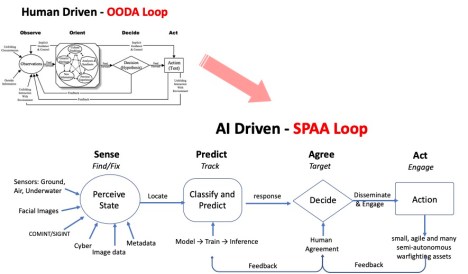
An example of this is DARPA’s ACE (Air Combat Evolution) program that is developing a warfighting concept for combined arms using a manned and unmanned systems. Humans will fight in close collaboration with autonomous weapon systems in complex environments with tactics informed by artificial intelligence.

A Once-in-a-Generation Event
Imagine it’s the 1980’s and you’re in charge of an intelligence agency. SIGINT and COMINT were analog and RF. You had worldwide collection systems with bespoke systems in space, air, underwater, etc. And you wake up to a world that shifts from copper to fiber. Most of your people, and equipment are going to be obsolete, and you need to learn how to capture those new bits. Almost every business processes needed to change, new organizations needed to be created, new skills were needed, and old ones were obsoleted. That’s what AI/ML is going to do to you and your agency.

The primary obstacle to innovation in national security is not technology, it is culture. The DoD and IC must overcome a host of institutional, bureaucratic, and policy challenges to adopting and integrating these new technologies. Many parts of our culture are resistant to change, reliant on traditional tradecraft and means of collection, and averse to risk-taking, (particularly acquiring and adopting new technologies and integrating outside information sources.)

History tells us that late adopters fall by the wayside as more agile and opportunistic governments master new technologies.

Carpe Diem.

Want more Detail?

Read on if you want to know about Machine Learning chips, see a sample Machine Learning Pipeline and learn about the four types of Machine Learning.


Artificial Intelligence/Machine Learning Semiconductors

Skip this section if all you need to know is that special chips are used for AI/ML.

AI/ML, semiconductors, and high-performance computing are intimately intertwined  – and progress in each is dependent on the others.  (See the “Semiconductor Ecosystem” report.)

Some machine learning models can have trillions of parameters and require a massive number of specialized AI chips to run. Edge computers are significantly less powerful than the massive compute power that’s located at data centers and the cloud. They need low power and specialized silicon.

Why Dedicated AI Chips and Chip Speed Matter
Dedicated chips for neutral nets (e.g. Nvidia GPUs, Xilinx FPUs, Google TPUs) are faster than conventional CPUs for three reasons: 1) they use parallelization, 2) they have larger memory bandwidth and 3) they have fast memory access.

There are three types of AI Chips:

  • Graphics Processing Units (GPUs) – Thousands of cores, parallel workloads, widespread use in machine learning
  • Field-Programmable Gate Arrays (FPGAs) – Good for algorithms; compression, video encoding, cryptocurrency,  genomics, search. Needs specialists to program
  • Application-Specific Integrated Circuits (ASICs) – custom chips e.g. Google TPU’s

Matrix multiplication plays a big part in neural network computations, especially if there are many layers and nodes. Graphics Processing Units (GPUs) contain 100s or 1,000s of cores that can do these multiplications simultaneously. And neural networks are inherently parallel which means that it’s easy to run a program across the cores and clusters of these processors. That makes AI chips 10s or even 1,000s of times faster and more efficient than classic CPUs for training and inference of AI algorithms. State-of-the-art AI chips are dramatically more cost-effective than state-of-the-art CPUs as a result of their greater efficiency for AI algorithms.

Cutting-edge AI systems require not only AI-specific chips, but state-of-the-art AI chips. Older AI chips incur huge energy consumption costs that quickly balloon to unaffordable levels. Using older AI chips today means overall costs and slowdowns at least an order of magnitude greater than for state-of- the-art AI chips.

Cost and speed make it virtually impossible to develop and deploy cutting-edge AI algorithms without state-of-the-art AI chips. Even with state-of-the-art AI chips, training a large AI algorithm can cost tens of millions of dollars and take weeks to complete. With general-purpose chips like CPUs or older AI chips, this training would take much longer and cost orders of magnitude more, making staying at the R&D frontier impossible. Similarly, performing inference using less advanced or less specialized chips could involve similar cost overruns and take orders of magnitude longer.

In addition to off-the-shelf AI chips from Nvidia, Xlinix and Intel, large companies like Facebook, Google, Amazon, have designed their own chips to accelerate AI. The opportunity is so large that there are hundreds of AI accelerator startups designing their own chips, funded by 10’s of billions of venture capital and private equity. None of these companies own a chip manufacturing plant (a fab) so they all use a foundry (an independent company that makes chips for others) like TSMC in Taiwan (or SMIC in China for for its defense related silicon.)

A Sample of AI GPU, FPGA and ASIC AI Chips and Where They’re Made

IP (Intellectual Property) Vendors Also Offer AI Accelerators
AI chip designers can buy AI IP Cores – prebuilt AI accelerators from Synopsys (EV7x,) Cadence (Tensilica AI,) Arm (Ethos,) Ceva (SensPro2, NeuPro), Imagination (Series4,) ThinkSilicon (Neox,) FlexLogic (eFPGA,) Edgecortix and others.

Other AI Hardware Architectures
Spiking Neural Networks (SNN) is a completely different approach from Deep Neural Nets. A form of Neuromorphic computing it tries to emulate how a brain works. SNN neurons use simple counters and adders—no matrix multiply hardware is needed and power consumption is much lower. SNNs are good at unsupervised learning – e.g. detecting patterns in unlabeled data streams. Combined with their low power they’re a good fit for sensors at the edge. Examples: BrainChip, GrAI Matter, Innatera, Intel.

Analog Machine Learning AI chips use analog circuits to do the matrix multiplication in memory. The result is extremely low power AI for always-on sensors. Examples: Mythic (AMP,) Aspinity (AML100,) Tetramem.

Optical (Photonics) AI Computation promise performance gains over standard digital silicon, and some are nearing production. They use intersecting coherent light beams rather than switching transistors to perform matrix multiplies. Computation happens in picoseconds and requires only power for the laser. (Though off-chip digital transitions still limit power savings.) Examples: Lightmatter, Lightelligence, Luminous, Lighton.

AI Hardware for the Edge
As more AI moves to the edge, the Edge AI accelerator market is segmenting into high-end chips for camera-based systems and low-power chips for simple sensors. For example:

AI Chips in Autonomous vehicles, Augmented Reality and multicamera surveillance systems These inference engines require high performance. Examples: Nvidia (Orin,) AMD (Versal,) Qualcomm (Cloud AI 100,) and acquired Arriver for automotive software.

AI Chips in Cameras for facial recognition, surveillance. These inference chips require a balance of processing power with low power. Putting an AI chip in each camera reduces latency and bandwidth. Examples: Hailo-8, Ambarella CV5S,  Quadric (Q16), (RealTek 3916N).

Ultralow-Power AI Chips Target IoT Sensors – IoT devices require very simple neural networks and can run for years on a single battery. Example applications: Presence detection, wakeword detection, gunshot detection… Examples: Syntiant (NDP,) Innatera, BrainChip

Running on the edge devices are deep learning models such as OmniMLFoghorn, specifically designed for edge accelerators.

AI/ML Hardware Benchmarks
While there are lots of claims about how much faster each of these chips are for AI/ML there are now a set of standard benchmarks –  MLCommons. These benchmarks were created by Google, Baidu, Stanford, Harvard and U.C. Berkeley.

One Last Thing – Non-Nvidia AI Chips and the “Nvidia Software Moat”
New AI accelerator chips have to cross the software moat that Nvidia has built around their GPU’s. As popular AI applications and frameworks are built on Nvidia CUDA software platform,  if new AI Accelerator vendors want to port these applications to their chips they have to build their own drivers, compiler, debugger, and other tools.

Details of a machine learning pipeline

This is a sample of the workflow (a pipeline) data scientists use to develop, deploy and maintain a machine learning model (see the detailed description here.)

The Types of Machine Learning

skip this section if you want to believe it’s magic.

Machine Learning algorithms fall into four classes:

  1. Supervised Learning
  2. Unsupervised Learning
  3. Semi-supervised Learning
  4. Reinforcement Learning

They differ based on:

  • What types of data their algorithms can work with
  • For supervised and unsupervised learning, whether or not the training data is labeled or unlabeled
  • How the system receives its data inputs

Supervised Learning

  • A “supervisor” (a human or a software system) accurately labels each of the training data inputs with its correct associated output
  • Note that pre-labeled data is only required for the training data that the algorithm uses to train the AI mode
  • In operation in the inference phase the AI will be generating its own labels, the accuracy of which will depend on the AI’s training
  • Supervised Learning can achieve extremely high performance, but they require very large, labeled datasets
  • Using labeled inputs and outputs, the model can measure its accuracy and learn over time
  • For images a rule of thumb is that the algorithm needs at least 5,000 labeled examples of each category in order to produce an AI model with decent performance
  • In supervised learning, the algorithm “learns” from the training dataset by iteratively making predictions on the data and adjusting for the correct answer.
  • While supervised learning models tend to be more accurate than unsupervised learning models, they require upfront human intervention to label the data appropriately.

Supervised Machine Learning – Categories and Examples:

  • Classification problems – use an algorithm to assign data into specific categories, such as separating apples from oranges. Or classify spam in a separate folder from your inbox. Linear classifiers, support vector machines, decision trees and random forest are all common types of classification algorithms.
  • Regression– understands the relationship between dependent and independent variables. Helpful for predicting numerical values based on different data points, such as sales revenue projections for a given business. Some popular regression algorithms are linear regression, logistic regression and polynomial regression.
  • Example algorithms include: Logistic Regression and Back Propagation Neural Networks

Unsupervised Learning

  • These algorithms can analyze and cluster unlabeled data sets. They discover hidden patterns in data without the need for human intervention (hence, they are “unsupervised”)
  • They can extract features from the data without a label for the results
  • For an image classifier, an unsupervised algorithm would not identify the image as a “cat” or a “dog.” Instead, it would sort the training dataset into various groups based on their similarity
  • Unsupervised Learning systems are often less predictable, but as unlabeled data is usually more available than labeled data, they are important
  • Unsupervised algorithms are useful when developers want to understand their own datasets and see what properties might be useful in either developing automation or change operational practices and policies
  • They still require some human intervention for validating the output 

Unsupervised Machine Learning – Categories and Examples

  • Clustering groups unlabeled data based on their similarities or differences. For example, K-means clustering algorithms assign similar data points into groups, where the K value represents the size of the grouping and granularity. This technique is helpful for market segmentation, image compression, etc.
  • Association finds relationships between variables in a given dataset. These methods are frequently used for market basket analysis and recommendation engines, along the lines of “Customers Who Bought This Item Also Bought” recommendations.
  • Dimensionality reduction is used when the number of features  (or dimensions) in a given dataset is too high. It reduces the number of data inputs to a manageable size while also preserving the data integrity. Often, this technique is used in the preprocessing data stage, such as when autoencoders remove noise from visual data to improve picture quality.
  • Example algorithms include: Apriori algorithm and K-Means

Difference between supervised and unsupervised learning

The main difference: Labeled data

  • Goals: In supervised learning, the goal is to predict outcomes for new data. You know up front the type of results to expect. With an unsupervised learning algorithm, the goal is to get insights from large volumes of new data. The machine learning itself determines what is different or interesting from the dataset.
  • Applications: Supervised learning models are ideal for spam detection, sentiment analysis, weather forecasting and pricing predictions, among other things. In contrast, unsupervised learning is a great fit for anomaly detection, recommendation engines, customer personas and medical imaging.
  • ComplexitySupervised learning is a simple method for machine learning, typically calculated through the use of programs like R or Python. In unsupervised learning, you need powerful tools for working with large amounts of unclassified data. Unsupervised learning models are computationally complex because they need a large training set to produce intended outcomes.
  • Drawbacks: Supervised learning models can be time-consuming to train, and the labels for input and output variables require expertise. Meanwhile, unsupervised learning methods can have wildly inaccurate results unless you have human intervention to validate the output variables.

Semi-Supervised Learning

  • “Semi- Supervised” algorithms combine techniques from Supervised and Unsupervised algorithms for applications with a small set of labeled data and a large set of unlabeled data.
  • In practice, using them leads to exactly what you would expect, a mix of some of both of the strengths and weaknesses of Supervised and Unsupervised approaches
  • Typical algorithms are extensions to other flexible methods that make assumptions about how to model the unlabeled data. An example is Generative Adversarial Networks trained on photographs can generate new photographs that look authentic to human observers (deep fakes)

Reinforcement Learning

  • Training data is collected by an autonomous, self-directed AI agent as it perceives its environment and performs goal-directed actions
  • The rewards are input data received by the AI agent when certain criteria are satisfied.
  • These criteria are typically unknown to the agent at the start of training
  • Rewards often contain only partial information. They don’t signal which inputs were good or not
  • The system is learning to take actions to maximize its receipt of cumulative rewards
  • Reinforcement AI can defeat humans– in chess, Go…
  • There are no labeled datasets for every possible move
  • There is no assessment of whether it was a “good or bad move
  • Instead, partial labels reveal the final outcome “win” or “lose”
  • The algorithms explore the space of possible actions to learn the optimal set of rules for determining the best action that maximize wins

Reinforcement Machine Learning – Categories and Examples

  • Algorithm examples include: DQN (Deep Q Network), DDPG (Deep Deterministic Policy Gradient), A3C (Asynchronous Advantage Actor-Critic Algorithm), NAF (Q-Learning with Normalized Advantage Functions), …
  • AlphaGo, a Reinforcement system played 4.9 million games of Go in 3 days against itself to learn how to play the game at a world-champion level
  • Reinforcement is challenging to use in the real world, as the real world is not as heavily bounded as video games and time cannot be sped up in the real world
  • There are consequences to failure in the real world

(download a PDF of this article here)

Sources:


Lessons for the DoD – From Ukraine and China

 Portions of this post previously appeared in War On the Rocks.


Looking at a satellite image of Ukraine online I realized it was from Capella Space – one of our Hacking for Defense student teams who now has 7 satellites in orbit.

National Security is Now Dependent on Commercial Technology
They’re not the only startup in this fight. An entire wave of new startups and scaleups are providing satellite imagery and analysis, satellite communications, and unmanned aerial vehicles supporting the struggle.

For decades, satellites that took detailed pictures of Earth were only available to governments and the high-resolution images were classified. Today, commercial companies have their own satellites providing unclassified imagery. The government buys and distributes commercial images from startups to supplement their own and shares them with Ukraine as part of a broader intelligence-sharing arrangement that the head of Defense Intelligence Agency described as “revolutionary.” By the end of the decade, there will be 1000 commercial satellites for every U.S. government satellite in orbit.

At the onset of the war in Ukraine, Russia launched a cyber-attack on Viasat’s KA-SAT satellite, which supplies Internet across Europe, including to Ukraine. In response, to a (tweeted) request from Ukraine’s vice prime minister, Elon Musk’s Starlink satellite company shipped thousands of their satellite dishes and got Ukraine back on the Internet. Other startups are providing portable cell towers – “backpackable” and fixed.  When these connect via satellite link, they can provide phone service and WIFI capability. Another startup is providing a resilient, mesh local area network for secure tactical communications supporting ground units.

Drone technology was initially only available to national governments and militaries but is now democratized to low price points and available as internet purchases. In Ukraine, drones from startups are being used as automated delivery vehicles for resupply, and for tactical reconnaissance to discover where threats are. When combined with commercial satellite imagery, this enables pinpoint accuracy to deliver maximum kinetic impact in stopping opposing forces.

Equipment from large military contractors and other countries is also part of the effort. However, the equipment listed above is available commercially off-the-shelf, at dramatically cheaper prices than what’s offered by the large existing defense contractors, and developed and delivered in a fraction of the time. The Ukraine conflict is demonstrating the changing character of war such that low-cost emerging commercial technology is extremely effective when deployed against a larger 20th-century industrialized force that Russia is fielding.

While we should celebrate the organizations that have created and fielded these systems, the battle for the Ukraine illustrates much larger issues in the Department of Defense.

For the first time ever our national security is inexorably intertwined with commercial technology (drones, AI, machine learning, autonomy, biotech, cyber, semiconductors, quantum, high-performance computing, commercial access to space, et al.) And as we’re seeing on the Ukrainian battlefield they are changing the balance of power.

The DoD’s traditional suppliers of defense tools, technologies, and weapons – the prime contractors and federal labs – are no longer the leaders in these next-generation technologies – drones, AI, machine learning, semiconductors, quantum, autonomy, biotech, cyber, quantum, high performance computing, et al. They know this and know that weapons that can be built at a fraction of the cost and upgraded via software will destroy their existing business models.

Venture capital and startups have spent 50 years institutionalizing the rapid delivery of disruptive innovation. In the U.S., private investors spent $300 billion last year to fund new ventures that can move with the speed and urgency that the DoD now requires. Meanwhile China has been engaged in a Civil/Military Fusion program since 2015 to harness these disruptive commercial technologies for its national security needs.

China – Civil/Military Fusion
Every year the Secretary of Defense has to issue a formal report to Congress: Military and Security Developments Involving the People’s Republic of China. Six pages of this year’s report describe how China is combining its military-civilian sectors as a national effort for the PRC to develop a “world-class” military and become a world leader in science and technology. A key part of Beijing’s strategy includes developing and acquiring advanced dual-use technology. It’s worth thinking about what this means – China is not just using its traditional military contractors to build its defense ecosystem; they’re mobilizing their entire economy – commercial plus military suppliers. And we’re not.

DoD’s Civil/Military Orphan-Child – the Defense Innovation Unit
In 2015, before China started its Civil/Military effort, then-Secretary of Defense Ash Carter, saw the need for the DoD to understand, embrace and acquire commercial technology. To do so he started the Defense Innovation Unit (DIU). With offices in Silicon Valley, Austin, Boston, Chicago and Washington, DC, this is the one DoD organization with the staffing and mandate to match commercial startups or scaleups to pressing national security problems. DIU bridges the divide between DOD requirements and the commercial technology needed to address them with speed and urgency. It accelerates the connection of commercial technology to the military. Just as importantly, DIU helps the Department of Defense learn how to innovate at the same speed as tech-driven companies.

Many of the startups providing Ukraine satellite imagery and analysis, satellite communications, and unmanned aerial vehicles were found by the Defense Innovation Unit (DIU). Given that DIU is the Department of Defense’s most successful organization in developing and acquiring advanced dual-use technology, one would expect the department to scale the Defense Innovation Unit by a factor of ten. (Two years ago, the House Armed Services Committee in its Future of Defense Task Force report recommended exactly that—a 10X increase in budget.) The threats are too imminent and stakes too high not to do so.

So what happened?

Congress cut their budget by 20%.

And their well-regarded director just resigned in frustration because the Department is not resourcing DIU nor moving fast enough or broadly enough in adopting commercial technology.

Why? The Defense Ecosystem is at a turning point. Defense innovation threatens entrenched interests. Given that the Pentagon budget is essentially fixed, creating new vendors and new national champions of the next generation of defense technologies becomes a zero-sum game.

The Defense Innovation Unit (DIU) had no advocates in its chain of command willing to go to bat for it, let alone scale it.

The Department of Defense has world-class people and organization for a world that no longer exists
The Pentagon’s relationship with startups and commercial companies, already an arms-length one, is hindered by a profound lack of understanding about how the commercial innovation ecosystem works and its failure of imagination about what venture and private equity funded innovation could offer. In the last few years new venture capital and private equity firms have raised money to invest in dual-use startups. New startups focused on national security have sprung up and they and their investors have been banging on the closed doors of the defense department.

If we want to keep pace with our adversaries, we need to stop acting like we can compete with one hand tied behind our back. We need a radical reinvention of our civil/military innovation relationship. This would use Department of Defense funding, private capital, dual-use startups, existing prime contractors and federal labs in a new configuration that could look like this:


Create a new defense ecosystem encompassing startups, and mid-sized companies at the bleeding edge, prime contractors as integrators of advanced technology, federally funded R&D centers refocused on areas not covered by commercial tech (nuclear and hypersonics). Make it permanent by creating an innovation doctrine/policy.

Reorganize DoD Research and Engineering to allocate its budget and resources equally between traditional sources of innovation and new commercial sources of innovation.

  • Scale new entrants to the defense industrial base in dual-use commercial tech – AI/ML, Quantum, Space, drones, autonomy, biotech, underwater vehicles, shipyards, etc. that are not the traditional vendors. Do this by picking winners. Don’t give out door prizes. Contracts should be >$100M so high-quality venture-funded companies will play. And issue debt/loans to startups.

Reorganize DoD Acquisition and Sustainment to create and buy from new 21st century arsenals – new shipyards, drone manufacturers, etc. that can make 1,000’s of extremely low cost, attritable systems – “the small, the agile and the many.”

  • Acquire at Speed. Today, the average Department of Defense major acquisition program takes anywhere from nine to 26 years to get a weapon in the hands of a warfighter. DoD needs a requirements, budgeting and acquisition process that operates at commercial speed (18 months or less) which is 10x faster than DoD procurement cycles. Instead of writing requirements, the department should rapidly assess solutions and engage warfighters in assessing and prototyping commercial solutions. We’ll know we’ve built the right ecosystem when a significant number of major defense acquisition programs are from new entrants.

  • Acquire with a commercially oriented process. Congress has already granted the Department of Defense “Other Transaction Authority” (OTA) as a way to streamline acquisitions so they do not need to use Federal Acquisition Regulations (FAR). DIU has created a “Commercial Solutions Opening” to mirror a commercial procurement process that leverages OTA. DoD could be applying Commercial Solutions Openings on a much faster and broader scale.

Integrate and create incentives for the Venture Capital/Private Equity ecosystem to invest at scale. The most important incentive would be for DoD to provide significant contracts for new entrants. (One new entrant which DIU introduced, Anduril, just received a follow-on contract for $1 billion. This should be one of many such contracts and not an isolated example.) More examples could include: matching dollars for national security investments (similar to the SBIR program but for investors), public/private partnership investment funds, incentivize venture capital funds with no-carry loans (debt funding) to, or tax holidays and incentives – to get $10’s of billions of private investment dollars in technology areas of national interest.

Buy where we can; build where we must. Congress mandated that the Department of Defense should use commercial off-the-shelf technology wherever possible, but the department fails to do this (see industry letter to the Department of Defense).

Coordinate with Allies. Expand the National Security Innovation Base (NSIB) to an Allied Security Innovation Base. Source commercial technology from allies.

This is a politically impossible problem for the Defense Department to solve alone. Changes at this scale will require Congressional and executive office action. Hard to imagine in the polarized political environment. But not impossible.

Put Different People in Charge and reorganize around this new ecosystem. The threats, speed of change, and technologies the United States faces in this century require radically different mindsets and approaches than those it faced in the 20th century. Today’s leaders in the DoD, executive branch and Congress haven’t fully grasped the size, scale, and opportunity of the commercial innovation ecosystem or how to build innovation processes to move with the speed and urgency to match the pace China has set.


Change is hard – on the people and organizations inside the DoD who’ve spent years operating with one mindset to be asked to pivot to a new one.

But America’s adversaries have exploited the boundaries and borders between its defense and commercial and economic interests. Current approaches to innovation across the government — both in the past and under the current administration —  are piecemeal, incremental, increasingly less relevant, and insufficient.

These are not problems of technology. It takes imagination, vision and the willingness to confront the status quo. So far, all are currently lacking.

Russia’s Black Sea flagship Moskva on the bottom of the ocean and the thousands of its destroyed tanks illustrate the consequences of a defense ecosystem living in the past. We need transformation not half-measures. The U.S. Department of Defense needs to change.

Historically, major defense reforms have come from inside the DoD, at other times Congress (National Security Act of 1947, Goldwater-Nichols Act of 1986) and others from the President (Roosevelt’s creation of the Joint Chiefs in 1942, Eisenhower and the Department of Defense Reorganization Act of 1958.)

It may be that the changes needed are so broad that the DoD can’t make them and Congress needs to act. If so, it’s their time to step up.

Carpe diem. Seize the day.

Here’s What Happened When Deputy Secretary of Defense Dr. Kathleen Hicks visited Stanford’s Gordian Knot Center for National Security Innovation

It was an honor to host US Deputy Secretary of Defense Dr. Kathleen Hicks at Stanford’s Gordian Knot Center for National Security Innovation.  (Think of the Deputy Secretary of Defense as the Chief Operating Officer of a company – but in this case the company has 3 million employees (~1.4 million active duty, 750,000 civilians, ~800,000 in the National Guard and Reserves.)

She came to the Gordian Knot Center to discuss our unique approach to national security and innovation, and how our curriculum trains the next generation of innovators. The Deputy also heard from us how the Department can better partner with and leverage the U.S. innovation ecosystem to solve national security challenges.

Our goal for the Secretary’s visit was to give her a snapshot of how we’re supporting the Department of Defense priority of building an innovation workforce. We emphasized the critical distinction between a technical STEM-trained workforce (which we need) and an innovation workforce which we lack at scale.

Innovation incorporates lean methodologies (customer discovery, problem understanding, MVPs, Pivots), coupled with speed and urgency, and a culture where failure equals rapid learning. All of these are accomplished with minimal resources to deploy at scale products/services that are needed and wanted. We pointed out that Silicon Valley and Stanford have done this for 50 years. And China is outpacing us by adopting the very innovation methods we invented, integrating commercial technology with academic research, and delivering it to the Peoples Liberation Army.

Therein lies the focus of our Gordian Knot Center —connect STEM with policy education and leverage the synergies between the two to develop innovative leaders who understand technology and policy and can solve problems and deliver solutions at speed and scale.

 What We Presented
A key component of the Gordian Knot Center’s mission is to prepare and inspire future leaders to contribute meaningfully as part of the innovation work force. We combine the unique strengths of Stanford and its location in Silicon Valley to solve problems across the spectrum of activities that create and sustain national power. The range of resources and capabilities we bring to the fight from the center’s unique position include:

  • The insights and expertise of Stanford international and national security policy leaders
  • The technology insights and expertise of Stanford Engineering
  • Exceptional students willing to help the country win the Great Power Competition
  • Silicon Valley’s deep commercial technology ecosystem
  • Our experience in rapid problem understanding, rapid iteration and deployment of solutions with speed and urgency
  • Access to risk capital at scale

In the six months since we founded the Gordian Knot Center we have focused on six initiatives we wanted to share with Secretary Hicks. Rather than Joe Felter and I doing all of the talking, 25 of our students, scholars, mentors and alumni joined us to give the Secretary a 3-5 minute precis of their work, spanning across all six of the Gordian Knot initiatives.  Highlights of these presentations include:

  1. Hacking for Defense Teams – Vannevar Labs, FLIP, Disinformatix
  2. CONOPS Development
  3. National Security Education Technology, Innovation and Great Power Competition
  4. Defense Innovation Scholars Program – 25 students now, 50 by the end of the year
  5. Policy Impact and Outreach –ONR Hedge Strategy, NSC Quad Emerging Technology Track 1.5 Conference
  6. Internships and Professional Workforce Development – Innovation Workforce Vignettes

If you can’t see the slides click here

Throughout the over 90 minutes session, Dr. Hicks posed insightful questions for the students and told our gathering that one of her key priorities is to accelerate innovation adoption across DoD, including organizational structure, processes, culture, and people.

It was encouraging to hear the words.

However, from where we sit..

  1. Our national security is now inexorably intertwined with commercial technology and is hindered by our lack of an integrated strategy at the highest level.
  2. Our adversaries have exploited the boundaries and borders between our defense and commercial and economic interests.
  3. Our current approaches – both in the past and current administration – to innovation across the government are piecemeal, incremental, increasingly less relevant and insufficient.

Listening to the secretary’s conversations, I was further reminded of how much of a radical reinvention of our civil/military innovation relationship is necessary if we want to keep abreast of our adversaries. This would use DoD funding, private capital, dual-use startups, existing prime contractors and federal labs  in a new configuration. It would:

Create a new defense ecosystem encompassing startups, scaleups at the bleeding edge, prime contractors as integrators of advanced technology, federally funded R&D centers refocused on areas not covered by commercial tech (nuclear, hypersonics,…). Make it permanent by creating innovation doctrine/policy.

Create new national champions in dual-use commercial tech – AI/ML, Quantum, Space, drones, high performance computing, next gen networking, autonomy, biotech, underwater vehicles, shipyards, etc. who are not the traditional vendorsDo this by picking winners. Don’t give out door prizes. Contracts should be >$100M so high- quality venture-funded companies will play.  Until we have new vendors on the Major Defense Acquisition Program list, all we have in the DoD is innovation theater – not innovation.

Acquire at Speed. Today, the average DoD major acquisition program takes 9-26 years to get a weapon in the hands of a warfighter. We need a requirements, budgeting and acquisition process that operates at commercial speed (18 months or less) which is 10x faster than DoD procurement cycles. Instead of writing requirements, DoD should rapidly assess solutions and engage warfighters in assessing and prototyping commercial solutions.

Integrate and incent the Venture Capital/Private Equity ecosystem to invest at scale. Ask funders what it would take to invest at scale – e.g. create massive tax holidays and incentives to get investment dollars in technology areas of national interest.

Recruit and develop leaders across the Defense Department prepared to meet contempory threats and reorganize around this new innovation ecosystem. The DoD has world-class people and organization for a world that in many ways no longer exists. The threats, speed of change and technologies we face in this century will require radically different mindsets and approaches than those we faced in the 20th century. Today’s senior DoD leaders must think and act differently than their predecessors of a decade ago. Leaders at every level must now understand the commercial ecosystem and how to move with the speed and urgency that China is setting.

It was clear that Deputy Secretary Hicks understands the need for most of if not all these and more. Unfortunately, given the DoD budget is essentially fixed, creating new Primes and new national champions of the next generation of defense technologies becomes a zero-sum game. It’s a politically impossible problem for the Defense Department to solve alone. Changes at this scale will require Congressional action. Hard to imagine in the polarized political environment. But not impossible.

These are our challenges for not just the Gordian Knot Center for National Security Innovation but for our nation. We’ve taken them on, in the words of President John F. Kennedy,  “not because they are easy, but because they are hard. because that goal will serve to organize and measure the best of our energies and skills, because that challenge is one that we are willing to accept, one we are unwilling to postpone, and one which we intend to win.”