You Negotiate Commodities, But You Seize Opportunities

It took losing something important to understand the difference between a commodity and an opportunity. Along the way I also learned yet another way entrepreneurs see the world differently from their investors.

Advisory Board
In the early days of Rocket Science I realized that we needed high-level advice on multiple fronts; technology, game development, video game distribution, etc. At one of our initial board meetings we had agreed on the general principle of an advisory board and put together an overall stock budget to compensate advisors.

One of the first potential advisors I reached out to was someone who 10 years earlier tried to hire me as the VP of Marketing of his new division at Sun Microsystems. For lots of reasons that never worked out, but I liked him so much that the following year I tried to hire him as the VP of Engineering of Ardent. (He was having too much fun at Sun and turned me down.)

Now a decade later, we caught up over lunch and I found that he was in the middle of taking a new job inside his company and had some time on his hands. Chatting with him just reinforced my earlier opinion that he was an extraordinary combination of sheer technical talent, great business and common sense and a level-headed decision maker. I knew he would bring immense value to me and the company.

Over the next week we exchanged emails over advisory board stock. I made him an offer and he countered with one I thought was still reasonable (but I didn’t tell him that.) The timing was perfect, my board meeting was in two days. I could get him the stock he asked for approved at my board meeting and then reply.

Death by Spreadsheet
I was so excited to break the news to the board that I put this new advisor on as the first agenda item. Even back then the advisor was a well-known name in Silicon Valley. The conversation went great and everyone agreed he’d teach us a lot – until one of the board members asked, “How much stock do we have to give him?”  I threw out the number of shares I had offered and he had requested, naively thinking everyone would see what a no-brainer this was. Instead what I got was, “Wait a minute. He’s asking for one-third of our advisory board stock budget. We had agreed we were going to get 5 to 6 advisors with that amount of stock.” At first I wasn’t sure I was hearing this correctly. The advisor was a world-class guy, in my judgment he was worth more than all the other advisors I was going to get.

Then the other VC’s piled on. “You need to live on the budget we gave you. Go back to him and offer him less stock.”

As a first-time CEO getting beaten up my board I thought this wasn’t a fight worth having. (I couldn’t have been more wrong.) So I agreed to go back to my potential advisor and tell him the best I could do was my first offer.

I was about to get a few lessons that have lasted for a long time.

Thanks But No Thanks
Putting my best marketing spin on it, I sent our potential advisor a message that essentially said, “I’m not sure I can meet your request, but here’s another offer.” I dressed it up as best as I could, making some of the other terms more palatable, but it still wasn’t what he asked for.

I guess I shouldn’t have been surprised when he sent me a very polite note back that said, “Thanks but no thanks. I’m now getting more involved in my new job as CTO and I’m too busy to go back and forth negotiating this.”  But I was crushed. I knew my company had just lost something important. Something that I couldn’t just go out and replace. And I realized I screwed up in at least two major ways.

You Negotiate Commodities, But You Seize Opportunities
I hadn’t just lost a potential advisor I had lost an irreplaceable opportunity. We lost him not just over a stock offer. We lost him because we had treated him as a commodity – something that was readily available from multiple sources – and that you could negotiate its price.

In reality what I had in front of me was an opportunity – a favorable combination of circumstances that rarely occurs and if seized upon would have given me an advantage.

You treat commodities and opportunities radically differently.

Founding CEO’s are supposed to search for a repeatable business model, not just blindly execute their original plan. That requires you to identify opportunities and seize the day. Opportunities are not just about sales, marketing or product. In this case it was about a resource I had in my hands and let go of.

I had acted like an employee, not as a founder and certainly not as the CEO of a startup. I had let my board tell me that the opportunity I saw was a commodity that could be managed by a spreadsheet. And I didn’t stand up for what I had believed in.

It would never happen again.

Lessons Learned

  • Great entrepreneurs see opportunities before others do.
  • Ask, “Is it a commodity or an opportunity?”
  • If it’s a one-of-a-kind that give you an advantage, it’s an opportunity.
  • Grab opportunities with both hands and don’t let go.
  • It’s better to beg for forgiveness than ask for permission.
  • Carpe Diem

Listen to this post here: Download the PodCast here

Boys Rules, Girls Lose – Women at Work

My two daughters are now in college and have put their toes in the working-world with summer jobs. As they’ve grown older, they’ve heard their parent’s advice about women in the workforce.

This post is not advice nor is it a recommendation of what you should do. It’s simply my interpretation of what I observed watching my daughters grow up. Our circumstances were unique, times have changed, and your conclusions and opinions will most certainly differ.

Gender Differences
Growing up in the 60’s and 70’s when women were struggling against inequality in jobs, pay, etc., my wife and I came into parenthood with an unconscious bias that gender differences were mostly cultural. So how we raised our kids was an unintended science experiment.

When our two girls were toddlers, my wife started dressing them in overalls, and consciously bought them trucks and “boy toys” to play with along with dolls. We were both surprised and bemused to see them ignore the trucks and cars and prefer to play house. A bit later, our biggest eye-opener was when our younger daughter started asking for the “pretty pink dresses” instead of the overalls. (Given they didn’t watch TV, we ruled that out as a major role in their choices.) We started to believe that perhaps there was some hard-wiring about gender.

Boys With Sticks
As our kids reached grade school, the next lesson was watching them at play. I remember hiking with my girls and two 8-year old boys. When we stopped for lunch, the boys found sticks and immediately began a sword fight. When they tired of that, the boys chased each other and wrestled until they were exhausted. The girls, finding their pile of sticks, began building something together and telling each other stories. The suggestion of “why don’t you guys try each others games?” was met with utter 8-year old disdain. I realized I was looking at something – competition versus collaboration – that also seemed hard-wired. (Competition versus collaboration is my shorthand for a much longer set of gender-linked behaviors.)

Boys Rules, Girls Lose
When I entered the business world, I quickly found that office politics was just an older version of boys with sticks. The testosterone level was higher, and the game was more like musical-chairs with winners and losers until there was a single person on top. As a guy I didn’t need a rulebook to understand the game; there was a hierarchy, it was competitive, I win you lose.

It took me awhile but I realized that implicitly that advancement in corporations was unconsciously constructed around how men interact with each other. And unless they consciously work at it, most companies are not set up for collaboration.

As I grew older I realized that women in the workplace around me were having a harder time than the guys. They’d all come from college equally ambitious, but only after a few years, something different was happening to their careers.

Over time, I observed women who succeeded in the business world (as defined by their interest in moving up the hierarchy) headed in one of four career directions:

  1. They chose departments within corporations where collaboration was an asset like Public Relations, HR, customer service, etc.
  2. They set up their own companies to provide services and ran their own companies collaboratively.
  3. They opted out of the workplace and raised a family, returning later.
  4. They figured out the “boys rules” and followed them (having to work harder and smarter to prove that they were.)

Understand There Are Rules – And They’re Not Yours
When my girls started to play soccer, I used to remind them, “Make sure the people on the field aren’t carrying sticks because if they’re playing field hockey while you’re playing soccer, you’re going to get hurt.” As they got older, they understood I wasn’t only talking about sports but that I was trying to teach them how to figure out the rules of any game they were about to play.  And that included the workplace.

My advice to our daughters about women in the workplace has been pretty simple:

  • The language of business is about winners and losers. Bosses who read Sun Tzu’s “The Art of War” as a guide to business strategy or “Leadership Secrets of Attila the Hun” are unlikely to create a culture of collaboration.
  • There are implicit rules of competition and collaboration in companies.  It’s not that anyone is hiding a secret rulebook; it’s just that no one has articulated the rules.
  • In most companies men set these rules. Again, nothing secret here, but men don’t realize that they behave and think differently. They don’t have to explain the rules to other men so it never occurs to them to explain the rules to women.
  • As women, they will be expected to perform to boys rules as defined in their workplace: This means they need to spend the time understanding what the rules are in their company and industry. If they don’t, they will find others less competent but more adept at playing the game getting promoted instead of them.
  • Women can be equally competitive if they desire. It’s not a question of competency. Or a skill only boys have. If they want to succeed by competing they can. They just have to learn the rules and practice them.
  • Find mentors then become one. In every organization or industry there’s someone who’s figured out the rules. Seek them out and know what they know. By the time you do, it’s your turn to mentor someone else.
  • Collaboration can make you a stronger competitor. The irony is that organizations which collaborate are more effective competitors. When they reach a position of authority, use their instincts to build a fearsome organization/company.
  • If they prefer to collaborate and don’t want to play by boy’s rules, they need to understand what their career choices are. There are plenty of other ways to be a productive member of society other than a position on a corporate org chart.
  • Understanding the rules and career options doesn’t mean the rules are right or they have to accept them as the only career choices.  They can make change happen if they so desire. But they need to understand the personal costs of doing so.
  • Some find the idea of gender differences uncomfortable. Having fought to have men and women be treated equally, discovering that there may be gender specific hard-wiring for behavior sets up cognitive dissonance. Some simply won’t accept that there are workplace gender differences.
  • I may be wrong. Perhaps I misunderstood what I’ve seen or that time has changed the workplace significantly. Take this advice as a working hypothesis and see if it matches your experience.

Time will tell whether we gave our daughters good advice.

Listen to the post here: Download the Podcast here

Entrepreneurial Finishing School – Should I Get an MBA?

I usually hear the “Should I get my MBA?” question at least once a month.

If you’re an entrepreneur, the glib answer is “no.”  It’s also the wrong answer.

Should I Get My MBA?
Last week I was having coffee with an ex engineering student of mine now on his second startup (and for a change it wasn’t a Web 2.0 startup) who wanted to chat about career choices.  “I’m thinking of going back to school to get my MBA.”  It was said less as a clear declaration than a question. It was six years since he had left school and three and a half years ago he had joined an 8-person startup as a product manager. The company was now 4-years old and 70+ people, profitable and growing fast.

I didn’t say anything as he continued, “I’m now director of product management, but I think I’m missing stuff I ought to know; finance, marketing, and operations management. We’re starting to hire senior execs as VP’s and all the jobs specs have “MBA” as a requirement.  What should I do?’

The easy answer would have been, “Yes, go back and get an MBA. You fit the perfect profile; you have an engineering background, work experience in two startups and you’ll be limited in your career growth without one.”  But the answer I gave him was a bit different.

Where Do You Fit?
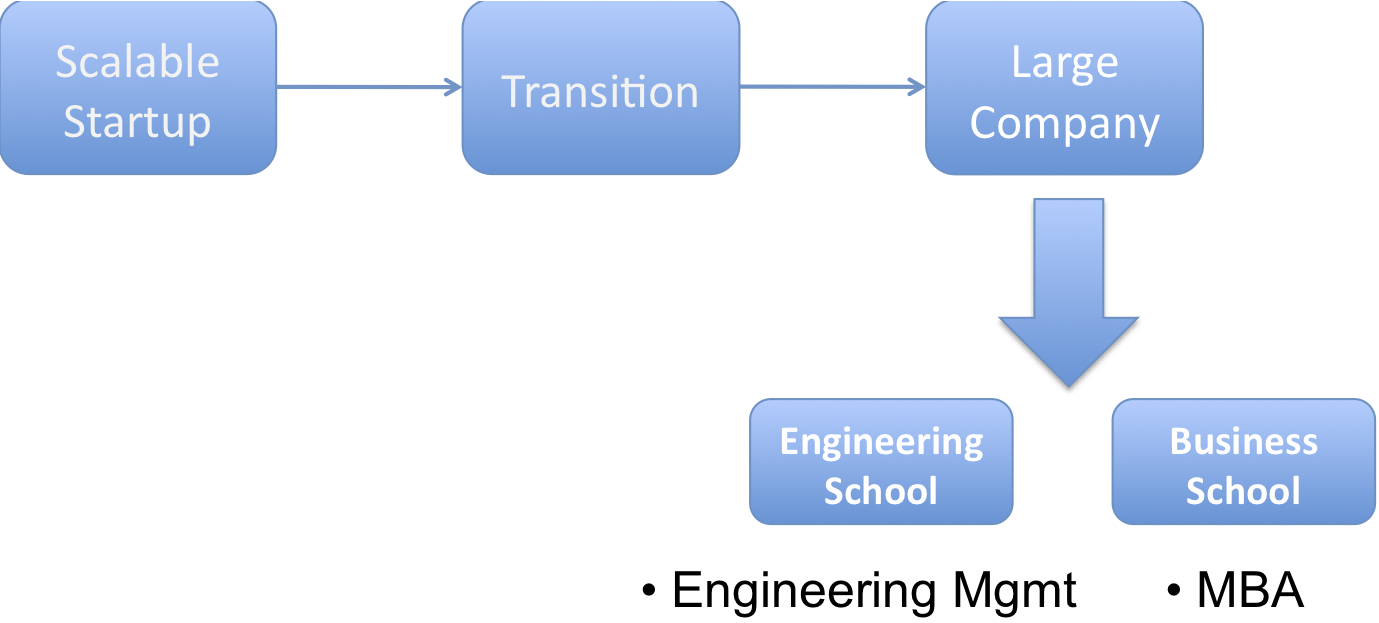
In between the coffee and breakfast I drew this diagram:

I explained that as startups grow, they go from the box on the left to the box on the right and the skills people need at each step of a company’s growth evolve and change. The skills required when they were an 8-person startup trying to “search for the business model” wasn’t the same set of skills needed now that they were  a 70-person company “executing the business model.”  I offered that it sounded to me as if his company was going through the transition (the box in the middle) where it was starting to put in place the processes needed to build and execute the business model.

Who Are You?
I suggested that perhaps his first question shouldn’t be whether he needed an MBA. Rather the question he should be thinking of was: in which part of a company’s lifecycle did he think he wanted to spend the rest of his career?  Did he enjoy the early chaotic stage of the startup?  Was he fondly telling stories of how much better it was when the company was smaller? After the rocketship ride of this successful startup, did he now want to be a founder of his own startup?

Or was he more comfortable now that there was more structure, repeatability and he was managing a staff? Was his goal to be a large company executive managing large groups of people?  And if a larger company was his destination, did he want to manage complex technology projects or did he see himself in more general management in sales, marketing or finance?

His vision about the trajectory of his career would answer what type of education he should get – and where he might get it.

MBA or Engineering Management?
I pointed out that if he wanted to work in a larger company he actually had two choices – go to business school for an MBA degree or go back to a graduate school of engineering for a Engineering Management degree.  (I find a disconcerting number of my MBA students with engineering backgrounds realized too late that they ought to have been in an engineering management program. They had picked the MBA route because it was trendy or they hadn’t thought through that managing engineering projects was what really excited them.)

Why Yes I Am an Entrepreneur
I could see I was having an effect when he blurted out, “You know my happiest times in these startups were when we were a small team figuring out the business model. The chaos and camaraderie gave me an adrenalin rush and incredible satisfaction. While I’m really good at managing the process, this phase of the company feels like a job. I’ve been bouncing some ideas about a company with some fellow employees who feel the same way. Maybe I do want to do startups as a career.”

Then he asked me the real hard question. “So what type of graduate school do I go to get the skills to be a great entrepreneur?”

Entrepreneurial Apprenticeship
I congratulated him.  “You already have started your apprenticeship. You have two startups under your belt as one of the first 10 employees. If you decide that you want to be a founder of a startup you’ve made a good start.”  “But where do I learn all the things a founder needs to know, not just an early employee? Team building? Creativity and innovation? Entrepreneurial finance? Agile Development? This Lean startup stuff?  Where’s the school for that?”

I said, “Welcome to the wondeful world of entreprenurial education.  It’s everywhere and nowhere.”

E-School versus B-School
Almost all business schools now have entrepreneurship programs or departments. (At U.C. Berkeley that’s exactly the program I teach in.) But you can also find entrepreneurship programs in most engineering schools. (At Stanford that’s the program I teach in as well.)

And startup “accelerators” like Y-Combinator, Techstars, etc. also offer a crash course in Darwinian education. I also pointed out, “If your passion is starting your own company, learning by doing is an equally viable choice.”

MBA? Engineering Management program? Startup accelerators? Just do it?  He had more choices than most.  But first…

Who was he?

And who did he want to be?

Lessons Learned

  • Where do you want to work: startups, mid-size or large companies?
  • If large companies, what do you want do: engineering management or corporate management?
  • If you find yourself debating the “startup versus large company” choice you’ve already chosen the big company.  Entrepreneurship isn’t a career choice it’s a passion and obsession.

Add to FacebookAdd to DiggAdd to Del.icio.usAdd to StumbleuponAdd to RedditAdd to BlinklistAdd to TwitterAdd to TechnoratiAdd to Yahoo BuzzAdd to Newsvine

Turning on your Reality Distortion Field

I was catching up over coffee and a muffin with a student I hadn’t seen for years who’s now CEO of his own struggling startup.  As I listened to him present the problems of matching lithium-ion battery packs to EV powertrains and direct drive motors, I realized that he had a built a product for a segment of the electric vehicle market that possibly could put his company on the right side of a major industry discontinuity.

But he was explaining it like it was his PhD dissertation defense.

Our product is really complicated
After hearing more details about the features of the product (I think he was heading to the level of Quantum electrodynamics) I asked if he could explain to me why I should care. His response was to describe even more features. When I called for a time-out the reaction was one I hear a lot. “Our product is really complicated I need to tell you all about it so you get it.”

I told him I disagreed and pointed out that anyone can make a complicated idea sound complicated. The art is making it sound simple, compelling and inevitable.

Turning on your Reality Distortion Field
The ability to deliver a persuasive elevator pitch and follow it up with a substantive presentation is the difference between a funded entrepreneur and those having coffee complaining that they’re out of cash. It’s a litmus test of how you will behave in front of customers, employees and investors.

30-seconds
The common wisdom is that you need to be able to describe your product/company in 30-seconds. The 30 second elevator pitch is such a common euphemism that people forget its not about the time, it’s about the impact and the objective.  The goal is not to pack in every technical detail about the product. You don’t even need to mention the product. The objective is to get the listener to stop whatever they had planned to do next and instead say, “Tell me more.”

How do you put together a 30-second pitch?

Envision how the world will be different five years after people started using your product. Tell me. Explain to me why it’s a logical conclusion. Quickly show me that it’s possible. And do this in less than 100 words.

The CEOs reaction over his half- finished muffin was, “An elevator pitch is hype. I’m not a sales guy I’m an engineer.”

The reality is that if you are going to be a founding CEO, investors want to understand that you have a vision big enough to address a major opportunity and an investment. Potential employees need to understand your vision of the future to decide whether against all other choices they will join you. Customers need to stop being satisfied with the status quo and queue up for whatever you are going to deliver. Your elevator pitch is a proxy for all of these things.

While my ex student had been describing the detailed architecture of middleware of electric vehicles I realized what I wanted to understand was how this company was going to change the world.

All he had to say was, “The electric vehicle business is like the automobile business in 1898.  We’re on the cusp of a major transformation. If you believe electric vehicles are going to have a significant share of the truck business in 10 years, we are going to be on the right side of the fault zone.  The heart of these vehicles will be a powertrain controller and propulsion system. We’ve designed, built and installed them. Every electric truck will have to have a product like ours.”

75 words.

That would have been enough to have me say, “Tell me more.”

Lessons Learned

  • Complex products need a simple summary
  • Tell me why I should quit my job to join you
  • Tell me why I should invest in you rather than the line outside my door
  • Tell me why I should buy from you rather than the existing suppliers
  • Do it in 100 words or less.

Add to FacebookAdd to DiggAdd to Del.icio.usAdd to StumbleuponAdd to RedditAdd to BlinklistAdd to TwitterAdd to TechnoratiAdd to Yahoo BuzzAdd to Newsvine

Airman Roachclip, Ashley P.

I thought today was an appropriate time to tell this story. I’m hoping the Statute of Limitations has run out.

————-

As I’ve gotten older, I realized that one of the skills I have is pattern recognition across large data sets.  When I was young, I didn’t have much data. So back then I constructed “what if…” scenarios in my head to amuse myself. The first time I did this I created havoc on an Air Force base by convincing everyone that gravity would be turned off. This time what was meant as a private joke accidentally ended up involving the entire U.S. Air Force Pacific Command in the middle of the Vietnam War.

The Night Shift
I was 20 years old in Thailand repairing electronic countermeasures receivers on the “graveyard” shift (midnight-to-eight in the morning.) Outside our air-conditioned shop, the nights were still warm and muggy as other maintenance technicians were also working through the night repairing all the broken parts of fighter planes; navigation, radar, jet engines, etc. The fighters would sit in their protective revetments until morning slowly being reassembled for the next days shift over North Vietnam. As the early morning sun was lighting up the flightline I could hear the rumble of the fighters taking off. I’d get off work with the sun still low in the morning sky and watch them taxi to the ready line, arm their weapons and roar down the runway.

Access
Since I was responsible for my tiny part of the 150+ person shop, I had the keys to the electronic warfare administrative office. Giving a 20-year old with an active imagination and a history of large scale pranks access to an administrative office was a bad idea. The office had file cabinets with personnel records, training records, administrative records, etc.  And with time on my hands I went through everybody’s files, and while there was nothing particularly interesting, it kept me busy reading for weeks.

As I looked at all these personnel records, I thought it would be funny to create an entirely new person who didn’t exist.  To amuse myself, my project over the next few months would be to create all the records for this fictional persona. But what to name him?  Cheech and Chong, a comedy team in the early 1970’s, had come up with a character whose name I had found laugh-out-loud funny (remember I was 20) – Ashley Roachclip.

That’s who I was going to have join the war effort –  Airman Ashley P. Roachclip.

Airman Ashley P. Roachclip Reporting For Duty
Each evening after I finished repairing microwave warning receivers that hopefully would allow our fighter planes to see the North Vietnamese Surface to Air Missiles before they launched, I sat and typed away. I spent weeks copying all the personnel and training forms, assembling a complete dossier for Airman Roachclip. This was my first attempt at creative writing, and I gave him a very interesting career (he was a very bad airman.) When I was done, there must have been 70 pages in Airman Ashley P. Roachclip’s personal file.

Airman Roachclip was now part of the Vietnam war effort. Feeling fulfilled, I put his records back in the files and never had a second thought.

Formation
Fast forward a few months. Most of the time my only interaction with our shop’s military hierarchy was getting briefed by the swing shift which preceded me, and me briefing the day shift which followed me. We’d discuss transition issues about equipment problems or talk about parts needed to fix the remaining equipment, etc.

But one day as I came into work, the swing shift said, “There is a mandatory military formation (meeting) at 0900.” And the meeting wasn’t just for me, it was for the entire 150+ people in the shop.

At 0900 we stepped out into the bright Thai sunlight and formed up. And I realized that it’s not just our shop, but it looks like it’s most of the 500 person avionics squadron.

On the Record
A few captains surrounded the assistant base commander. For an enlisted man sighting of an officer other than the flight crews was never a good sign. I managed to work my way to the back row. Stacked on a long table in front of the officers were boxes of personnel records. As we formed up, we’re all asking each other, “What’s going on?”

Finally someone calls us all to attention, and the assistant base commander announced, “We’re here today because of a personnel matter. This base submitted the total number of airmen we have to Pacific Headquarters in Hawaii.  According to USAF records, 123,912 airmen were sent to Southeast Asia, but they have records showing that are 123,913 airmen here. That means there is one extra airman we can’t account for. Headquarters has traced that one extra airman in the entire Pacific theatre down to this avionics squadron.”

“When we call your name come up to the table, report in to your shop chief and pick up your personnel record. We’ll start with the radar shop,” a captain announced.

At this moment I realized the personnel record I created had somehow gotten reported as being a real member of our shop and had screwed up the system. I’m in a war zone, and I’m probably going to be shot for this.

The captain read names alphabetically through each shop. When he called out, “Airman Jones,” you went up, saluted and picked up your records. They looked at it, they looked at you, and then you were dismissed.  I died a bit at each time they called a name. They called all the names in radar shop, then the nav shop and now they were down to the electronic warfare shop.

He’s A Mythical Character Sir
The names became a blur, “Airman Johnson, yes, sir, Airman Potts, yes sir…” I couldn’t tell if I was sweating from standing in the Thai sunlight or out sheer terror. How did this happen? Unlike my previous prank I had no intention of this one becoming public. Now I was wondering if they’d arrest me in front of my entire shop. And I wondered what kind of prison the military had.

Finally the captain calls out, “Airman Roachclip,” … Silence.  They call again, this time louder, “Airman Roachclip front and center.” People began to snicker, as they yell again, “Airman Ashley P. Roachclip front and center.”  And all of a sudden all the young guys started to laugh out loud.

The assistant base commander who had been irritated at the start of this process was now really mad. He walked out from behind the table and put his face right in front of one of my shop mates who had been laughing the loudest. “What’s so funny, airman?” He shouted. The startled airmen replied, “Sir, Ashley P. Roachclip is a mythical character, sir.”

This time it was the major’s turn to be surprised, “What did you say, son?”  My shop mate managed to stammer out, “Sir, Ashley Roachclip is in a Cheech and Chong album and he’s the President of the United Heads For Hemp.”  The base commander started to turn red, but before he could say anything else someone else volunteered, “I have the album in my barracks, sir. I can get it for you.”

Finally the base commander asks, “Are you telling me Ashley P. Roachclip is not an airman in the United States Air Force?” The airman replied, “ Yes, sir, no he’s not, sir.”

You can just imagine the fur ball of activity this revelation created among the officers and shop chiefs. All I could think is: “Why did I do this again?  It was the same chaos that happened the last time I pulled a prank in the military. I promised myself that if I somehow got out of this one without being caught, I was never going to do another practical joke again.

After 15 minutes of further discussion, (and after review of the clearly fantastic accomplishments in Airman Roachclip’s personnel record) they dismissed us. For the next three months I thought they would dust the personnel record for fingerprints, find out it was me, and send me to jail.

And then one day the air war was over the North was over. We were all going home.

I never did do another prank…

Until 20 years later when I put the Moon Rock in the Rocket Science lobby.

Add to FacebookAdd to DiggAdd to Del.icio.usAdd to StumbleuponAdd to RedditAdd to BlinklistAdd to TwitterAdd to TechnoratiAdd to Yahoo BuzzAdd to Newsvine

Emulating Empathy

One of the hardest problems for engineers in founding roles in a startup is interacting with customers up close and personal. Over the years I’ve found the best way to learn to do this is by emulating empathy.

The Problem
I was having dinner in Palo Alto with some of my Stanford engineering students and one of the subjects they were most interested in talking about was “how do you really get out of the building and talk to customers.”  Listening to them reminded me how terribly painful it had been for me.

Data Driven
I was always curious about technology and how things worked, but early in my career, this curiosity didn’t extend to people. I was more comfortable with data.

In my first company, ESL, I sat in secure locations and taught complex intelligence gathering systems to a classroom of maintenance and/or operations students. I was essentially responsible for imparting a fire hose of technical information efficiently. At my next company, Zilog, it was the same – I taught microprocessor system design to engineers. It was all about the efficient transfer of knowledge. High bandwidth, low noise.

But later at Zilog I moved into marketing. While I learned how to write data sheets, product marketing at Zilog was very little “listen to customers” and much more “talk at customers.”  It wasn’t until my next company, Convergent Technologies, that I began to understand the value of customer interaction.  As a product marketing manager, I traveled to customers at the behest of our sales people to impart the latest technical wisdom from the factory. Traveling with these salesmen was eye opening – they were comfortable having conversations with strangers and knew how to build rapport, relationships and trust. These guys explained to me that most people were happy to talk about themselves. My job was just to get the conversation started. Our products improved as our salesmen made customers comfortable enough to share their needs and issues. (As I would find out, every one of these salesmen had been design engineers in their past.  Yet most of the time, they artfully hid how much they knew.)

Emulation
I began to understand that while my brain was wired to dive into technical minutia and exchange product information at high speed, this wasn’t what most potential customers (and most people who had a modicum of social skills) wanted to do. In fact, unbelievably (to me) most people would trade valuable time in a meeting for social niceties.

Although these social cues were something that still didn’t come naturally to me, I concluded that to get much further in my career, I was going to have to have to learn. Over time, I watched how the best sales people did it and emulated their behavior. I learned how to smile, shake hands, make eye contact rather than stare at my shoes, talk about sports, ask customers about their jobs, their families, etc. and evidence apparent interest in people I didn’t know way before we got to chat about products. I’d even go out to lunch or dinner and manage to hold a conversation. The two hardest things to learn were: how to speak in front of a group and to make “cold calls” by myself. (Every once in awhile I’d run into a customer wired like me who’d say, “Can we cut the chatter and get down to business?” I’d laugh, and we’d do a high-speed data transfer.)

Surprisingly, I learned that listening to customers and others made me more creative. My best ideas started coming from brainstorming with others, something just not possible when communication was a one-way street.

Fast forward a few companies – MIPS and Ardent – I was still learning (at times painfully) to appreciate that facts were outside the building and not between my ears. After a decade in Silicon Valley, I had finally learned to emulate empathy.

Emulating Empathy
By the time I got to SuperMac, the transformation had taken hold. It was here that I began to teach others what I had learned.

I had inherited a manager of technical marketing, much smarter than me but with zero instinct or feel for customers. He was completely data driven, and our sales department wanted him nowhere near customers. I felt like I had just met my doppelganger from ten years ago. We established that his world view was not shared by most customers. And he understood that if he wanted a bigger role in marketing, he was going to have to change. So I ran the first of what would be many “how to emulate empathy” classes.

I described how getting closer to customers was at first going to be a cerebral rather than gut activity. With no instinct to guide him, he would have to consciously precompute what kind of response each situation called for and play them back when appropriate. He was going to have to sign up for public speaking classes. He was going to go on the road with our sales people, but this time he was going to have to watch what they do and start to copy them. I found him a mentor in a salesman who appreciated his technical skill and was willing to let him tag along.

As expected, the first couple of months was tough – on him, sales and customers. We’d debrief after many of his road trips and calls and course correct as necessary.  (At times I’d feel like I was talking to some earlier version of myself.) But by the end of the year, he had learned enough that the VP of Sales asked whether he could move permanently into a presales support role.

Repeatability
Over the next ten years in startups, I repeated this process with others. Today I remind my engineering students that empathy, while seemingly a foreign language, is possible to learn.

As for me, what I had emulated became second nature. Most of the time I can’t tell which mode is running.

Lessons Learned

  • Customer metrics are not the same as customer interaction.
  • Customer interaction is necessary for startup founders.
  • For some it is extremely difficult.
  • If it’s not instinctual customer empathy is a skill that can be taught and learned.

Add to FacebookAdd to DiggAdd to Del.icio.usAdd to StumbleuponAdd to RedditAdd to BlinklistAdd to TwitterAdd to TechnoratiAdd to Yahoo BuzzAdd to Newsvine

Incentives and Legends

Entrepreneurs and the early startup team all need to be motivated by a shared vision, passion and desire to build a large company.  Yet it’s the company legends that live on.

Fund Raising
Rocket Science, our little startup was less than a year-old.  We had been busy assembling our team and had just hired the last member of our exec staff.  We had also just closed our Series B financing with a major overseas partner.  The financing felt like a real validation of our strategy. In truth, it was only proof that our reality distortion field worked in Asia as well.

My Wife Thinks I Deserve a Bonus
One of the new hires was Jim Wickett, my VP of Business Development.  He knew so little about technology that I used to say he needed a manual to operate a light switch, but I hired him because a small voice said, “He’ll do extraordinary things.”

He did.  And still does.

Jim, among other things ran the fundraising for us in Asia and worked with an outside firm that had great connections in Japan to drag us around Tokyo and get the deal closed.  As in raising $10Million dollars kind of closed.

Everyone at our startup was working on startup starvation salaries, and Jim had taken a large pay cut to join us. When the Japanese partner deal was done, Jim said,  “Steve, I deserve at least a $10,000 bonus.  I haven’t been home in weeks, and I pulled off a financing even you admit was unbelievable.”

I patiently explained that this type of miraculous event was the norm for startups. The engineers were pulling off miracles on a daily basis, we were all taking fumes for salaries, but our payoff will be when our stock is worth something.  Until then, tell your wife you’ll get $10,000 when hell freezes over. No bonuses in a startup. To his credit Jim said while he understood, he was going to hear about it at home for not being appreciated.

Dinner
Since our management team hadn’t met each others’ spouses, I thought the financing would be a great reason to get everyone together for a low key celebratory dinner.  We picked a restaurant in Palo Alto down the street from the company and got a private room.

We drank lots of wine, had a nice dinner and after the dinner plates had been cleared I made a speech about teamwork, startup, passion, commitment, blah, blah.

I then congratulated the outside firm that Jim had used in Japan. I had invited their CEO and his wife and handed him a check for their retainer bonus for their help in the deal. Jim kept glancing at his wife who was giving him frosty looks and was very clearly not happy.

The New Briefcase
I then announced that it was unfair that Jim shouldn’t go unrecognized for his hard work so I had an award for him as well. The atmosphere around Jim’s wife began to thaw.  I said, “Jim had carried the same old beat up leather briefcase he had since law school and I knew he wouldn’t trade it for anything but I think its time he had something more professional looking.  So Jim, on behalf of the company, we bought you a new briefcase.”

The look on both Jim’s face and his wife’s went from happy to disbelief, to “I can’t believe you’re working for this idiot” on his wife’s face to “I can’t believe I work for this idiot” on Jim’s face.

I said, “Your new briefcase is under the table by your feet.  Why don’t you just put it on the table.”  Jim rooted around a bit and found the briefcase and put it on the table. It was the ugliest and cheapest briefcase you will ever see.

Everyone was now looking slightly embarrassed, all thinking that perhaps they had the most obtuse CEO in Silicon Valley. I thought Jim’s wife was going to throw a steak knife across the table.  I made another speech about how great Jim was and then sat down and said, “Lets get the waiter for coffee and desert.”

The ugly briefcase with its implicit statement sat on the table virtually steaming.

Legend
“Oh, one more thing,” I said.  “Jim, can you open up the briefcase and dump the papers on the table. We should clear out the stuffing so you can put your papers from your old briefcase in it.”

With almost an audible sigh, Jim unlatched the briefcase, held it upside down over the table and dumped out the contents.

In slow motion, dollar bills began to tumble out of the new briefcase.  And they kept coming out.  And they started making a pile of bills in front of Jim and his wife and the rest of the executive staff.

15,000 dollars in dollar bills.

Jim’s wife started crying.

I said, “Extraordinary work in a startup is the norm, but you performed even beyond my expectations. In my startups that’s worth recognizing.”

Rewards for extraordinary effort became part of the company’s legend.

Epilogue
Lest you think only salespeople are motivated by cash in a startup, over the life of the company we sprung the same surprise on engineers who did deliver the impossible. And at Christmas we gave out hundred dollar bills to each employee. While this small token of appreciation would have been dismissed if it had been a check, it had our engineers showing these bills to their friends in other companies.

In three or so years these cash incentives added up to no more than $50K. While everyone understood the theory that we were working to make the stock valuable, the cash reminded them that we cared and noticed.

Lessons Learned

  • Cash has a much greater affect than a check.
  • Awards for critical contributions can make a lasting impact.
  • Small amounts spread through the company can be a great motivator.
  • Done correctly it turns incentives into legends.

The Seven Days of Christmas

I’m sitting next to the fireplace in my favorite chair listening to holiday music, looking at the ocean and making occasional attempts to “help” get ready for Christmas dinner. We went for a hike checking out our new trail signs and playing “spot the bobcat.” Our kids are home for the school break, some friends are visiting from the east coast and we have everything for the holidays but snow on the California coast.

My kids are now almost the age I was long ago at another Christmas.

So This is Christmas
As a 20-year old in Thailand in the middle of the chaos of the Vietnam War, my days were filled being a infinitesimal part of the synchronized machinery of maintaining, arming, and launching row after row of fighter planes parked in their revetments –
F-105 Wild Weasels, F-4’s, A-7’s, as well AC-130 Spectre gunships.

There was something both awe-inspiring and incongruous watching fighter planes with bombs on the wing racks take off two at a time. They would accelerate down the runway with full afterburners with sound you could feel in your chest, climb steeply banking sharply to avoid the towering thunderstorms and seem to fly through double rainbows so bright and beautiful they looked painted on the sky.

While I spent most of my time in an air-conditioned avionics shop, my forays out to the flight-line forever made the smell of JP-4 (jet fuel) an integral part of my life. I still associate the kerosene odor with the ballet-like choreography and precision of hundreds of bomb loaders, pod loaders, start-carts, maintenance crews and the cacophonous sound of dozens of jet engines and fighters purposefully taxiing to the runway. As I look out of the window from a seat of a commercial airplane and see the fuel trucks and baggage carts scurry about, the smell of jet fuel still makes me remember somewhere else.

R&R
Halfway through my tour of duty I got to go on vacation – what the military called R&R (rest and recreation.) All my buddies went to Bangkok or somewhere equally exotic. I decided to go to Ann Arbor Michigan to see my girlfriend. Normally you got 5 days off and then it was time to forget civilian life and get back to the war. Somehow (lost in the mist of time, or perhaps it was because my R&R would occur over the Christmas holidays) I managed to make my R&R 7 days.

One day I was in the middle of Thailand and the next I was hopping space-available military flights to snow-bound Michigan.

So This is Christmas
To my girlfriend Christmas was the high point of her year. Getting off the plane I was in a jet-lagged daze, standing out with very short-hair in a ‘70’s college town, as she met me by at the gate reminding me that having me back was her best Christmas present. As soon as we left the airport we began a 7-day frenzy of a full-immersion Christmas. (All of this was new for me, as I was raised by a single mother who never celebrated holidays- secular or religious, including events like birthdays.)

I still remember some of the things we did; making wrapping paper by tie-dying plain tissue paper, baking Christmas cookies and Gingerbread men and fruitcake. We made our own Christmas ornaments. I even believe, given how little money we had, we made each other our presents. We went caroling in the snow and had Christmas dinner with friends.

Yet with all of that holiday activity the one thing I still remember, the one thing I can still feel after almost 40 years, was regardless of the adventures you have, how important coming home to a family was.

Of all the goals I set in my life coming home to a family was the one I set standing in the snow that Christmas.


Duality of Man
On the flight back I had plenty of time to think of the contradictions of war with the messages of peace, the imperfections of man and the limits of reason.

Merry Christmas and Happy Holidays

From our family to yours.

Listen to this blog post here

[audio http://traffic.libsyn.com/albedrio/steveblank_hplewis_091224_FULL.mp3]

Download the podcast here or here

The Elves Leave Middle Earth – Sodas Are No Longer Free

Sometimes financial decisions that are seemingly rational on their face can precipitate mass exodus of your best engineers.

We Hired the CFO
Last week as a favor to a friend, I sat in on a board meeting of a fairly successful 3½  year-old startup. Given all that could go wrong in this economy, they were doing well. Their business had just crossed cash flow breakeven, had grown past 50 employees, just raised a substantive follow-on round of financing and had recently hired a Chief Financial Officer. It was an impressive performance.

Then the new CFO got up to give her presentation – all kind of expected; Sarbanes Oxley compliance, a new accounting system, beef up IT and security, Section 409A (valuation) compliance, etc. Then she dropped the other shoe.

“Do you know how much our company is spending on free sodas and snacks?”  And to answer her own question she presented the spreadsheet totaling it all up.

There were some experienced VC’s in the room and I was waiting for them to “educate” her about startup culture. But my jaw dropped when the board agreed that the “free stuff” had to go.

“We’re too big for that now” was the shared opinion. But we’ll sell them soda “cheap.”

Unintended Consequences
I had lived through this same conversation four times in my career, and each time it ended as an example of unintended consequences. No one on the board or the executive staff was trying to be stupid. But to save $10,000 or so, they unintentionally launched an exodus of their best engineers.

This company had grown from the founders, who hired an early team of superstars, many now managing their own teams. All these engineers were still heads-down, working their tails off, just as they had been doing since the first few months of the company. Too busy working, most were oblivious to the changes that success and growth had brought to the company.

The Elves Leave Middle Earth – Sodas Are No Longer Free
One day the engineering team was clustered in the snack room looking at the soda machine. The sign said, “Soda now 50 cents.” The uproar began. Engineers started complaining about the price of the soda. Someone noticed that instead of the informal reimbursement system for dinners when they were working late, there was now a formal expense report system. Some had already been irritated when “professional” managers had been hired over their teams with reportedly more stock than the early engineers had. Lots of email was exchanged about “how things were changing for the worse.” A few engineers went to the see the CEO.

But the damage had been done. The most talented and senior engineers looked up from their desks and noticed the company was no longer the one they loved. It had changed. And not in a way they were happy with.

The best engineers quietly put the word out that they were available, and in less than month the best and the brightest began to drift away.

What Happened?
Startups go through a metamorphosis as they become larger companies. They go from organizations built to learn, discover and iterate, to predominately one that can execute adroitly having found product/market fit.

Humans seem to be hard-wired for numbers of social relationships. These same numbers also define boundaries in growing an organization – get bigger than a certain size and you need a different management system. The military has recognized this for thousands of years as they built command and control hierarchies that matched these numbers.

Wake Up Call
The engineers focused on building product never noticed when the company had grown into something different than what they first joined.

The sodas were just the wake-up call.

As startups scale into a company, founders and the board need to realize that the most important transitions are not about systems, buildings or hardware. It’s about the company’s most valuable asset – its employees.

Great companies do this well.

Lessons Learned

  • Be careful of unintended consequences when you grow
  • Recognize the transition boundaries in company size
  • Preserve and manage an Innovation Culture

Thanksgiving Day

Thursday is Thanksgiving Day in the United States.  Families gather from across the country to spend time with each other and feast on a traditional turkey dinner.

Since our kids were little our Thanksgiving tradition was to head to Hawaii with friends and eat Thanksgiving dinner under the palm trees to the sound of the waves next to the warm ocean. (Imu turkey can’t be beat if you’re trying to exceed any rational amount of salt intake.) This year, with the kids grown, their choice was to fly up from Southern California and spend the holidays at our ranch.  My brother and sister in-law, niece and nephew are here, and we’re all going to spend Thanksgiving morning creating a new tradition –  an extended family scavenger hunt that will take us across the ranch trails. Hopefully we won’t run into any wildlife bigger than us (other than our assortment of rattlesnakes, rabbits, deer, bobcats, wild boar, and mountain lions). Our friends who run the state park surrounding our ranch will join all of us for Thanksgiving dinner.

So no post today on entrepreneurship, Secret History of Silicon Valley, Customer Development, Lean Startups, etc. Just a reflection on my family and hopes for our children.

A Few Thoughts for Thanksgiving

  • On this day it’s hard not to be grateful and give thanks for the things that matter – family, friends, our health, and feel blessed for all the things that have come to us. It’s harder to remember that we have no perpetual rights to them, they aren’t our due, but they’re gifts.  We try our best to give back to our community and country and always wonder – is it enough?
  • We’ve taken the kids to enough places in the world to realize the United States still remains a country of opportunity and hope. For all its flaws, America is still a beacon of liberty and justice. My parents were immigrants who came through Ellis Island with nothing but the clothes on their backs – but they believed in the American dream. They worked hard their entire lives so their children could have a better life. Each year I teach hundreds of students from around the world who come to America to pursue their version of this same dream.
  • This year as American families face economic hardships, (one out of eight Californian’s are unemployed,) we remember that as a nation we are still a generous people, willing to share and give to others less fortunate then ourselves – both at home and abroad. I hope we managed to teach our children compassion and charity for others. And as they find their own way in life, they will continue to give back to others.
  • I’m grateful to those who serve our country and remember that people sleep peaceably in their beds at night only because rough men stand ready to do violence on their behalf. I hope our children remember that freedom needs to be earned and that they too find their way to serve their country.

Happy Thanksgiving

Steve

Add to FacebookAdd to DiggAdd to Del.icio.usAdd to StumbleuponAdd to RedditAdd to BlinklistAdd to TwitterAdd to TechnoratiAdd to Yahoo BuzzAdd to Newsvine